
The Himalayan Peak So Sacred Nepal Has Never Once Let Anyone Legally Climb It
Machapuchare's twin summit rises 6,993 metres above Pokhara — and for more than sixty years, Nepal has refused every application to stand on top of it.
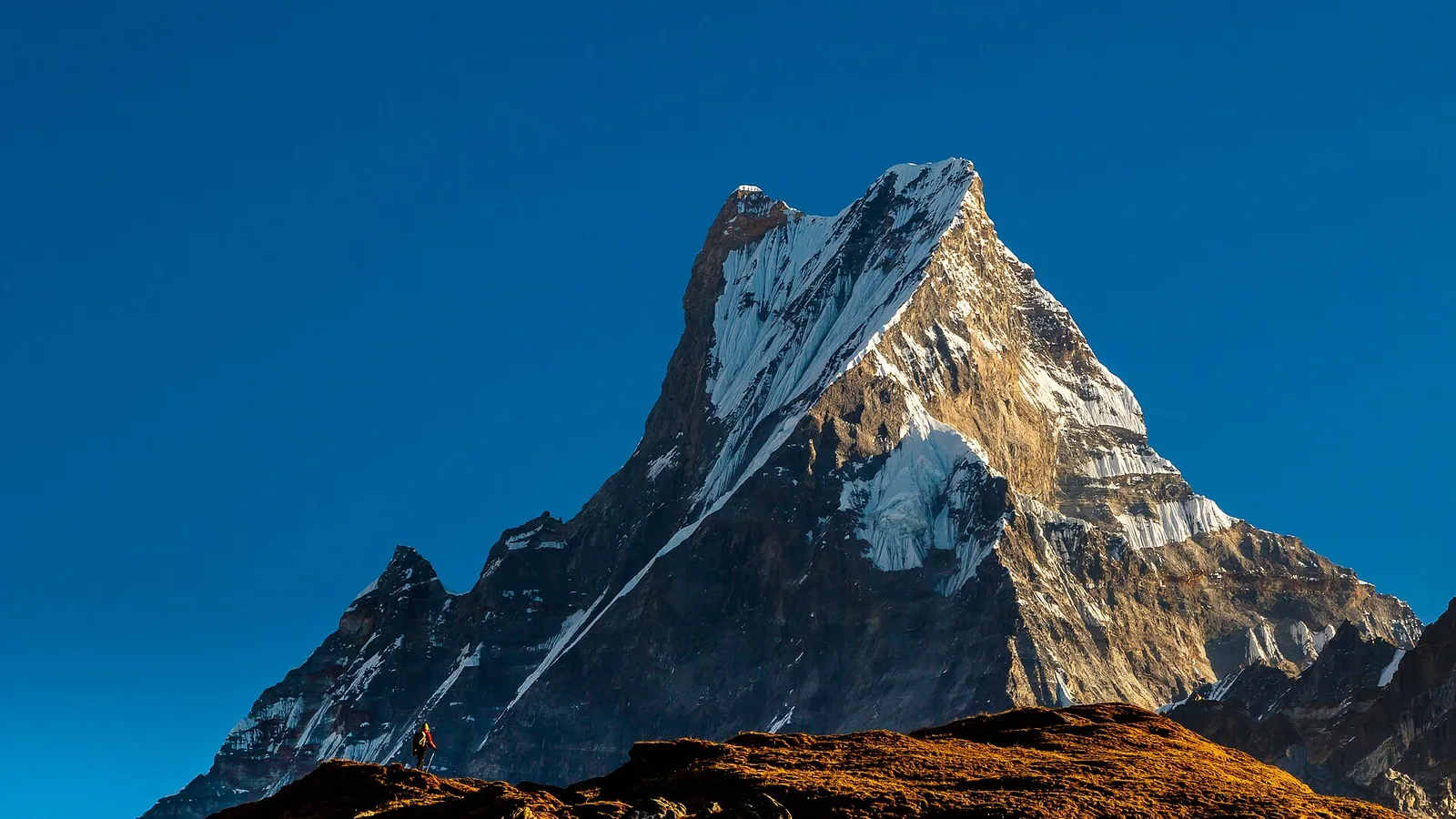
Stand on the shore of Phewa Lake in Pokhara at sunrise and the mountain in front of you turns rose-gold before anything else in the sky does. It looks close enough to touch, and its twin summit is genuinely striking — the reason it is called Machapuchare, 'Fish Tail.' What most visitors never learn is that nobody has ever legally stood on top of it, and nobody currently can, because Nepal has enforced a climbing ban on its true summit for more than sixty years.
Key facts
- Machapuchare stands 6,993m (22,943ft), about 25km north of Pokhara in the Annapurna Himalaya.
- A British team came within roughly 50 vertical metres of the true summit in 1957 — then turned back on purpose.
- Nepal has issued zero summit permits since, protecting the mountain's status as a home of Shiva.
- A disputed solo ascent claim from 1981 by New Zealander Bill Denz has never been independently verified.
The story starts in 1957, when a British expedition including climbers Wilfrid Noyce and David Cox worked their way up Machapuchare's north ridge with rare permission to attempt the summit for the first, and so far only, sanctioned time. They climbed to within about 50 vertical metres of the highest point. Then they stopped, turned around, and downclimbed without touching the top, honouring a promise made before the expedition began: that no one on the team would set foot on the actual summit, out of respect for the mountain's sacred status among local Gurung and Hindu communities, for whom Machapuchare is a home of Lord Shiva.
Nepal's government took what came out of that expedition seriously enough to make it permanent policy. No summit permit for Machapuchare has been issued since — not for one attempt, across more than six decades of applications from mountaineers around the world. It is one of the very few mountains on Earth that isn't simply hard to climb, but is, by government policy, not for climbing at all.
Wilfrid Noyce and David Cox stop about 50 vertical metres short of the true summit and turn back by design.
Nepal's government stops issuing climbing permits for Machapuchare's summit, citing its sacred status.
New Zealand climber Bill Denz reportedly summits alone without a permit; no independent verification exists, and Denz died in an avalanche on Makalu two years later.
Machapuchare remains, by Nepal's own record, one of the tallest unclimbed mountains anywhere in the world.
What this means for trekkers
What this means for you
You cannot climb Machapuchare — nobody can, permit or no permit — but you can walk into its lap. The Annapurna Base Camp trek takes you directly into the Annapurna Sanctuary, the high glacial bowl Machapuchare guards, with the mountain filling the sky on both sides of the trail for the final two days. The shorter Mardi Himal trek climbs a ridge built for exactly one view: Machapuchare's east face, close enough that our guides usually stop the group and just let people look. From Ghandruk, a Gurung village a short trek from Pokhara, it frames almost every photo you take without you trying.
None of Nepal's 8,000-metre giants carry a ban like this. Everest, Kanchenjunga, Manaslu, Dhaulagiri, Annapurna itself — all open to permitted expeditions, all climbed dozens or hundreds of times a year. Machapuchare is smaller than every one of them and, in the pure mountaineering sense, less technically extreme than several. What sets it apart isn't the rock. It's the decision Nepal made in the 1960s to leave one mountain exactly as it found it, and the fact that six decades of applications from serious expeditions have not moved that decision an inch.
For a country that built a tourism economy on selling summits, that restraint stands out. Our guides at Travel Himalaya Nepal have walked underneath Machapuchare more times than any of us can count, on treks into the Sanctuary and around Pokhara's lakeside trails, and it never stops being strange to look at a peak that close, that climbable-looking, and know that it is, on paper and in practice, off-limits forever.
Source: Machapuchare — expedition and permit history.
Cover photo: Nrik kiran via Wikimedia Commons (CC BY-SA 4.0).
来源: Machapuchare expedition and permit history
计划徒步?
我们负责许可证、后勤与向导
NMA 认证的本地向导,价格透明,自 1998 年以来 5,000+ 次徒步。告诉我们你的日期,其余的交给我们。


更多「Records & People」
Records & People
In 1951, an Everest Climber Photographed a Giant Footprint in the Snow. Nobody Has Fully Explained It Since.
Eric Shipton's photo of a 13-inch print near Everest sparked global Yeti mania — DNA science later traced most of the physical 'evidence' back to Himalayan bears.
Records & People
Fire Burns Directly Out of Water at This Himalayan Shrine — and Nobody Lit It
At 3,762 metres in Nepal's Mustang district, natural gas has kept a flame alight beside — and by tradition within — a spring for so long that Hindus and Buddhists both call the same shrine holy.
Records & People
Everest Isn't the Deadliest 8,000m Mountain. Annapurna Is — and It's Not Close
Guinness World Records has certified Annapurna I as the deadliest Himalayan giant, with a death-to-summit ratio over five times Everest's. Here's the real math behind the title, and why the trek to its base camp is nothing like the climb.