
Best Travel Insurance for High-Altitude Trekking in 2026 (What Actually Covers Everest Base Camp)
Standard policies quietly stop at 4,000m — but Everest Base Camp is 5,364m. Which cover actually pays for a Himalayan helicopter rescue, the exclusions that void a claim, and how to check your policy before you fly.
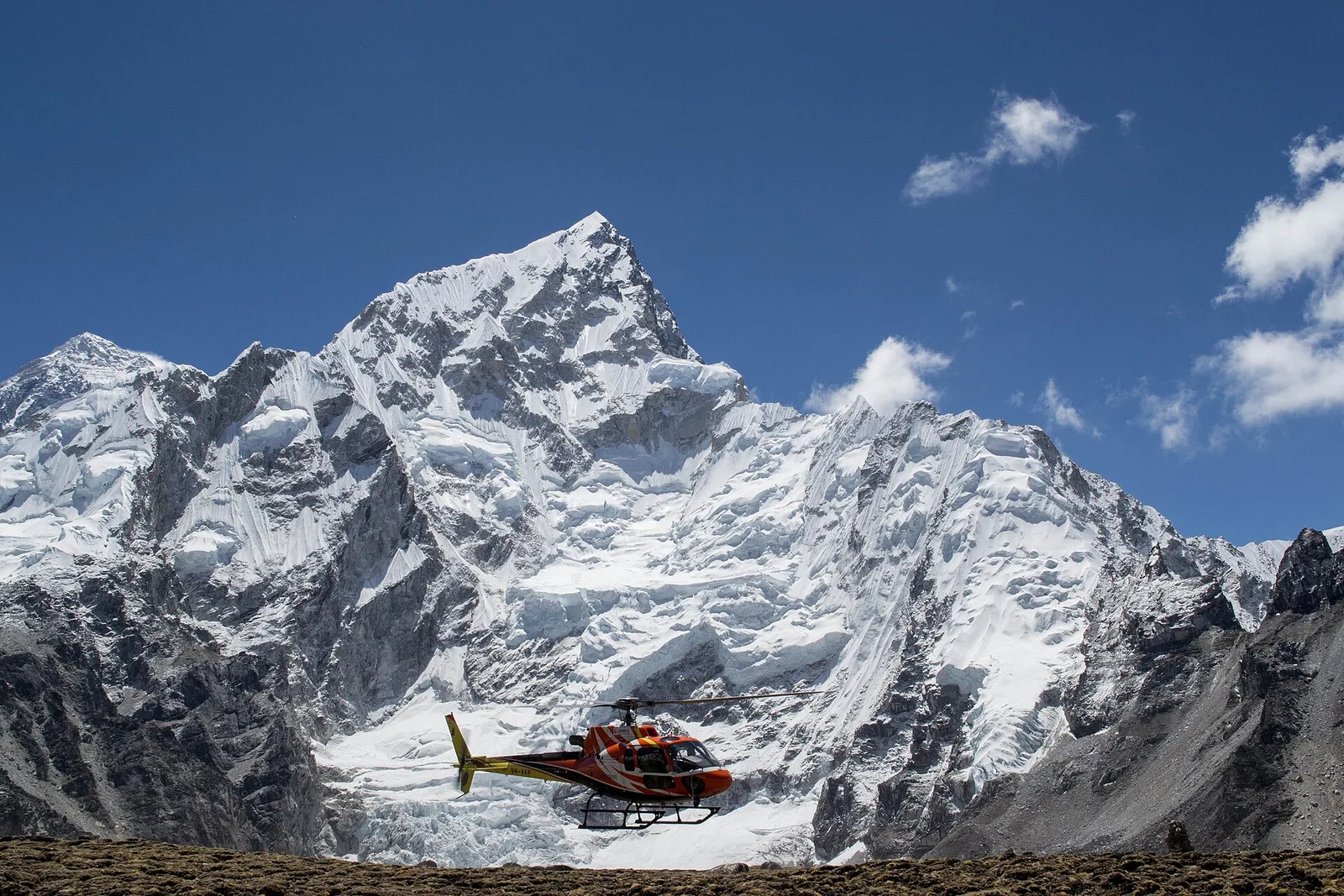
Most trekkers only discover the hole in their travel insurance at 5,000 metres, in a stone lodge, at 4am, when someone in the group can't breathe. We run the Everest and Manaslu trails every season, and we deal with this exact problem more than almost anything else — a customer who bought a policy, ticked "trekking", and assumed they were covered for the one thing that actually matters up here: a helicopter off the mountain. Very often they are not. Here is what a high-altitude policy must do in 2026, and how to check yours before you fly to Kathmandu.
The short version
- Everest Base Camp sits at 5,364m, and the Kala Patthar viewpoint above it tops 5,500m — well beyond where ordinary policies stop.
- Many standard travel policies cap altitude cover at 2,000m to 4,000m; above that, trekking claims are simply excluded.
- Your policy must name emergency helicopter evacuation and your trek's maximum altitude in writing — "adventure activities" is not enough.
- A helicopter lift from the Everest region can run USD 3,000–10,000; a worst case with hospitalisation and repatriation home can exceed USD 80,000.
- Since 2024, proof of trekking insurance is required for TIMS and permits; since March 2026 it is mandatory for restricted-area permits (Manaslu, Upper Mustang, Tsum, Nar Phu).
Why standard travel insurance fails trekkers
An off-the-shelf holiday policy is written for beaches and city breaks. Read the fine print and you will usually find an altitude limit — a height above which every claim is void. As of 2026, plenty of standard policies stop at 2,000m, and even many "adventure" add-ons top out around 4,000m. World Nomads, one of the most trekker-facing names, only includes hiking automatically to 2,000m and needs an upgrade above that. Everest Base Camp, Gokyo, Thorong La on the Annapurna Circuit, the Larke Pass on Manaslu — all sit far higher. The word "trekking" on your certificate means nothing if the number beside it is lower than the ground you'll be standing on.
The second trap is the rescue itself. Some policies cover your hospital bill but exclude the cost of physically getting you off the mountain — and in the Himalaya, that extraction is a helicopter. Cover for medical treatment and cover for evacuation are two different promises. You need both.
What your policy must actually cover
Do not buy on brand name or price. Buy on the specific clauses below and confirm each one in writing before you pay.
| What to check | Why it matters |
|---|---|
| Maximum altitude at or above your trek's high point (6,000m ceiling on most policies) | Everest Base Camp reaches 5,364m and Kala Patthar over 5,500m; a 4,000m cap voids the whole claim |
| Emergency helicopter evacuation named explicitly | A single lift from the Everest region can cost USD 3,000–10,000, payable before the rotors even turn |
| Emergency medical + evacuation limit of at least USD 100,000 | Evacuation plus hospital care plus flying you home can exceed USD 80,000 in a bad case |
| Repatriation to your home country | Kathmandu stabilises you; serious cases still need a medical flight home |
| A 24/7 assistance line and a Guarantee of Payment letter | Nepali operators rarely launch without upfront cash or a GoP letter from your insurer |
| Cover for search & rescue, not just evacuation of a confirmed casualty | Some policies (World Nomads among them) exclude search and rescue outright |
Note the split between two kinds of product. Ordinary travel insurance pays your medical and trip costs. Dedicated evacuation membership — Global Rescue's High-Altitude Evacuation Package is the best-known example — is built specifically to extract you from remote ground; its standard cover reaches 4,600m and the high-altitude add-on goes above that. Serious high-altitude trekkers often carry one of each so there is no gap. We name these only as factual examples; we sell no insurance and earn nothing from any provider.
The Nepal reality nobody tells you
Here is the part that surprises people. In Nepal, a helicopter almost never takes off for a foreign trekker on the promise of a claim form. The operator wants money on the table first — either your card, cash, or a Guarantee of Payment letter issued by an insurer that has an assistance desk awake at 4am Nepal time. This is why the 24/7 line and direct-billing arrangement matter as much as the coverage figure. A brilliant policy with a call centre that only answers office hours in another time zone is not much use on the Manaslu side of the Larke Pass.
What we tell every client
Bring the printed policy, the 24-hour emergency number, and your policy reference on paper — not only on a phone that dies in the cold. Give a copy to your guide on day one. When altitude sickness turns serious, minutes and a working phone number decide the outcome, not the size of the payout.
Before you buy — a two-minute test
Email the insurer one plain question: "Does this policy cover trekking to [your maximum altitude]m in Nepal, including emergency helicopter evacuation and repatriation, with 24/7 assistance and a Guarantee of Payment?" If the answer is anything other than a clear yes in writing, keep looking. That single email has saved more of our clients from a ruinous bill than any brand recommendation ever could.
We also handle the ground half of this equation. On every Travel Himalaya Nepal departure we carry a first-aid trained guide, monitor acclimatisation daily, and coordinate rescue directly with Kathmandu operators when it is needed — so your insurer's Guarantee of Payment reaches the right desk fast. If you want the trek without the guesswork, our Everest Base Camp Trek — 14 Days runs from USD 1,850 per person and our Manaslu Circuit Trek — 16 Days from USD 2,450 per person, both with fixed group departures.
For the deeper detail, read our full Nepal trekking insurance guide for 2026 and our breakdown of what a Himalayan helicopter rescue actually costs and how the process works. Get the policy right, and the mountain becomes the only thing you have to think about.
Cover photo: Daniel Oberhaus via Wikimedia Commons (CC BY-SA 4.0).
来源: Global Rescue — High-Altitude Evacuation Package
计划徒步?
我们负责许可证、后勤与向导
NMA 认证的本地向导,价格透明,自 1998 年以来 5,000+ 次徒步。告诉我们你的日期,其余的交给我们。


更多「Money & Insurance」
Money & Insurance
Travel Insurance for Visiting the USA in 2026: Why You Need $1M+ in Medical Cover
American hospitals bill like nowhere else on earth. Before you add a US layover or a New York stopover to your Himalayan trip, here is the medical cover that actually protects you — and why a bare-minimum policy can leave you owing five or six figures.
Money & Insurance
The Hidden Airline Fees That Cost You Hundreds in 2026 (and How to Dodge Them)
Baggage, seat selection, basic-economy traps, payment surcharges, change fees and currency conversion at booking can quietly double a headline fare. Here is what each typically costs in 2026 — and how to avoid it.
Money & Insurance
Annual Multi-Trip vs Single-Trip Travel Insurance in 2026: Which Actually Saves You Money?
An annual policy can be cheaper than buying cover trip by trip — but only past a break-even you can calculate yourself. Here's when it wins, the trip-length and adventure-sport limits that catch people out, and why altitude cover is a separate decision.