
Travel Plug Adapters by Country in 2026: Plug Types, the Two Voltage Worlds, and Why an Adapter Is Not a Converter
A practical reference to the world's plug types (A/B, C/E/F, G, D/M, I), the ~120V vs ~230V split, and the one rule that saves your devices: an adapter reshapes the pins, it does not convert voltage.
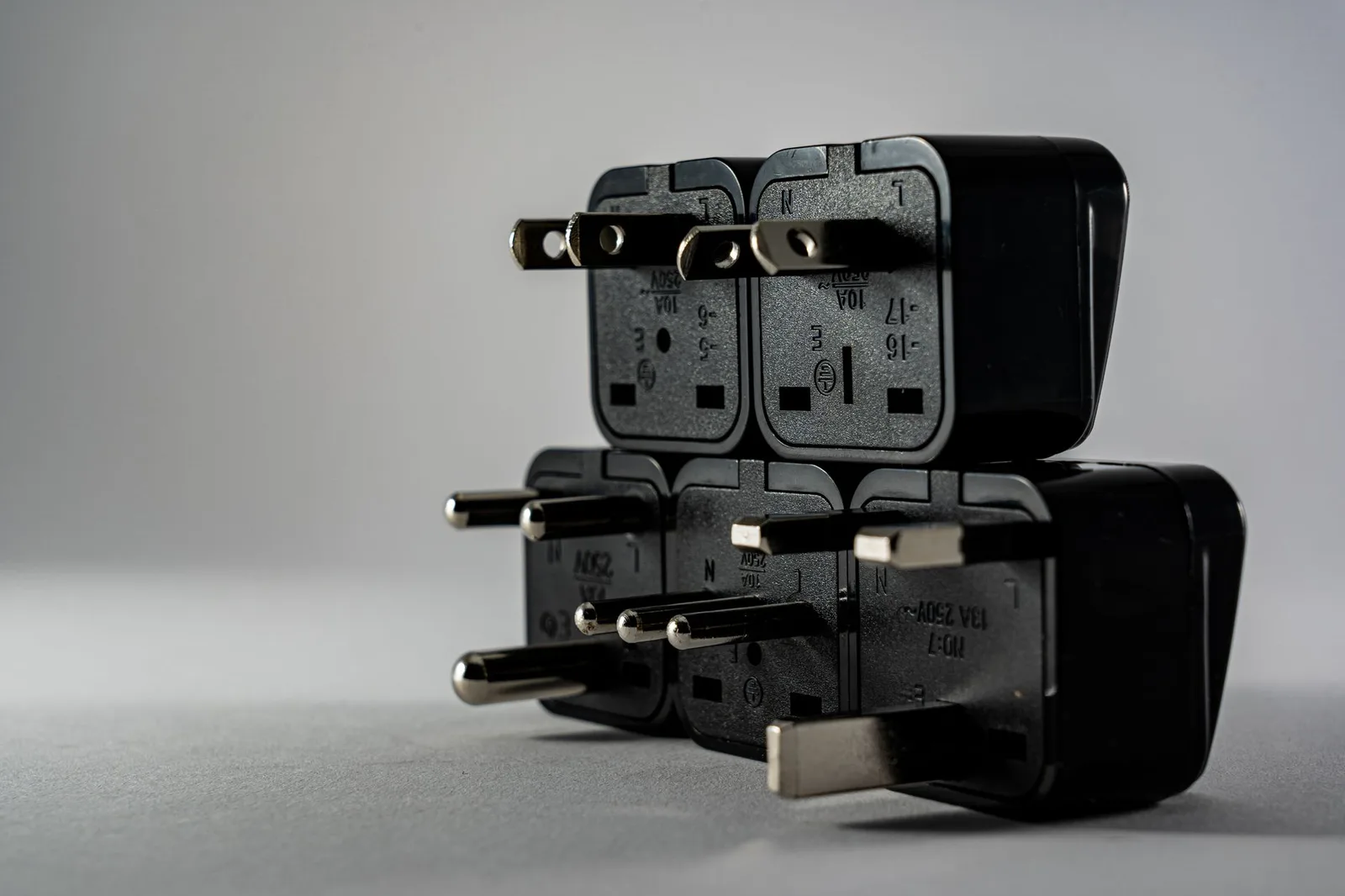
Here is the whole thing in one breath, so you can pack the right adapter before reading the detail: the world runs on two voltage systems — roughly 120 volts (North America, Japan) and roughly 230 volts (Europe, Africa, most of Asia, Australia) — and a handful of physically different plug shapes on top. A universal travel adapter reshapes your plug's pins to fit a foreign socket, but it does not change the voltage. That distinction is the one that fries hair dryers and straighteners. Most phone, laptop and camera chargers are "dual-voltage" (marked 100–240V) and simply work anywhere with a plug adapter; a single-voltage heating appliance does not. For nearly every traveller, one good universal adapter with built-in USB is the whole solution.
Key facts (as of 2026)
- There are two voltage worlds: about 120V (North America, Japan) and about 230V (Europe, Africa, most of Asia, Australia, most of South America)
- A universal adapter changes the plug shape only — it is not a voltage converter
- Check the charger's small print: if it reads "100–240V" it is dual-voltage and safe worldwide with just an adapter
- The devices that get destroyed are single-voltage heating tools — some hair straighteners, dryers and travel kettles rated 120V only
- Nepal is 230V, 50Hz on Type C, D and M sockets — bring a universal adapter
The two voltage worlds
Every mains socket on Earth delivers one of two broad voltages. The lower band, around 100–127 volts, covers the United States, Canada, Mexico, much of Central America and Japan (which sits lowest at 100V). The higher band, around 220–240 volts, covers Europe, Africa, most of Asia, Australia and New Zealand, and most of South America. Nepal, India and the UK are all in the 230V camp. Frequency differs too — the low-voltage world is mostly 60Hz, the high-voltage world mostly 50Hz — but for a phone or laptop charger the frequency is irrelevant. It is the voltage that decides whether a device survives.
Adapter vs converter — the mistake that fries devices
A plug adapter is a passive lump of plastic and metal: it lets your plug's pins fit a differently shaped hole, and nothing more. A voltage converter (or transformer) is a separate, heavier device that actually steps 230V down to 120V, or up the other way. If you plug a 120V-only appliance into Nepal's 230V supply through a mere adapter, you send it double the voltage it was built for — and it can burn out in seconds. The fix is not a bigger adapter; it is either a dual-voltage device or a genuine converter. For a trek, the simplest fix is to leave the single-voltage gadget at home.
The main plug types, by country
Sockets are catalogued by letter, from Type A to Type N. You only need to recognise a handful. Type A and B are the flat-pin North American and Japanese plugs. Type C, E and F are the round-pin family across continental Europe — a two-pin Type C plug fits E and F sockets, which is why the "Europlug" travels so well. Type G is the big three-rectangular-pin British plug, also standard in Ireland, Singapore, Malaysia and Hong Kong. Type D and M are the round-pin plugs of India, Nepal and southern Africa. Type I is the angled-pin plug of Australia, New Zealand and China.
| Region / country | Plug type(s) | Voltage | Note |
|---|---|---|---|
| North America (US, Canada, Mexico) | A, B | 120V | Low-voltage world, 60Hz |
| Japan | A, B | 100V | Lowest common voltage |
| Continental Europe (France, Germany) | C, E, F | 230V | Type C fits E/F sockets |
| UK & Ireland | G | 230V | Also Singapore, Malaysia, Hong Kong |
| India | C, D, M | 230V | Same mix as Nepal |
| Nepal | C, D, M | 230V | 50Hz; bring a universal adapter |
| Southern Africa (South Africa) | C, D, M | 230V | Large Type M three-pin is common |
| Australia & New Zealand | I | 230V | Also Argentina |
| China | A, I | 220V | Sockets often accept both |
Dual-voltage: what is safe, what is not
The good news is that almost everything you charge from a small brick is already built for the whole planet. Look at the fine print on the charger for your phone, laptop, camera, tablet or electric toothbrush and you will almost always see "INPUT: 100–240V, 50/60Hz". That means the device handles either voltage world internally, and all it needs from you is a plug adapter to fit the wall. The problem children are appliances that heat: some hair dryers, straighteners, curling irons and travel kettles are single-voltage. A 120V-only straightener from the US will not survive Nepal's 230V through a plain adapter. Either buy a dual-voltage travel version, or do without it.
Nepal: 230V, Type C/D/M, and charging on the trek
Nepal's mains supply is 230 volts at 50 hertz, delivered through Type C (the two round European pins), Type D (the old three-round-pin British-India standard) and Type M (a chunkier three-pin plug shared with South Africa). A lodge in the Annapurna or Everest region might hand you any of the three, which is exactly why one universal adapter beats a drawer of country-specific plugs. India uses the same C/D/M mix at the same 230V, so a Nepal–India trip needs nothing extra. If you have read our companion guide to travel adapters and power banks, the packing logic is the same: one adapter, plenty of USB.
The wrinkle is on the trail. Above the roadhead, teahouses run on solar, micro-hydro or a generator, and most charge a fee per device per hour to top up your phone or camera — power is patchy, and on the busiest evenings the queue for a socket is real. That is why an adapter alone is not enough on a Himalayan trek: pair it with a decent power bank so you are not paying by the hour or waiting your turn at the one outlet in the dining room. Charge the bank whenever mains power is available, then charge your devices from the bank overnight in your room.
Planning a trek and want the practical kit dialled in before you fly? Our team lives on these trails and briefs every guest on power, adapters and what is genuinely worth carrying. Browse our Himalayan treks and ask us anything when you enquire — the honest gear advice is part of the trip.
The bottom line
Buy one boring universal travel adapter with USB-A and USB-C built in, confirm your important devices read "100–240V", and leave the single-voltage heating gadgets at home. Remember the one rule that saves hardware: an adapter changes the shape of the plug, never the voltage behind it. For Nepal specifically — 230V, Type C/D/M, patchy power on the trail — a universal adapter plus a power bank is the whole answer.
Cover photo: Castorly Stock via Pexels (Pexels License).
来源: Wikipedia: AC power plugs and sockets; Mains electricity by country
计划徒步?
我们负责许可证、后勤与向导
NMA 认证的本地向导,价格透明,自 1998 年以来 5,000+ 次徒步。告诉我们你的日期,其余的交给我们。


更多「Gear & Tech」
Gear & Tech
How to Sleep on a Long-Haul Flight in 2026: Seat, Kit and Timing Tactics That Actually Help
Real, practical tactics for in-flight sleep — pick a window seat, pack a proper neck pillow, eye mask and earplugs, time your rest to the destination, skip the alcohol, and move every couple of hours. Plus the honest limits.
Gear & Tech
How to Avoid Getting Locked Out of Your Accounts Abroad in 2026: 2FA, Authenticator Apps and Backup Codes
The digital lock-outs travellers hit overseas — SMS codes sent to a home number you cannot receive, an authenticator app on a lost phone, a bank that blocks a foreign login, an email recovery loop — and the twenty minutes of setup before you fly that prevents every one.
Gear & Tech
How to Pack a Suitcase Efficiently in 2026: Rolling vs Folding, Packing Cubes, and the Weigh-Before-You-Fly Trick
The real techniques that save space and dodge fees — when to roll, when to fold, how packing cubes actually help, loading heavy items over the wheels, a mix-and-match capsule wardrobe, and what must stay in your carry-on.