
Lukla Is the World's Most Dangerous Airport — and There's No Way to Abort the Landing
A 527-metre runway that ends in a cliff, an 11.7% uphill slope, and pilots who need a year of Nepal experience before they're allowed to try it — meet the airstrip every Everest trekker has to survive first.
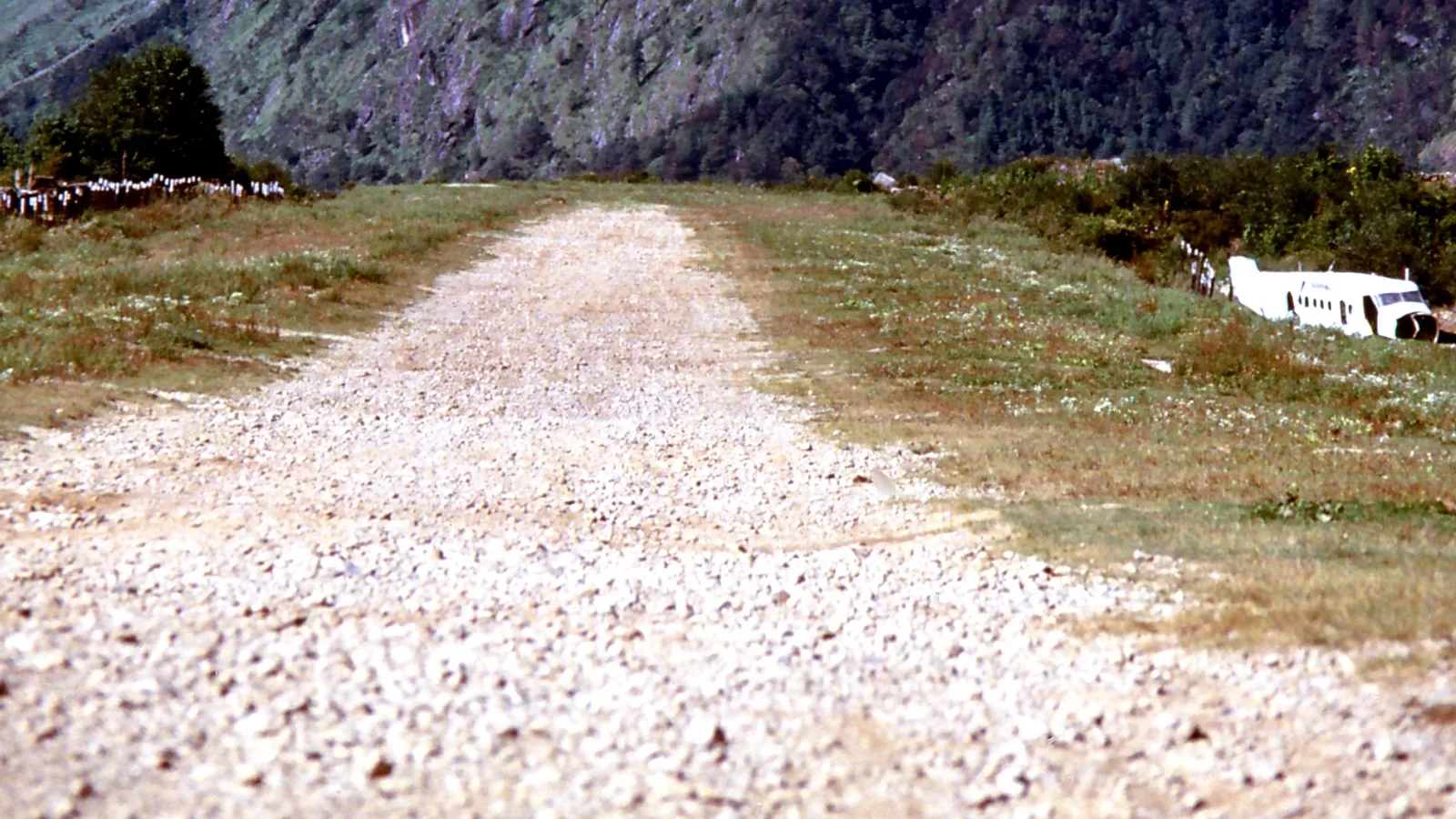
Key facts
- Runway length: just 527 metres (1,729 ft) — a fraction of a normal commercial runway
- Elevation: 2,845m (9,334 ft), among the highest airports any trekker will ever land at
- Gradient: an 11.7% uphill slope that helps stop landing planes and helps launch departing ones
- Renamed Tenzing-Hillary Airport in 2008, after the first two men confirmed to summit Everest
There is one runway on Earth where the pilot cannot change their mind halfway down. At Tenzing-Hillary Airport in Lukla, the gateway to Everest, the strip is 527 metres long, tilted uphill at an 11.7% gradient, boxed in by mountainside on three sides, and ends at a stone wall with a cliff behind it. There is no go-around. A pilot commits to the landing the moment the wheels are down, because there is nowhere else to put the plane.
Every trekking season, small STOL aircraft thread a narrow valley to reach this single asphalt strip carved into a hillside at 2,845 metres, carrying the great majority of foreign trekkers who attempt Everest Base Camp each year, along with their guides, porters and supplies. In its busiest recorded year, 2017, the airport handled around 147,000 passengers — remarkable traffic for a runway shorter than five football pitches laid end to end.
The airport wasn't built by an aviation authority. It was built by Sir Edmund Hillary.
Local farmers refused to sell their flat land, so Hillary bought a sloped potato field from Sherpa villagers for about $2,650. Local lore says he had them flatten it by throwing a party and getting the crowd to stamp the earth down in a traditional dance.
For 37 years the strip was packed dirt and gravel. It was only surfaced with asphalt in 2001, as trekking and climbing traffic to Everest kept growing.
On 10 February 2008, Nepal's government renamed it to honour Tenzing Norgay and Edmund Hillary, the first two people confirmed to stand on Everest's summit, in 1953.
Why there's no second attempt
Most airports let a pilot abort a bad approach and circle back. Lukla's geography removes that option entirely: high terrain sits immediately beyond the runway's upper end, and a steep drop falls away at the lower end, where the terminal building and a cliff wait. A missed approach has nowhere safe to go, so pilots are trained never to attempt one — they land, or they divert long before they're anywhere near the strip.
Because of that, only pilots who have logged at least 100 short-takeoff-and-landing missions and a full year of flying experience in Nepal's mountains are permitted to fly the route. The uphill gradient that makes Lukla famous is also, oddly, part of what makes it survivable: the same 11.7% slope that helps a landing plane brake in a short distance also gives a departing one a downhill run-up, using gravity to reach flying speed before the runway runs out.
What this means for your trek
What this means for your trek
Lukla flights fly early for a reason: mountain wind picks up by mid-morning and the strip regularly closes by 10 or 11am, so almost every departure is scheduled for first light. During the two busiest trekking seasons — spring and autumn — Nepal's Civil Aviation Authority often shifts Lukla flights away from Kathmandu's main airport entirely, to Manthali airport in Ramechhap, several hours' drive from the city, simply to give planes a calmer, less congested morning window. Build at least one buffer day into any Everest itinerary regardless of which airport you fly from — fog and wind delays are routine, not rare, and a missed connecting flight home is the single most common thing that goes wrong on an EBC trip. If your schedule genuinely cannot absorb a delay, a helicopter transfer gives you a fixed, bookable time instead of a weather-dependent one.
None of this makes Lukla unsafe by design — modern Nepali carriers fly it daily throughout the trekking seasons with rigorously trained crews, and our own guides fly it dozens of times a year. It simply means the flight is part of the adventure, not a formality before it. We build every Everest Base Camp itinerary with a buffer day around the Lukla flights for exactly this reason, and for travellers on a fixed schedule we also run a fixed-time helicopter version that skips the runway roulette entirely. For more on how real the risks on Everest's trails actually are, see our look at what the death and rescue data actually says.
Source: Tenzing-Hillary Airport, Wikipedia
Cover photo: Albert Backer via Wikimedia Commons (CC BY-SA 4.0).
来源: Wikipedia — Tenzing-Hillary Airport
计划徒步?
我们负责许可证、后勤与向导
NMA 认证的本地向导,价格透明,自 1998 年以来 5,000+ 次徒步。告诉我们你的日期,其余的交给我们。


更多「Flights & Access」

Flights & Access
Airport Security Rules in 2026: The 100ml Liquids Limit Is Back, and What You Still Can't Carry
CT scanners were meant to kill the 100ml liquids rule. Many airports reimposed it in 2024, so it is back and inconsistent airport to airport. Here is what you can carry through security in 2026 — liquids, laptops, powders and power banks — plus Nepal’s own strict cabin limits.
Flights & Access
No Commercial Flight Has Ever Crossed Directly Over Mount Everest — Here's the Real Reason Why
Everest's summit sits well within cruising altitude for a jet, but there's no safe way down from there in an emergency — which is exactly why every scheduled route bends around it, not over it.
Flights & Access
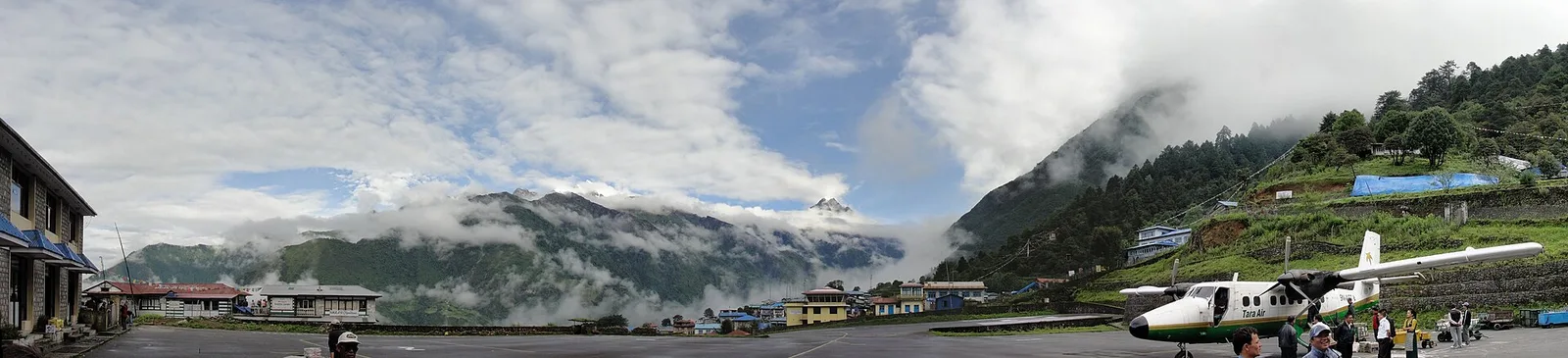
The World's Most Dangerous Airport Has No Go-Around Option — and It's the Only Way to Everest
Tenzing-Hillary Airport's runway is shorter than five football pitches, tilts uphill at nearly 12%, and ends in a rock wall on one side and a valley drop on the other — every Everest trekker flies through it anyway.