
Nepal's First Female Helicopter Long-Line Rescuer Also Holds the Women's Everest Speed Record — Meet Phunjo Jhangmu Lama
Phunjo Jhangmu Lama is Nepal's first woman qualified to fly high-altitude long-line helicopter rescues, and in May 2024 she climbed Everest from Base Camp to summit in 14 hours 31 minutes — the fastest ascent by any woman.
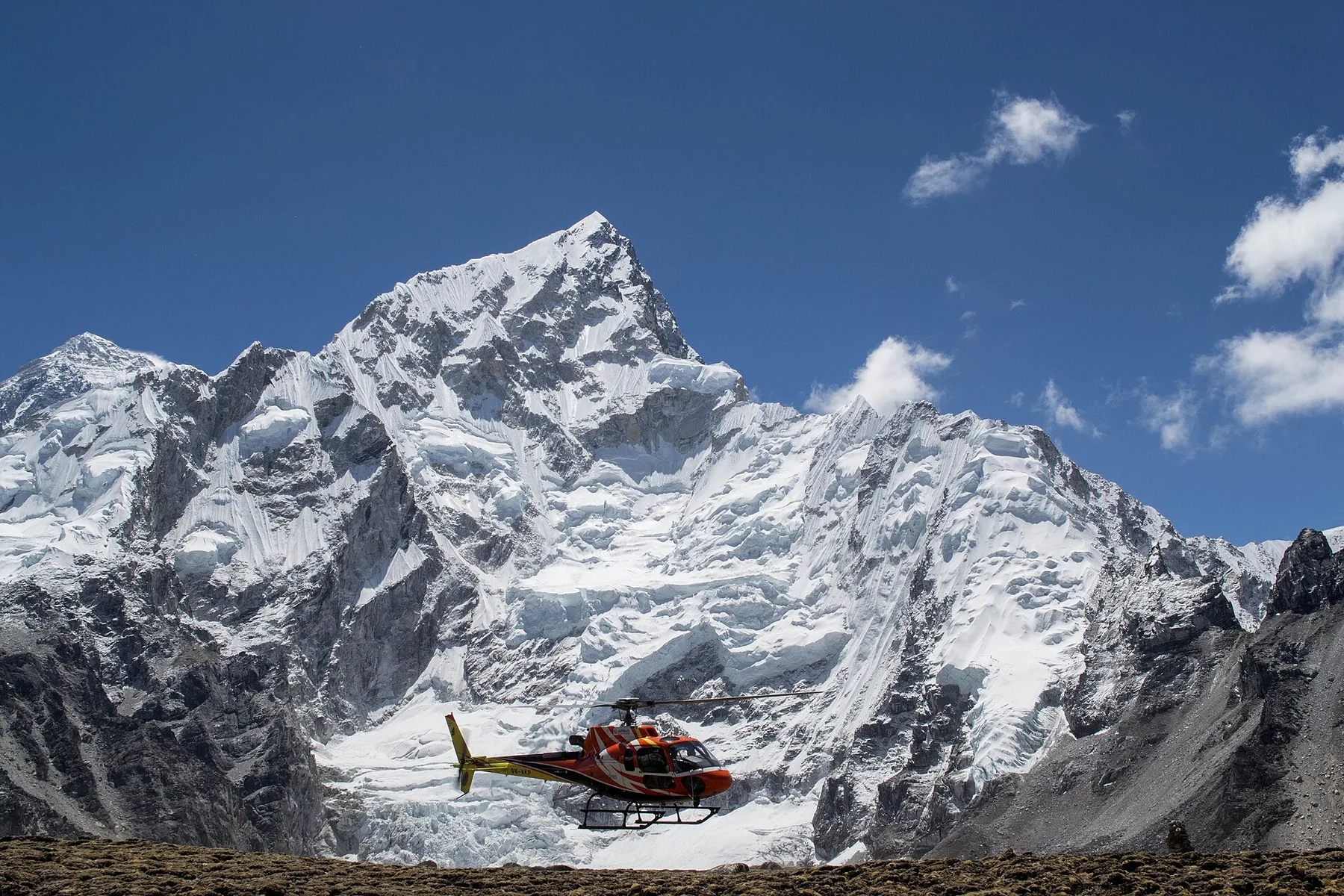
Phunjo Jhangmu Lama does two of the most dangerous jobs in the Himalaya — and she is either the first or the fastest at both. She is Nepal's first female helicopter long-line rescuer, the person who hangs on a cable slung beneath a hovering helicopter to pluck stranded climbers straight off the mountain, and she holds the women's world record for the fastest ascent of Mount Everest, climbing from Base Camp to the 8,849-metre summit in 14 hours and 31 minutes. Both are real, documented and rare, and both were achieved in a field that has been overwhelmingly male for as long as people have climbed in Nepal.
Key facts
- First female long-line helicopter rescuer in Nepal — trained in both the Swiss Alps and the Nepalese Himalaya, per her Wikipedia profile
- 14 hours 31 minutes Base Camp to Everest summit in May 2024 — the fastest ascent by any woman, reported by CNN and The Kathmandu Post
- 24 hours 26 minutes for the full round trip back to Base Camp
- Born in Chokangparo, Tsum Valley, Gorkha — the first woman from the Tsum Valley and Manaslu region to summit Everest
- Recipient of Nepal's Tenzing–Hillary Award and a national tourism goodwill ambassador
Who she is
Phunjo Jhangmu Lama grew up in Chokangparo, a village in the remote Tsum Valley of Gorkha district, tucked into the same Manaslu massif that our trekkers cross on the restricted-area circuit. She became the first woman from that region to stand on top of Everest, and she has since summited Manaslu, Cho Oyu — reportedly without supplemental oxygen — Denali in Alaska, Ama Dablam, Island Peak and Lobuche, according to her Wikipedia biography and a detailed UKClimbing interview. Along the way the Nepal government handed her the Tenzing–Hillary Award, the country's highest mountaineering honour, and named her a tourism goodwill ambassador.
What a long-line rescue actually is
Most people picture a mountain rescue as a helicopter landing on a ledge. At Himalayan altitude that is often impossible — there is nowhere flat, the air is too thin for the rotors to bite, and a casualty may be pinned on a slope or in a crevasse. The alternative is the long line: a rope, sometimes tens of metres of it, fixed under the aircraft with a rescuer clipped to the end. The helicopter flies the rescuer in like a pendulum, the rescuer secures the injured climber, and both are flown out dangling in open air. It demands nerve, precise communication with the pilot, and the ability to work while hypoxic and freezing. Phunjo trained for it in the Swiss Alps, where the technique was pioneered, and brought it home — becoming, as multiple Nepali outlets and her Wikipedia entry state, the first Nepali woman qualified to do it.
The record, in numbers
Phunjo first set the women's Everest speed record in 2018. Hong Kong's Ada Tsang took it in 2021. In May 2024 Phunjo took it back — and rewrote it emphatically. She left Base Camp in the afternoon and reached the summit before dawn the next morning, an ascent of 14 hours 31 minutes, then descended in a little over nine hours for a round trip of 24 hours 26 minutes.
| Year | Holder | Time (Base Camp → summit) |
|---|---|---|
| 2018 | Phunjo Jhangmu Lama | 39h 06m* |
| 2021 | Ada Tsang | 25h 50m |
| 2024 | Phunjo Jhangmu Lama | 14h 31m |
| *2018 figure is her original round-trip record time | — | |
To put 14 hours 31 minutes in context: a typical guided summit push from Base Camp, staged across the intermediate camps with rest and acclimatisation, unfolds over several days. Phunjo compressed the vertical part of that into a single overnight effort.
Why it matters
Nepal's high-altitude economy — guiding, rope-fixing, rescue flying — has been almost entirely a men's world. The porters, the Sherpa climbing guides, the icefall doctors and the rescue crews are overwhelmingly male, and the risks are real: more people die descending Everest than ascending it, as we've written about before. A woman holding the speed record and qualifying as the first female long-line rescuer is not a symbolic footnote — it is a working professional doing the hardest, most exposed jobs on the mountain and outperforming the field. For the next generation of girls in villages like Chokangparo, that is a template that simply did not exist a decade ago.
What this means for trekkers
Fast records grab headlines, but the same skills — high-altitude rescue flying, trained local crews — are exactly what keeps ordinary trekkers safe on the trail. When you walk to Everest Base Camp, the helicopter that would come for you in an emergency is flown and crewed by professionals like Phunjo. That safety net is a reason to trek with a licensed local operator, not a solo shortcut.
Trekking the Everest region safely — with a local team
You will not be speed-climbing anything. But the Khumbu that made Phunjo is open to any reasonably fit walker, and the way to see it well is with the same local guides, porters and rescue relationships that underpin her world. Our 14-day Everest Base Camp Trek runs in small groups of 2–12 people, from $1,850 per person for a solo booking and dropping to $1,350 per person once your group reaches eight — every departure with a licensed Nepali guide, insured porters and helicopter-evacuation contingency built in. For the fuller picture of routes, permits and acclimatisation, read our Everest Base Camp trek guide and our Everest region guide.
Records are set by exceptional people. Getting to the foot of the same mountain, safely, is something we can arrange for you.
Sources: Wikipedia — Phunjo Jhangmu Lama; The Kathmandu Post; CNN Travel; UKClimbing.
Cover photo: a helicopter departing Everest Base Camp in Nepal's Khumbu region — the kind of high-altitude aircraft flown on the rescue missions Phunjo Jhangmu Lama trained for. Photo by Daniel Oberhaus via Wikimedia Commons (CC BY-SA 4.0). Not a photograph of Phunjo Lama.
来源: The Kathmandu Post / CNN / Wikipedia
计划徒步?
我们负责许可证、后勤与向导
NMA 认证的本地向导,价格透明,自 1998 年以来 5,000+ 次徒步。告诉我们你的日期,其余的交给我们。


更多「Records & People」
Records & People
At 17, a Nepali Teenager Led 80 Artists Into Tibet. He Designed the White Pagoda Beijing Still Protects 700 Years Later
Long before Nepal became a bucket-list trekking destination, one Kathmandu Valley teenager designed a monument so revered that a Chinese premier personally ordered it saved from the Cultural Revolution.
Records & People
Snow Leopards Vanished From the Everest Region in the 1960s. A DNA Study Just Found 24 Living There Again
Sagarmatha National Park is famous for one mountain — but genetic testing shows the ghost cats that disappeared from its slopes two generations ago have quietly recolonised it.
重大 · Records & People
Nine Months Buried in the Snow: Nepal Just Recovered Five Climbers Lost on a Peak Almost No Trekker Has Heard Of
Rescuers located the bodies of three foreign climbers and two Nepali nationals on August 8, 2026 — nine months after an avalanche buried Yalung Ri's base camp on the closed Tibet border.