
Nepal's Honey Hunters Climb 50-Metre Cliffs on Rope Ladders for a Honey That Can Make You Hallucinate
High in Lamjung's Gurung villages, hunters dangle from handwoven rope ladders to harvest the world's largest honeybee — and a red spring honey potent enough to cause hallucinations in the wrong dose.
At a glance
- Published
- TopicRecords & People
- Verified againstDialogue Earth
- Treks coveredMardi Himal Trek — 7 Days, Kori Danda Trek — 5 Days, Ghalegaun Homestay Trek
Key facts
- Apis laboriosa, the Himalayan giant honeybee, is the largest honeybee species on Earth — workers run close to 3cm long, roughly double a European honeybee.
- Colonies build open-air combs on sheer cliff faces from 2,500m to 3,600m, some over 50 metres tall, to stay out of reach of bears and birds.
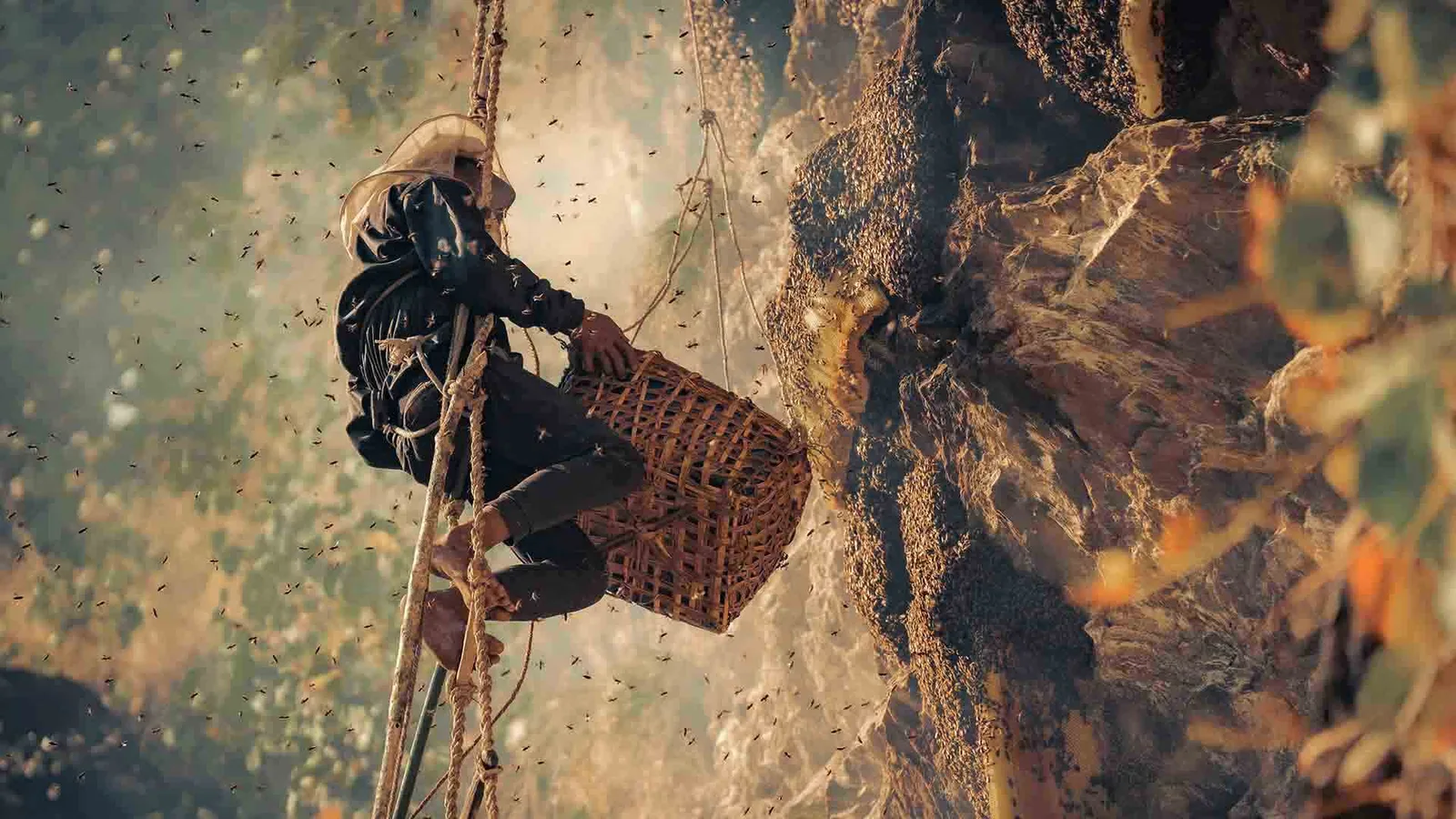
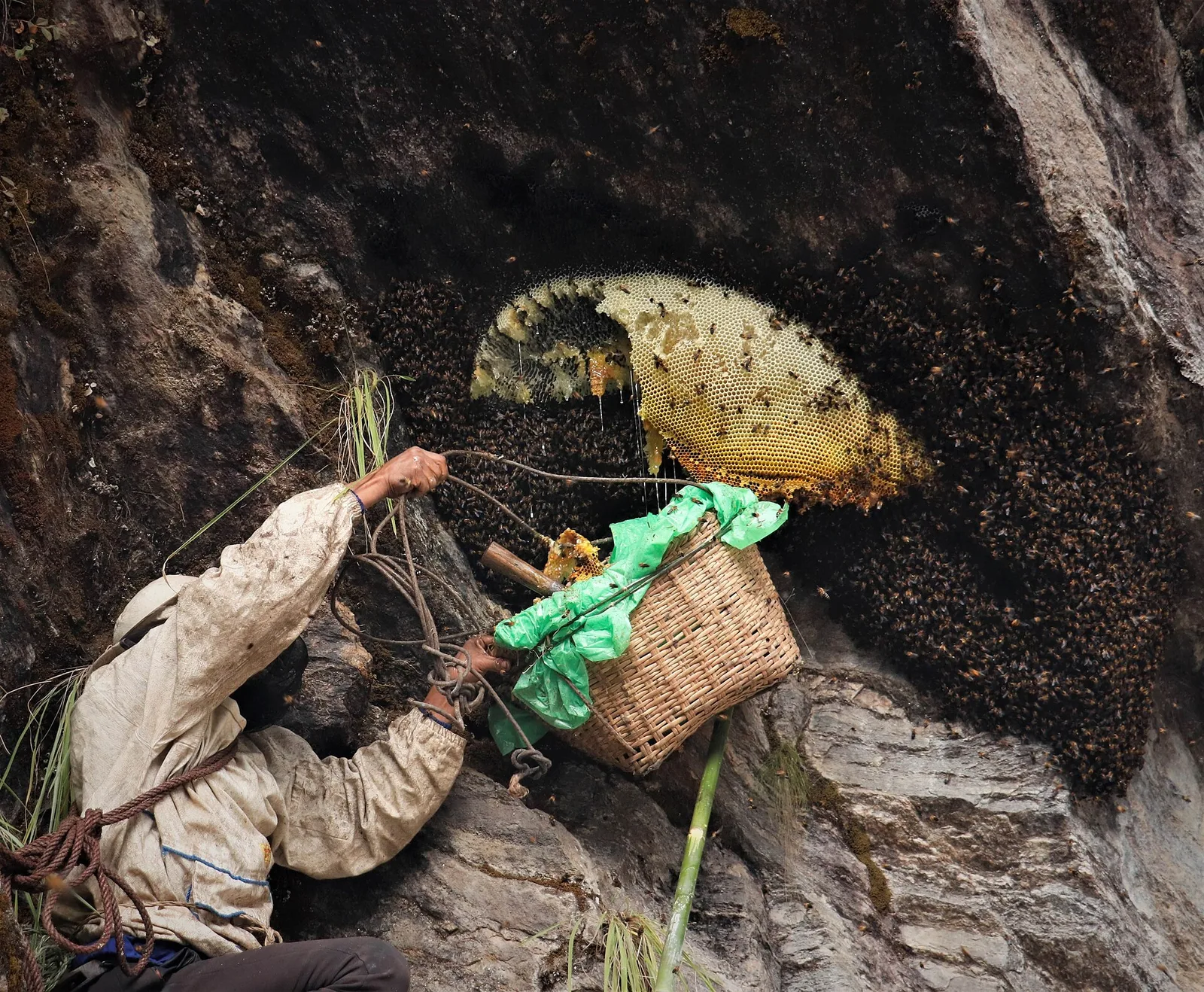
- Hunters climb handwoven bamboo and rope ladders, cutting the comb free with a long pole called a tango while a fire lit below smokes the bees into confusion.
- The reddish spring harvest carries grayanotoxin from rhododendron nectar — the compound behind 'mad honey's' psychoactive, occasionally dangerous, kick.
- The hunt happens only twice a year, and wild colony numbers have dropped enough that researchers now call the tradition endangered within a generation.
Twice a year, in the cliffs above Lamjung's Marshyangdi valley, a handful of Gurung men do something almost nobody else on Earth still does for a living: they climb 50 metres of sheer rock on a rope ladder they wove themselves, reach into a wild beehive the size of a dinner table, and cut it loose by hand — while the world's largest honeybee stings every inch of exposed skin.
The bee is Apis laboriosa, the Himalayan giant honeybee, found nowhere but a narrow band of the Himalayan foothills stretching roughly 2,500km from Bhutan to northern India. It builds its comb in the open, on overhangs and cliff faces between 2,500m and 3,600m, specifically because nothing else can reach it there — nothing, that is, except a honey hunter with a tango, a bamboo pole with a curved blade, and technique passed down for generations. One man descends the ladder while a ground crew below lights a smoky fire to disorient the swarm and holds the ropes taut; a basket is lowered and raised to bring each slab of comb down without a hand ever touching an angry hive directly.
What makes the harvest famous well beyond Nepal is what's inside the comb. The spring crop, gathered when the bees have fed almost exclusively on Himalayan rhododendron blossom, carries grayanotoxin — a naturally occurring compound that gives the honey a deep red colour and a genuinely psychoactive effect. In small amounts, traditionally used as a folk remedy for high blood pressure and digestive complaints, it produces mild tingling and light-headedness. In larger amounts it can cause nausea, vomiting, hallucination and a dangerous drop in blood pressure — documented cases of mad honey poisoning turn up in medical literature from Turkey, where a related bee produces a milder version, to Nepal itself. Hunters know the spring harvest by taste and colour alone and sell it separately, in smaller jars, at several times the price of the ordinary autumn crop.
The tradition reached a global audience in 1988, when French photographer Eric Valli spent eight months living with a band of nine hunters led by a 63-year-old climber named Mani Lal and published the results in National Geographic — a story that went on to win a World Press Photo award. Nearly four decades on, the same cliffs are still climbed, mostly by Gurung communities in the Annapurna foothills and by Kulung Rai hunters further east near Taplejung, but the trade researchers describe today is a shrinking one. Warmer winters have shifted when rhododendrons flower, throwing off timing hunters have relied on for generations; deforestation and pesticide use have thinned wild colonies; and fewer young Gurung men are willing to learn a skill that carries a real risk of a fatal fall for a harvest that still fetches only a modest local price. Conservation researchers working with these communities now describe honey hunting as a tradition that could disappear within a generation if nothing changes.
| Trait | Autumn honey | Spring 'mad' honey |
|---|---|---|
| Main nectar source | Mixed wildflowers | Himalayan rhododendron |
| Colour | Golden | Deep red |
| Grayanotoxin present | Negligible | Yes |
| Small-dose effect | None | Mild tingling, light-headedness |
| Large-dose effect | None | Nausea, hallucination, low blood pressure |
What this means for trekkers
What this means for you
You can't book a honey hunt — it isn't a tourist activity, it's dangerous subsistence work done on the hunters' own schedule, and reputable operators, us included, won't stage one for a camera. But you don't have to book one to see where it happens. Routes through Lamjung and Kaski's Gurung villages, like the Ghalegaun Homestay Trek, the Mardi Himal Trek or the Kori Danda Trek, pass directly beneath cliffs hunters have worked for generations, and homestay hosts along the way will often talk about it over dinner — and sometimes pour a small taste of real, ordinary honey from their own hives. It's one more reason a village homestay night is worth building into a Nepal itinerary alongside the big treks.
Source: Dialogue Earth
Cover photo: Kandelrashmi via Wikimedia Commons (CC BY-SA 4.0).
Planning a trek?
Trek this route with us — Mardi Himal Trek — 7 Days
NMA-certified local guides, transparent pricing, 5,000+ treks since 1998. Message us your dates and we'll sort the permits, lodges and logistics — reply within 24 hours, no obligation.


Popular Nepal treks
All treks →


Related coverage
Records & People
Nepal's Cliff Honey Hunters Risk Their Lives for a Honey That Can Get You High — and the Bees Are Vanishing
High in the cliffs of Lamjung, Gurung hunters climb hand-woven rope ladders for the world's largest honeybee's harvest — a tradition now disappearing at an alarming rate.
Records & People
Nepal Is Home to the World's Largest Rhododendron Forest, and It Blooms Blood-Red Every Spring
Inside the Annapurna forest above Ghorepani that turns crimson for ten weeks a year, and the narrow window when the low, mid and high bloom all line up at once.
Records & People
The World's Deepest Gorge Splits Two 8,000-Metre Peaks — and a Trail Runs Right Through It
Nepal's Kali Gandaki Gorge drops 5,571 metres between Annapurna and Dhaulagiri, deeper than the Grand Canyon three times over — and the Annapurna Circuit walks straight along its floor.
Records & People
The Temple Where Fire Burns on Water — and Two Religions Call It Holy
At 3,762 metres in Nepal's Mustang district, natural gas burns continuously above a spring inside Jwala Mai temple, part of a shrine both Hindus and Buddhists climb the Himalaya to reach.
Latest from the desk

Gear & Tech
How to Avoid Roaming Charges Abroad in 2026: eSIM, Local SIM, Roaming Passes and Wi-Fi Calling Compared
A practical decision framework for staying connected overseas without the bill shock — carrier roaming passes, local SIMs, eSIMs and Wi-Fi calling, the EU "roam like at home" rules, and what to do in Nepal.
Flights & Access
No Commercial Flight Has Ever Crossed Directly Over Mount Everest — Here's the Real Reason Why
Everest's summit sits well within cruising altitude for a jet, but there's no safe way down from there in an emergency — which is exactly why every scheduled route bends around it, not over it.

Visas & Entry
Digital Nomad Visas in 2026: Which Countries Offer Them, the Income You Need, and the Tax Catch
A verified 2026 guide to digital nomad visas - Portugal, Spain, Estonia, Croatia, the UAE, Costa Rica and Thailand DTV - with the exact monthly income each demands, how long you can stay, the tax angle, and how to bolt a Himalayan trek onto your base.