
Nobody tells you Everest can only be climbed a few days a year, and the jet stream is why
For most of the year a jet stream sits on the summit of Everest with winds over 250 km/h. It lifts north for a few weeks each May when the monsoon pushes it aside, and that short calm is the only time the mountain is climbable.
At a glance
- Published
- TopicRecords & People
- ReportingOriginal, by our guides in Pokhara
- Treks coveredEverest Base Camp Trek — 14 Days, Everest View Trek — 7 Days
Mount Everest can only be climbed for a handful of days each year, and the reason is a river of wind in the sky called the jet stream. For most of the year it sits directly on the summit, blasting the top of the mountain with sustained winds of 160 km/h and gusts that can top 250 km/h — conditions no human can climb or survive in. For a few weeks each spring, as the monsoon shoulders the jet stream north, that wind lifts off the summit and the mountain briefly falls calm. That short calm is the only window climbers get. Miss it, and the mountain closes again for a year.
At a glance
- From October to April the jet stream sits over Everest, making the summit a wind-scoured, unclimbable place.
- In May the South Asian monsoon pushes the jet stream north over the Tibetan Plateau and the winds drop.
- The calm usually lasts only days, most often in the second half of May — not weeks.
- The monsoon then arrives with heavy snow and avalanche risk, slamming the window shut by early June.
The jet stream that owns the summit
The jet stream is a band of very fast, high-altitude wind that circles the planet at roughly the height of Everest’s summit, around 9,000 m. For most of the year it flows straight across the Himalaya, and the top of Everest sits squarely in it. That is why, from autumn through early spring, the summit is a vertical desert of hurricane-force wind: sustained speeds around 100–180 km/h, with gusts that have been measured well above 250 km/h. At those speeds a climber cannot stand, tents are shredded, exposed skin freezes in minutes, and the wind chill drives an already lethal cold far lower. It is not a matter of toughness. The upper mountain is simply uninhabitable while the jet stream is parked on it.
Why May opens the door
Everything changes when the South Asian monsoon begins its annual march north in late April and May. As that vast weather system advances, it nudges the jet stream off the Himalaya and up over the Tibetan Plateau to the north. With the jet gone, the winds over the summit collapse, the pressure edges up, and for a short spell the top of the world becomes climbable. This is the “weather window,” and it is why almost every Everest summit in history has happened in a narrow band of days, usually in the second half of May. Expedition teams spend six weeks acclimatising on the lower mountain doing nothing but waiting for the forecast to show that the jet has lifted.
| Time of year | What the summit is doing | Climbable? |
|---|---|---|
| December–February | Jet stream on the summit; winds to 250+ km/h; deep cold | No (winter ascents are rare, elite feats) |
| March–April | Teams arrive and acclimatise; upper mountain still too windy | Prep only |
| Late April–May | Monsoon pushes the jet north; winds drop | Yes — the main window |
| ~1 June onward | Monsoon arrives: heavy snow, wet avalanches, warming | No — season closes |
| July–August | Full monsoon over the range | No |
| Late September–October | Post-monsoon lull before the jet returns | A smaller, colder autumn window (rarely used) |
The pattern shifts year to year, and forecasters now model the jet-stream position days ahead so teams can time their push. But the fundamentals do not change: a usable window is measured in days, and the mountain grants only one or two of them per season.
Why the window itself is dangerous
The cruel twist is that the same narrow window that makes Everest climbable also makes it crowded and deadly. When hundreds of people have spent weeks and fortunes waiting, and the forecast finally shows three calm days, everyone goes at once. That is exactly what produced the notorious 2019 traffic jam, when a queue of climbers stacked up in the death zone during a two-day window and eleven people died — a story we tell in full in why the Everest traffic jam of 2019 turned deadly. A short window forces a gamble: push when the crowd pushes, or hold out for a cleaner day that may never arrive before the monsoon slams the door. Thin air makes that decision even harder — see our guide to altitude sickness, AMS, HACE and HAPE.
Trekkers do not need a summit window. The jet stream punishes the top of the mountain, but the trekking valleys below run on ordinary seasons — the clear, stable months of spring (March–May) and autumn (late September–November) are the best time to walk to Everest Base Camp, with no wind gamble involved. If you want honest advice on when to come, message us on WhatsApp at +45 91 71 72 19 or through our contact page.
See Everest in its own best season
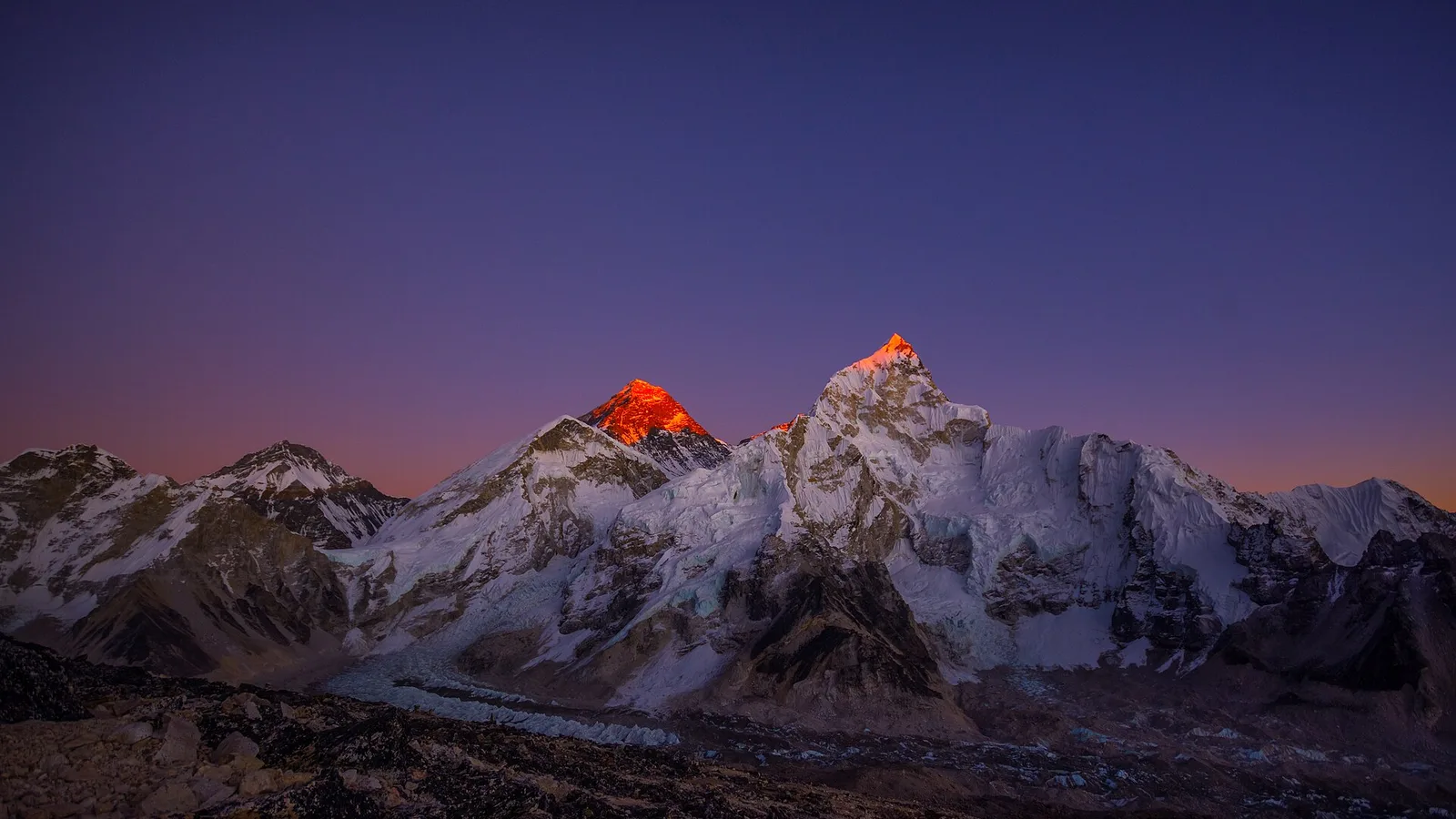
You do not need the summit window to stand beneath Everest. Trek to Base Camp at 5,364 m and the Kala Patthar viewpoint in spring or autumn, when the Khumbu is at its clearest.
- Everest Base Camp Trek — 14 days · the classic, well-acclimatised itinerary
- Everest View Trek — 7 days · the shorter high-viewpoint option
Sources. Jet-stream behaviour over Everest and wind speeds: Alan Arnette (alanarnette.com) and everestweather.com. Weather-window timing and the ~1 June deadline: MountEverest.net expedition guide, Alan Arnette, and operator season guides. Monsoon migration and jet-stream displacement: standard meteorological record for the South Asian summer monsoon. 2019 overcrowding cross-reference: AFP and Outside. Windows vary year to year; figures describe the typical pattern.
Cover photo: Nir B. Gurung via Wikimedia Commons (CC BY-SA 4.0).
Still running this season
Everest Base Camp Trek — 14 Days is running normally
NMA-certified local guides, transparent pricing, 5,000+ treks since 1998. Message us your dates and we'll sort the permits, lodges and logistics — reply within 24 hours, no obligation.


Popular Nepal treks
All treks →


Related coverage
Records & People
Mount Everest's Summit Is Made of Ancient Seafloor — and the Fossils Are Still There
The highest rock on Earth is 450-million-year-old limestone packed with fossilised sea creatures — proof the roof of the world was once the floor of a tropical ocean.
Records & People
Everest Is Only Part of the Story: Inside the World's Highest National Park
Sagarmatha National Park stretches from 2,845 metres to Everest's 8,848-metre summit — and after a roughly 40-year absence, snow leopards are being seen inside it again.
Records & People
He Climbed Everest Four Times in 15 Days — Guinness Just Made It Official
Rope-fixing, a solo push, a client summit, then solo again: Nepali guide Tashi Gyalzen Sherpa's four ascents in May 2025 are now the certified record for the most Everest summits in a single season.
Records & People
In 1951, an Everest Climber Photographed a Giant Footprint in the Snow. Nobody Has Fully Explained It Since.
Eric Shipton's photo of a 13-inch print near Everest sparked global Yeti mania — DNA science later traced most of the physical 'evidence' back to Himalayan bears.
Latest from the desk
Money & Insurance
Here's what a Manaslu Circuit trek really costs in 2026 now that solo trekkers can finally get the permit
A guided Manaslu Circuit runs about US$1,550 to US$2,100 per person in autumn 2026 - and since 22 March the old two-person permit rule is gone, so lone walkers no longer pay for a phantom second permit. Here's the honest, line-by-line breakdown.
Records & People
Why some 8,000-metre peaks get climbed thousands of times and others almost never
Everest has over 12,000 ascents and Cho Oyu thousands more; Annapurna I and Kangchenjunga barely a few hundred each. The gap between the most-climbed and least-climbed eight-thousanders is not about height.
Records & People
Everyone has seen the Everest traffic jam photo, this is what standing in that line actually does to you
In 2019 a record 381 permits funnelled onto Everest during just two good-weather days put hundreds of climbers in a single queue above 8,000 m. Eleven died. The crowd, not the mountain, was the danger.