
Travel Money Mistakes to Avoid in 2026: The Quiet Fees That Drain Your Trip
From the "pay in your home currency" trap to airport exchange kiosks and telling no one at your bank you’ve left the country — the small, repeated money mistakes that cost real cash, and the free fix for each.
At a glance
- Published
- TopicMoney & Insurance
- Verified againstWikipedia (Dynamic currency conversion; Bureau de change)
- Treks coveredAnnapurna Circuit Trek — 13 Days, Everest Base Camp Trek — 14 Days, Manaslu Circuit Trek — 14 Days
The quick version
- The costliest travel-money mistakes are rarely dramatic — they are small, repeated choices: the wrong button at a card terminal, the wrong place to change cash, the wrong ATM.
- Two are almost universal and both are avoidable for free: agreeing to “pay in your home currency” (dynamic currency conversion) and changing money at an airport exchange kiosk.
- Fees vary wildly by bank, card and country, so we quote none here — the point is to know the mistake and check your own terms before you fly.
- For Nepal specifically: bring some US-dollar cash for the visa and permits, draw rupees from a bank ATM in town rather than the airport counter, and carry enough cash for the trail, where machines simply run out.
You can spend weeks comparing flights and haggling over a guesthouse, then quietly hand back all those savings in a single week of careless spending abroad. The expensive travel-money mistakes are almost never the obvious ones. They are the tiny, repeated decisions — a button you tap without reading it, a counter you use because it is the first one you see. Here are the ones that cost real money in 2026, and the free fix for each.
1. Letting the machine charge you in your home currency
This is the big one, and it catches seasoned travellers as often as first-timers. At a card terminal or a foreign ATM you are offered a “helpful” choice: pay in the local currency, or in your own. Your own currency feels safer because you recognise the number — and that is exactly the trap. This is dynamic currency conversion (DCC), and the conversion is done by the merchant’s processor at a marked-up rate, not by your bank. As Wikipedia’s own summary of the practice puts it, in most cases customers are charged more with DCC than if they had simply paid in the foreign currency. The screen is designed to nudge you toward the pricier option.
The one-second mistake
Whenever a terminal or ATM abroad asks whether to bill you in your home currency or the local one, always choose the local currency. Let your own bank handle the conversion. Saying no to DCC takes one second, costs nothing, and is the single easiest saving on this list.
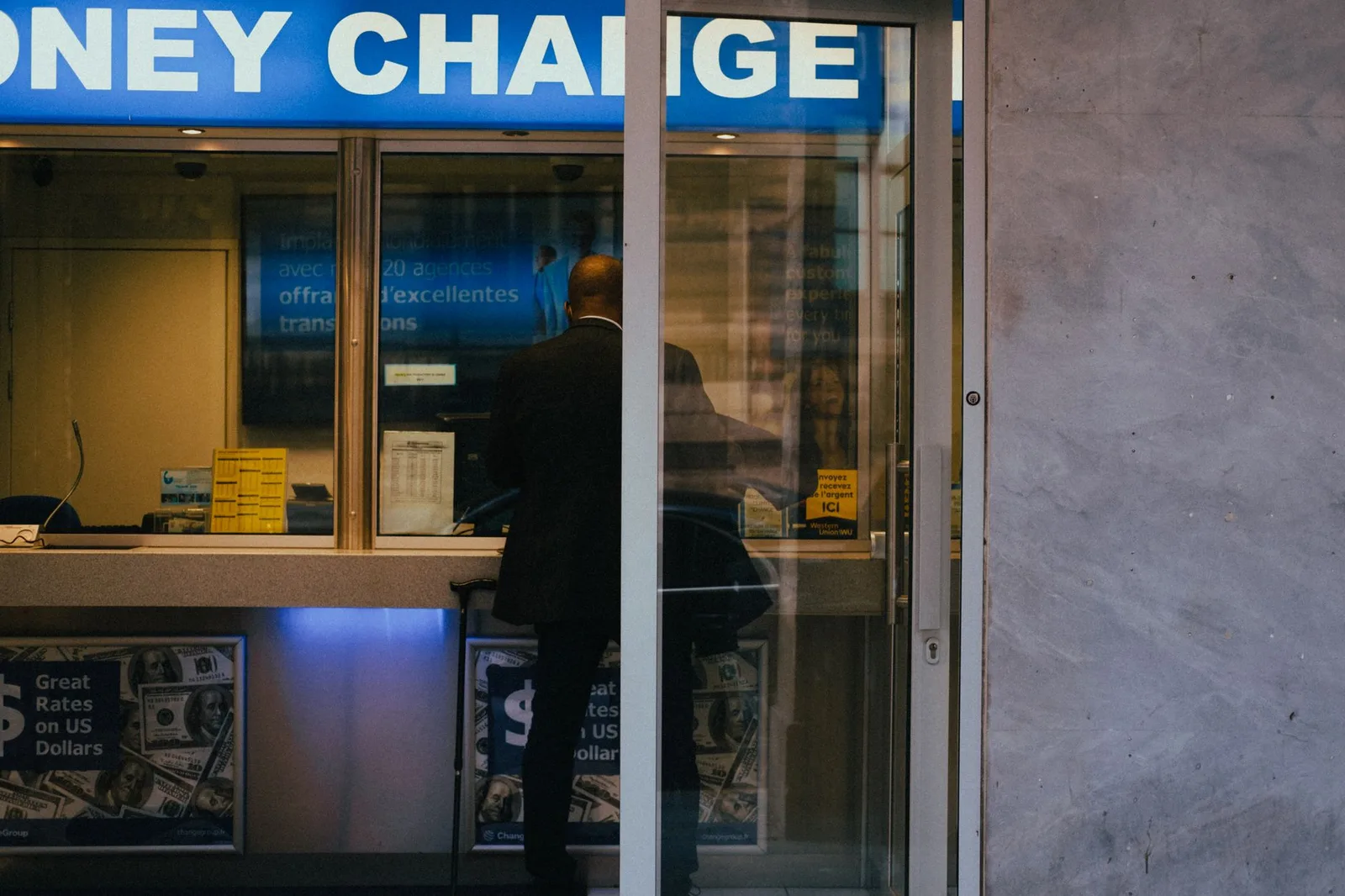
2. Changing cash at the airport exchange kiosk
The bureau on the airport concourse exists because you are tired, you have just landed, and you feel you need local notes right now. It makes its money on the spread — the gap between the rate it buys a currency at and the rate it sells it back to you — and that gap is at its widest exactly where competition is thinnest and travellers are most captive. A bank ATM in town, or paying directly by card, is almost always cheaper than an airport counter. Change only what you genuinely need to get into the city, and do the rest later.
The mistakes at a glance
| The mistake | Why it quietly costs you | Do this instead |
|---|---|---|
| Paying in your home currency (DCC) | A hidden markup added by the merchant’s processor, not your bank | Always choose the local currency |
| Airport exchange kiosk | Widest buy/sell spread of anywhere you’ll change money | Use a bank ATM in town; change only a little on arrival |
| Airport / non-bank ATMs | Standalone machines stack their own surcharge on top of your bank’s fee | Use a bank-branded ATM; decline mid-transaction surcharge prompts |
| Not telling your bank you’re travelling | Fraud systems freeze an unexpected foreign transaction — card dead abroad | Set a travel notice, and check your app has your current number |
| Relying on a single card | One block, loss or skimmed card and you have no way to pay at all | Carry two cards from different networks, stored separately |
| Carrying too much cash | Uninsured, unrecoverable if lost or stolen, and hard to change back | Carry a sensible float; top up from ATMs as you go |
3. Trusting standalone ATMs
Not all cash machines are equal. The independent ATMs in airport halls, tourist strips and convenience shops frequently levy their own operator surcharge on top of whatever your own bank charges — and they are the machines most likely to push DCC at you as well. A machine attached to an actual bank branch is your best bet. Withdraw a slightly larger amount less often, so any flat per-withdrawal fee is spread across more cash.
4. Not telling your bank you’re going
Modern fraud systems watch for the improbable, and a card that has only ever been used at home suddenly buying dinner two time zones away is exactly that. The result is a frozen card at the worst possible moment. A quick travel notice in your banking app — or a call — prevents it. While you are in there, confirm the bank has a phone number that will actually reach you abroad.
5. Relying on one card — and 6. carrying too much cash
These two are opposite failures of the same lesson: never have a single point of failure. One card can be blocked, demagnetised, swallowed by a machine or skimmed, and if it is your only card the trip stops. Carry two cards, ideally on different networks, and keep them in different places. Cash is the mirror image — a fat envelope of notes is uninsured and gone for good if it is lost or stolen. Carry a reasonable working float and rebuild it from ATMs as you travel.
7. Shrugging at foreign-transaction fees
Many everyday cards add a fee to every purchase and withdrawal made abroad. It is small enough to ignore per transaction and large enough to matter across a whole trip. We are not going to name a card — terms change and yours may already be fine — but do one thing before you fly: read your card’s foreign-use terms so you know what you are paying. Fees vary; check yours.
The Nepal angle
Trekkers face a specific version of all this. Bring some US-dollar cash for your visa on arrival and for national-park and trekking permits. Draw your Nepali rupees from a bank ATM in Kathmandu or Pokhara — not the airport kiosk — and do it while you still have signal and choice. Most importantly, carry enough cash for your days on the trail: high in the Everest, Annapurna and Manaslu regions there are no ATMs, teahouses want rupees, and “I’ll get it up there” is not a plan. Work out your daily spend, add a buffer, and draw it before you leave the road-head.
Want the deeper mechanics? Our guide to avoiding foreign-transaction and ATM fees abroad breaks down exactly how each charge is built, and cash vs debit vs credit vs prepaid covers what to actually carry.
None of these fixes need an app, a subscription or a clever card — just the habit of pausing for the one-second decision. If Nepal is on your list, our team is happy to talk through exactly what to carry and where to draw cash before you go — browse the trips and get in touch.
Cover photo: Mathias Reding via Pexels (Pexels License).
Still running this season
Annapurna Circuit Trek — 13 Days is running normally
NMA-certified local guides, transparent pricing, 5,000+ treks since 1998. Message us your dates and we'll sort the permits, lodges and logistics — reply within 24 hours, no obligation.


Popular Nepal treks
All treks →


Related coverage
Money & Insurance
Travel Money in 2026: Cash vs Debit vs Credit vs Prepaid Cards — What to Carry and How to Spend It
No single method wins abroad. Here is how cash, debit, credit and prepaid multi-currency cards really compare on fees — plus the dynamic-currency-conversion trap to dodge, how much cash to carry, and why Nepal’s trail runs on rupees.
Visas & Entry
Do You Need an Onward or Return Ticket to Enter a Country in 2026? The Rule That Catches One-Way Travellers
Many countries — and the airlines that face the fines — want proof of onward travel before you board. Here is who it bites, why it is enforced at check-in, and how to satisfy it.

World Destinations
Where to Travel Each Month in 2026: A Month-by-Month Guide to the Best Seasons Worldwide
A season-first calendar of where the weather works best in every month of 2026 — from Southeast Asia’s dry winter and Japan’s cherry blossom to Europe’s summer, Nepal’s autumn trekking peak and the Caribbean’s dry-season sun.
Deals & Routes
How to Survive a Long Layover in 2026: Lounges, Sleep Pods, Showers and Leaving the Airport
A multi-hour connection can wreck your trip or become the easy part. Here is how to play a long layover in 2026 — when you can leave the airport, lounges and day passes, sleep pods, showers, left-luggage, and staying comfortable.
Latest from the desk

World Destinations
Cheapest Countries to Visit in Asia in 2026 (Where Your Money Goes Furthest)
From Nepal’s Himalaya on a backpacker budget to the street-food value of Vietnam, India and Kyrgyzstan — the great-value Asian destinations for 2026, why each is cheap, and when to go.
Records & People
Nepal Has a Temple Where Fire Burns Straight Out of Water, and Nobody Fully Explains Why It Never Goes Out
At 3,710 metres beneath the Thorong La pass, a natural gas seep keeps a flame burning above a spring at Muktinath, a site sacred to both Hindus and Buddhists.
Festivals & Events
Kathmandu's Biggest Street Festival Has a Stone Demon That Spits Rice Beer Into the Crowd
Indra Jatra runs September 25 to October 2, 2026, and turns Kathmandu Durbar Square into eight days of chariot processions, masked demon dances and a mask that pours alcohol from its mouth.