
Is Balen Shah the best prime minister alive right now? We ran the numbers
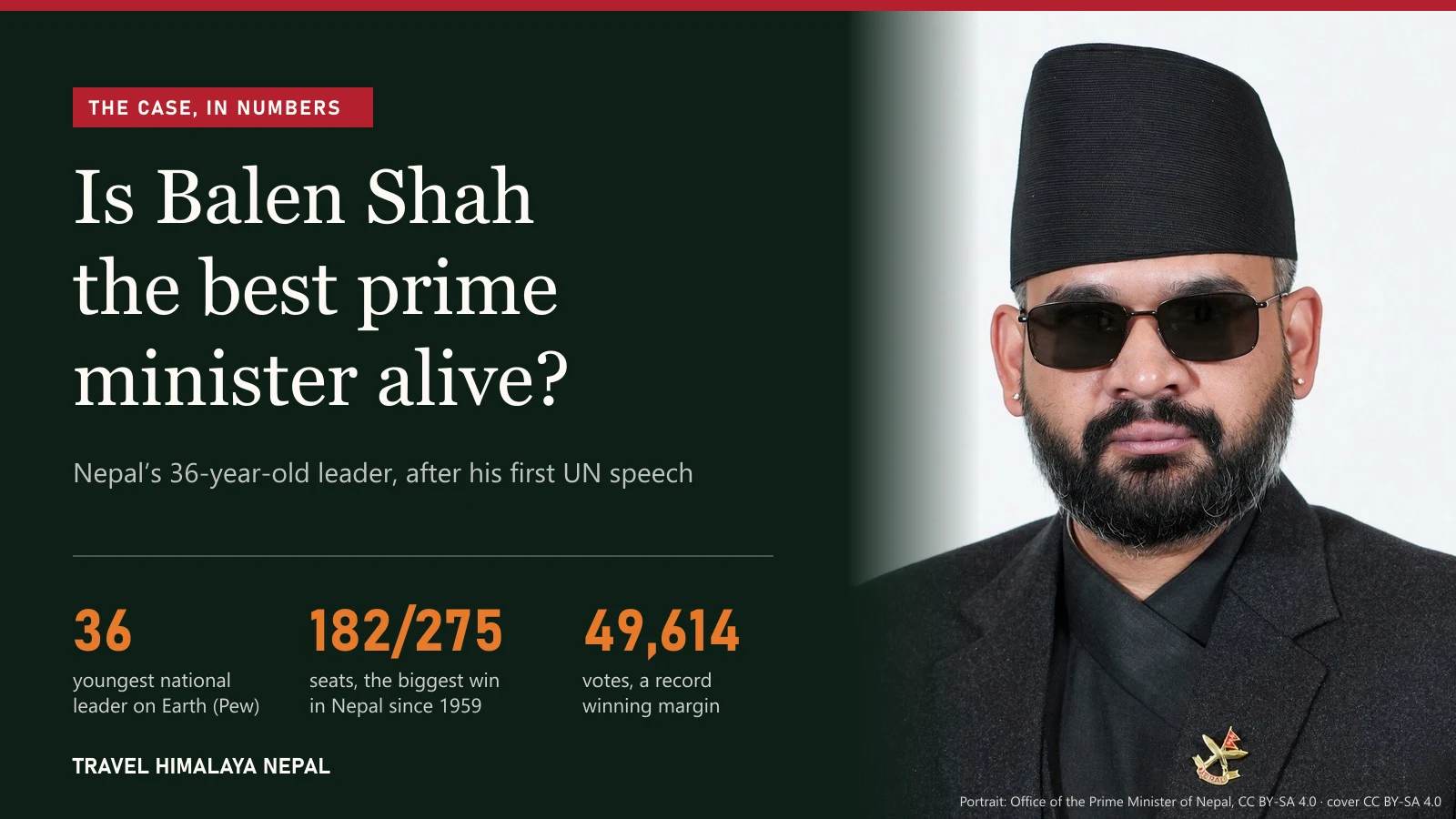
Balen Shah won Nepal's biggest mandate since 1959 and is the youngest leader on Earth. The case for and against calling him the best PM alive, in 11 charts.
On this page (8)
Short answer: on the parts of the question that can be measured, the case is stronger than for any Nepali prime minister in living memory. Balen Shah won the biggest mandate Nepal has seen since 1959, he is the youngest national leader on Earth, and on 24 September he gave Nepal its sharpest voice at the United Nations in years. Whether he is the best prime minister alive is a judgement, not a fact, and no poll, index or betting market can settle it. So we did the next best thing. We collected the numbers, drew them, and put the case against him on the same page.
- Proven: the biggest election win since 1959, the youngest national leader in the world, a record winning margin, and a UN speech that travelled.
- Promising but early: anti-corruption cases, faster public services, and the first real chance in decades that a Nepali government lasts a full term.
- Against him: a closed door to the press, forced evictions, flood relief that reached villages slowly, and forecasts that miss his 7% growth target.
- Our call: the strongest start of any prime minister in Nepal's democratic era. Koirala's record over decades is still the one to beat. "Best in the world" stays an argument, and we mark it as one.
The UN speech that put him on the world stage
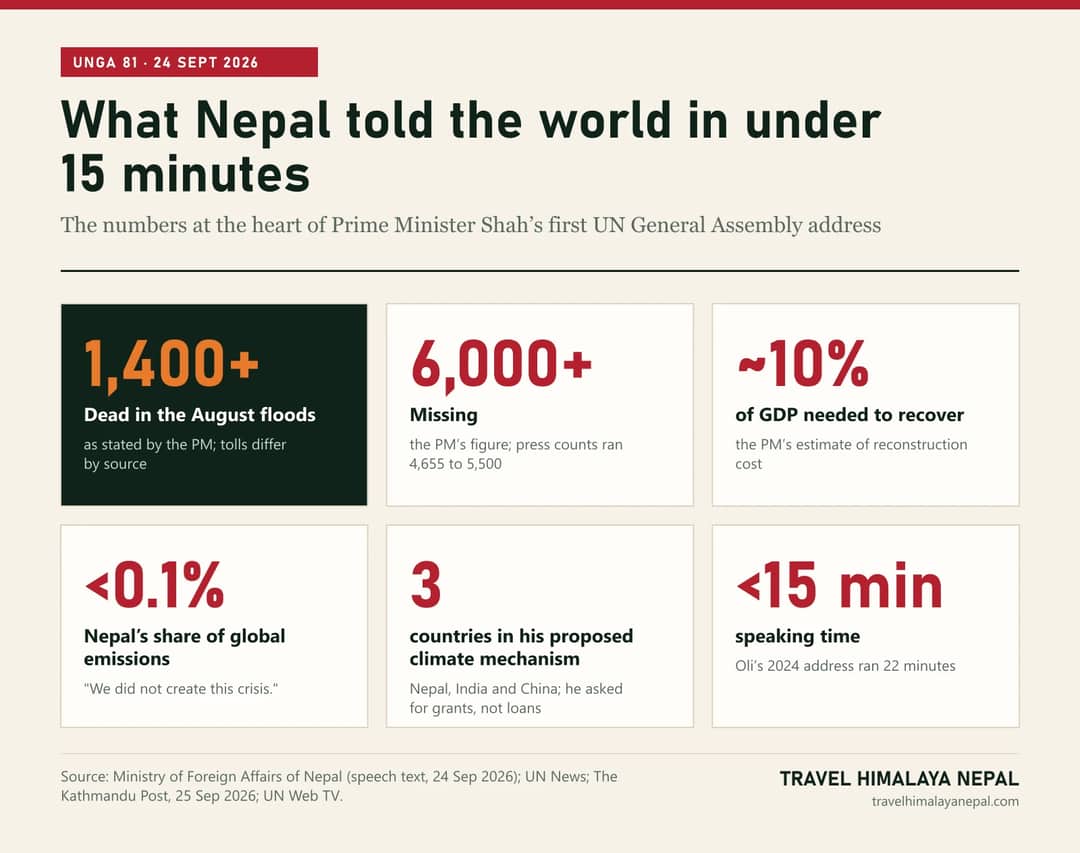
On Thursday 24 September 2026 Shah addressed the 81st UN General Assembly in New York, four weeks after the Bhotekoshi floods tore through Rasuwa and Nuwakot. He spoke for under 15 minutes. K.P. Sharma Oli's 2024 address ran 22, and in 2025 Nepal's statement was read by an ambassador because no prime minister went. The Kathmandu Post and UN News both covered the speech in full.
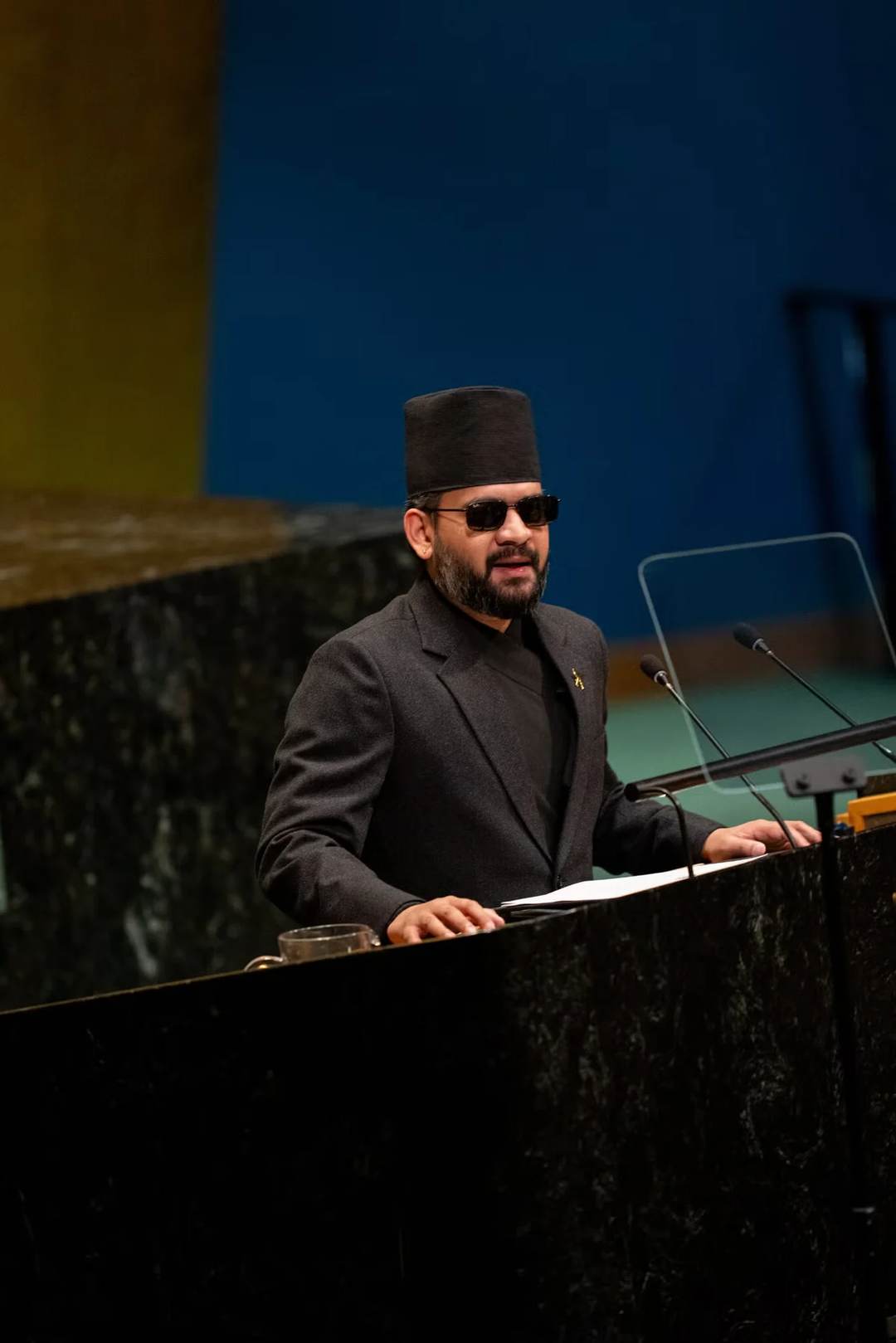
The argument was simple. Nepal emits less than 0.1% of the world's greenhouse gases and is paying for a crisis it did not cause. Rebuilding will cost about 10% of GDP. Climate money should come as grants, not "another mega loan". He also proposed a Himalayan Climate Resilience Mechanism led by Nepal, India and China. Madhu Raman Acharya, a former Nepali ambassador to the UN, called it "one of the best among contemporary prime ministers."
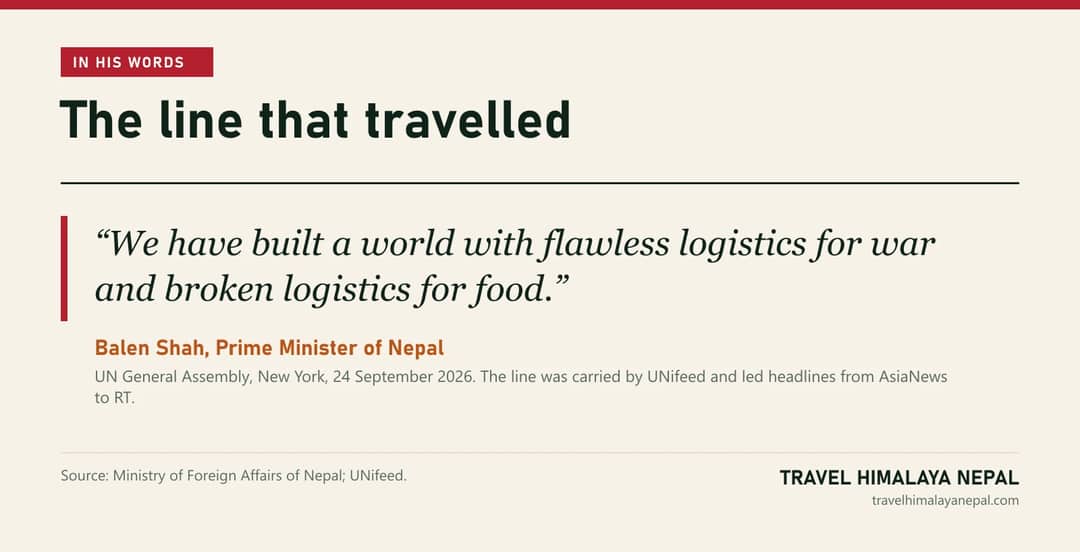
Two more lines worth keeping: "Climate change does not recognize borders. Glaciers and floods do not travel with a visa stamped on passports." And, on red tape in disaster finance: "When the house is burning, we do not ask the family to complete fifty forms." (speech text, Ministry of Foreign Affairs). We covered what he asked the world for in our news report on the speech.
The case for: eight arguments, with the numbers
1. The biggest mandate any Nepali leader has won since 1959
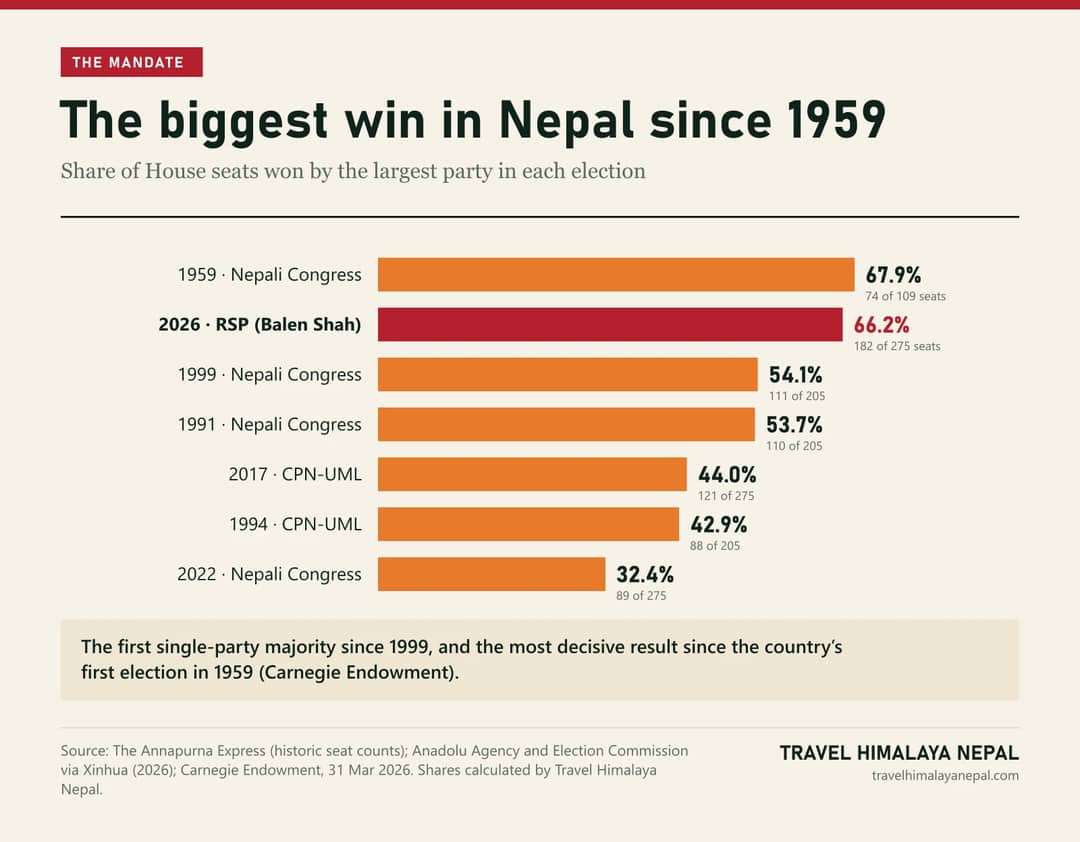
The Rastriya Swatantra Party won 182 of 275 seats on 5 March 2026: 125 directly elected and 57 from the proportional list. That is 66.2% of the House, two seats short of two-thirds, in a party founded only in 2022. Carnegie Endowment calls it the first single-party majority since 1999 and the most decisive result since Nepal's first election in 1959.
2. He beat a four-time prime minister on his own seat, by a record margin
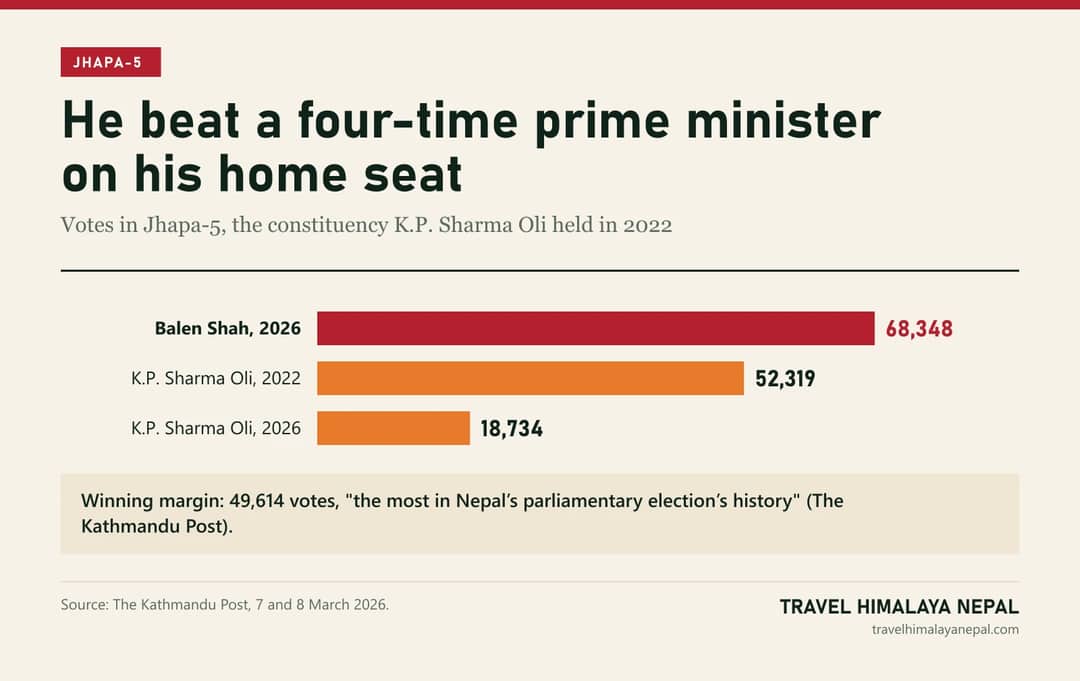
Shah did not take a safe seat. He ran in Jhapa-5, the constituency of UML chair K.P. Sharma Oli, and won 68,348 votes to 18,734. Oli had taken 52,319 votes there in 2022. The 49,614-vote margin is, in The Kathmandu Post's words, "the most in Nepal's parliamentary election's history."
3. The youngest national leader on Earth
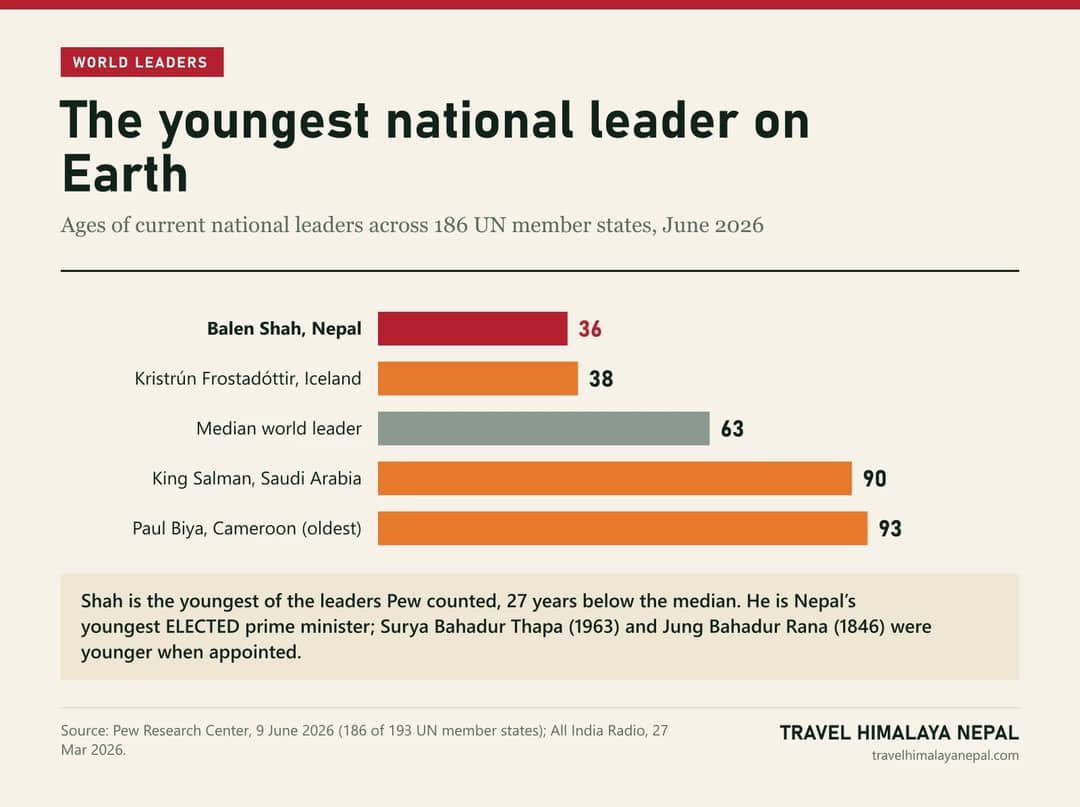
Pew Research counted the leaders of 186 UN member states in June 2026. The youngest was "36-year-old Balen Shah", against a median age of 63. He is also Nepal's first Madhesi prime minister and its youngest elected one. He is not the youngest ever to hold the office: Surya Bahadur Thapa in 1963 and Jung Bahadur Rana in 1846 were appointed younger.
4. The whole government got younger with him
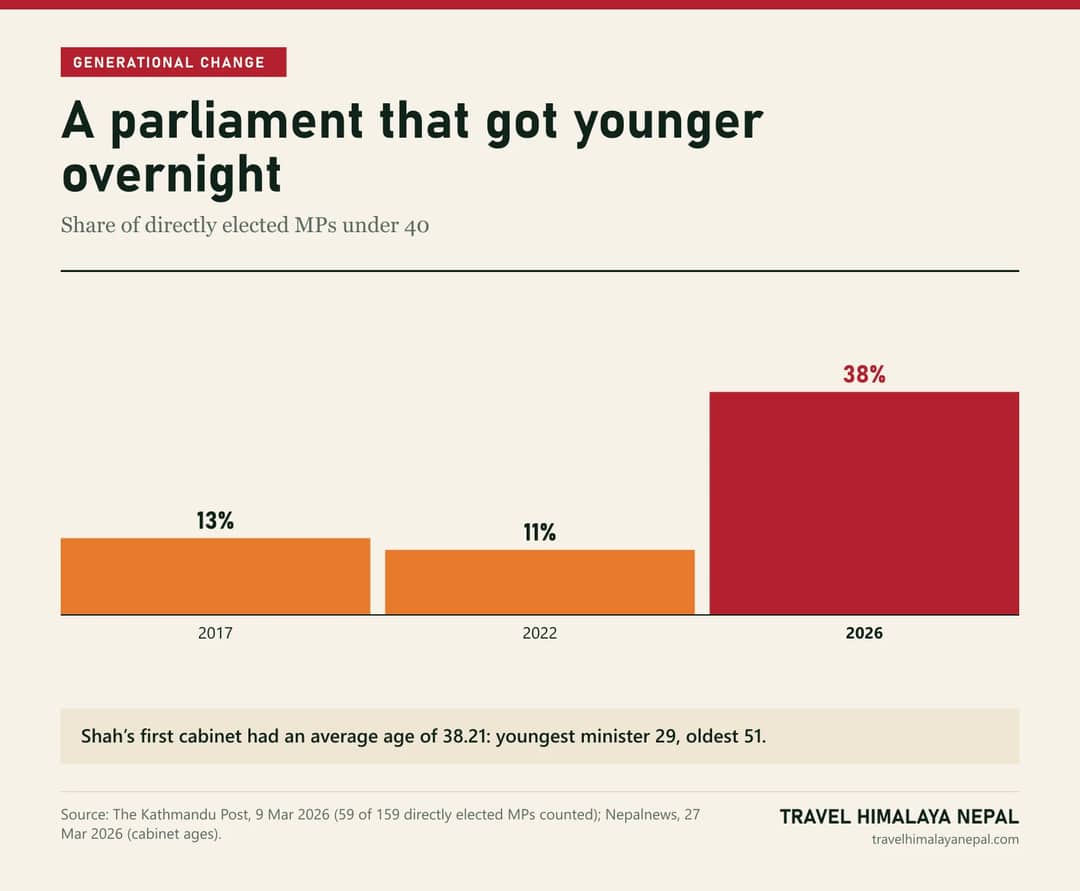
The generational change was not one man. Among directly elected MPs, 38% are now under 40, up from 11% in 2022 and 13% in 2017 (The Kathmandu Post). His first cabinet averaged 38.21 years, with the youngest minister 29 (Nepalnews). Communist parties' combined share of the vote fell from around 40% to 21%.
5. The best chance in decades to end Nepal's revolving door
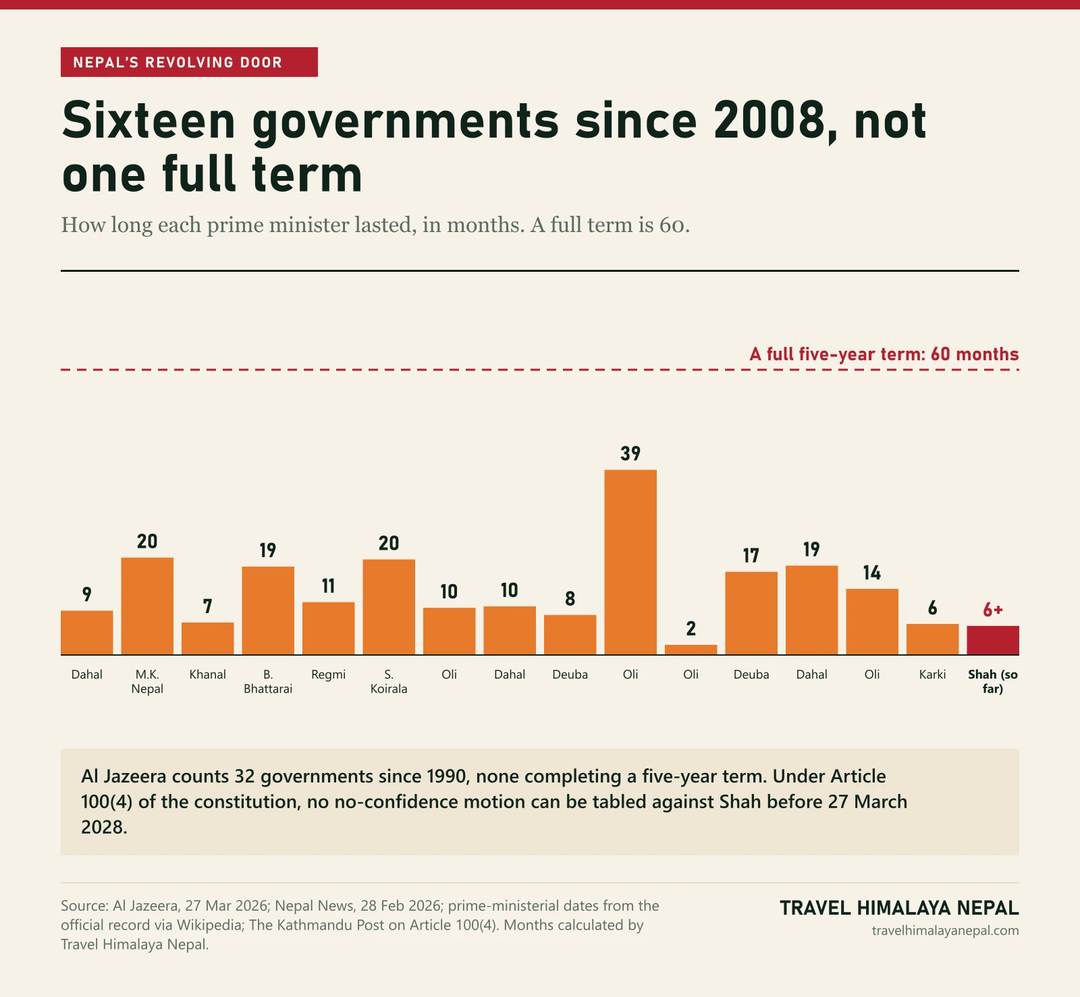
This is the argument that matters most for "best in Nepal's history". Al Jazeera counts 32 governments since 1990, and none has completed a five-year term. Our own count of every unbroken term since April 1990 gives 29 governments led by 15 people, averaging 14.9 months each. The longest were G.P. Koirala (42 months, 1991 to 1994) and Oli (about 41 months, 2018 to 2021).
Shah is protected in a way his predecessors were not. Article 100(4) of the constitution bars a no-confidence motion for a new government's first two years, so the earliest one can be tabled against him is 27 March 2028. And he has a majority, which no coalition-juggling predecessor since 1999 had. Fitch said the result "reduces near-term political uncertainty" (via The Kathmandu Post), and the World Bank lists "improved political stability" as an upside for growth.
6. Anti-corruption with no protected class, his own ministers included
The day after he was sworn in, former prime minister Oli and former home minister Ramesh Lekhak were arrested over the deadly response to the September 2025 Gen Z protests; 76 people died across the two days of protest and the six days of unrest that followed (Amnesty International). The anti-corruption commission filed a Rs 10.13 billion case over the e-passport contract in June. When his own labour minister's wife was appointed to a public post, Shah fired the minister. His home minister stepped aside pending an inquiry, saying "morality is greater than a position." An ordinance on 3 May removed more than 1,200 political appointees.
His record before power helps here. As mayor of Kathmandu from 2022, analysts noted "the absence of corruption allegations against him" in a country where corruption is pervasive.
7. The state started working for ordinary people
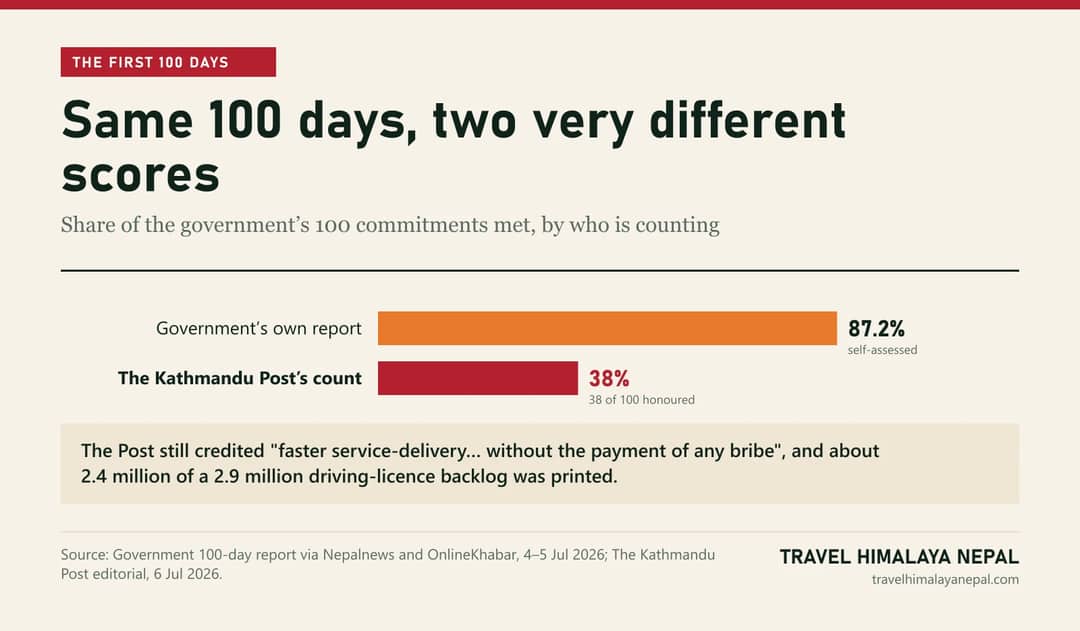
Even the government's critics noticed the counters. The Kathmandu Post's 100-day editorial, which was otherwise harsh, reported "faster service-delivery, and how work gets done without the payment of any bribe." About 2.4 million of a 2.9 million driving-licence backlog was printed. The first budget raised the income-tax exemption threshold to Rs 1 million, cut customs tiers from 11 to 7, abolished excise on 360 items and capped ministries at 18, down from 22.
8. Tested before power
Shah won Kathmandu as an independent in 2022 with 61,767 votes against 38,341 and 38,117 for the two big parties' candidates. In the three years that followed, the city's budget spending rose from 40% to more than 52% of what it allocated, house-rent tax income rose 130%, and he broadcast executive meetings live. He was not a lone upset either: in those same May 2022 local elections, 385 independent candidates won, seven of them as mayors (Election Commission figures, via Republica). Some of his city policies, including the "Book Free Friday" school day, are now planned nationwide.
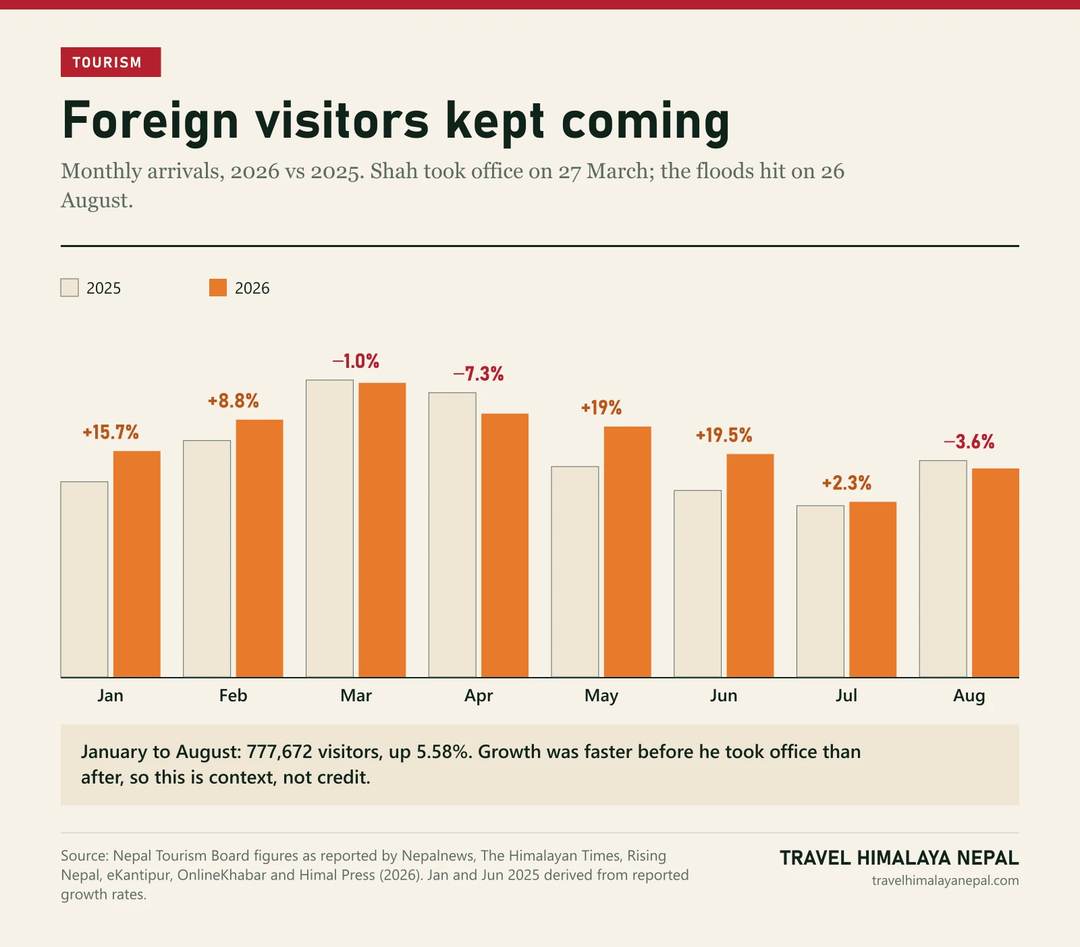
The political handover was peaceful, and foreign arrivals are up 5.6% on 2025 for January to August. Our Pokhara team will tell you honestly which routes are open after the August floods and which are not.
Ask our guides, freeThe case against: what his critics say
A case this one-sided would not be worth reading, so here is the other side, with the same sourcing.
- The mandate is thinner than the seat count. 47.8% of the proportional vote became 66.2% of the seats, and turnout was 59.84%, the lowest since 1991 (The Kathmandu Post). 42 of the party's winners came from other parties.
- The press cannot reach him. He held no press conference in his first 100 days, government notices were restricted to state media, and journalist Kanak Mani Dixit says "the media has zero access to Balendra Shah." He had spoken in Parliament only twice by September.
- Evictions. About 15,000 people were displaced from squatter settlements from 25 April. Amnesty International warned of "an increasingly authoritarian approach". As mayor, his crackdown on street vendors drew criticism from Human Rights Watch.
- Rule of law. Oli was arrested on an urgent warrant and bailed by the Supreme Court on 9 April without charge. In 2023, as mayor, Shah wrote that on questions of sovereignty "I am not going to obey any law or court." In March 2024 a group of prominent rights advocates published an open letter warning that he was "treading an authoritarian path". As prime minister the charge returned: on 4 May 2026, 28 prominent citizens, among them Kanak Mani Dixit and former human rights commissioner Sushil Pyakurel, accused his government of an authoritarian drift, citing the evictions, rule by ordinance and the mass removal of officials (ThePrint).
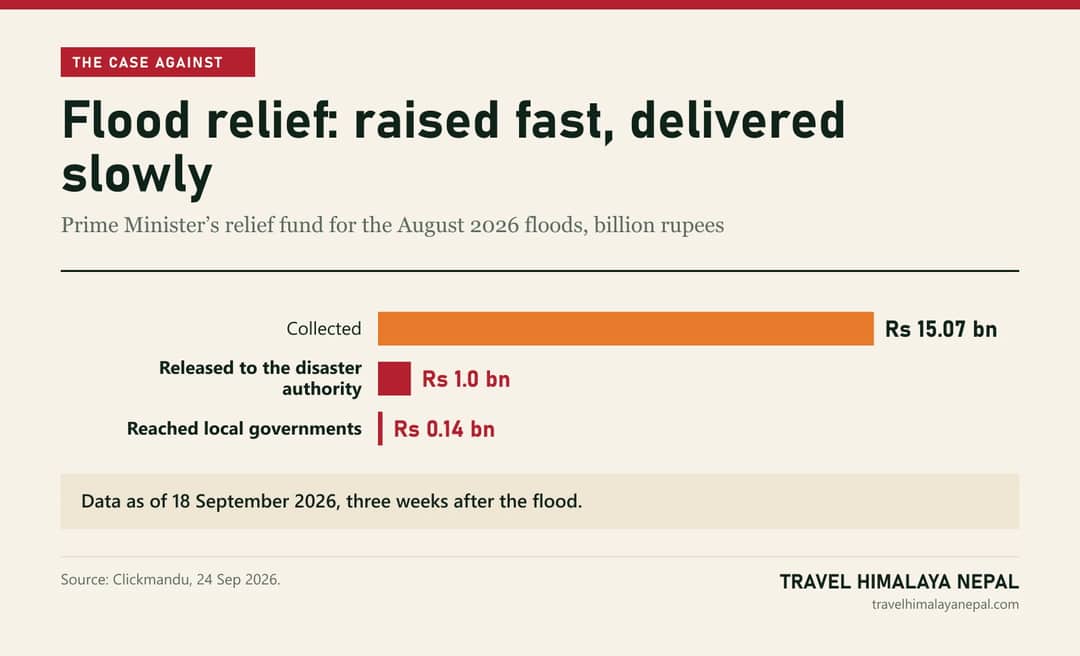
- Flood relief moved slowly. The prime minister's relief fund raised Rs 15.07 billion, but by 18 September only Rs 1 billion had been released and Rs 137.5 million had reached local governments (Clickmandu). 35 civil-rights figures said local councils were being sidelined.
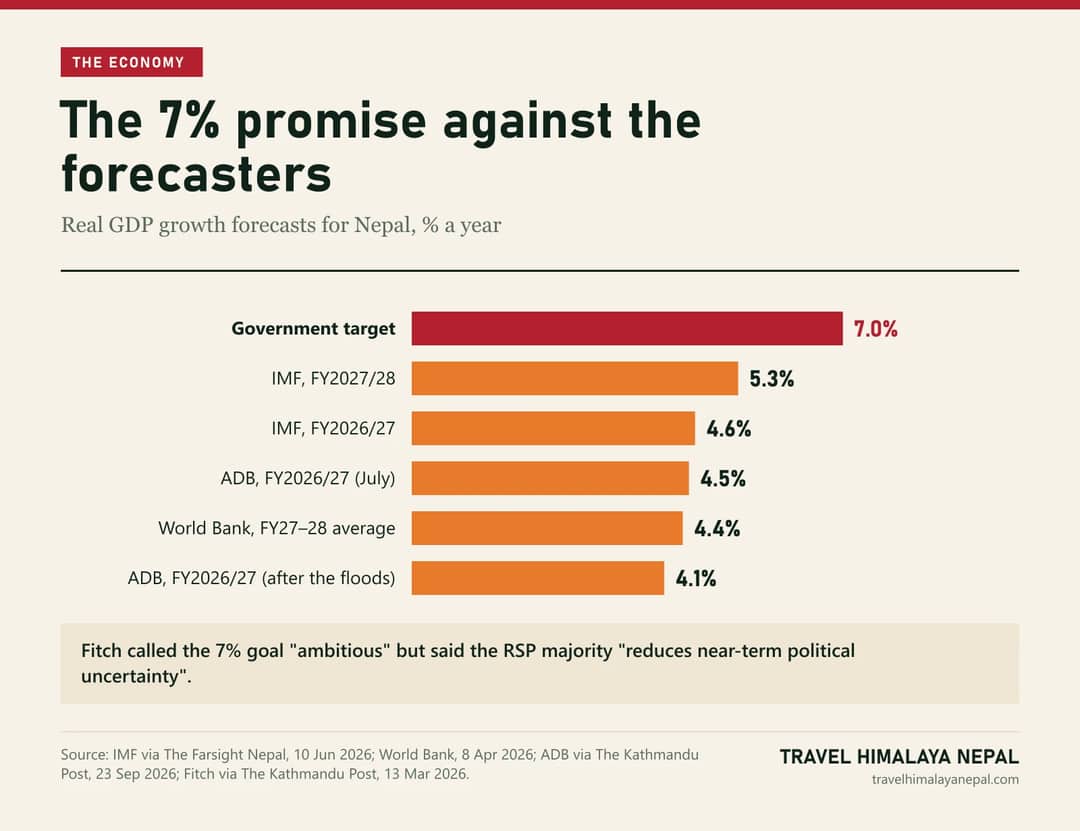
- Markets and growth. The NEPSE stock index fell 10.9% between the eve of his oath and 24 September, and every major lender forecasts growth well below his 7% target.
- Gen Z's own verdict is mixed. 25 of 29 invited activists boycotted his constitutional-amendment talks, and more than 900 protesters were still in jail a year after the uprising (Al Jazeera).
- The UN speech had critics too. A Nepal News analysis said "rhetoric is not a strategy", because the climate mechanism came with no budget, secretariat or timeline.
The economy and tourism: context, not credit
Here we are careful, because much of what looks good happened before he arrived. Remittances and reserves were strong in the fiscal year that ended in July, most of which predates his government. The two trekker-friendly rule changes of the past year, allowing single trekkers into restricted areas and cutting the Upper Mustang fee to $50 a day, were made by the interim government of Sushila Karki. The $15,000 Everest permit came in under Oli.
Tourism held up through a hard year. Foreign arrivals from January to August reached 777,672, up 5.58% on 2025, even with April hit by the Middle East conflict and August by the floods. Growth was faster before he took office than after, so we show it as context, not as his achievement. What his government has done for travellers is in the budget: Rs 7.34 billion for tourism, a Nepal Wellness Year in 2027, a plan to split the Civil Aviation Authority by January 2027 to get Nepali airlines off the EU safety list, and incentives that brought the first daily international flight to Pokhara on 25 September.
Bets and forecasts: will he last?
Everything in this section is a forecast or our own arithmetic, and it is labelled as such.
| Forecast | Who says so | What it means |
|---|---|---|
| Growth of 4.6% in FY2026/27, 5.3% in FY2027/28 | IMF, June 2026 | Solid, but short of the 7% promise |
| Growth of 4.1% in FY2026/27 | ADB, September 2026 (after the floods) | The floods cost growth |
| BB- rating, Stable outlook | Fitch, March 2026 | The majority lowers political risk |
| $4-5 billion to rebuild after the floods | Finance Minister Swarnim Wagle | The biggest test of his first term |
| No no-confidence motion possible before 27 March 2028 | Constitution, Article 100(4) | Two guaranteed years |
| Passes the average post-2008 tenure in about May 2027 | Our arithmetic | Already a sign of change if it happens |
| Passes Koirala's post-1990 record of about 42 months in about September 2029 | Our arithmetic | The longest-serving PM of the democratic era |
| A full term ends in March 2031 | Our arithmetic | It would be the first full term since 1990 |
Where the risk comes from: not the opposition, which is too small to topple him, but his own side. A Kathmandu Post columnist wrote on 26 September that there is talk of "a big plan to replace Shah with Lamichhane", the party's chair, and history is not kind to Nepal's strongest governments. The 1959 majority lasted 18 months, 1991 about three years, and 1999 ten months. A note on betting: we looked for prediction-market odds on Shah and found none we could verify, so we are not quoting any.
Our bet: he reaches March 2028 with his majority intact, because the constitution and the numbers both favour him. Whether he earns "best in Nepal's history" will be decided by what happens after that, when the protection runs out.
So, is he the best prime minister alive?
No one can prove it, and anyone who says they have is selling something. What the numbers show is a leader with the biggest mandate in 67 years, the youngest in the world, who has already done things no predecessor dared, like arresting a former prime minister and firing his own ministers, and who used 15 minutes at the UN better than most leaders use 30. They also show a leader who avoids questions, moved too slowly on flood relief and has yet to prove his economics.
In Nepal's own history, the strongest competitor is G.P. Koirala, who liberalised the economy in the 1990s and signed the 2006 peace accord that ended the war. Shah has six months against Koirala's decades. Ask us again on 27 March 2028.
Frequently asked questions
Who is Balen Shah?
Balendra "Balen" Shah is the Prime Minister of Nepal, sworn in on 27 March 2026 at age 35. He is a structural engineer and a former rapper who won the Raw Barz rap battle in 2013. He was elected mayor of Kathmandu as an independent in 2022 and led the Rastriya Swatantra Party to a 182-of-275-seat majority on 5 March 2026.
Is Balen Shah the youngest prime minister in the world?
Yes, among current national leaders. Pew Research listed him in June 2026 as the youngest of the leaders of 186 UN member states, at 36, against a median age of 63. He is Nepal's youngest elected prime minister, but not the youngest ever to hold the office: Surya Bahadur Thapa (1963) and Jung Bahadur Rana (1846) were younger.
How big was Balen Shah's election win?
His party won 182 of 275 seats, or 66.2%, two short of a two-thirds majority. It was the first single-party majority since 1999 and the most decisive result since 1959. In his own seat he beat former prime minister K.P. Sharma Oli by 68,348 votes to 18,734, the largest margin in Nepal's parliamentary history.
What did Balen Shah say at the UN General Assembly?
On 24 September 2026 he centred Nepal's address on the Bhotekoshi floods, which he said left at least 1,400 dead and more than 6,000 missing. He said Nepal emits under 0.1% of global greenhouse gases, asked for climate grants rather than loans, and proposed a Himalayan Climate Resilience Mechanism led by Nepal, India and China.
Why do people call him the best prime minister?
Supporters point to the largest mandate in decades, his age, his record against corruption as mayor and as prime minister, and the fact that his majority gives Nepal its best chance in 30 years of a government that lasts a full term. No independent ranking names him the best; that remains opinion.
What are the main criticisms of Balen Shah?
Critics point to his refusal to take questions from the press, forced evictions that displaced about 15,000 people, arrests of opponents without charges, a disputed 100-day record (87.2% by the government's count, 38% by The Kathmandu Post's), and slow delivery of flood relief.
Can Balen Shah be removed before 2028?
Not by a no-confidence motion. Article 100(4) of Nepal's constitution bars one for a government's first two years, so the earliest date is 27 March 2028. He could still be replaced as parliamentary party leader by his own party, which is the risk analysts watch most closely.
Is it safe to travel to Nepal under the new government?
Yes, politically. The handover was peaceful, and tourist arrivals for January to August 2026 were up 5.6% on 2025, with a record spring season on Everest. The real risk right now is flood damage in Rasuwa, Nuwakot and Dhading from August 2026, so check route-specific conditions before you book a trek there.
Keep reading
Our news report on the speech and the flood behind it.
One month after the floodsThe search, the toll and the rebuild bill.
Should you cancel your trek?What the tourism minister is asking visitors, and what we tell clients.
Is Nepal safe to visit in 2026?Our honest safety guide, route by route.
Cover image: derived from the official portrait of Prime Minister Balendra Shah by the Office of the Prime Minister and Council of Ministers of Nepal, CC BY-SA 4.0; the cover is released under the same licence. Infographics drawn by Travel Himalaya Nepal from the sources printed on each. Research compiled on 27 September 2026; figures can change, and flood tolls differ between sources.


Written by
Laxman RawalPokhara-based, NMA-certified trekking guides. We’ve led 5,000+ treks across the Annapurna and Everest regions since 1998 — every word here comes from the trail. More from this author →
Ready to Trek?
From reading about it to standing on it
Our Pokhara-based guides have been doing this since 1998. Tell us your dates and fitness level — we'll build your perfect itinerary. Free, no obligation.
More guides like this
Popular trips to consider
View all treks & toursFree Trekker’s Insider Guide
Permits, packing lists, cost breakdowns — no fluff.
We send one useful email. You can unsubscribe anytime.