
EU261 extraordinary circumstances and what actually counts
Airlines dodge EU261 payouts by citing extraordinary circumstances. What the EU court accepts, what it rejects, and how to challenge a refusal.
On this page (10)
- What counts as extraordinary circumstances under EU261?
- What is NOT extraordinary, so you are paid
- What IS extraordinary, so cash is not owed
- The excuse is real. Does the airline still owe you?
- The new list in the EU reform
- How UK261 handles it
- How Canada and the US draw the same line
- How to challenge an extraordinary circumstances refusal
- Frequently asked questions
- Keep reading
Under EU261 and UK261 an airline escapes paying €250 to €600 (or £220 to £520) only if it proves two things: the cause was an extraordinary circumstance, meaning an event outside its normal operations and outside its control, and it could not have avoided the cancellation or delay even with every reasonable measure. Bad weather, air traffic control strikes, bird strikes and security threats usually qualify. Technical faults, the airline’s own staff striking over pay and a crew member calling in sick do not. Even when the excuse is genuine, meals, drinks and a hotel are still owed.
- There is no binding list yet. Today the answer comes from Court of Justice rulings, gathered in the European Commission’s 2024 guidelines.
- “Technical problem” is the excuse to challenge first. A part that fails is part of running an airline, the court has held, even when it fails unexpectedly.
- A real extraordinary event is not the end of it. The airline also has to show it did everything reasonable, including keeping some buffer time.
- The EU reform writes a list into law and makes the airline name which item it relies on.
What counts as extraordinary circumstances under EU261?
An event that, by its nature or origin, is not part of the airline’s normal activity and is beyond its actual control; both conditions must be met, and the airline carries the burden of proof. That two-part test comes from the Court of Justice in Wallentin-Hermann (C-549/07, 2008) and has been applied in every case since. Recital 14 of the 2004 regulation names political instability, weather incompatible with the flight, security risks, unexpected flight safety shortcomings and strikes as examples, but the Commission’s interpretative guidelines (C/2024/5687) stress that even those require a case-by-case look, because the exemption is read strictly. The court sorts causes into internal events, which are the airline’s problem, and external ones, which usually are not.
What is NOT extraordinary, so you are paid
Anything that comes from running the aircraft and the airline: technical faults, the airline’s own staff and its ground equipment.
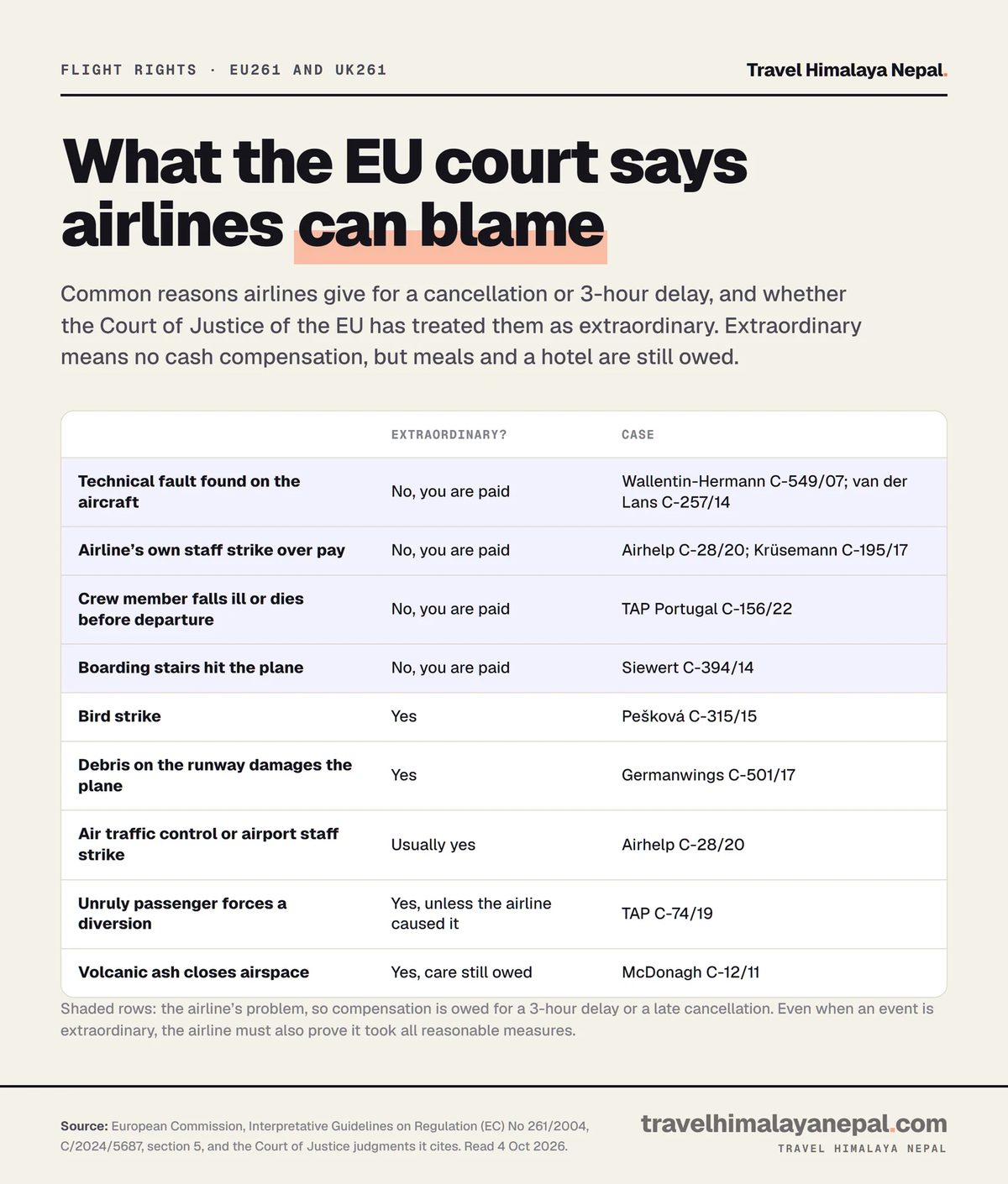
- Technical faults. A defect found in maintenance, or caused by poor maintenance, never qualifies. Nor does an unexpected failure of a component, because “no component of an aircraft lasts forever” (van der Lans, C-257/14). The exception is a hidden manufacturing defect revealed by the manufacturer or an authority, or sabotage.
- The airline’s own strikes. A strike by the airline’s staff over pay or working conditions is not extraordinary (Airhelp v SAS, C-28/20), and neither is a wildcat strike after a surprise restructuring (Krüsemann, C-195/17) or a solidarity strike with a parent company’s staff (Eurowings, C-613/20). Only a strike over demands that public authorities alone can meet may qualify.
- Crew illness or death. An essential crew member absent shortly before departure, even through sudden death, is not extraordinary (TAP Portugal, C-156/22).
- Boarding stairs and gangways. A collision with mobile stairs is part of normal operations (Siewert, C-394/14).
What IS extraordinary, so cash is not owed
Events that come from outside: nature, other companies and public authorities. The Commission’s guidelines list the court’s examples:
- Bird strikes, whether or not they damage the aircraft (Pešková, C-315/15).
- Collisions caused by others, such as another airline’s aircraft or a third party’s catering truck.
- Debris on the runway that damages the aircraft (Germanwings, C-501/17), and fuel on the runway that closes the airport, if it did not come from the airline’s own aircraft (Moens, C-159/18).
- An airport-run refuelling system that breaks down across the board.
- Unruly passengers who force a diversion, unless the airline caused the behaviour or ignored warning signs (C-74/19), and medical emergencies that require a passenger to be removed.
- Volcanic ash closing airspace (McDonagh, C-12/11).
- Bad weather causing congestion at an airport, including capacity cuts.
- Strikes outside the airline, by air traffic controllers or airport staff, which can qualify because they are beyond its control.
- A shortage of the airport’s own baggage-loading staff (Touristic Aviation Services, C-405/23).
The excuse is real. Does the airline still owe you?
It can, if it did not take every reasonable measure, and it always owes care. The airline must show it deployed the staff, equipment and money at its disposal to avoid the disruption, short of “intolerable sacrifices”, and courts can expect it to plan some buffer time to fly once the problem ends. It may blame an extraordinary event on an earlier flight with the same aircraft, even three rotations back (Austrian Airlines, C-826/19), but only with a direct causal link. And extraordinary circumstances never cancel the duty of care: meals and drinks in proportion to the wait, a hotel and transfers if you are stuck overnight (McDonagh confirmed this held even through the 2010 ash cloud).
The new list in the EU reform
The reformed regulation adds an annex with a non-exhaustive list of extraordinary circumstances, and an airline refusing to pay will have to say which item it relies on. The final text (PE-CONS 39/2/26 REV 2) lists natural and environmental disasters, weather or weather damage incompatible with safe operation, war or insurrection, serious cross-border health threats, unruly passengers and short-notice medical emergencies, sabotage, terrorism and other unlawful acts, hidden manufacturing defects, air traffic management restrictions and airspace or runway closures, unscheduled airport closures and system failures, a generalised refuelling breakdown, strikes at airports, air navigation and ground-handling providers, strikes at the airline only over demands public authorities alone can meet, damage by third parties, animals or foreign objects, contaminated runways, a crew member’s medical emergency after departure, and operational shortcomings of airport service providers the airline cannot control. An event that meets the list still has to be causally linked to your flight, and the airline still has to prove it took all reasonable measures. It must reply to a claim within 30 days with a “clear and substantiated explanation”. The reform applies 12 months after it enters into force; until then the case law above governs.
How UK261 handles it
UK261 keeps the original 2004 wording, so the same test applies, but UK courts decide it and the EU reform does not reach the UK. The leading UK case is Huzar v Jet2.com (Court of Appeal, 2014), which held that an unexpected wiring defect was not extraordinary, the same answer the EU court reached. UK courts are not bound by EU court rulings made after 2020, so later decisions such as the 2021 SAS strike ruling are persuasive in Britain rather than binding. The amounts are £220, £350 and £520 by distance.
How Canada and the US draw the same line
Canada keeps its own list, and it is kinder to airlines on strikes: a labour disruption within the carrier counts as outside its control, the reverse of the EU court’s position. Section 10 of the Air Passenger Protection Regulations names war, sabotage, weather, air traffic control instructions, security threats, airport operation issues, medical emergencies, wildlife strikes, labour disruptions at the airline or an essential service provider, and manufacturer-identified defects. The United States pays no cash for any delay, so there the question only shapes the meals and hotels an airline has promised in its own customer service commitments.
| System | Where the line comes from | Airline’s own staff strike | Technical fault |
|---|---|---|---|
| EU261 today | EU court rulings, Commission guidelines 2024 | You are paid | You are paid, unless a hidden manufacturing defect |
| EU261 after the reform | Annex list plus case law | Paid, unless over demands only government can meet | Same as today |
| UK261 | UK courts, same 2004 text | Persuasive EU ruling says paid | Paid (Huzar v Jet2) |
| Canada (APPR) | Section 10 list | Outside control, no compensation | Within control unless required for safety |
| United States | No compensation law | No cash either way | No cash either way |
How to challenge an extraordinary circumstances refusal
Ask for the specific cause in writing, ask for the evidence, and test it against the rulings above.
- Get the reason in writing at the airport or in the airline’s reply. “Operational reasons” is not a reason.
- Ask for proof. The Commission’s guidelines say an airline relying on the defence should provide logbook extracts, incident reports or other documents free of charge.
- Check the timeline. Was the storm or strike at your airport at your departure time? Did other airlines fly the same route? Was the problem on an earlier rotation, and how much buffer did the airline leave?
- Name the ruling. If the reply says “technical issue”, cite van der Lans; if it says “industrial action” by its own crew, cite C-28/20.
- Escalate to the national enforcement body or approved dispute resolution scheme in the country you departed from (the CAA or the airline’s ADR body in the UK), then to the small claims court. You do not need a claims company, which takes a share of the payout for the same letter.
Our flight rights guide sets out who pays what by country, and real cases are worked through in what airlines owe when air traffic control fails, easyJet’s Italy crew strike and EU261 on connections to Kathmandu.
One booking from a European airport is protected by EU261 end to end, connections included. Land a day early anyway. Our 12-day Everest Base Camp trek is $1,700 solo, from $1,230 each in a group of eight or more, with permits, a government-registered guide, porter, teahouses and meals.
See the trek →Frequently asked questions
Is a technical problem an extraordinary circumstance?
Almost never. The EU court has held that faults found in maintenance and unexpected component failures are part of normal operations. Only hidden manufacturing defects revealed by the manufacturer or an authority, or sabotage, qualify.
Is bad weather an extraordinary circumstance?
Usually, when the weather is incompatible with the flight, including congestion it causes at an airport. The airline still has to show it could not reasonably avoid the delay, and it still owes meals and a hotel.
Is an air traffic control strike an extraordinary circumstance?
Yes, it is external to the airline. A strike by the airline’s own pilots or cabin crew over pay is not.
Is crew sickness an extraordinary circumstance?
No. The EU court ruled in 2023 that a crew member’s sudden illness or death shortly before departure does not exempt the airline.
Is there an official EU list of extraordinary circumstances?
Not yet in force. The reformed regulation adds a non-exhaustive list in an annex, applying 12 months after it enters into force. Until then the Commission’s 2024 guidelines summarise the court rulings.
Do I get anything if the circumstances really were extraordinary?
Yes: a refund or rerouting, plus meals, drinks and a hotel and transfers if needed. Only the fixed cash compensation falls away.
Keep reading
What airlines owe you, country by country.
When the airline must put you on a rival.
What airlines have to pay when you are bumped.
Limits, deadlines and how to claim.
Sources: Regulation (EC) No 261/2004, Article 5(3) and recital 14; European Commission, Interpretative Guidelines on Regulation (EC) No 261/2004, C/2024/5687 (OJ C, 25 September 2024), section 5, and the Court of Justice judgments cited there (C-549/07, C-257/14, C-28/20, C-195/17, C-613/20, C-156/22, C-394/14, C-315/15, C-501/17, C-159/18, C-74/19, C-12/11, C-405/23, C-826/19); European Parliament and Council, regulation amending Regulation (EC) No 261/2004, PE-CONS 39/2/26 REV 2 (16 September 2026), Articles 6c and 7 and Annex I; Huzar v Jet2.com Ltd [2014] EWCA Civ 791; Canada, Air Passenger Protection Regulations SOR/2019-150, section 10 (current to 21 September 2026). Read 4 October 2026. This is general information, not legal advice.
Photos via Pexels: Rodolfo Gaion (cover), Ivan Chumakov, Quang Nguyen Vinh.

Written by
Anjali ShresthaPokhara-based, NMA-certified trekking guides. We’ve led 5,000+ treks across the Annapurna and Everest regions since 1998 — every word here comes from the trail. More from this author →
Ready to Trek?
From reading about it to standing on it
Our Pokhara-based guides have been doing this since 1998. Tell us your dates and fitness level — we'll build your perfect itinerary. Free, no obligation.
More guides like this
Popular trips to consider
View all treks & toursFree Trekker’s Insider Guide
Permits, packing lists, cost breakdowns — no fluff.
We send one useful email. You can unsubscribe anytime.