
Garmin inReach vs Zoleo vs a PLB for trekking, and who should buy none
A PLB has no subscription. inReach plans run $7.99 to $49.99 a month and Zoleo $19.99 or $34.99, and on a guided teahouse trek you may need none.
On this page (7)
A personal locator beacon is the cheapest way to call for rescue, because it has no subscription. A Garmin inReach or a Zoleo costs a monthly plan, and in return you can send messages and receive replies. In the US, Garmin’s inReach plans run from $7.99 to $49.99 a month plus a $39.99 activation fee. Zoleo’s are $19.99 or $34.99 a month, with a $19.99 activation fee and a three-month minimum. A beacon sends one thing, a distress signal, and costs nothing after you buy it. On a guided teahouse trek, many people need none of the three.
- Buy a beacon if all you want is a rescue button and no bill.
- Buy a messenger if you want to say “I’m fine” or “I’m hurt but walking”, and hear back.
- Garmin is cheaper for one trip a year, because you can suspend it. Zoleo makes you pay for at least three months.
- Buy nothing for a guided trek on a main teahouse route. Spend the money on insurance that covers helicopter rescue.
Messenger or beacon, the real difference
A messenger is a conversation and a beacon is an alarm. A Garmin inReach or a Zoleo sends and receives text over the Iridium satellite network, so you can explain what happened and get an answer. A personal locator beacon, or PLB, transmits a distress signal on 406 MHz to the international Cospas-Sarsat system. According to NOAA, which runs the US side of that system, PLBs “can only be activated manually” and alert rescue authorities within minutes.
With a messenger, a twisted ankle can be a text home and a slow walk down. A beacon can only say you need help. Some newer beacons have a Return Link Service light that confirms the alert was received. NOAA points out that the light does not mean a rescue has been launched.
| Garmin inReach | Zoleo | Personal locator beacon | |
|---|---|---|---|
| Network | Iridium | Iridium | Cospas-Sarsat, 406 MHz |
| Two-way messages | Yes | Yes | No |
| Who gets your SOS | Garmin Response, 24/7 | Zoleo’s 24/7 SOS monitoring | National rescue authorities |
| Monthly plan (US) | $7.99, $14.99, $29.99 or $49.99 | $19.99 or $34.99 | None |
| Activation fee | $39.99 | $19.99 | None; registration free |
| Minimum term | Billed monthly | 3 months | — |
| Between trips | Suspend for $0, up to 12 months | Pause for $4.50 a month; no SOS while paused | Nothing to pay |
| Battery (maker’s figure) | Up to 350 hours at 10-minute tracking (Mini 3) | Over 200 hours | 24 hours minimum once activated |
What each one costs for a single trek
For one three-week trek a year, a Garmin plan costs less to run than a Zoleo, and a beacon costs nothing to run. Plan prices are from each maker’s US page on 27 September 2026. The device is extra on all three; check its price on the maker’s own page.
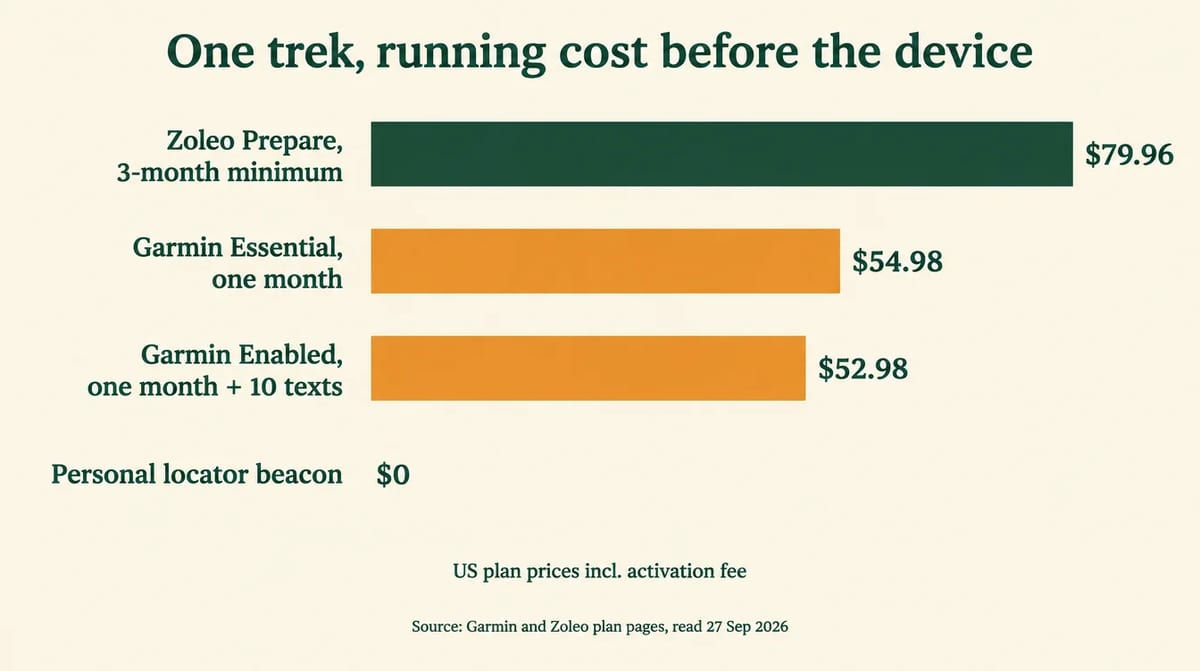
Garmin’s four plans differ mainly in messages. Enabled charges 50 cents per text, Essential includes 50, Standard 150 and Premium unlimited. Every plan includes SOS. You can suspend service at no cost for up to twelve months, and Garmin says SOS stays available during a suspension on some devices. Zoleo’s Prepare plan includes 50 messages and Protect is unlimited. SOS is included on both and never counts against your allowance. After the three-month minimum you can pause for $4.50 a month, but Zoleo says plainly that a paused device can’t send an SOS.
| Running cost for one trek | What you pay | Total before the device |
|---|---|---|
| Garmin Essential, one month | $39.99 activation + $14.99 | $54.98 |
| Garmin Enabled, one month, 10 texts | $39.99 + $7.99 + $5.00 | $52.98 |
| Zoleo Prepare, minimum term | $19.99 activation + 3 × $19.99 | $79.96 |
| Personal locator beacon | Free registration | $0 |
The totals are our own arithmetic on the published prices, before tax. Between trips the gap widens. A suspended Garmin costs nothing for up to twelve months at a time, while a paused Zoleo still costs $4.50 a month. That is why the inReach suits people who trek once a year. One catch: Garmin says some devices are cancelled automatically after twelve months in suspension, and then you pay a reactivation fee.
What happens when you press SOS
With a messenger, a staffed centre contacts local rescuers for you. With a beacon, the signal goes into the government search-and-rescue system. Garmin says its Response team keeps a global database of local first responders, contacts the right one, messages you during the emergency and updates your emergency contacts. It is also blunt about two limits: there’s “no specific timeline” for a rescue, and any rescue fees are charged to the person the SOS was for.
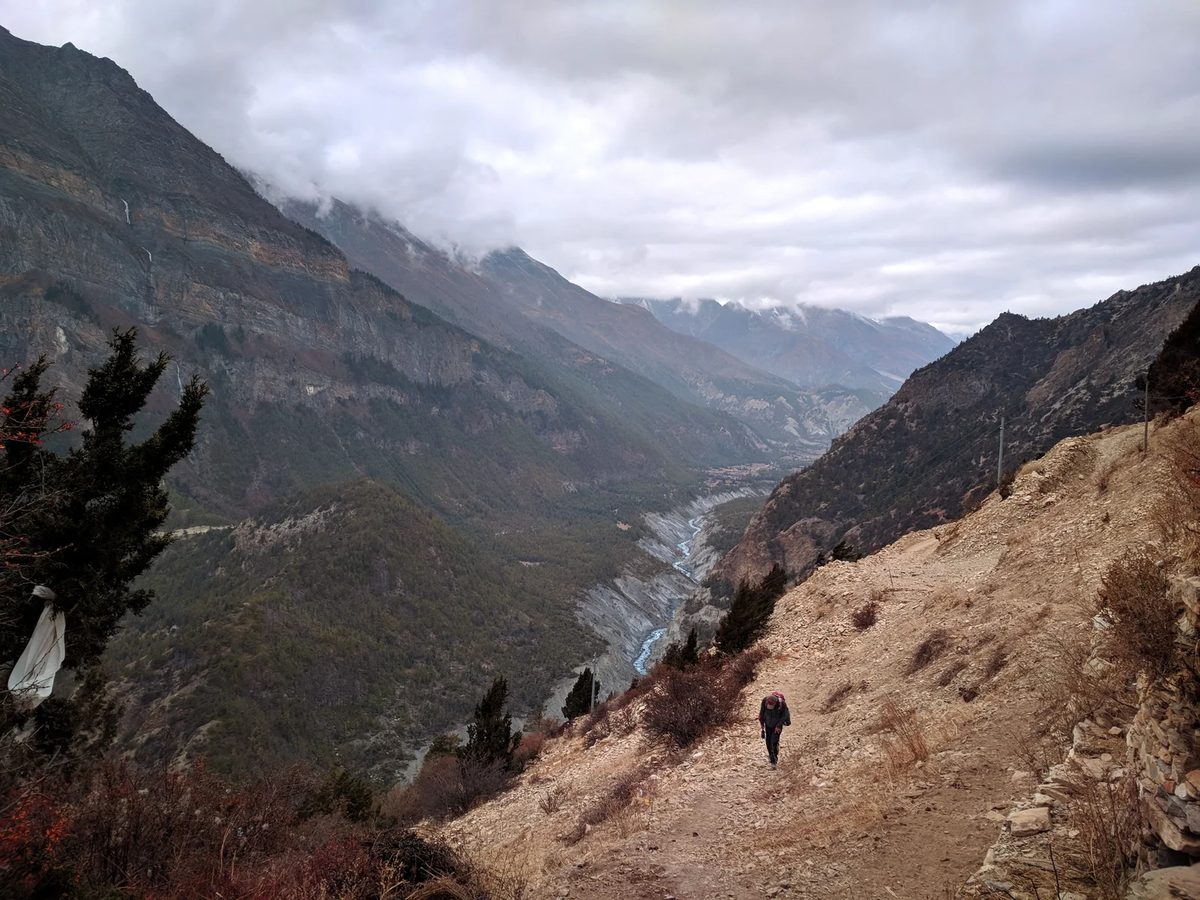
With a PLB, NOAA explains that the alert goes to a mission control centre and then to the right rescue authority, which can be another country’s point of contact. Registration speeds this up, because your details travel with the alert. It’s free, and you register in the country your beacon is coded for, which isn’t necessarily where you trek.
None of these devices pays for the rescue. In Nepal that means a helicopter, and what a helicopter rescue costs in Nepal is the number to plan around. The device and an insurance policy that covers rescue at your altitude are two halves of one plan. Buying only the device isn’t a plan.
Battery, cold and the Himalaya
All three last a normal trek on paper. Cold is what shortens that in practice. Garmin’s manual gives the inReach Mini 3 up to 350 hours at a 10-minute tracking interval, falling to 105 hours at two minutes. Zoleo claims over 200 hours. NOAA sets a PLB’s minimum at 24 hours of transmission once activated. That’s why a beacon sits switched off in your pack until the day you need it.
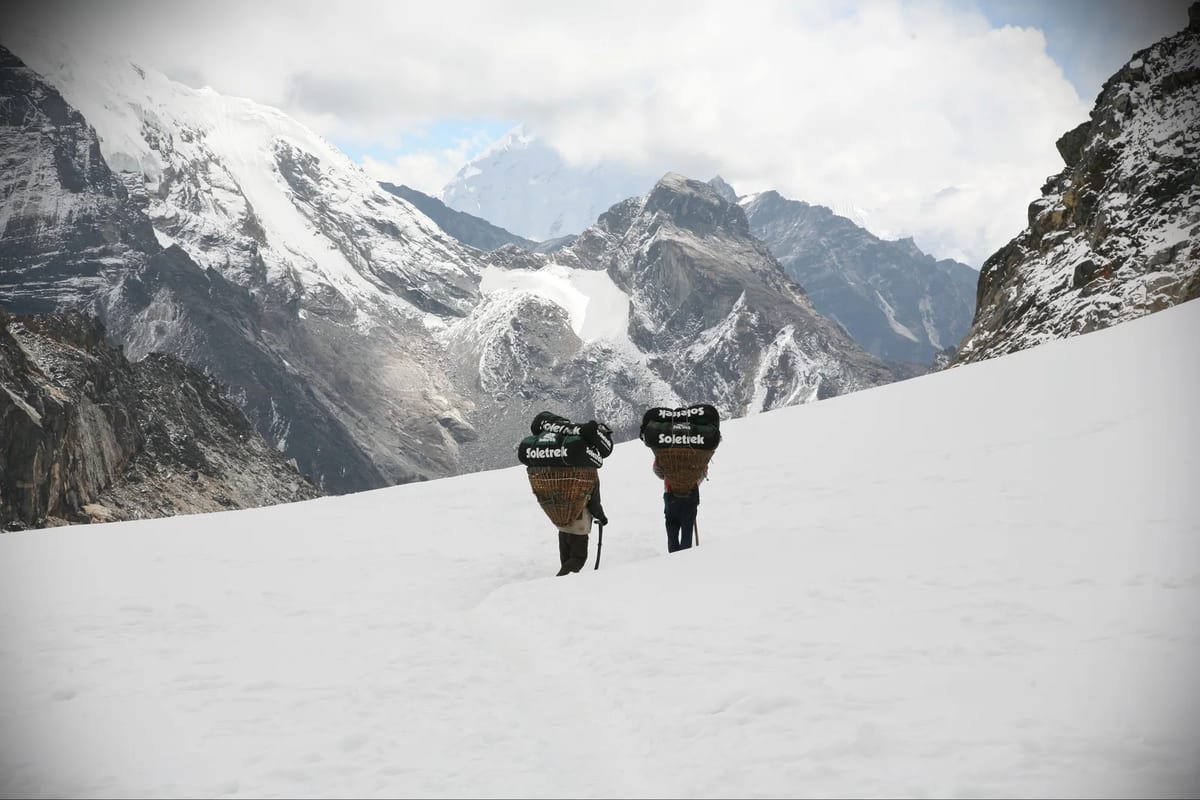
Charging is where trekkers get caught. Both Garmin’s Mini 2 manual and Zoleo’s spec sheet list a charging range that starts at 0°C. A dining-room socket at 4,500 metres may be colder than that before the stove is lit. Charge in the warm part of the evening, and keep the device in an inside pocket on the trail, as with your phone. Our travel tech hub covers power banks and cold batteries.
Is a satellite device legal in Nepal and on the way?
We couldn’t find an official Nepali rule that deals specifically with personal satellite messengers, so check with the Nepal Telecommunications Authority before you rely on one. What we could verify is broader. In May 2025, in a notice reported by Republica, the NTA said that using or distributing telecommunications services without government permission or an NTA licence is punishable. Garmin and Zoleo both warn that some jurisdictions restrict these devices and that knowing the local law is the user’s responsibility.
The rule that catches trekkers most often is India’s. It needs prior permission for two-way satellite devices, and many flights to Kathmandu connect through Delhi. Read the India transit rule for satellite messengers before you book a flight with an inReach or a Zoleo in your bag. And don’t expect your phone to fill the gap: phone satellite SOS isn’t offered in Nepal by Apple or Google.
The verdict, including who should buy nothing
Buy a beacon if you want a rescue button and no bill, a Garmin inReach if you trek once a year and want to talk to people, and a Zoleo if you’ll use it for more than three months. Buy nothing if you’re on a guided teahouse trek. On the main Everest, Annapurna and Langtang routes you pass villages with phone signal most days, and your guide is in touch with the office.
The people who should buy one are those heading somewhere remote without a guide, or anyone whose family genuinely needs to hear from them every evening. The question for them is whether they want to be heard or only found. A beacon gets you found; a messenger does both, for a monthly fee.
Tell us where you’re going and we’ll tell you where the signal stops and what communication your guide carries, so you can decide whether to buy anything at all. Annapurna Base Camp is nine days at $920 USD solo and Everest Base Camp is twelve days at $1,700 USD solo, including permits, a government-registered guide, a porter, teahouses and meals.
See the Annapurna Base Camp trek →Is a Garmin inReach or a personal locator beacon better for trekking?
A beacon is better if you only want an emergency button with no subscription. An inReach is better if you want to send and receive messages. Its plans cost $7.99 to $49.99 a month in the US, plus a $39.99 activation fee.
How much does a Zoleo plan cost?
On Zoleo’s US page on 27 September 2026, Prepare was $19.99 a month with 50 satellite messages and Protect $34.99 with unlimited messages, plus a $19.99 activation fee and a three-month minimum term.
Does a personal locator beacon need a subscription?
No. A PLB transmits on 406 MHz to the Cospas-Sarsat system with no service plan. You register it for free with the authority for the country it’s coded for.
Can I take a Garmin inReach to Nepal through India?
India requires prior permission for two-way satellite devices, and devices have been seized at customs without it. Route through the Gulf, Istanbul or Southeast Asia instead, or leave the device at home.
Do I need a satellite device for Everest Base Camp?
Usually not if you trek with a guide. The route passes villages with phone signal most days. A device earns its place on remote or unguided routes, and even then insurance that covers helicopter rescue matters more.
Keep reading
Data, power, wifi safety, maps and the device rules, in one place.
Why a Delhi connection can cost you the device.
The helicopter bill that no SOS button pays.
The altitude limit that voids most policies.
Sources: Garmin, inReach Consumer Plans page (US) and “Top questions: Triggering an SOS on an inReach device”, and the inReach Mini 3 and Mini 2 manuals; Zoleo, Monthly Plans page (US) and Satellite Communicator specifications; NOAA SARSAT, 406 MHz emergency beacons, FAQs and Cospas-Sarsat system overview, all read on 27 September 2026; Republica, 6 May 2025, on the Nepal Telecommunications Authority notice. The single-trek totals are our own arithmetic. No maker pays us for this page and it contains no affiliate links. Features and coverage change; check the maker’s own page before you rely on a device.
Photos via Pexels: Maël Balland (cover), Chandra, Jungsik Kwak.
Written by
Prakash TamangPokhara-based, NMA-certified trekking guides. We’ve led 5,000+ treks across the Annapurna and Everest regions since 1998 — every word here comes from the trail. More from this author →
Ready to Trek?
From reading about it to standing on it
Our Pokhara-based guides have been doing this since 1998. Tell us your dates and fitness level — we'll build your perfect itinerary. Free, no obligation.
More guides like this
Popular trips to consider
View all treks & toursFree Trekker’s Insider Guide
Permits, packing lists, cost breakdowns — no fluff.
We send one useful email. You can unsubscribe anytime.