
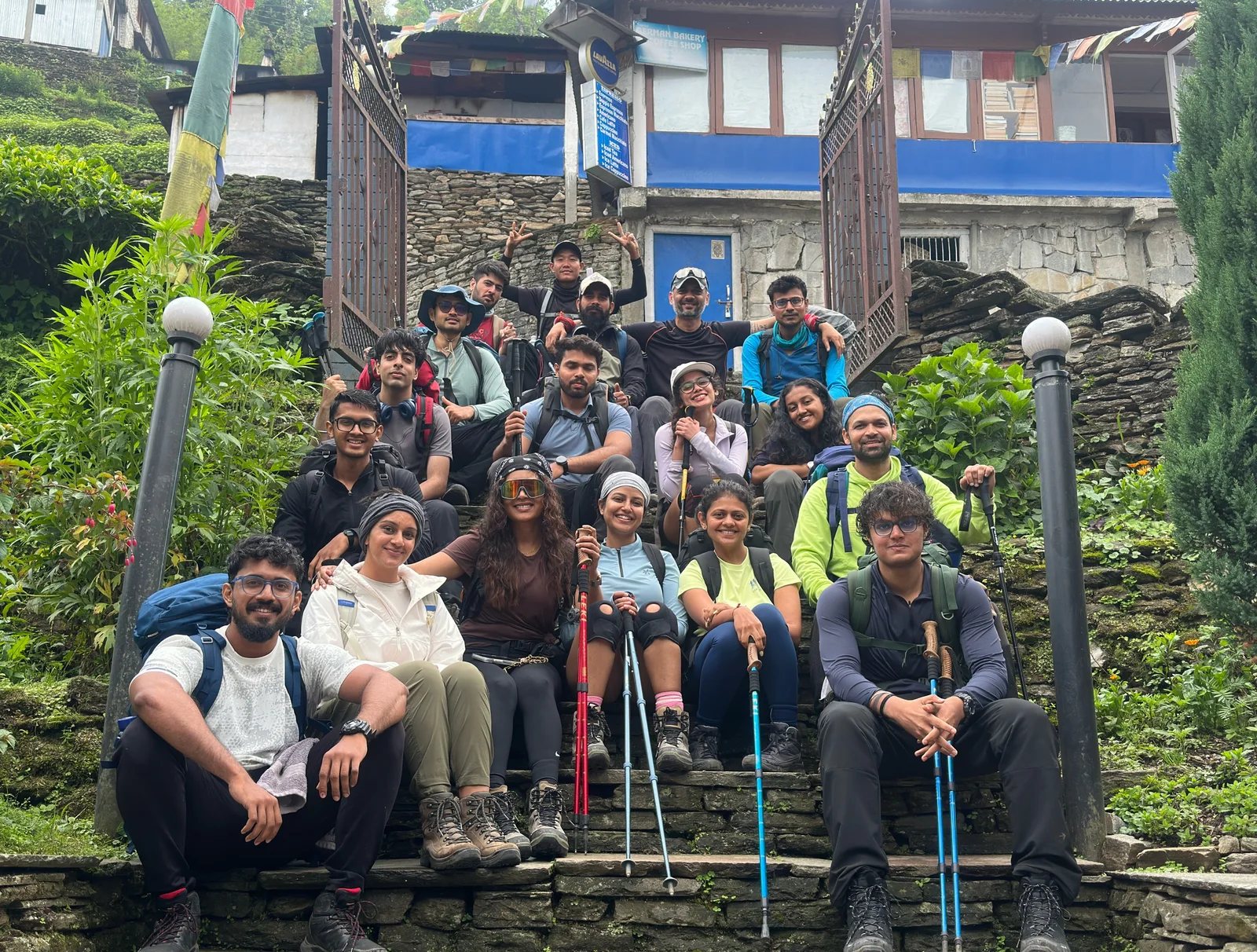
The short version
The complete Annapurna Base Camp (ABC) itinerary, day by day — from Nayapul to the 4,130m sanctuary beneath Annapurna I — with altitudes, walking hours, and flexible 7, 9, and 11-day versions.
- The classic 9-day Annapurna Base Camp route includes the famous Poon Hill sunrise; a 7-day version skips it and goes direct via Chhomrong.
- No flight needed — you drive from Pokhara, making ABC significantly cheaper than Everest Base Camp.
- Max altitude is a forgiving 4,130m, so acclimatisation is easier than EBC — but still ascend steadily above Chhomrong.
- The Ulleri stone staircase and the climb into the sanctuary are the hardest sections.
Into the sanctuary
The Annapurna Base Camp trek climbs into a natural amphitheatre ringed by peaks over 7,000m, ending at the 4,130m sanctuary directly beneath Annapurna I (8,091m). The most rewarding trek accessible to fit beginners.


The classic 9-day itinerary, day by day
This is the version most people mean by "ABC". It folds the Poon Hill sunrise into the walk in, which costs two days and is worth them: you get a wide Himalayan panorama early, while your legs are fresh and before the valley closes in around you.
Day 1 — Pokhara → Nayapul → Ulleri (2,050m) · 4–5 hrs
A 90-minute drive out of Pokhara drops you at the trailhead. The walking starts gently along the Modi Khola, through terraced fields and buffalo, and then you reach the Ulleri staircase — roughly 3,300 stone steps cut straight up the hillside. There is no technique to it. You simply climb, slowly, and it ends. Most people remember day one for those steps and nothing else.
Day 2 — Ulleri → Ghorepani (2,870m) · 6 hrs
The best forest day of the trek. The path climbs through old rhododendron woods, mossy and dim, with water running everywhere. In late March and April this forest is in full flower and genuinely worth planning around. You reach Ghorepani in the afternoon; it is cold once the sun drops behind the ridge, and every lodge has a stove in the dining room that everyone crowds around.
Day 3 — Poon Hill (3,210m) at dawn → Tadapani · 6 hrs
You leave in the dark, around 4:30am, for a 45-minute climb to the viewpoint. Dhaulagiri, Annapurna South and Machapuchare come up one after another as the light arrives. Be honest with yourself about the crowds — on a clear October morning there can be well over a hundred people on that hilltop. It is still worth doing. After breakfast you descend, then contour through forest to Tadapani, which is quiet by comparison.
Day 4 — Tadapani → Chhomrong (2,170m) · 5 hrs
A long descent through forest to Kimrong Khola, then the climb up to Chhomrong. This is the gateway village to the sanctuary and the last place with proper shops, bakeries and a hot shower worth paying for. Machapuchare stands directly above the village. Buy anything you have forgotten here; prices climb with the altitude from this point on.
Day 5 — Chhomrong → Dovan (2,600m) · 5–6 hrs
The day everyone underestimates. You lose several hundred metres straight down the Chhomrong stone steps to the river, then win it all back on the far side up to Sinuwa. After that the valley narrows and the trail settles into bamboo and rhododendron through Bamboo village to Dovan. The mountains disappear behind the walls of the gorge — this is the enclosed, green middle of the trek.
Day 6 — Dovan → Machhapuchhre Base Camp (3,700m) · 5 hrs
Through Himalaya Hotel and past the Hinku Cave, the treeline thins and then stops. You climb into open, rocky ground at Deurali and the valley finally opens ahead of you. This stretch between Deurali and MBC is the avalanche-prone section after heavy snow; in winter and early spring your guide may hold you at Deurali until it is safe to cross, and that judgement is exactly what you are paying for. MBC is cold, exposed, and the first place you feel the altitude.
Day 7 — MBC → Annapurna Base Camp (4,130m) → descend to Bamboo
The short, slow climb to ABC takes about two hours and you start before dawn to be there for sunrise. The sanctuary is a natural amphitheatre — a ring of peaks over 7,000m with Annapurna I, at 8,091m, directly above you. The light hits the summits first and works down. It is the reason people come.
Then you turn around and descend a long way, all the way to Bamboo, which is a hard afternoon on tired legs. Poles help here more than anywhere else on the trek.
Day 8 — Bamboo → Jhinu Danda (1,780m) · 5 hrs
Back down through the forest and the Chhomrong steps in reverse, finishing at Jhinu Danda. Twenty minutes below the village are natural hot springs beside the river. After seven days of walking, that soak is the single best-value part of the itinerary — build the time in rather than rushing past.
Day 9 — Jhinu → Nayapul → Pokhara · 4 hrs
An easy morning's walk out along the river to the road, then the drive back to Pokhara. Most people are at Lakeside in time for a late lunch.
The 7-day version — what you give up
The 7-day ABC drives higher and goes in directly via Chhomrong, skipping Ghorepani and Poon Hill entirely.
You lose the panoramic sunrise and the rhododendron forest. You keep the sanctuary itself, which is the part nobody should skip. If your holiday is short, this is the right trade — a week that reaches base camp beats ten days that never gets there.
| Day | Route | Sleep at |
|---|---|---|
| 1 | Pokhara → Siwai, trek to Chhomrong | Chhomrong (2,170m) |
| 2 | Chhomrong → Dovan | Dovan (2,600m) |
| 3 | Dovan → Deurali → MBC | MBC (3,700m) |
| 4 | MBC → ABC at sunrise, descend to Bamboo | Bamboo (2,310m) |
| 5 | Bamboo → Jhinu Danda, hot springs | Jhinu (1,780m) |
| 6 | Jhinu → Ghandruk | Ghandruk (1,940m) |
| 7 | Ghandruk → Pokhara | — |
The 11-day version — and who it is actually for
The 11-day is not the 9-day walked slowly. It adds two things worth having: a night in Ghandruk, the Gurung stone village with Annapurna South standing over it, and a spare day held in reserve.
That spare day is the point. Snow closes the Deurali–MBC section, a lodge fills, someone in the group has a bad night at altitude — with a buffer day you absorb it and still reach base camp. Without one you turn around. If you have flown a long way for this and only get one attempt, the extra day is the cheapest insurance on the whole trip.
Under a week in Nepal: take the 7-day. Two weeks and you want the full experience: take the 9-day. Coming from far away with fixed flights, or trekking in December–March when snow is a real possibility: take the 11-day and use the buffer.
The natural hot springs at Jhinu Danda on the descent are the perfect reward for tired legs — build in time to soak.
The natural hot springs at Jhinu Danda on the descent are the perfect reward for tired legs — build in time to soak.
Difficulty & permits
Graded moderate, max 4,130m. The Ulleri steps and the climb into the sanctuary are hardest; acclimatisation is easier than EBC. You need the ACAP and a TIMS card. Best seasons: October–November and March–April.
Plan it properly
See the full Annapurna Base Camp trek guide, the cost breakdown, and the packing list. Ready? Tell us your dates — we're based 45 minutes from the trailhead in Pokhara.
What is the hardest day on the Annapurna Base Camp trek?
Two compete. Day 1's Ulleri staircase — roughly 3,300 stone steps — is the hardest on the way up for most people. But the descent from Annapurna Base Camp all the way down to Bamboo on day 7 is longer and harder on the knees, and it comes when you are already tired. Trekking poles matter more on that day than any other.
Can you do the Annapurna Base Camp trek in 7 days?
Yes. The 7-day version drives higher and goes in directly via Chhomrong, skipping the Ghorepani and Poon Hill loop. You still reach the 4,130m sanctuary. You give up the Poon Hill sunrise and the rhododendron forest, which is a fair trade if your time in Nepal is short.
Is the Annapurna Base Camp trek dangerous?
Not technically — it is a walking trail the whole way, with no ropes or equipment. The two real risks are altitude, which is mild here compared with Everest at 4,130m, and avalanche on the enclosed stretch between Deurali and Machhapuchhre Base Camp after heavy snowfall. In winter and early spring a guide may hold the group at Deurali until that section is safe to cross.
How hard is the Annapurna Base Camp trek?
ABC is graded moderate and non-technical, reaching 4,130m. The hardest parts are the Ulleri stone staircase and the climb into the sanctuary. Fit beginners who train for a few weeks complete it comfortably.
Do you need to fly for ABC?
No — the Annapurna Base Camp trek starts and ends from Pokhara (a 1–1.5 hour drive to the trailhead at Nayapul), so no internal flight is required. This makes it cheaper and more flexible than Everest Base Camp.
Private Annapurna departures on any date, hand-picked NMA guides, and 25+ years on these trails. Tell us your dates — we usually reply within a few hours.
Browse Annapurna treks & tours → Read the Annapurna guide →
Written by
Travel Himalaya NepalPokhara-based, NMA-certified trekking guides. We’ve led 5,000+ treks across the Annapurna and Everest regions since 1998 — every word here comes from the trail. More from this author →
Share this article
Ready to Trek?
From reading about it to standing on it
Our Pokhara-based guides have been doing this since 1998. Tell us your dates and fitness level — we'll build your perfect itinerary. Free, no obligation.
Why trek with our licensed agencyMore guides like this
Popular trips to consider
Free Trekker's Insider Guide
Permits, packing lists, cost breakdowns — no fluff.
We send one useful email. You can unsubscribe anytime.