
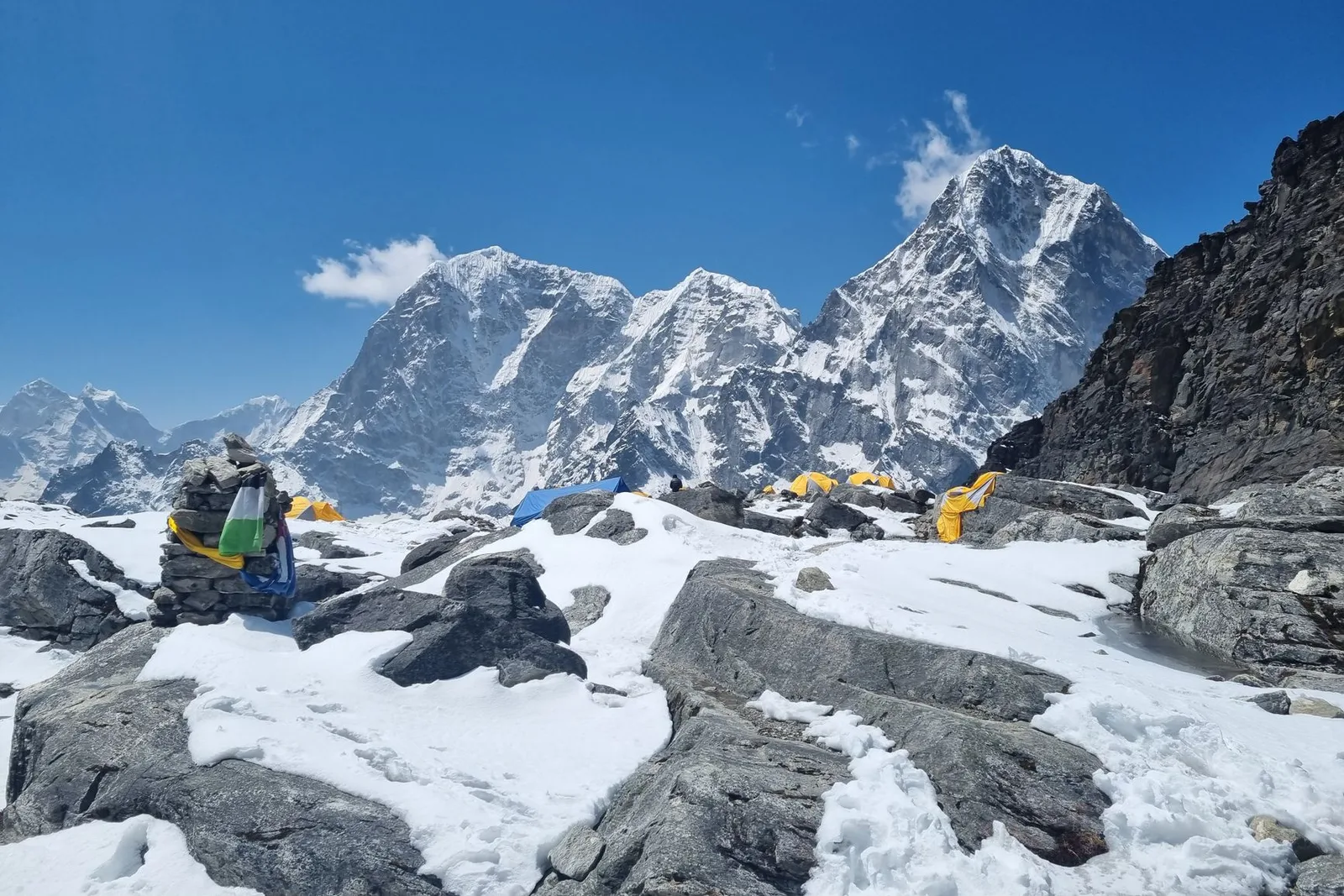
The short version
All 14 eight-thousanders ranked by height — with range, country, first ascent, first winter ascent and death rate. Plus how to trek beneath 8 of them.
There are exactly fourteen mountains on Earth that rise above 8,000 metres (26,247 ft) — a rarefied band of altitude climbers call the "death zone," where there is roughly a third of the oxygen available at sea level and the human body slowly shuts down. All fourteen stand in just two mountain ranges, the Himalaya and the Karakoram, strung across the borders of Nepal, China (Tibet), Pakistan and India. Together they are known as the eight-thousanders, and reaching the top of one is among the most serious undertakings in all of mountaineering.
This is the complete reference: every 8,000-metre peak ranked by height, with its range, country, first ascent, first winter ascent and approximate death rate. Bookmark it. Then read the part most travellers do not realise — you can walk to the base of eight of these giants without any climbing at all, and we will show you exactly how at the end.
The 14 Eight-Thousanders: full comparison table
Ranked tallest to shortest. Heights are the internationally accepted figures; death rates are approximate historical records (deaths relative to summits/attempts) and vary by source and methodology — they are falling as weather forecasting, fixed ropes and logistics improve.
| # | Peak | Height | Range | Country | First ascent | First winter ascent | Death rate* |
|---|---|---|---|---|---|---|---|
| 1 | Mount Everest (Sagarmatha / Chomolungma) | 8,849 m / 29,032 ft | Himalaya | Nepal & China | 1953 — Edmund Hillary & Tenzing Norgay | 1980 — Cichy & Wielicki (Poland) | ~4% |
| 2 | K2 (Chhogori) | 8,611 m / 28,251 ft | Karakoram | Pakistan & China | 1954 — Compagnoni & Lacedelli (Italy) | 2021 — 10-member Nepali team | ~13% |
| 3 | Kangchenjunga | 8,586 m / 28,169 ft | Himalaya | Nepal & India | 1955 — Band & Brown (UK) | 1986 — Wielicki & Kukuczka (Poland) | ~15% |
| 4 | Lhotse | 8,516 m / 27,940 ft | Himalaya | Nepal & China | 1956 — Luchsinger & Reiss (Switzerland) | 1988 — Krzysztof Wielicki (Poland) | ~3% |
| 5 | Makalu | 8,485 m / 27,838 ft | Himalaya | Nepal & China | 1955 — Couzy & Terray (France) | 2009 — Moro & Urubko | ~8% |
| 6 | Cho Oyu | 8,188 m / 26,864 ft | Himalaya | Nepal & China | 1954 — Tichy, Jöchler & Pasang Dawa Lama | 1985 — Berbeka & Pawlikowski (Poland) | ~1.4% |
| 7 | Dhaulagiri I | 8,167 m / 26,795 ft | Himalaya | Nepal | 1960 — Swiss/Austrian team (Diemberger et al.) | 1985 — Czok & Kukuczka (Poland) | ~15% |
| 8 | Manaslu | 8,163 m / 26,781 ft | Himalaya | Nepal | 1956 — Imanishi & Gyalzen Norbu (Japan) | 1984 — Berbeka & Gajewski (Poland) | ~10% |
| 9 | Nanga Parbat | 8,126 m / 26,660 ft | Himalaya (western anchor) | Pakistan | 1953 — Hermann Buhl (Austria), solo | 2016 — Sadpara, Moro & Txikon | ~20% |
| 10 | Annapurna I | 8,091 m / 26,545 ft | Himalaya | Nepal | 1950 — Herzog & Lachenal (France) | 1987 — Kukuczka & Hajzer (Poland) | ~32% |
| 11 | Gasherbrum I (Hidden Peak) | 8,080 m / 26,509 ft | Karakoram | Pakistan & China | 1958 — Kauffman & Schoening (USA) | 2012 — Bielecki & Gołąb (Poland) | ~9% |
| 12 | Broad Peak | 8,051 m / 26,414 ft | Karakoram | Pakistan & China | 1957 — Austrian team (Buhl, Diemberger et al.) | 2013 — Polish team | ~5% |
| 13 | Gasherbrum II | 8,034 m / 26,358 ft | Karakoram | Pakistan & China | 1956 — Moravec, Larch & Willenpart (Austria) | 2011 — Moro, Urubko & Richards | ~2.3% |
| 14 | Shishapangma | 8,027 m / 26,335 ft | Himalaya | China (Tibet) | 1964 — Xu Jing & Chinese team | 2005 — Morawski & Moro | ~8% |
*Death rate is an approximate historical figure (deaths as a share of summits/attempts, as recorded by mountaineering databases). Sources differ; treat these as orders of magnitude, not precise statistics.
What counts as an eight-thousander?
The definition is simple and strict: an independent summit whose true elevation exceeds 8,000 metres above sea level. Fourteen mountains qualify. Everything else — however famous, from the Matterhorn to Denali — falls short. Two features unite the fourteen:
- They cluster in one small part of the planet. Ten stand in the Himalaya and four in the Karakoram, all within a few hundred kilometres of one another across the Nepal–Tibet–Pakistan frontier.
- They all pierce the "death zone." Above roughly 8,000 m the air holds about a third of the oxygen at sea level. The body cannot acclimatise or recover; it deteriorates by the hour. Time spent there is measured in careful minutes, not days.
Nepal is the undisputed heartland of the eight-thousanders. Eight of the fourteen lie in or on Nepal's borders — Everest, Kangchenjunga, Lhotse, Makalu, Cho Oyu, Dhaulagiri, Manaslu and Annapurna — which is why Kathmandu, not any European capital, has been the launch pad for high-altitude mountaineering for seventy years. For the wider context, see our roundup of Nepal Himalaya facts and the most beautiful mountains in the world.
The Nepal giants: eight-thousanders 1–10 (and where they hide)
Everest (8,849 m) — the highest point on Earth
The roof of the world, straddling the Nepal–Tibet border. First climbed in 1953 by Edmund Hillary of New Zealand and Tenzing Norgay Sherpa via the South Col from Nepal. Everest's death rate — around 4% — is far lower than its fearsome reputation suggests, precisely because it is the most heavily supported and best-understood 8,000er on the planet. Its base camp is the single most popular high-altitude trek in the world.
Kangchenjunga (8,586 m) — the third-highest, and the most remote
The world's third-highest mountain sits on the Nepal–India border in the far east, wrapped in local reverence — the 1955 British first-ascent team stopped a few feet short of the true summit out of respect for the deity believed to dwell there, a tradition many climbers still honour. Its remoteness keeps crowds away and its death rate high, near 15%.
Lhotse (8,516 m) & Makalu (8,485 m) — Everest's neighbours
Lhotse, the fourth-highest, shares the Western Cwm and much of its route with Everest, which is why it has one of the lower death rates among the giants. Makalu, the fifth-highest, is a strikingly isolated four-sided pyramid a short distance east — beautiful, technical and far quieter.
Cho Oyu (8,188 m) — the "easiest" of the fourteen
The sixth-highest is widely regarded as the most accessible 8,000er, with the lowest death rate of all (around 1.4%). Its gentler slopes make it the traditional first eight-thousander for climbers building towards Everest.
Dhaulagiri I (8,167 m) & Annapurna I (8,091 m) — the two ends of one valley
These two rise on opposite sides of the Kali Gandaki, the deepest gorge on Earth. Dhaulagiri, the seventh-highest, was the last of the fourteen to receive a route survey. Annapurna I holds a double distinction: in 1950 it became the very first eight-thousander ever climbed, by Frenchmen Maurice Herzog and Louis Lachenal — and today it carries the highest death rate of any 8,000er, around 32%, its south face swept by unpredictable avalanches.
Manaslu (8,163 m) — the "mountain of the spirit"
The eighth-highest, in west-central Nepal, was first climbed by a Japanese expedition in 1956 and remains closely tied to Japanese mountaineering. It is one of the more attainable 8,000ers for commercial expeditions, though its snow slopes carry serious avalanche risk. The trail that circles its base is one of the finest treks on the planet.
Shishapangma (8,027 m) — the fourteenth, entirely in Tibet
The shortest of the fourteen and the only one that lies completely inside China (Tibet). That is exactly why it was the last to be first-climbed — not until 1964, once China opened the region — giving it the honour of completing the set.
The Karakoram four: harder, colder, deadlier
Four eight-thousanders stand not in the Himalaya but in the Karakoram, in the disputed high country of northern Pakistan. As a group they are more technical, more weather-beaten and considerably more dangerous than their Nepali cousins.
K2 (8,611 m) — the Savage Mountain
The second-highest peak on Earth and, by grim consensus, the hardest and most lethal of the fourteen to climb. Steeper and more sustained than Everest with no easy line to the top, K2 was not summited in winter until January 2021, when a ten-member all-Nepali team made the first winter ascent — the last of the fourteen to fall in winter, and a landmark moment for Nepali mountaineering.
The Gasherbrums (I: 8,080 m, II: 8,034 m) & Broad Peak (8,051 m)
Gasherbrum I (Hidden Peak) and Gasherbrum II are neighbouring giants; Gasherbrum II, with a death rate near 2%, is among the "safer" 8,000ers, while Broad Peak sits between them on the same glacier. All three demand a long, committing approach through the Baltoro region and remote high-camp logistics.
Nanga Parbat (8,126 m) — the Killer Mountain
Technically the western anchor of the Himalaya rather than the Karakoram, Nanga Parbat is Pakistan's other 8,000er and one of the deadliest, with a death rate around 20%. It was first climbed in 1953 by Hermann Buhl in an astonishing solo push over the final stretch, and was the second-to-last of the fourteen to be climbed in winter (2016).
The "14 Peaks" club: climbing all of them
Summiting even one eight-thousander is a career achievement. Climbing all fourteen is one of mountaineering's ultimate quests, completed by only a few dozen people in history. The milestones:
- Reinhold Messner (Italy), 1986 — the first person to climb all fourteen 8,000ers, finishing on Lhotse, and famously doing every one of them without supplemental oxygen.
- Jerzy Kukuczka (Poland), 1987 — the second to complete the set, only a year behind Messner, largely by new routes and winter ascents.
- Nirmal "Nims" Purja (Nepal), 2019 — "Project Possible" compressed all fourteen summits into six months and six days, obliterating a previous record that had stood at nearly eight years and bringing Nepali high-altitude climbing to a global audience.
- Kristin Harila (Norway) & Tenjen "Lama" Sherpa (Nepal), 2023 — halved even that mark, topping out on the last peak in 92 days (three months and one day).
Every one of these records leaned heavily on the skill of Nepali and Sherpa climbers — the same mountain culture whose guides make the safe, walking version of the Himalaya possible for the rest of us.
A word on the death rates
The figures in the table are sobering, and they are real. Behind Annapurna's ~32% and K2's fearsome record are people who did not come home. But two things are worth understanding. First, these are cumulative historical rates, weighted by decades when there were no reliable forecasts, no fixed ropes and no rescue helicopters — modern seasons are far safer than the lifetime averages suggest. Second, and most importantly for the vast majority of visitors: none of this danger applies to trekking. The risks of the death zone belong to a few hundred elite mountaineers a year. Millions more simply walk the valleys beneath — which brings us to the point.
You can trek beneath 8 of them — no climbing required
Here is what most people never realise. Standing on the summit of an 8,000er is elite, oxygen-starved mountaineering. Standing at its base is a guided walk. Nepal is laced with well-worn trekking trails that carry ordinary travellers — with no ropes, no ice-axe skills and no climbing experience — right up beneath these giants, sleeping in warm teahouses and eating hot meals along the way. Of the eight eight-thousanders on Nepal's borders, you can trek to the foot of the most spectacular of them:
- Everest (8,849 m) — the Everest Base Camp Trek (14 days) walks you to 5,364 m at the foot of the highest mountain on Earth. From $1,850 per person as a solo traveller, dropping to $1,350 in a group of eight or more. Plan it with our Everest Base Camp trek guide and Everest region guide.
- Annapurna I (8,091 m) — the Annapurna Base Camp Trek (6 days) drops you into a natural amphitheatre ringed by 7,000 m and 8,000 m walls. From $695 per person solo, from $505 in a group of eight-plus. See the Annapurna region guide.
- Manaslu (8,163 m) — the Manaslu Circuit Trek (16 days) loops the eighth-highest mountain in the world over the 5,106 m Larke Pass. From $2,450 per person solo, from $1,750 in a group of eight-plus. Details in our Manaslu Circuit trek guide and Manaslu region guide.
- Kangchenjunga & Makalu — dedicated base-camp treks reach the feet of the third- and fifth-highest peaks on Earth through Nepal's wildest, least-crowded country, for travellers who want the giants without the crowds.
If you want to go one step higher without becoming a full-blown 8,000er mountaineer, Nepal's trekking peaks are the bridge — real snow-and-ice summits climbed with a guide, ropes and basic training but no death-zone commitment. The Island Peak climb (18 days, 6,189 m) from $3,600 per person solo and the Mera Peak climb (15 days, 6,476 m) from $2,500 per person solo let you stand on a Himalayan summit and look across at the eight-thousanders themselves.
Every one of these trips runs with government-licensed Nepali guides, careful acclimatisation and a safety margin the summit climbers never get. For the paperwork, see our Nepal trekking permits guide and Nepal visa guide; for inspiration, our picks of the best treks in the world and the best places to visit in Nepal.
Frequently asked questions
How many 8,000-metre peaks are there in the world?
Exactly fourteen. These are the only mountains on Earth that rise above 8,000 metres (26,247 ft), and they all lie in the Himalaya and Karakoram ranges of Asia. The tallest is Mount Everest (8,849 m) and the shortest is Shishapangma (8,027 m).
How many of the eight-thousanders are in Nepal?
Eight of the fourteen lie in or on Nepal's borders: Everest, Kangchenjunga, Lhotse, Makalu, Cho Oyu, Dhaulagiri, Manaslu and Annapurna. Three (Dhaulagiri, Manaslu and Annapurna) are entirely within Nepal; the others are shared with Tibet or India. This is why Nepal is the historic centre of high-altitude mountaineering.
Which is the deadliest eight-thousander?
By historical death rate, Annapurna I is the deadliest, with roughly one death for every three summits (~32%). K2 is widely considered the hardest and most dangerous to climb technically, and Nanga Parbat (the "Killer Mountain") also has a very high fatality rate near 20%. These figures are cumulative historical averages and are lower in modern, well-supported seasons.
Can tourists trek to the base camps of the 8,000-metre peaks?
Yes. While summiting an eight-thousander is elite mountaineering, trekking to the base of one is a guided walk that requires no climbing skills. Everyday travellers regularly trek to Everest Base Camp (5,364 m), Annapurna Base Camp, and around Manaslu, Kangchenjunga and Makalu, sleeping in teahouses along the way. With a licensed guide and proper acclimatisation these treks are safe and suitable for reasonably fit first-timers.
Who was the first person to climb all 14 eight-thousanders?
Reinhold Messner of Italy, who completed the set in 1986 and did so entirely without supplemental oxygen. Poland's Jerzy Kukuczka became the second a year later. In 2019 Nepal's Nirmal "Nims" Purja climbed all fourteen in just six months and six days, a record later lowered to 92 days by Kristin Harila and Tenjen Sherpa in 2023.
Stand beneath a giant
You do not need to enter the death zone to feel the scale of these mountains — you need a good pair of boots, a couple of weeks, and a guide who has walked the trail a hundred times. Browse our Himalayan base-camp treks, or tell us which of the eight-thousanders you want to stand beneath and we will build the trip around it.
Written by
Travel Himalaya NepalPokhara-based, NMA-certified trekking guides. We’ve led 5,000+ treks across the Annapurna and Everest regions since 1998 — every word here comes from the trail. More from this author →
Share this article
Ready to Trek?
From reading about it to standing on it
Our Pokhara-based guides have been doing this since 1998. Tell us your dates and fitness level — we'll build your perfect itinerary. Free, no obligation.
Why trek with our licensed agencyMore guides like this
Popular trips to consider
View all treks & toursFree Trekker's Insider Guide
Permits, packing lists, cost breakdowns — no fluff.
We send one useful email. You can unsubscribe anytime.