
The short version
From a one-hour Norwegian plunge to a seven-day Siberian marathon, here are twelve of the most spectacular train journeys on earth to ride in 2026 — routes, distances, altitudes and when to go, with an honest comparison table and a Himalayan twist.
We run treks in the Nepal Himalaya, so we spend our working lives helping people cross mountains on foot. But we also know the other great way to see a landscape: pressed against a train window while the world scrolls past, close enough to read a river and far enough to keep your boots dry. A truly great railway does something a plane never can — it shows you the ground between two places, the slow accumulation of a country. So we polled our guides, our most-travelled clients and our own memories, and built the list below: twelve of the most spectacular train journeys on earth to ride in 2026, from a one-hour Norwegian plunge to a seven-day Siberian marathon.
We have kept every figure honest and checked it against the operators and railway records — routes, distances, altitudes, running times. Two of these lines climb straight into the Himalaya, which is where our own story starts, so near the end you will find an unashamed nudge toward trading the window for the trail. But first, the world's greatest rides.
The 12 journeys at a glance
| Journey | Country | Route | Distance | Typical duration | Best time |
|---|---|---|---|---|---|
| Glacier Express | Switzerland | Zermatt ↔ St. Moritz | 291 km | ~8 hours | Year-round; snow Dec–Feb |
| Bernina Express | Switzerland–Italy | Chur/St. Moritz ↔ Tirano | 144 km | ~4 hours | Year-round |
| Trans-Siberian Railway | Russia | Moscow ↔ Vladivostok | 9,289 km | ~7 days | Summer, Jun–Sep |
| Qinghai–Tibet Railway | China / Tibet | Xining ↔ Lhasa | 1,956 km | ~21 hours | Apr–Oct |
| Flåm Railway | Norway | Myrdal ↔ Flåm | 20 km | ~1 hour | May–Sep peak |
| Jacobite Steam Train | Scotland | Fort William ↔ Mallaig | 66 km each way | ~2 hours each way | Late Apr–Oct |
| Darjeeling Himalayan Railway | India | New Jalpaiguri ↔ Darjeeling | 88 km full line | 2-hr joy ride / ~7 hrs full | Oct–Nov, Mar–May |
| Belmond Andean Explorer | Peru | Cusco – Puno – Arequipa | Multi-day | 1–2 nights | Dry season May–Oct |
| Sunrise Izumo / Seto | Japan | Tokyo ↔ Izumoshi / Takamatsu | Overnight | ~12 hours | Year-round, nightly |
| The Ghan | Australia | Adelaide ↔ Darwin | 2,979 km | 3 days / 2 nights | Apr–Oct dry season |
| Rocky Mountaineer | Canada | Vancouver ↔ Banff / Jasper | Multi-day | 2 days, daylight only | Late Apr–mid Oct |
| Bergen Railway | Norway | Oslo ↔ Bergen | 496 km | ~6.5–7.5 hours | Year-round |
1. Glacier Express — the slowest express in the world, Switzerland
Marketed with a wink as "the slowest express train in the world," the Glacier Express links two of the Alps' grandest resorts, Zermatt and St. Moritz, in a single unforgettable day. Over roughly eight hours it covers 291 kilometres, crosses 291 bridges, threads 91 tunnels, and climbs to the 2,033-metre Oberalp Pass, all on metre-gauge track that uses rack-and-pinion sections to grip the steepest gradients. Panoramic glass roofs turn the whole carriage into a viewing gallery as it winds beneath the Matterhorn, through the Rhine Gorge — Switzerland's own "Grand Canyon" — and across the spidery Landwasser Viaduct. It runs year-round; ride it under fresh snow in deep winter and it becomes something close to a fairy tale.
2. Bernina Express — a UNESCO crossing of the Alps
The little red Bernina Express is short at just 144 kilometres, but few four-hour rides pack more in. Running from Chur or St. Moritz down to Tirano in Italy, it climbs to 2,253 metres at Ospizio Bernina, the highest point, with no rack assistance at all — an astonishing feat of adhesion railway engineering on gradients as steep as 1 in 14. The line, part of the Rhaetian Railway, was inscribed as a UNESCO World Heritage Site in 2008, and you understand why as the train spirals down the open-air Brusio circular viaduct and drops from glaciers to Italian palm trees in a single afternoon. Pair it with the Glacier Express for the ultimate Alpine double.
3. Trans-Siberian Railway — the longest of them all, Russia
No list of great railways is complete without the giant. The Trans-Siberian runs 9,289 kilometres from Moscow to Vladivostok, the longest continuous rail line on the planet, crossing seven time zones in roughly seven days of near-continuous travel. This is less a scenic ride than a meditation on distance: birch forest, the vast blue eye of Lake Baikal, wooden villages and the slow realisation of just how large a country can be. Most travellers break the journey into stages, or branch south onto the Trans-Mongolian toward Beijing. An honest note for 2026: several governments currently advise against non-essential travel to Russia, so check your own country's advisories before committing.
4. Qinghai–Tibet Railway — the highest railway on earth, China
If the Trans-Siberian is the longest, this is the highest. The Qinghai–Tibet Railway climbs 1,956 kilometres from Xining to Lhasa, cresting the Tanggula Pass at 5,072 metres — the highest point on any railway in the world — and passing the highest railway station ever built, Tanggula at 5,068 metres. Carriages are pressurised and supplied with supplemental oxygen because so much of the line sits above 4,000 metres, much of it laid across permafrost on elevated beds. The roughly 21-hour run delivers the Tibetan Plateau at eye level: yak herds, frozen lakes, snow peaks and prayer flags. It is also the mechanical cousin of the trek we know best — the same thin Himalayan air, met from a seat rather than on foot. Tibet travel requires special permits arranged in advance, so plan early.
5. Flåm Railway — Norway's vertical marvel
The shortest journey here is also one of the most dramatic. In just 20 kilometres and about an hour, the Flåm Railway drops 866 metres between the mountain junction of Myrdal and the fjord village of Flåm, making it one of the steepest standard-gauge railways in the world. Nearly 80 percent of the line runs at a punishing gradient, spiralling through hand-cut tunnels past thundering waterfalls — the train even pauses at the Kjosfossen falls so passengers can step out and feel the spray. It is the perfect appetiser to a Norwegian fjord tour and connects directly to our next entry, the Bergen Railway, at Myrdal.
6. Jacobite Steam Train — the Hogwarts run, Scotland
Better known to a generation of film-goers as the "Hogwarts Express," the Jacobite is a genuine steam-hauled service on the West Highland Line between Fort William and Mallaig. The 66-kilometre run each way — a full-day round trip — passes lochs, moors and the shoulder of Ben Nevis, Britain's highest peak, before the showpiece: the Glenfinnan Viaduct, a graceful 21-arch curve of mass concrete completed in 1901, sweeping above Loch Shiel. It runs from late April into October and sells out fast, so book the moment tickets open. Few railways this modest feel this cinematic.
7. Darjeeling Himalayan Railway — the original "toy train," India
Now the mountains get personal. The Darjeeling Himalayan Railway, affectionately the "toy train," has climbed the foothills of the eastern Himalaya on tiny 2-foot gauge track since 1881, and was named a UNESCO World Heritage Site in 1999. The full line runs 88 kilometres from New Jalpaiguri up to Darjeeling, gaining altitude through six zig-zags and five loops, including the famous Batasia Loop with its Kanchenjunga views. Most visitors ride the two-hour joy ride from Darjeeling up to Ghum, at 2,258 metres the highest railway station in India. From Darjeeling's ridgelines you look straight into Nepal and the wall of the Himalaya — the very range our treks explore. It is the closest a train comes to the world we work in, and a natural first taste of it.
8. Belmond Andean Explorer — South America's first luxury sleeper, Peru
Launched in 2017, the Belmond Andean Explorer was South America's first luxury sleeper train, and it wanders one of the highest rail routes on earth. Over one or two nights it links Cusco, Lake Titicaca at Puno, and Arequipa, climbing to around 4,800 metres on the Altiplano before descending to the shores of the world's highest navigable lake. En-suite cabins, a spa car and an open-air observation deck make the altitude feel like a privilege rather than a hardship. For anyone drawn to high, thin-aired landscapes — the same pull that sends people to the Himalaya — this is the Andes at their most refined.
9. Sunrise Izumo / Seto — Japan's last sleeper
Japan runs the fastest trains in the world, yet its most romantic is the slowest survivor: the Sunrise Izumo and Sunrise Seto, the country's only regularly scheduled overnight sleeper. Departing Tokyo after the last bullet train, the coupled 14-car service runs through the night and splits at Okayama — one half bound for Izumoshi (around 12 hours), the other for Takamatsu across the Seto Inland Sea. Choose a private cabin or the budget "nobinobi" carpeted berth, watch the neon give way to dawn over rice paddies, and arrive rested. It is a nightly ritual of old Japan running quietly beneath the Shinkansen age.
10. The Ghan — across the Red Centre, Australia
Named for the Afghan cameleers who once crossed this country, The Ghan is a transcontinental epic: 2,979 kilometres from Adelaide to Darwin over three days and two nights, straight up the spine of the continent through the Red Centre. It pauses at Alice Springs and Katherine for off-train excursions — desert gorges, Aboriginal culture, star-scattered outback skies — while the carriages deliver fine dining and cabins between stops. There is a profound stillness to watching an entire continent's empty heart roll by, unbroken, for days.
11. Rocky Mountaineer — daylight through the Canadian Rockies
The Rocky Mountaineer is built on a single clever principle: it only runs in daylight, so you never sleep through the scenery. Its glass-dome coaches carry passengers between Vancouver and the mountain resorts of Banff, Lake Louise and Jasper, with an overnight hotel stop roughly halfway. Across two days you pass Hell's Gate on the Fraser River, the spiral tunnels near Kicking Horse Pass, and the sheer face of Mount Robson, the Rockies' highest peak. It runs from late April to mid-October, and the GoldLeaf dome, with its outdoor viewing platform, is worth the splurge.
12. Bergen Railway — Northern Europe's highest mainline, Norway
We close back in Norway, on the line the Flåm Railway feeds into. The Bergen Railway crosses southern Norway for 496 kilometres between Oslo and Bergen in about seven hours, and remains Northern Europe's highest mainline. Its summit is Finse, at 1,222 metres — a station so remote that no public road reaches it — set on the wild, treeless Hardangervidda plateau. Through 182 tunnels the train climbs from forest to snowfield to fjord-side descent into Bergen. In winter it becomes a corridor through pure white; in summer, a green-and-blue dream. Ride it end-to-end with the Flåm branch for one of Europe's finest rail days.
Trade the window for the trail
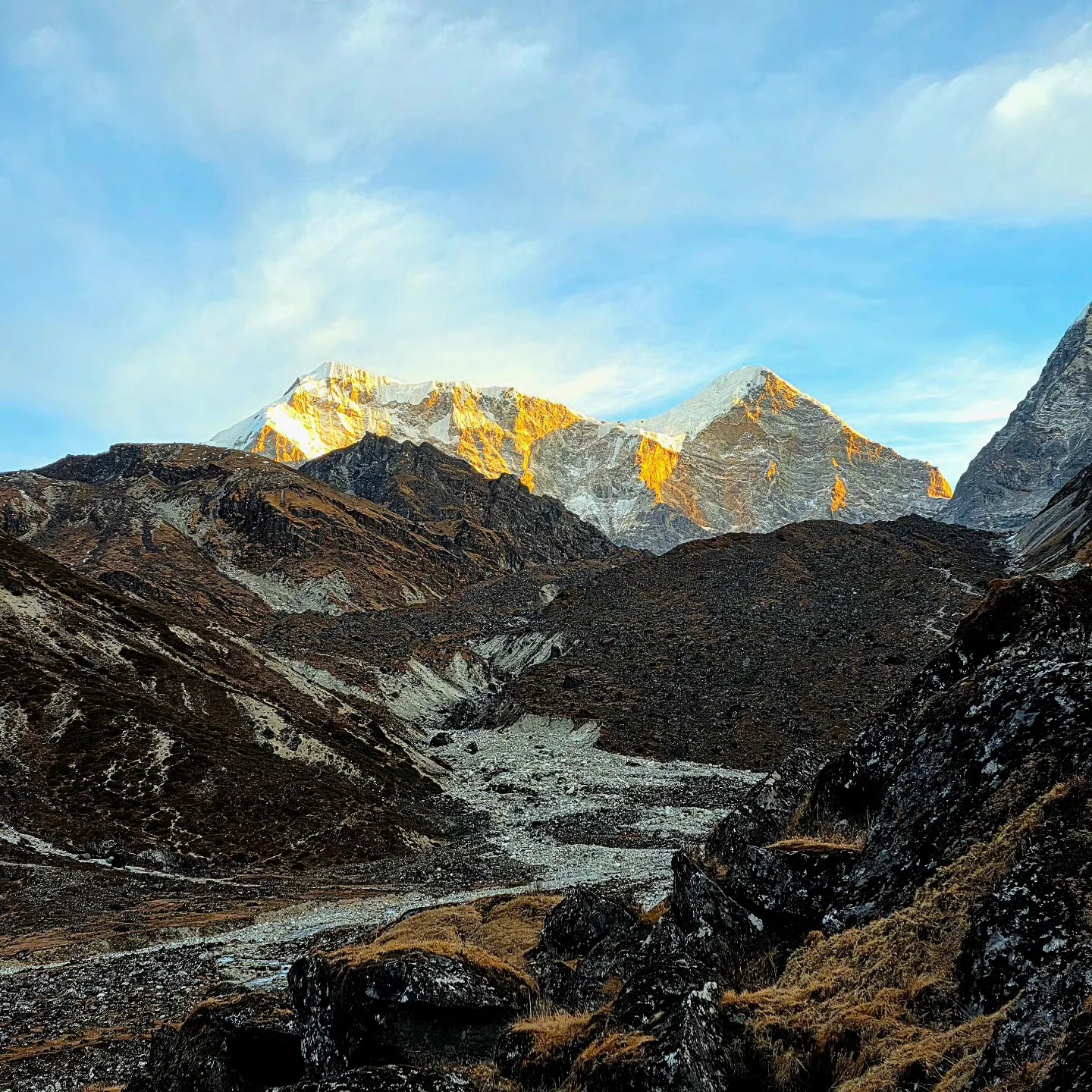
Here is the quiet confession behind this whole list. Two of these journeys — the Darjeeling toy train and the Qinghai–Tibet Railway — deliver you to the very edge of the Himalaya, close enough to see the peaks fill a window. And every traveller who rides them eventually feels the same pull: the wish to get out and walk into that landscape rather than watch it slide by behind glass.
That is exactly what we do. From Darjeeling's ridgelines you are looking straight at eastern Nepal; from the Tibetan Plateau you are staring at the north side of Everest. The most humbling way to meet those mountains is on foot, and it is more attainable than most rail travellers assume. Our 14-day Everest Base Camp Trek reaches 5,364 metres at the foot of the world's highest mountain and runs from US$1,850 per person as a solo trekker, dropping to US$1,350 per person in a group of eight or more — comparable to a single premium rail journey, but it changes you in a way no seat can. Start with our Everest region guide, browse the full range of Himalayan treks and tours, and when you are ready to plan the practicalities, our Nepal trekking permits guide and Nepal visa guide cover everything the paperwork throws at you.
Still deciding where 2026 should take you? We have written honest, worldly guides to help: our pick of the best places to visit in the world in 2026, and the regional deep-dives for Asia and Europe. If it is adrenaline you are chasing, the world's best adventure destinations lays out the great expeditions, and for pure scenery there is nothing like our tour of the most beautiful mountains in the world. A great train shows you a country. A great trek lets you belong to it, if only for a fortnight.
Frequently asked questions
What is the most scenic train journey in the world?
There is no single answer — it depends on the landscape you love. For alpine drama, Switzerland's Glacier Express and Bernina Express are hard to beat. For sheer altitude, the Qinghai–Tibet Railway crosses the 5,072-metre Tanggula Pass, the highest railway point on earth. For raw distance, nothing rivals the 9,289-kilometre Trans-Siberian. And for a short, jaw-dropping hit, Norway's Flåm Railway drops 866 metres in about an hour.
Which is the highest railway in the world?
The Qinghai–Tibet Railway between Xining and Lhasa holds the record. Its highest point, the Tanggula Pass, sits at 5,072 metres, and Tanggula station at 5,068 metres is the world's highest railway station. Carriages are supplied with supplemental oxygen because so much of the line runs above 4,000 metres.
Do any of these trains go into the Himalaya?
Two do. India's Darjeeling Himalayan Railway climbs into the eastern Himalayan foothills to Ghum, at 2,258 metres the highest station in India, with views straight toward Nepal and Kanchenjunga. The Qinghai–Tibet Railway crosses the Tibetan Plateau to Lhasa, on the north side of the Everest massif. To actually walk among these peaks, most travellers fly into Kathmandu and trek from there — see our Everest region guide.
Which of these is the best value?
The short scenic lines give the most spectacle per dollar: Norway's Flåm Railway (about an hour) and Scotland's Jacobite Steam Train are single-day rides at modest fares. The luxury sleepers — Belmond Andean Explorer, The Ghan, Rocky Mountaineer — are premium experiences priced accordingly. For perspective, a multi-day Himalayan trek such as our Everest Base Camp Trek often costs less than a single night on the top luxury trains, and lasts two weeks.
When is the best time to take these journeys in 2026?
Most European and alpine lines — the Glacier Express, Bernina Express and Bergen Railway — run year-round, with winter offering snow scenery. Seasonal services like Scotland's Jacobite and Canada's Rocky Mountaineer run roughly late April to October. For the Tibetan and Australian high country, the shoulder seasons (April–June and September–October) balance clear skies with comfortable temperatures. Always confirm current timetables and any travel advisories with the operator before booking.
Written by
Travel Himalaya NepalPokhara-based, NMA-certified trekking guides. We’ve led 5,000+ treks across the Annapurna and Everest regions since 1998 — every word here comes from the trail. More from this author →
Share this article
Ready to Trek?
From reading about it to standing on it
Our Pokhara-based guides have been doing this since 1998. Tell us your dates and fitness level — we'll build your perfect itinerary. Free, no obligation.
Why trek with our licensed agencyMore guides like this
Popular trips to consider
View all treks & toursFree Trekker's Insider Guide
Permits, packing lists, cost breakdowns — no fluff.
We send one useful email. You can unsubscribe anytime.