
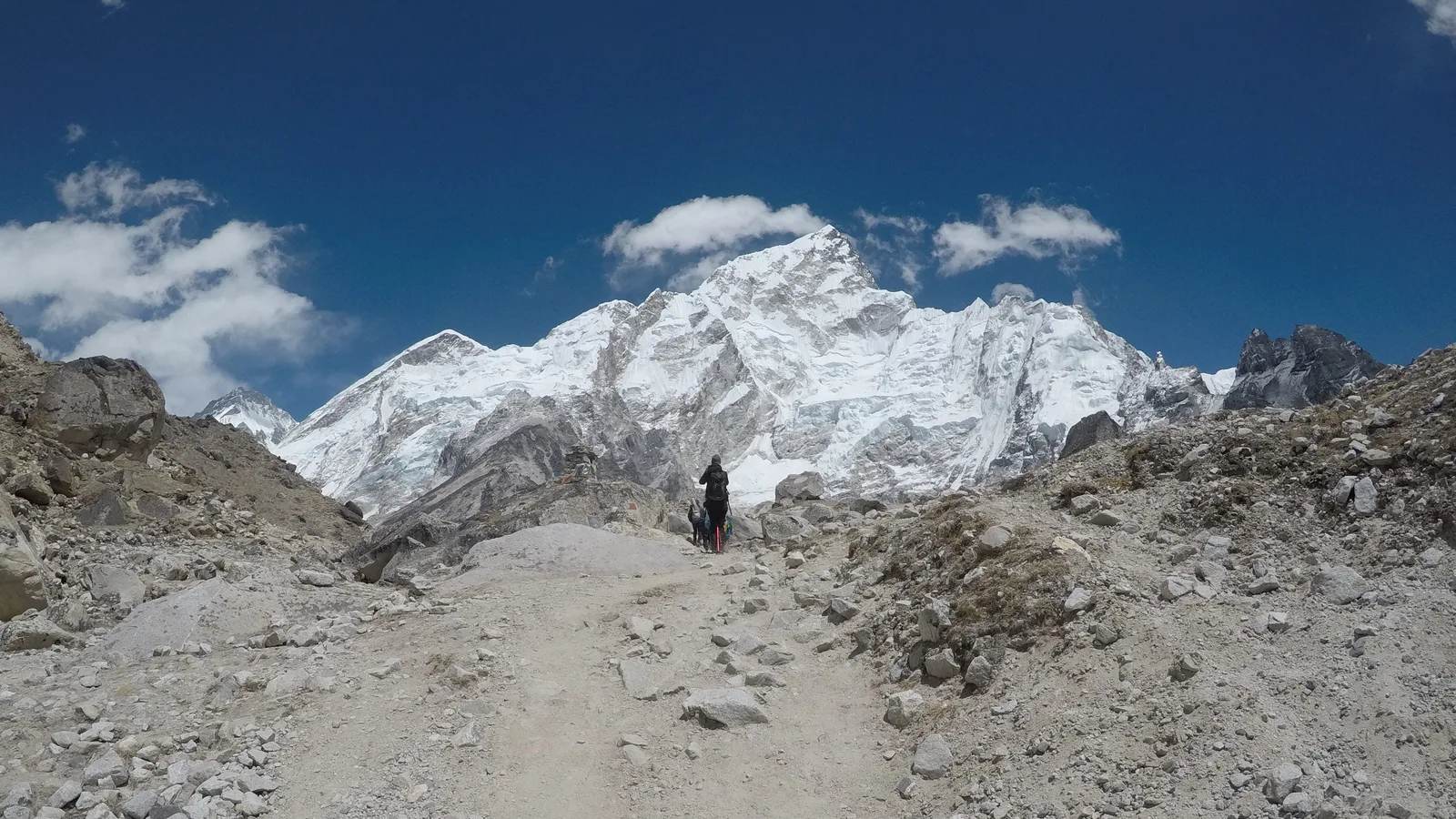
The short version
Mardi Himal tops out above Mount Whitney. Island Peak sits within five feet of Denali. And sleeping high, not standing high, is what actually tests you.
Most altitude advice is written in metres, and most Americans think in feet, so the numbers slide past without meaning anything. Put them on the same scale and two things jump out. The four-day Mardi Himal trek from Pokhara reaches its upper viewpoint at about 14,760 ft — higher than Mount Whitney, the tallest summit in the lower 48. And Island Peak, one of the most climbed trekking peaks in Nepal, stands at about 20,305 ft, within five feet of Denali. The more useful thing to understand, though, is why having stood on a 14,000-footer tells you much less than you would think about how you will handle a week in the Himalaya.
- Kathmandu sits at about 4,590 ft — lower than Denver.
- Everest Base Camp is about 17,600 ft, some 3,100 ft above Whitney.
- Mardi Himal, a four-day trek, touches about 14,760 ft. Island Peak is Denali’s height to within a metre.
- The test is not the highest point you stand on. It is the height you sleep at, night after night.
The same scale, side by side
Here is every number on one ladder. The American summits use the figures their land managers publish today; the Nepal figures are the high points of our own itineraries, converted and rounded to the nearest ten feet, because the metre figures they come from are rounded too.
| Place | Feet | Metres |
|---|---|---|
| Kathmandu | ~4,590 | 1,400 |
| Denver, Colorado | 5,280 | 1,609 |
| Ghorepani Poon Hill | ~10,530 | 3,210 |
| Annapurna Base Camp | ~13,550 | 4,130 |
| Pikes Peak, Colorado | 14,115 | 4,302 |
| Gosaikunda lake | ~14,370 | 4,380 |
| Mount Rainier, Washington | 14,410 | 4,392 |
| Mount Whitney, California | 14,505 | 4,421 |
| Mardi Himal | ~14,760 | 4,500 |
| Gokyo Ri | ~17,580 | 5,357 |
| Everest Base Camp | ~17,600 | 5,364 |
| Thorong La pass | ~17,770 | 5,416 |
| Island Peak summit | ~20,305 | 6,189 |
| Denali, Alaska | 20,310 | 6,190 |
Two readings surprise almost everyone. The first is how low the starting point is: Kathmandu is about 690 ft below Denver, so arriving in Nepal does nothing to your body at all. The second is that one of the most accessible short treks in the country, Mardi Himal, climbs higher than any summit in California or Colorado.
Why “I was fine on Pikes Peak” tells you less than you think
Most people who have been above 14,000 ft in America got there by car, cog railway or a long day hike, stood at the top for an hour, and came down to sleep in a town at a fraction of the height. That is a real exposure to altitude, and it is almost nothing like a trek. On the way to Everest Base Camp you spend seven nights sleeping above 11,000 ft, four of them higher than Pikes Peak’s summit, and sleeping is when altitude catches up with people — breathing slows, oxygen drops further, and the headache that was a nuisance at noon becomes the reason you cannot eat at breakfast.
The CDC’s guidance is built around exactly that distinction. Altitude illness can affect anyone going to 8,000 ft or higher. Above 9,000 ft, it advises raising your sleeping elevation by no more than about 1,600 ft a day, and adding an extra day for every 3,300 ft gained. And it warns against going straight from low elevation to sleep above 9,000 ft in a single day — which is precisely what flying into a high mountain airstrip does.
A good day on a 14,000-footer tells you that you are not unusually sensitive to a short exposure. It does not tell you how you will sleep at 16,000 ft on night six, and nobody can tell you that in advance, including us. Previous success is encouraging. It is not a guarantee, and people who treat it as one are the ones who push through symptoms they should have stopped for.
How our own itineraries measure up against that rule
This is the part most operators would leave out. We checked our standard itineraries against the CDC’s 1,600-ft-a-day guideline, night by night, and none of them meets it on every single day. Almost no standard route in Nepal does, because the trails, villages and lodges were not placed with a guideline in mind. What matters is what surrounds the big days.
| Everest Base Camp, night by night | Sleeping height | Gain that day | Against the 1,600 ft guide |
|---|---|---|---|
| 1 · Phakding | ~8,560 ft | — | Deliberately below 9,000 ft on day one |
| 2 · Namche Bazaar | ~11,290 ft | +2,720 ft | Over — followed by a rest day |
| 3 · Namche, rest day | ~11,290 ft | 0 | Acclimatisation |
| 4 · Tengboche | ~12,660 ft | +1,380 ft | Within |
| 5 · Dingboche | ~14,300 ft | +1,640 ft | On the line (500 m) |
| 6 · Dingboche, rest day | ~14,300 ft | 0 | Acclimatisation |
| 7 · Lobuche | ~16,210 ft | +1,900 ft | Over — comes straight after a rest day |
| 8 · Gorak Shep | ~16,940 ft | +730 ft | Within |
Here is the counter-intuitive result. The highest trek on this page is the most carefully paced one, because it has to be: its biggest single-night gain is about 2,720 ft and both of its big days sit next to a rest day. The short treks climb faster.
| Trek | High point | Biggest single-night gain | What makes it work |
|---|---|---|---|
| Ghorepani Poon Hill, 5 days | ~10,530 ft | +4,330 ft, to Ghorepani at ~9,380 ft | Only one night above 9,000 ft, then down |
| Mardi Himal, 4 days | ~14,760 ft | +3,380 ft, to High Camp at ~11,750 ft | One night high; the top is visited, not slept at |
| Annapurna Base Camp, 9 days | ~13,550 ft | +3,020 ft, Bamboo to Deurali | Two gentler days follow before the top |
| Everest Base Camp, 12 days | ~17,600 ft | +2,720 ft, to Namche | Two rest days, each beside a big day |
Two practical conclusions. First, a short trek is not automatically a gentle one: Poon Hill’s second day is the biggest single jump in sleeping height on this whole page, and although it only takes you to about 9,400 ft, that is just past the line the CDC draws for a first-day climb. In our experience most walkers are fine there, and the ones who are not feel it that night. Second, if you have had altitude trouble before, tell us before you book. Adding a night to break up the biggest day is straightforward and costs far less than turning back.
Choosing a trek by the altitude you already know
Treat this as a starting point for a conversation, not medical advice:
| Your experience | A sensible first Himalayan trek | Why |
|---|---|---|
| Never been above 8,000 ft | Ghorepani Poon Hill, 5 days | Lowest high point, one night above 9,000 ft |
| Comfortable hiking at 10,000–12,000 ft | Annapurna Base Camp, 9 days | Builds over several days before the top |
| Summited a 14,000-footer and felt fine | Mardi Himal, 4 days | Mirrors that pattern: up high briefly, then down |
| Have slept above 10,000 ft for several nights | Everest Base Camp, 12 days | A week sleeping above 11,000 ft, with rest days |
If you want the full picture of symptoms, prevention and the medication question, our complete altitude sickness guide covers it. What this page is for is simpler: knowing, in the units you think in, how high you are actually going.
Not the highest summit you have stood on — the highest night. It is the single most useful thing you can tell us, and we will use it to suggest a trek and an itinerary you will actually finish. Our guides are NMA-certified and have been walking these routes since 1998.
Ask which trek fitsHow high is Everest Base Camp in feet?
About 17,600 ft (5,364 m) — roughly 3,100 ft higher than Mount Whitney, the highest summit in the lower 48.
Is Everest Base Camp higher than any mountain in the US?
Higher than every summit in the lower 48. Only Alaska’s tallest peaks, led by Denali at 20,310 ft, go higher.
Is Kathmandu at high altitude?
No. At about 4,590 ft it is lower than Denver, and well below the 8,000 ft at which the CDC says altitude illness becomes a risk.
If I did fine on Pikes Peak, will I be fine in Nepal?
It is encouraging but it is not a prediction. A few hours on a summit is very different from sleeping above that height for a week, which is what a trek like Everest Base Camp involves.
US elevations from the National Park Service (Mount Whitney, NAVD88; Mount Rainier), the US Forest Service (Pikes Peak) and the 2015 Denali survey accepted by USGS and the National Geodetic Survey. Nepal high points are from our own published itineraries. Ascent guidance from the CDC Yellow Book’s chapter on high-altitude travel. This is general information, not medical advice.
Written by
Dawa SherpaPokhara-based, NMA-certified trekking guides. We’ve led 5,000+ treks across the Annapurna and Everest regions since 1998 — every word here comes from the trail. More from this author →
Share this article
Ready to Trek?
From reading about it to standing on it
Our Pokhara-based guides have been doing this since 1998. Tell us your dates and fitness level — we'll build your perfect itinerary. Free, no obligation.
Why trek with our licensed agencyMore guides like this
Popular trips to consider
View all treks & toursFree Trekker’s Insider Guide
Permits, packing lists, cost breakdowns — no fluff.
We send one useful email. You can unsubscribe anytime.