
Health insurance for parents visiting Australia, and what condition 8501 really asks
Most visiting parents can't use Medicare, and condition 8501 means keeping adequate health cover all stay. What Home Affairs says to include.

On this page (6)
Most parents visiting Australia are not eligible for Medicare, so every doctor, hospital and ambulance bill is theirs to pay as a private patient, and if their visa carries condition 8501 they must hold “adequate arrangements for health insurance” for the whole stay. Home Affairs does not publish a dollar minimum. What it does publish is a list of what a policy should cover, the waiting periods it suggests, and a warning that insurance is unlikely to cover every cost. Parents from 11 countries with a reciprocal health care agreement get some public care, and nothing private. Everything here is as published by Home Affairs and the Department of Health, read on 9 October 2026.
- Check the grant letter or VEVO for condition 8501. It is mandatory on some visas and added at the officer’s discretion on others.
- “Adequate” means five kinds of cover: doctors, hospital, prostheses, prescriptions and ambulance.
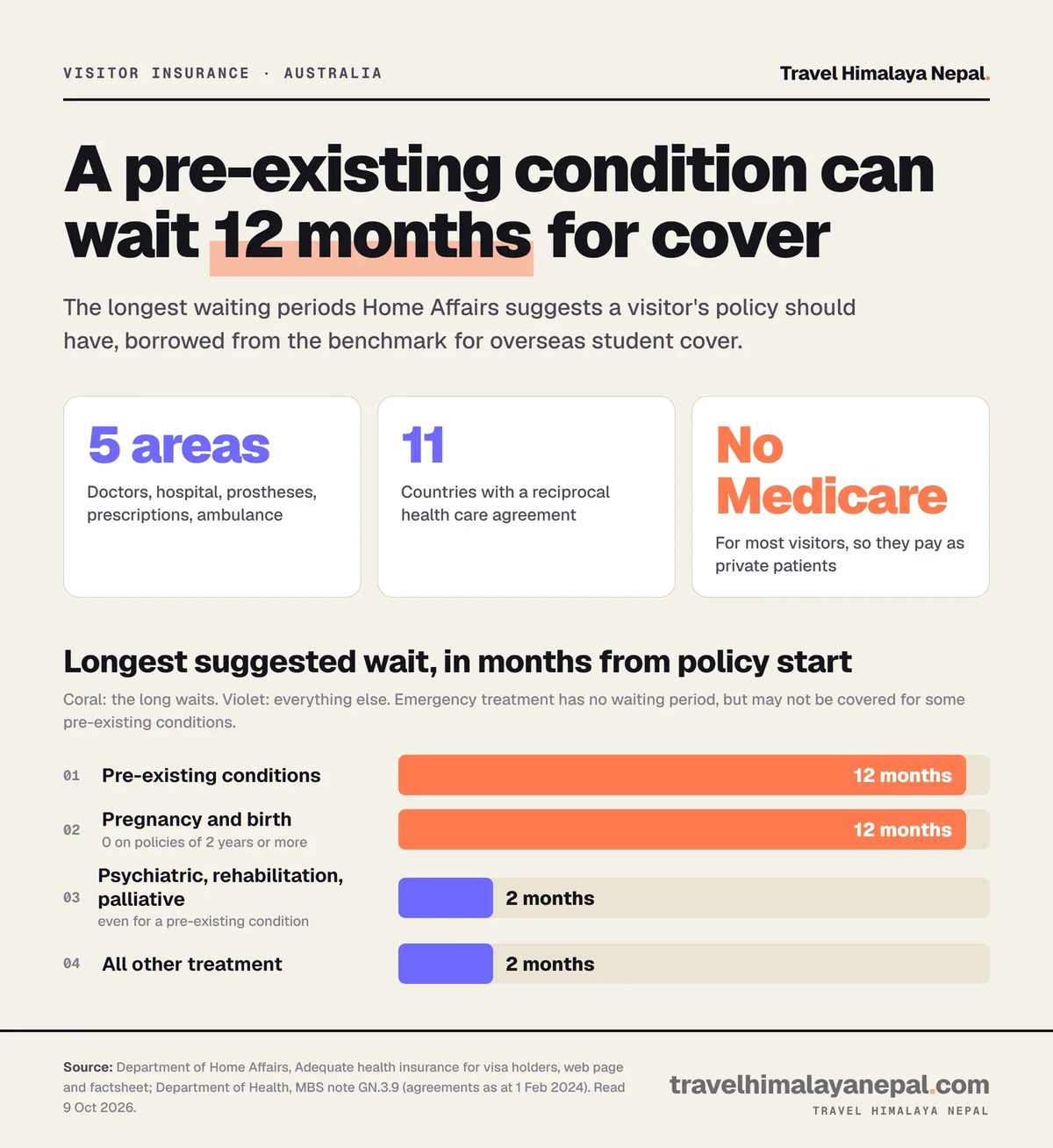
- Read the waiting periods. A pre-existing condition can wait up to 12 months under the benchmark Home Affairs suggests.
- Unpaid health debts can follow your parent into a future visa application.
What condition 8501 actually says
It says the visa holder “must maintain adequate arrangements for health insurance while the holder is in Australia”, and that is the whole text. Home Affairs explains that condition 8501 is mandatory for some visas and discretionary for others. Where it is discretionary, it applies only if the case officer chose to add it. Your parent can check their own visa conditions online in VEVO, or on the grant letter.
Two different rules are easy to confuse. Some visas require evidence of adequate health insurance before they are granted; for those, Home Affairs asks for a copy of a current policy held with an Australian registered private health insurer. Condition 8501 is the separate, ongoing duty to keep that cover for the whole stay. A policy that lapses in month eight breaks the condition even though the visa was granted properly.
Home Affairs says visitors are financially responsible for any health care debts they run up in Australia, and that it may consider outstanding health debts when the same person applies for a visa in future.
The Medicare gap for visitors, in plain terms
For most visitors the gap is the whole bill, because Medicare pays nothing. Home Affairs says that in the majority of cases visitors are not eligible for Medicare and are responsible for all health care costs, in public and private hospitals alike. A person not covered by Medicare is treated as a private patient, and must pay anything their insurance does not cover at the time of treatment.
Medicare eligibility is limited to Australian citizens, permanent visa holders, New Zealand citizens lawfully in Australia, Resident Return visa holders, some applicants for permanent residency, temporary visa holders covered by a Ministerial Order, and residents of Norfolk Island, the Cocos (Keeling) Islands, Christmas Island and Lord Howe Island. A parent on a visitor or sponsored parent visa is usually none of these.
Insurance closes most of that gap, not all of it. Home Affairs warns that health care costs in Australia are unlikely to be covered completely by private health insurance, and that the balance, the out-of-pocket gap fee, is the patient’s. Its advice is to ask for an estimate of costs, what the policy pays and what you will owe before any non-emergency treatment.
What “adequate” health insurance should cover
Home Affairs recommends cover for five things at a minimum, and suggests waiting periods no longer than those set for overseas student cover. It gives no single dollar figure. Overseas Visitors Health Cover (OVHC) products commonly provide that minimum level, Home Affairs says, though the cover varies between products.
| Area of cover | What Home Affairs recommends | Suggested maximum waiting period |
|---|---|---|
| Out-of-hospital medical | GP and specialist visits, pathology, x-rays | 2 months |
| Hospital treatment | Public or private hospital | 2 months |
| Prostheses | Medical devices and human tissue products | 2 months |
| Pharmaceuticals | Including prescription medicines | 2 months |
| Ambulance | Including inter-hospital transfers and emergency treatment | 2 months |
| Pre-existing conditions | Covered after the waiting period | 12 months |
| Psychiatric, rehabilitation, palliative care | Even for a pre-existing condition | 2 months |
| Pregnancy and birth | Obstetrics | 12 months (0 on policies of 2 years or more) |
Two lines in the factsheet matter most for an older parent. Waiting periods do not apply to emergency treatment, yet the cost of emergency treatment “may not be covered” by the insurer for some pre-existing conditions. Read exactly how the policy handles a condition your parent already has, both in an emergency and after the waiting period. Home Affairs also notes that some products carry a notice stating they do not satisfy condition 8501, so look for that wording before you pay.
Australian or overseas insurers may be acceptable for 8501, Home Affairs says, but the visas that require evidence before grant ask for an Australian registered insurer. If your parent’s home policy is offered as the 8501 cover, compare it line by line with the table above. The same questions about pre-existing conditions apply in the US visitor insurance guide and the Canadian super visa rules, which, unlike Australia, set a dollar minimum.
Reciprocal health care agreements, and what they leave out
Parents from 11 countries get some publicly funded care under a reciprocal agreement, but never private treatment, and never care they travelled to receive. As at 1 February 2024, the Department of Health’s Medicare Benefits Schedule notes list the agreements: Belgium, Finland, Italy, Malta, the Netherlands, New Zealand, Norway, Ireland, Slovenia, Sweden and the United Kingdom.
- Italy and Malta: eligibility is limited to six months from the date of arrival.
- New Zealand and Ireland: public hospital care and PBS medicines only, not Medicare-funded doctor services.
- Every agreement: no cover for treatment as a private patient, in a public or private hospital, and no cover for anyone visiting Australia to receive medical treatment.
The pages we read do not say that reciprocal eligibility on its own satisfies condition 8501, so if the condition is on the visa, ask Home Affairs or keep a policy that meets the table above. Ambulance deserves its own check: it is on Home Affairs’ list of what a policy should cover, and the reciprocal entitlements above do not mention it. UK readers will recognise the logic from the GHIC, which the NHS lists as valid in Australia and which, like the agreement, is no substitute for travel insurance.
What is visa condition 8501?
It requires the visa holder to “maintain adequate arrangements for health insurance while the holder is in Australia”. It is mandatory on some visas and discretionary on others; check VEVO or the grant letter.
Can visiting parents use Medicare in Australia?
Usually not. Home Affairs says most visitors are not eligible for Medicare. Parents from one of the 11 reciprocal agreement countries can get some publicly funded care, within that agreement’s limits.
Does travel insurance satisfy condition 8501?
Home Affairs does not name product types that fail. It recommends cover for out-of-hospital medical services, hospital, prostheses, pharmaceuticals and ambulance, and notes that some products state they do not satisfy 8501. Compare any policy against that list.
Is there a waiting period for pre-existing conditions?
Home Affairs suggests choosing a product whose waiting period for pre-existing conditions is no longer than 12 months, the benchmark set for overseas student cover.
How long can parents stay on the Sponsored Parent (Temporary) visa?
Home Affairs lists stays of up to three or five years, depending on the visa chosen. Check the grant letter for condition 8501.
The verdict
If condition 8501 is on your parent’s visa, buy a policy that covers all five of Home Affairs’ areas, with waiting periods no longer than its benchmark, and keep it running until the day they leave. If it is not on the visa, Home Affairs still strongly recommends private health insurance for every visitor who is not eligible for Medicare, and the cost logic is identical: a private patient pays the bill. Read how the policy treats existing conditions in an emergency, find out whether a reciprocal agreement applies and what it leaves out, and get a cost estimate before any planned treatment. That is the cheapest correct plan; anything less leaves the family holding the gap.
Keep reading
The six lines IRCC checks on the policy.
Medicare won't pay, so what a visitor plan must do.
The fee, the app and how long you can stay.
The three checks before anyone flies.
Sources: Department of Home Affairs, “Adequate health insurance for visa holders” web page and factsheet (wording of condition 8501, Medicare eligibility, recommended cover, suggested waiting periods, out-of-pocket costs, health debts); Home Affairs, Sponsored Parent (Temporary) visa subclass 870 page (length of stay); Department of Health, Disability and Ageing, MBS explanatory note GN.3.9 (reciprocal agreements as at 1 February 2024); NHS GHIC page via our GHIC guide. All read 9 October 2026. No insurer or plan is named or recommended here. This is general information, not insurance, migration or financial advice; check your visa conditions in VEVO and read the policy before you buy.

Written by
Bishnu AdhikariPokhara-based, NMA-certified trekking guides. We’ve led 5,000+ treks across the Annapurna and Everest regions since 1998 — every word here comes from the trail. More from this author →
Ready to Trek?
From reading about it to standing on it
Our Pokhara-based guides have been doing this since 1998. Tell us your dates and fitness level — we'll build your perfect itinerary. Free, no obligation.
More guides like this
Popular trips to consider
View all treks & toursFree Trekker’s Insider Guide
Permits, packing lists, cost breakdowns — no fluff.
We send one useful email. You can unsubscribe anytime.