
Visitor insurance for parents visiting the USA, and the clause to read first
Medicare won't pay for visiting parents, and an average US hospital stay cost about $16,700 to provide in 2022. What to check in a visitor plan.

On this page (7)
If your parents are visiting the USA, Medicare will not pay for their care and nothing else steps in by default, so a visitor medical plan is the only thing standing between a hospital stay and your family’s savings. A US hospital’s own cost for an average inpatient stay was about $16,700 in 2022, and about $28,100 for a heart attack, before a single doctor’s fee is added. The plan that matters is the one whose wording on pre-existing conditions, limits and claims you have read before your parents board.
- Medicare is for US citizens and long-term green card holders, not for parents on a visit.
- Emergency rooms must treat, not waive. The emergency law guarantees access, and the bill still follows.
- The pre-existing condition clause is the one to read first for older travellers, word for word.
- Buy before departure and make the dates match the I-94, including any extension.
Why US medical cover matters more than anywhere else
Because there is no public system a visitor can fall back on, and hospital care is expensive even at cost. The Agency for Healthcare Research and Quality counted 32.9 million US hospital stays in 2022 with aggregate hospital costs of $548.5 billion. Divide one by the other and the average stay cost the hospital about $16,700 to provide.
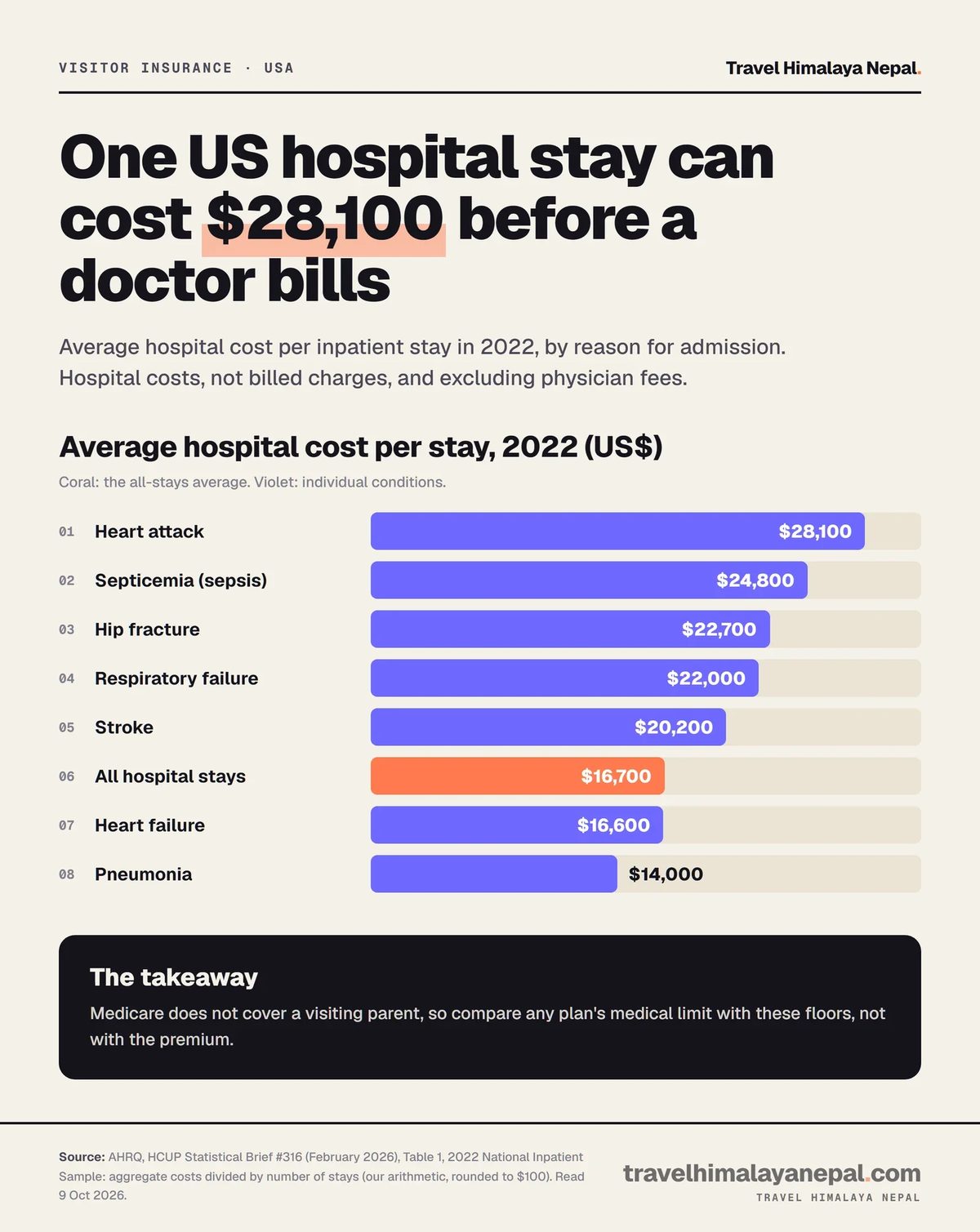
That figure is the hospital’s cost to produce the care, not the bill. AHRQ says plainly that its numbers are not the amount paid and do not include separately billed physician fees. A self-paying patient is invoiced charges, and charges sit above cost. So treat every number below as a floor.
| Reason for the hospital stay | Average hospital cost per stay, 2022 |
|---|---|
| Heart attack | About $28,100 |
| Septicemia (sepsis) | About $24,800 |
| Hip fracture | About $22,700 |
| Respiratory failure | About $22,000 |
| Stroke | About $20,200 |
| All stays | About $16,700 |
| Heart failure | About $16,600 |
| Pneumonia | About $14,000 |
Our arithmetic: each condition’s aggregate cost divided by its number of stays, from Table 1 of HCUP Statistical Brief #316 (February 2026). We picked conditions that can interrupt any visit: a fall, a cardiac event, an infection that turns serious.
Will Medicare or an emergency room cover a visiting parent?
Medicare will not, and an emergency room will treat your parent but not for free. CMS lists who can buy into Medicare: a US citizen, or a lawful permanent resident who has lived in the US for five continuous years before applying. A parent here on a visit is neither.
The emergency law is the part families misread. Under EMTALA, a hospital that takes part in Medicare must give a medical screening exam to anyone who asks for emergency care and must stabilise an emergency condition. CMS describes its purpose as public access to emergency services “regardless of ability to pay.” That is a promise of access. Nothing on the CMS page says the care is free, and the invoice arrives afterwards, addressed to the patient.
Being treated is not the same as being covered. A parent can be stabilised in an emergency room under the law and still leave with the full bill, plus separate bills from each doctor who saw them.
How pre-existing conditions work in a visitor plan
Read this clause first, because plans write it differently and it is where older travellers’ claims are most exposed. The National Association of Insurance Commissioners, the body of US state insurance regulators, lists pre-existing health conditions among the most common travel insurance exclusions, and tells buyers to ask whether they are excluded and whether the insurer must approve care first.
If your parent takes medicine for diabetes, blood pressure or a heart condition, read the wording with these questions:
- How does the plan define a pre-existing condition? Look for the look-back window, meaning how far before the start date a diagnosis, treatment or prescription change counts against your parent.
- Does it pay anything for a sudden flare-up of a known condition? If yes, find the separate limit for it, and the age band it applies to.
- Is a stable, managed condition treated differently from one that changed recently? A new medicine weeks before travel can matter.
- What must be declared on the application, and what happens if something is left out.
Never assume a plan will pay for an existing condition because the sales page says “comprehensive”. The policy wording is the contract. If the answer is unclear, ask the insurer and keep the reply in writing.
What to check before you buy
Check six things in the wording: the medical maximum, the pre-existing clause, the deductible, the coinsurance, how bills get paid, and the dates. Price comes after those, not before. The NAIC’s own advice is to ask the insurer or agent exactly what a policy covers before buying, because each policy sets its own limits.
| What pays | Hospital stay | Emergency room | Doctor visit | Flight home or evacuation |
|---|---|---|---|---|
| Medicare | No (visitor) | No (visitor) | No (visitor) | No |
| EMTALA (the emergency law) | No; it requires stabilising, not paying | Screening and stabilising, then billed | No | No |
| Home-country health cover | Check; often limited abroad | Check | Check | Rarely |
| Visitor medical plan | Up to its limit, after deductible and coinsurance | Up to its limit | If listed | Only if the wording includes it |
- Medical maximum. Set it against the cost table above, and remember those are costs before doctors’ fees.
- Deductible and coinsurance. A low premium often means a high deductible or a share of every bill. Add up what you would pay on a $25,000 stay.
- Direct billing or reimbursement. Find out whether the insurer pays the hospital or you pay first and claim later, and whether there is a provider network.
- Evacuation and repatriation. These are separate clauses. Our guide to evacuation membership versus travel insurance explains the difference.
- Dates and renewals. The plan should run for the whole authorised stay, and you should know whether it can be extended from inside the US.
- Card cover. Check whether a credit card’s travel insurance covers a parent flying in on their own ticket at all before counting on it. Here is what card travel insurance actually covers.
Getting the dates right for a long visit
Match the plan to the date on your parent’s I-94, not to the return ticket. USCIS tells visitors to check the date on the Form I-94 arrival record to see when their authorised stay ends. To stay longer, the extension is generally filed on Form I-539, and USCIS recommends applying at least 45 days before the authorised stay expires.
If you extend the stay, extend the insurance too, before the old end date. A plan that lapses on the day of the original flight home leaves the extra weeks uncovered, and that gap is easy to close in advance. Parents arriving on the Visa Waiver Program also need an approved ESTA before they fly; our guide to ESTA, ETA and ETIAS covers the fee and the rules.
Do visitors to the USA need health insurance?
Nothing in the Medicare or emergency-care rules covers a visitor’s bills, so without a plan the family pays. Whether a plan is required for a visa is a separate question; the cost risk exists either way.
Can my parents get Medicare if they visit me in the US?
No. CMS limits Medicare enrolment to US citizens and lawful permanent residents who have lived in the US for five continuous years before applying.
Will a US hospital treat my parent without insurance?
In an emergency, yes. EMTALA requires a Medicare-participating hospital to screen and stabilise anyone with an emergency condition, regardless of ability to pay. The hospital still bills for that care.
Does visitor insurance cover pre-existing conditions?
It depends entirely on the wording. US state regulators list pre-existing conditions among the most common travel insurance exclusions. Read the definition, the look-back window and any separate limit for a sudden flare-up.
How much does a hospital stay cost in the US?
AHRQ data for 2022 put the hospital’s average cost per stay at about $16,700 by our calculation, and about $28,100 for a heart attack. Bills to self-paying patients are usually higher, and doctors bill separately.
The verdict
Buy a visitor medical plan before your parents fly, and choose it on the pre-existing clause and the medical maximum, not the premium. One ordinary hospital stay costs a US hospital about $16,700 to provide, Medicare does not apply, and the emergency law guarantees treatment rather than payment. Read the wording, put the answers to the four pre-existing questions in writing, and set the end date to the I-94, not the ticket. If your family is also hosting parents in Canada or Australia, the insurance rules there are written into the visa rules themselves: see what IRCC checks on a super visa policy and what Australia’s condition 8501 asks of visiting parents.
Keep reading
What each one pays for, and where the gaps are.
What card cover includes, and what it leaves out.
The fees and rules for visa-free arrivals.
The health checks to make before any long trip.
Sources: AHRQ, HCUP Statistical Brief #316, “National Inpatient Hospital Costs: The Most Expensive Conditions by Payer, 2022” (February 2026), Table 1 and highlights, for stays and aggregate costs (per-stay figures are our arithmetic, rounded to $100); CMS, “Original Medicare (Part A and B) Eligibility and Enrollment”, last modified 10 March 2026; CMS, “Emergency Medical Treatment & Labor Act (EMTALA)”, last modified 10 March 2026; NAIC, “Should I get travel insurance?”, 16 June 2026; USCIS, “Extend your stay”, last reviewed 24 January 2024. All read 9 October 2026. No insurer or plan is named or recommended here. This is general information, not insurance or financial advice; read the policy wording before you buy.

Written by
Bishnu AdhikariPokhara-based, NMA-certified trekking guides. We’ve led 5,000+ treks across the Annapurna and Everest regions since 1998 — every word here comes from the trail. More from this author →
Ready to Trek?
From reading about it to standing on it
Our Pokhara-based guides have been doing this since 1998. Tell us your dates and fitness level — we'll build your perfect itinerary. Free, no obligation.
More guides like this
Popular trips to consider
View all treks & toursFree Trekker’s Insider Guide
Permits, packing lists, cost breakdowns — no fluff.
We send one useful email. You can unsubscribe anytime.