
Super visa insurance requirements, and the six lines IRCC checks on the policy
IRCC wants $100,000 of emergency cover for at least a year, paid, from a Canadian or OSFI-authorised insurer. What to check before you apply.

On this page (7)
For a Canadian super visa, IRCC wants proof of private health insurance that gives at least Can$100,000 of emergency coverage, lasts at least one year from the date your parent enters Canada, covers health care, hospitalisation and repatriation, and is paid in full or in instalments with a deposit. The policy must come from a Canadian insurance company, or from a foreign insurer that OSFI has authorised to sell accident and sickness insurance in Canada. A quote does not count. The rules below are as published by IRCC on its super visa forms and documents page, dated 30 July 2026, and read on 9 October 2026.
- A quote is not proof. The policy has to be bought, or started with a deposit.
- Brokers are not insurers. The document must name the company that actually issued the policy.
- Foreign insurers are allowed only if OSFI lists them, and the policy must say it was issued under their Canadian business.
- Cover is checked on every entry, so renew it if it ends before your parent leaves.
What IRCC requires from the insurance policy
Six conditions, all on the same IRCC page, and the policy has to meet every one of them. IRCC says the policy should name the insurance company that issued it, be valid for at least one year from the date of entry, be paid in full or in instalments with a deposit, cover health care, hospitalisation and repatriation, give at least $100,000 of emergency coverage, and be available for a border services officer to review on request.
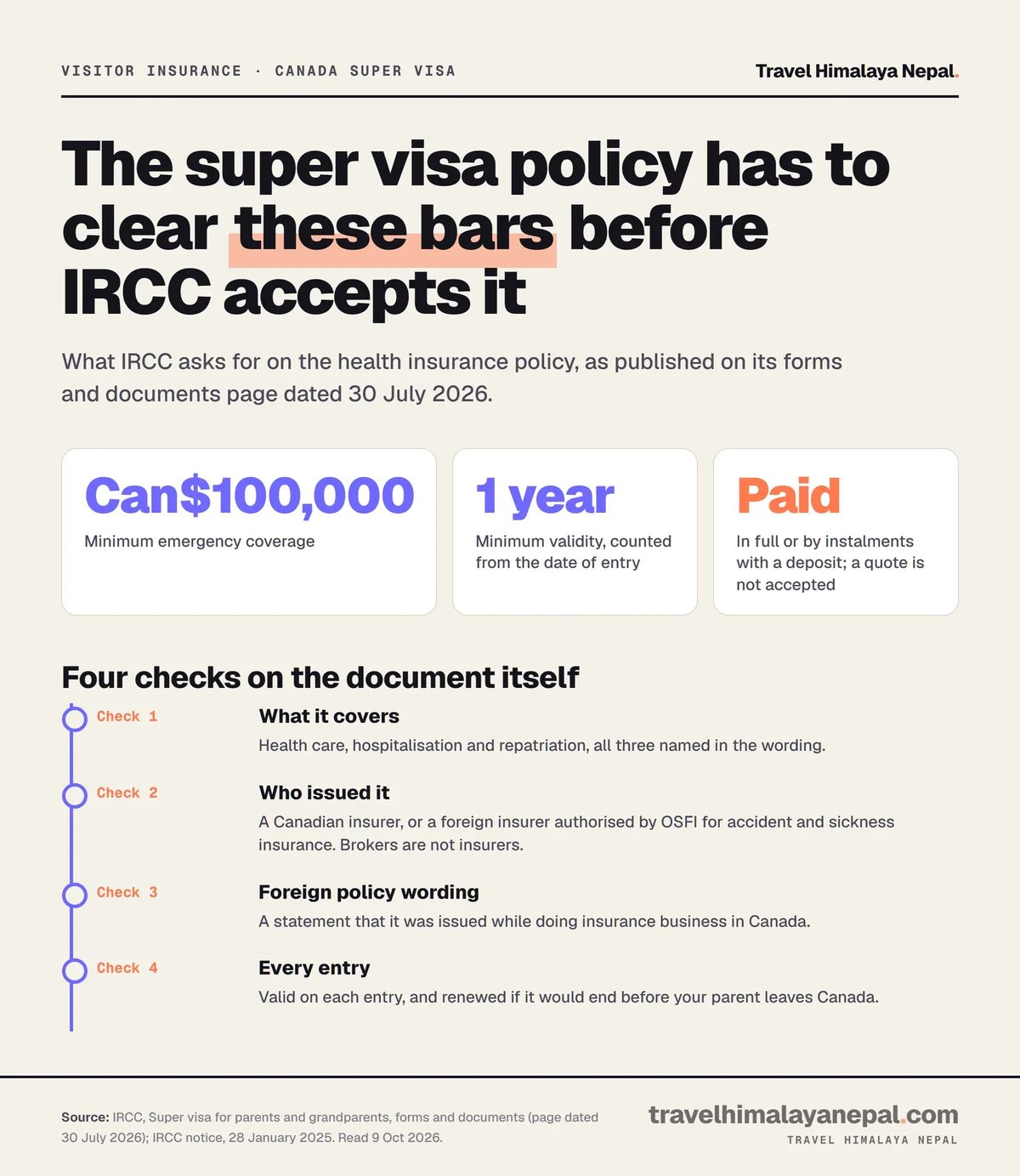
| IRCC requirement | What the rule says | What to check on the policy |
|---|---|---|
| Emergency coverage | At least $100,000 | The emergency medical limit printed on the certificate, per person |
| Length | At least 1 year from the date of entry | Start date matches the arrival date, not the purchase date |
| What it covers | Health care, hospitalisation and repatriation | All three named in the wording |
| Payment | Paid in full, or instalments with a deposit | A receipt; never a quote |
| Issuer | Canadian insurer, or a foreign insurer authorised by OSFI | The insurer’s own name on the document, not a broker’s |
| Foreign insurer wording | A statement that it was issued while doing insurance business in Canada | That sentence, in the policy |
The column on the right is ours. It turns each rule into the line an officer will look for. If a single line is missing, the policy does not meet the requirement as written, however good the price.
Canadian insurer or foreign insurer, which one counts
Both can count, but a foreign insurer only if OSFI has authorised it to provide accident and sickness insurance and lists it as a federally regulated institution. IRCC opened the door to foreign insurers in a notice dated 28 January 2025. Before that, only Canadian insurance companies qualified.
The notice and the forms page set three tests for a foreign policy. The company must be authorised by the Office of the Superintendent of Financial Institutions for accident and sickness insurance. It must appear on OSFI’s list of federally regulated financial institutions. And the policy must be issued under the company’s insurance business in Canada, with a statement in the policy saying so.
IRCC says insurance brokers and claims administrators are not insurance companies. A policy sold by a broker can be fine, but the document must name the insurer that issued it. If you only see the broker’s name, ask for the issuer’s.
You can check whether a foreign company is authorised on the OSFI website, which is the step IRCC itself points to. A policy bought at home that fails those tests is a problem twice over: it may not satisfy IRCC, and it may not be what you think it is when a Canadian hospital asks who will pay.
How long the cover must last, and the five-year stay
The policy must run at least one year from the date of entry and be valid on each entry, while the visa itself allows stays of up to five years at a time. IRCC describes the super visa as multiple-entry for up to 10 years, with each visit lasting up to five years. The insurance rule does not stop at one year: IRCC says your parent must have proof of a health insurance policy on each entry, and should renew it if it will expire before they leave Canada.
In plain terms, one year is the minimum to get the visa, not the length of cover a long stay needs. If your parent plans to stay two or three years, budget for renewing the policy every year it runs out. The 2025 IRCC notice says the same thing more directly: super visa holders should have a valid policy for the whole stay.
Why the rule exists, and what provincial health care will not do
Because super visa holders do not qualify for provincial health insurance, so without private cover the cost of their care has nowhere else to go. An IRCC report to Parliament on the super visa says so plainly, and notes that if a visitor cannot pay, the health care system may have to absorb the cost of emergency care.
That is the whole logic of the $100,000 floor. It is a minimum for emergencies, and IRCC’s wording is about emergency coverage. It says nothing about routine visits or ongoing treatment of a condition your parent already has, so check what the policy says about those separately. The questions are the same ones that matter for visitor insurance for parents visiting the USA: how the policy defines a pre-existing condition, how far back it looks, and whether a stable condition is treated differently from one that recently changed.
The rest of the application, in one place
Insurance is one of several requirements, and the host has to meet some of them too. According to IRCC’s eligibility page, read on 9 October 2026:
- The host is your child or grandchild, at least 18, living in Canada, and a Canadian citizen, permanent resident or registered Indian.
- The host’s income must meet the minimum necessary income. IRCC’s report to Parliament says it is based on the low income cut-off (LICO).
- A signed letter of invitation from the host.
- An immigration medical exam.
- Your parent must be outside Canada when the application is submitted.
IRCC lists the fee as starting from Can$100, and says biometrics may also be needed. Parents from visa-exempt countries can still apply for a super visa to stay five years; for a short visit they would otherwise fly on an eTA, which our guide to the eTA, ESTA and ETIAS explains. For the wider picture on passports and entry rules, see our visas, passports and entry guide.
How much insurance do you need for a super visa?
At least $100,000 of emergency coverage, valid for at least one year from the date of entry, covering health care, hospitalisation and repatriation, per IRCC as of October 2026.
Can I buy super visa insurance from a company outside Canada?
Yes, since January 2025, if OSFI has authorised the company to provide accident and sickness insurance, it appears on OSFI’s list of federally regulated institutions, and the policy was issued under its Canadian insurance business.
Can super visa insurance be paid monthly?
IRCC accepts a policy paid in full or in instalments with a deposit. A quote is not accepted as proof.
Does the insurance have to cover the full five years?
The minimum is one year from the date of entry, but IRCC says the policy must be valid on each entry and should be renewed if it expires before your parent leaves Canada.
Are super visa holders covered by provincial health care?
No. An IRCC report to Parliament states that super visa holders do not qualify for provincial health insurance.
The verdict
Buy the policy only after you have checked the six lines in the table against the actual document, and treat Can$100,000 and one year as the floor, not the target. The ways to fall short are all avoidable: a quote instead of a paid policy, a broker’s name with no insurer, a foreign policy without OSFI authorisation, or cover that lapses in year two of a five-year stay. Provincial health care will not step in, so the policy is the only thing between an emergency and the family’s bank account. If your family is weighing Australia instead, the rule there sits in a visa condition called 8501, and it works differently; here is what condition 8501 asks of visiting parents.
Keep reading
Medicare won't pay, so what a visitor plan must do.
The three checks before anyone flies.
Fees and rules for visa-free arrivals.
What card cover includes, and what it leaves out.
Sources: IRCC, “Super visa for parents and grandparents: forms and documents” (page dated 30 July 2026), for every insurance requirement; IRCC, super visa eligibility and “About” pages (dated 6 July 2026), for host, income, medical exam, stay, validity and fee; IRCC notice “Change to health insurance requirement makes the super visa more accessible”, 28 January 2025, for foreign insurers and OSFI; IRCC, “Report to Parliament on the Super Visa Income Requirement”, for provincial health insurance and the LICO basis. All read 9 October 2026. Amounts are in Canadian dollars. No insurer or plan is named or recommended here. This is general information, not insurance, immigration or financial advice; check IRCC’s page before you apply.

Written by
Bishnu AdhikariPokhara-based, NMA-certified trekking guides. We’ve led 5,000+ treks across the Annapurna and Everest regions since 1998 — every word here comes from the trail. More from this author →
Ready to Trek?
From reading about it to standing on it
Our Pokhara-based guides have been doing this since 1998. Tell us your dates and fitness level — we'll build your perfect itinerary. Free, no obligation.
More guides like this
Popular trips to consider
View all treks & toursFree Trekker’s Insider Guide
Permits, packing lists, cost breakdowns — no fluff.
We send one useful email. You can unsubscribe anytime.