
If a medical condition pushes up your UK travel insurance, this rule is on your side
If a condition adds £200+ to a UK quote or gets you refused, the insurer must signpost a specialist directory. How it works, and what to declare.

On this page (9)
- When does an insurer have to send you to the directory?
- What changed in January 2026?
- Where are the directories, and what do they do?
- How do you declare a condition properly?
- What happens if you don’t declare?
- Will a GHIC cover the gap if you go uninsured?
- Your checklist before you buy
- Our verdict
- Keep reading
Since 1 January 2026, a UK travel insurer that adds £200 or more to your premium because of a medical condition must point you to a specialist directory, and the same applies if it refuses you, cancels you, or leaves you with an exclusion you cannot remove. The threshold was £100 before then. The FCA recognises two directories, MoneyHelper’s and BIBA’s, and both exist to find firms that cover people with serious conditions. The rule only helps if you declare properly, because an undeclared condition can sink a claim that has nothing to do with it.
- The signpost is a right, not a favour. If a trigger applies, the firm must give you the directory’s contact details, purpose and benefits.
- Declare everything the questions ask, including pending tests and mental health conditions.
- Getting it wrong costs more than the premium. A careless answer can cut a claim; a deliberate one can void the policy.
- A GHIC is not a backup plan. It covers state care in Europe, not private treatment or a flight home.
When does an insurer have to send you to the directory?
When any of five things happens because of a medical condition: you are refused a quote, your policy is cancelled, a condition is excluded and cannot be removed, the medical part of the premium is £200 or more, or the firm cannot tell you what the medical part costs. The rule is ICOBS 6A.4.6R in the FCA Handbook, and the wording matters, so here it is.
| The firm… | Exact FCA wording |
|---|---|
| Refuses you | “declines, or otherwise does not offer, a consumer a quotation due (wholly or partly) to a medical condition” |
| Cancels you | “cancels a consumer’s policy due (wholly or partly) to a medical condition” |
| Excludes a condition for good | “offers a policy with a medical condition exclusion which cannot be removed from the policy” |
| Charges a lot extra | “offers a policy with a medical condition premium” of £200 or more (ICOBS 6A.4.6AR) |
| Cannot say what it costs | “offers a policy in respect of which the medical condition premium is not known” |
When one applies, ICOBS 6A.4.5R says the firm must give you “the contact details, including telephone number and website, of the medical cover firm directory”, its purpose, and “the potential benefits of accessing” it. That must be prominent, clear and accurate. FCA guidance adds that the message should tell you why you are getting it and should not, taken as a whole, discourage you from using the directory.
Two exceptions are worth knowing. A firm does not have to signpost if it can offer you, at the same time, a policy where none of the five triggers applies. And a firm that is itself listed on a directory can skip it if it knows you have already used that directory for the same trip and the only trigger is the premium. Neither exception applies where signposting would still be in your best interests.
What changed in January 2026?
The premium trigger doubled from £100 to £200 on 1 January 2026, and it will now move with inflation every five years. The FCA’s review of the rules, last updated on 3 December 2025, says it was “increasing the medical condition premium trigger point for signposting from £100 to £200.” The rule text sets £200 as the base, adjusted by CPI at the end of each five-year period, with the first period running from January 2025 to January 2030.
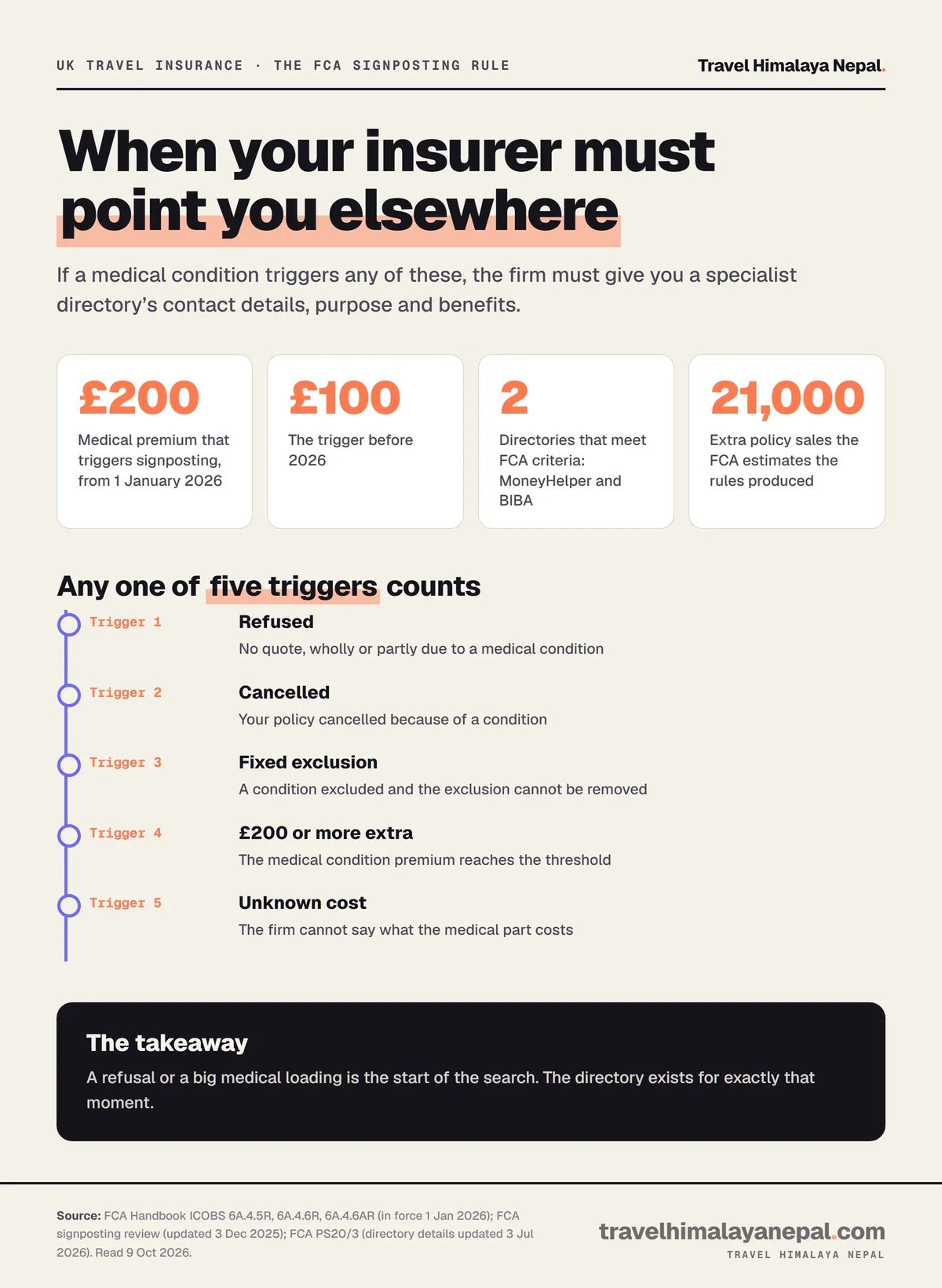
In plain terms: a medical loading of £150 used to trigger a signpost and now does not. If your quote rises by less than £200 because of a condition, nobody is obliged to mention the directory, but nothing stops you using it. The same FCA review estimated the signposting rules produced about 21,000 additional policy sales, which it called “a positive, albeit lower than we expected, impact on the market.”
Where are the directories, and what do they do?
The FCA says “two directories, for people with serious PEMCs, that meet our criteria”: the MoneyHelper directory, provided by the Money and Pensions Service, and BIBA’s. PEMC means pre-existing medical condition. Every firm selling retail travel insurance must show details of at least one of them on its website.
- MoneyHelper travel insurance directory: linked from the FCA’s policy statement PS20/3, at moneyhelper.org.uk.
- BIBA: the FCA lists its consumer line as 0370 950 1790, Monday to Friday, 9am to 6pm (hours updated by the FCA on 3 July 2026).
A directory does not sell you a policy. It points you to firms that are set up to quote for serious conditions, and from there you compare as you would anywhere else. GOV.UK’s foreign travel insurance guidance mentions both, and is the page we would send any older relative to first.
How do you declare a condition properly?
Answer every screening question fully and honestly, including conditions you think are minor, medication, and tests or treatment you are still waiting for. GOV.UK’s guidance says to “declare existing conditions or pending treatment or tests”, and that “you must declare mental health conditions or risk invalidating your policy.”
The legal duty is in the Consumer Insurance (Disclosure and Representations) Act 2012, section 2(2): “It is the duty of the consumer to take reasonable care not to make a misrepresentation to the insurer.” In practice, reasonable care means:
- Have your repeat prescription list and recent letters from your GP or consultant in front of you.
- Answer the question asked, about the period asked (some ask about the last two or five years).
- Declare for every traveller on the policy, not just yourself.
- Tell the insurer if anything changes between buying and travelling: a new diagnosis, new medicine or a referral.
- Keep a copy of your answers or a screenshot of the screening summary.
The FCA’s guidance also flags joint applications. If one traveller’s condition drives up a joint price, separate policies may work out better, and the firm is expected to consider that when it explains the directory to you.
What happens if you don’t declare?
It depends on how the insurer judges your answer: deliberate or reckless, and it can refuse every claim and keep your premium; careless, and the remedy depends on what it would have done had it known. The remedies sit in Schedule 1 of the 2012 Act, summarised below.
| If the misrepresentation was… | And the insurer would have… | What the insurer can do |
|---|---|---|
| Deliberate or reckless | Any of the below | Avoid the policy, refuse all claims, keep the premium unless unfair |
| Careless | Refused you | Avoid the policy and refuse claims, but refund the premium |
| Careless | Insured you on different terms | Treat the policy as if it had those terms, such as an exclusion |
| Careless | Charged more | Pay only a proportion of the claim |
That last row is the one that surprises people: the Act lets the insurer “reduce proportionately the amount to be paid on a claim”, even on a broken ankle that has nothing to do with the condition you left out. GOV.UK puts it more simply: “failing to declare something may invalidate your travel insurance.”
Will a GHIC cover the gap if you go uninsured?
No: GOV.UK says “EHIC and GHIC are not alternatives to travel insurance” because they do not cover private medical costs, repatriation or additional costs. The card gets you state care in Europe on the same terms as a local, and it is free, so carry one. Our guide to the free UK GHIC and the gap it leaves covers where it works. What it will not do is fly you home after a stroke in Spain, which is exactly the claim a condition-related policy exists for.
Your checklist before you buy
Six steps cover it: gather your medical details, screen honestly, read the result, use the directory if the result is poor, keep the insurer updated, and carry a GHIC as well.
Prescriptions, diagnoses, dates, pending tests, for every traveller.
Every question, every condition, even the ones that feel minor.
Extra premium, exclusions, and whether exclusions can be removed.
Over £200 extra, refused or excluded: you should be signposted. Use it anyway if the price is poor.
Any change in your health before you travel.
Free, useful in Europe, and never a substitute.
Our verdict
Declare everything, and treat a big medical loading or a refusal as the start of the search, not the end. The directories exist because the cheapest mainstream policy is often the wrong one for a serious condition, and the January 2026 change means fewer people will be told about them automatically. A policy that costs more and pays out beats a cheap one that does not. For how screening works in more depth, see what declaring a pre-existing condition really means, and if age is part of the picture, the age-limit traps in travel insurance for seniors.
This page explains the FCA rules and GOV.UK guidance as read on 9 October 2026. We do not recommend any insurer. Check a policy’s wording, and ask the insurer or a regulated broker if you are unsure what to declare.
Does the £200 trigger apply to the whole premium?
No. It applies to the medical condition premium, the extra charged because of a medical condition, not the total price of the policy.
Do I have to use the directory if I am signposted?
No. It is information, not an obligation. You can buy the policy offered, use the directory, or shop elsewhere.
What if a condition is diagnosed after I buy the policy?
Tell the insurer, and check what your policy wording says about changes in health before you travel. GOV.UK says to declare pending treatment or tests, so a new referral counts too.
Keep reading
Free state care in Europe, and the gap it leaves.
How medical screening works, and what declaring means.
Cover, costs and the age-limit traps.
Packing, paperwork and transit rules.
Sources: FCA Handbook, ICOBS 6A.4 (6A.4.5R, 6A.4.6R and 6A.4.6AR in force from 1 January 2026; guidance updated 26 June 2026); FCA, Travel insurance signposting rules for consumers with medical conditions: review (first published 11 April 2024, updated 3 December 2025); FCA, PS20/3 Signposting to travel insurance for consumers with medical conditions (directory details updated 3 July 2026); GOV.UK, Foreign travel insurance (updated 2 August 2024); Consumer Insurance (Disclosure and Representations) Act 2012, section 2 and Schedule 1, legislation.gov.uk. All read on 9 October 2026. General information, not financial advice.
Cover photo via Pexels: Kindel Media.

Written by
Bishnu AdhikariPokhara-based, NMA-certified trekking guides. We’ve led 5,000+ treks across the Annapurna and Everest regions since 1998 — every word here comes from the trail. More from this author →
Ready to Trek?
From reading about it to standing on it
Our Pokhara-based guides have been doing this since 1998. Tell us your dates and fitness level — we'll build your perfect itinerary. Free, no obligation.
More guides like this
Popular trips to consider
View all treks & toursFree Trekker’s Insider Guide
Permits, packing lists, cost breakdowns — no fluff.
We send one useful email. You can unsubscribe anytime.