
The 183-day rule is only half the story when you work abroad for months
183 days is a common tax trigger, but the UK, Spain and Portugal can catch you sooner, and US citizens are taxed anyway. How each counts.

On this page (9)
Spending more than 183 days in a country in a year is the most common way to become tax resident there, but it is only one of several tests, and many of them catch you sooner. The UK can treat you as resident after 16 days if you have enough ties, Portugal counts any 12-month window and also looks at whether you keep a home there, Spain looks at where your economic interests sit, and a US citizen owes US tax on worldwide income wherever they work. Your employer has its own 183-day and home-office questions. Count your days, then check the other doors.
- 183 days is a threshold, not a safe harbour. Staying under it does not prove you are not resident.
- Each country counts differently: tax year, calendar year, income year or a rolling 12 months.
- A short workation rarely changes where you are resident at home. The bigger risk is becoming resident in two places at once.
- Your employer carries its own risk, and many will say no to a long stay for that reason alone.
This is general information from the tax authorities’ own pages, read on 9 October 2026. Your position depends on your facts. Confirm it with the tax authority or a qualified adviser before you go, and especially before you stay beyond a few weeks.
Why is 183 days the number everyone quotes?
Because 183 days is just over half a year, and it appears both in many countries’ domestic rules and in the model tax treaty most treaties copy. The OECD Model Tax Convention, Article 15, says your salary for work done in another country stays taxable only at home if three things are all true:
“the recipient is present in the other State for a period or periods not exceeding in the aggregate 183 days in any twelve month period commencing or ending in the fiscal year concerned, and the remuneration is paid by, or on behalf of, an employer who is not a resident of the other State, and the remuneration is not borne by a permanent establishment which the employer has in the other State.”
That test decides which country may tax your salary, only where a treaty follows the model, and all three conditions must hold. Whether you become resident is a separate question, decided by each country’s own law.
How does the UK decide if you are tax resident?
The UK uses the Statutory Residence Test: 183 days or more in the UK in the tax year makes you resident automatically, but fewer days can do it too if you have enough ties. The UK tax year runs from 6 April to 5 April, and GOV.UK says residents “normally pay UK tax on all their income, whether it’s from the UK or abroad.”
HMRC’s guidance note RDR3 (updated 11 June 2026) works in three steps.
- Automatic overseas tests. Non-resident if you spend fewer than 16 days in the UK (46 if you were not resident in any of the previous three tax years), or work full-time overseas with fewer than 91 UK days.
- Automatic UK tests. Resident if you spend 183 days or more in the UK, have a UK home under the home test, or work full-time in the UK.
- Sufficient ties test. Otherwise your days are weighed against family, accommodation, work, 90-day and country ties.
The ties tables are where people get caught: a recent UK resident with 46 to 90 days in the UK needs only 3 ties to stay resident, and with more than 120 days, 1 tie is enough. For a UK employee on a two- or three-month workation, you usually stay UK resident. The question is whether the country you are in also claims you.
Does the 183-day rule apply to Americans?
For US citizens, no day count gets you out: the IRS says citizens and resident aliens abroad are “subject to tax on worldwide income from all sources.” The country you work from may tax you as well.
The foreign earned income exclusion is not built for workations. It needs a foreign tax home plus either bona fide residence abroad or physical presence in a foreign country for “330 full days during any period of 12 consecutive months”, where a full day is 24 hours from midnight to midnight. The IRS adds that “you do not have a foreign tax home if your abode remains in the United States.” Three months away, with a lease back home, does not qualify.
For a non-citizen working from the US, the substantial presence test applies: at least 31 days this year and 183 days over three years, counting every day this year, one-third of last year’s and one-sixth of the year before. The IRS example: 120 days in each of three years makes 120 + 40 + 20 = 180, just short. Any part of a day counts.
How does Australia decide?
Australia’s 183-day test makes you resident if you are in Australia for more than half the income year, unless your usual place of abode is outside Australia and you have no intention to take up residence. The ATO (page updated 3 June 2026) says the days need not be continuous, the days of arrival and departure both count, and the test runs on the income year, not the calendar year.
For an Australian heading out, the domicile test matters more. The ATO says that if you have always lived in Australia, “you’ll retain a domicile here when you’re absent overseas, unless you choose to permanently migrate”, and it asks whether you have a permanent place of abode abroad. A flat rented for a season is not that.
How do Spain and Portugal count your days?
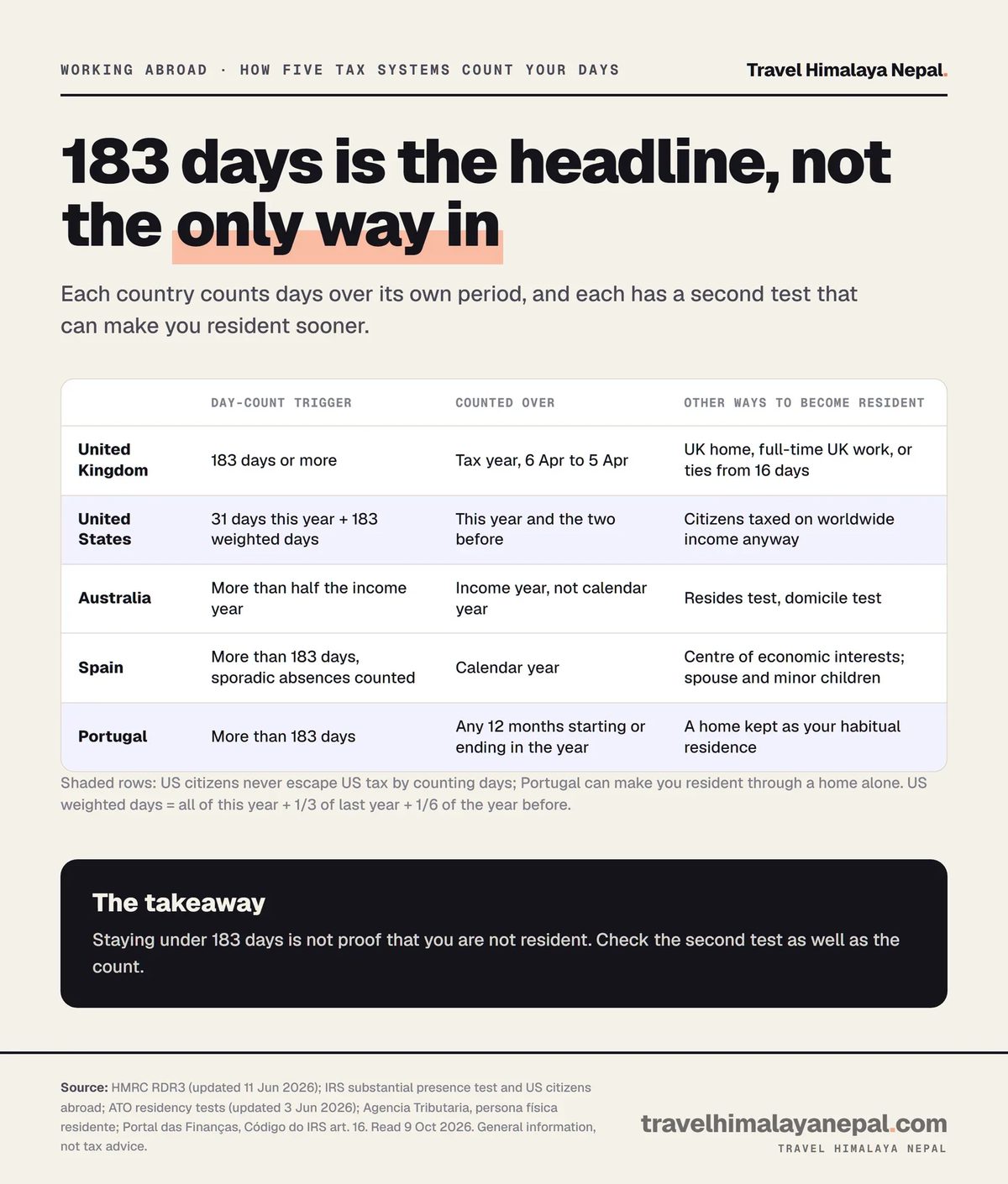
Both use more than 183 days as the headline, but Spain counts the calendar year and adds sporadic absences, while Portugal counts any 12-month window and can make you resident through a home alone.
Spain’s tax agency says you are resident if you spend more than 183 days in Spain in the calendar year, and that “sporadic absences” are counted towards those days unless you prove tax residence in another country. You are also resident if Spain is the main base of your activities or economic interests, and residence is presumed if your spouse and dependent minor children live there.
Portugal’s IRS Code, Article 16, makes you resident if you stay more than 183 days, consecutive or not, “in any 12-month period” starting or ending in the year. It also catches someone who stayed less time but had, on any day in that period, a home in conditions suggesting an intention to keep and occupy it as their habitual residence. Any day that includes an overnight stay counts as a day of presence.
| Country | Day-count trigger | Counting period | Other ways to become resident |
|---|---|---|---|
| United Kingdom | 183 days or more | Tax year, 6 April to 5 April | UK home, full-time UK work, or ties from 16 days |
| United States | 31 days this year and 183 weighted days | Current year plus two previous years | Citizens taxed on worldwide income regardless |
| Australia | More than half the income year | Income year, not calendar year | Resides test, domicile test |
| Spain | More than 183 days, sporadic absences counted | Calendar year | Centre of economic interests; spouse and minor children |
| Portugal | More than 183 days | Any 12 months starting or ending in the year | A home kept as your habitual residence |
If two countries both claim you, a treaty usually decides. Spain’s agency lists the standard order: where you have a permanent home available, then where your personal and economic ties are closer, then where you habitually live, then nationality. That is why keeping your home at home matters on a long trip.
Why might your employer say no?
Your employer has two risks: payroll obligations in the country you work from, and the chance your presence creates a “permanent establishment” that makes the company itself taxable there. That, not doubt about your work ethic, is why many employers cap workations.
The payroll risk follows Article 15 above: once you pass the treaty day count, or if a local entity bears your salary, the host country may tax your pay, and the employer may have to withhold. The company risk was clarified in the OECD’s 2025 Update to the Model Tax Convention, published on 19 November 2025. A May 2026 OECD blog by its treaty team summarised it: “a person working from their home in another country for less than half of their total working time would not, on its own, result in a place of business.” Even above that, it says, the question is whether there is a commercial reason for the work to be done from that country. A holiday rental chosen because you like the light is not a commercial reason.
What should you check before you go?
Six checks cover most workations: your days, your counting period, your home, your employer, the treaty and your paper trail.
Tax, calendar, income year or rolling 12 months.
It is the first treaty tie-breaker.
Dates and country, before you book.
Your home country and the destination, employment article.
Boarding passes, stamps, a spreadsheet.
An adviser can still change the plan.
The visa is a separate question: working remotely on a tourist visa covers it country by country, and in Europe the Schengen 90/180-day rule often ends the trip before any tax threshold does.
Our verdict
Keep a workation under three months, keep your home and your employer’s written approval, and you will usually stay taxed where you live now. Past that, stop treating 183 days as a finish line: the UK ties test, Portugal’s home test and Spain’s economic-interests test can all bite earlier, and an American is in the US system either way. The cheapest correct plan is one adviser call before you book, not after the bill. For the wider picture of nomad tax, see why working abroad does not make you tax-free.
Can I work anywhere for 182 days without paying tax there?
No. 183 days is a common trigger, not a guarantee. Ties, a home or your economic interests can make you resident sooner, and a treaty can let the host country tax your salary if a local entity pays it.
Can I be tax resident in two countries at once?
Yes, because each country applies its own law. Where a treaty exists, its tie-breaker usually settles which one wins.
Does a digital nomad visa settle my tax?
No. A visa decides whether you may stay. Some nomad schemes carry their own tax terms, so read the scheme, not just the visa page.
Keep reading
The visa side: where visitors may work remotely.
Which countries offer one, and the income they ask for.
Travel, nomad or expat plan, and what each leaves out.
Why working abroad does not make you tax-free.
Sources: OECD, Model Tax Convention on Income and on Capital, condensed version 2017, Article 15; OECD press release, 19 November 2025, and OECD blog “Home and away”, 26 May 2026; HMRC, Guidance note for Statutory Residence Test (RDR3), updated 11 June 2026, and GOV.UK, Tax on foreign income: residence; IRS, Substantial presence test (reviewed 14 March 2026), US citizens and resident aliens abroad (28 September 2026), Foreign earned income exclusion and physical presence test; ATO, Residency: the 183-day test, the resides test and the domicile test (updated 3 June 2026); Agencia Tributaria, Persona física residente en España; Portal das Finanças, Código do IRS, Article 16. All read on 9 October 2026. This is general information, not tax advice.
Cover photo via Pexels: Kaboompics.

Written by
Bishnu AdhikariPokhara-based, NMA-certified trekking guides. We’ve led 5,000+ treks across the Annapurna and Everest regions since 1998 — every word here comes from the trail. More from this author →
Ready to Trek?
From reading about it to standing on it
Our Pokhara-based guides have been doing this since 1998. Tell us your dates and fitness level — we'll build your perfect itinerary. Free, no obligation.
More guides like this
Popular trips to consider
View all treks & toursFree Trekker’s Insider Guide
Permits, packing lists, cost breakdowns — no fluff.
We send one useful email. You can unsubscribe anytime.