
The drink driving limit abroad is lower than you think
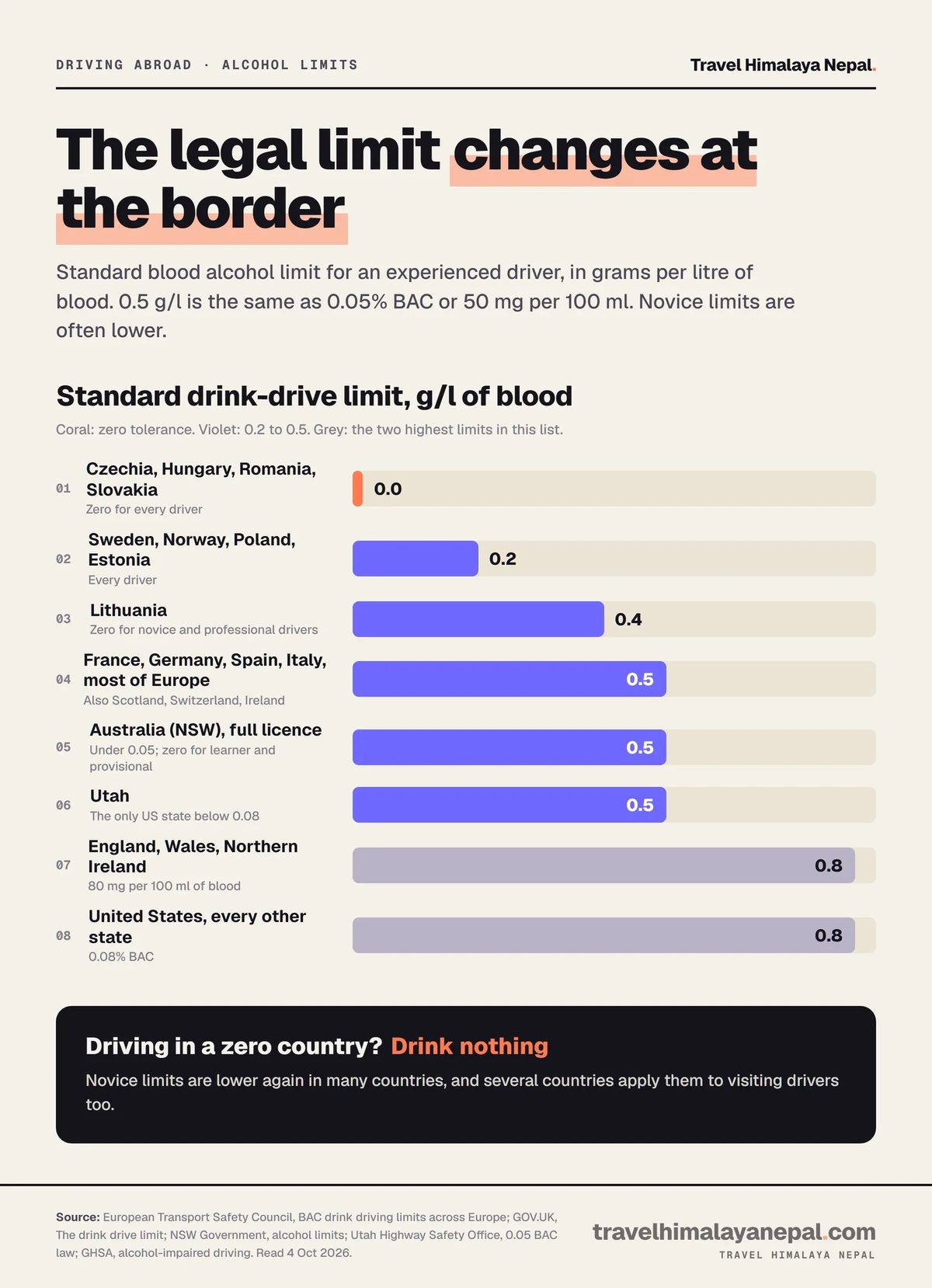
Most of Europe allows 0.5 g/l, four EU countries allow zero, and England and the US sit at 0.8. The full table by country, with the novice limits.

On this page (7)
Most of Europe sets the drink-drive limit at 0.5 grams of alcohol per litre of blood (0.05% BAC), but the Czech Republic, Hungary, Romania and Slovakia allow none at all, and Sweden, Norway, Poland and Estonia stop at 0.2. England, Wales and Northern Ireland sit at 0.8, the same as every US state except Utah, which drops to 0.05%. Australia uses 0.05 for full licence holders and zero for learners and provisional drivers. If you have held your licence for only a couple of years, your limit abroad may be lower still.
The trap is the unit as much as the number. A Briton used to 80 mg, an American used to 0.08 and a German used to 0.5 per mille are all describing the same scale in different words, and a limit that sounds generous at home can be a criminal offence one border later. Here is the full table and how to read it.
- 0.5 g/l, 0.05% and 50 mg per 100 ml are the same limit. Convert before you compare.
- Four EU countries allow zero. One drink the night before can still show the next morning.
- Novice limits often apply by licence age, not by nationality. France drops to 0.2 for anyone with under three years behind the wheel.
- There is no safe number of drinks. Body weight, food and time all change the result, which is why we do not print one.
How to read a drink-drive limit in any unit
Every limit in this article is blood alcohol concentration, and 0.5 g/l equals 0.05% BAC equals 50 mg per 100 ml. Europe mostly writes grams per litre (sometimes "per mille", or mg/ml, which is the same number). The US writes a percentage. The UK writes milligrams per 100 millilitres. Move the decimal point and they line up: the UK’s 80 mg is 0.8 g/l is 0.08%.
Police often test breath rather than blood, and breath limits use their own numbers. GOV.UK gives England, Wales and Northern Ireland as 35 micrograms per 100 ml of breath and Scotland as 22. Germany’s entry on the EU’s Your Europe site gives 0.5 mg/ml in blood or 0.25 mg/l in breath. Do not try to compare a breath figure from one country with a blood figure from another; use the blood limit in the table below.
Renting a car for the trip? Read what rental car insurance abroad actually covers before you reach the counter.
Drink-drive limits by country
Standard drivers in most European countries may drive up to 0.5 g/l, but professional and novice drivers usually face a lower limit, and in some countries it is zero. The European figures below are from the European Transport Safety Council, cross-checked against the EU’s Your Europe pages for the main holiday countries. Where the two disagree we say so.
| Country | Standard (g/l) | Novice (g/l) | Professional (g/l) |
|---|---|---|---|
| Austria | 0.5 | 0.1 | 0.1 |
| Belgium | 0.5 | 0.5 | 0.2 |
| Croatia | 0.5 | 0.0 | 0.0 |
| Czech Republic | 0.0 | 0.0 | 0.0 |
| Denmark | 0.5 | 0.2 (from 1 July 2025)* | 0.5 |
| Estonia | 0.2 | 0.2 | 0.2 |
| France | 0.5 | 0.2 | 0.5 (0.2 bus drivers) |
| Germany | 0.5 | 0.0 | 0.0 |
| Greece | 0.5 | 0.2 | 0.2 |
| Hungary | 0.0 | 0.0 | 0.0 |
| Ireland | 0.5 | 0.2 | 0.2 |
| Italy | 0.5 | 0.0 | 0.0 |
| Lithuania | 0.4 | 0.0 | 0.0 |
| Netherlands | 0.5 | 0.2 | 0.5 |
| Norway | 0.2 | 0.2 | 0.2 |
| Poland | 0.2 | 0.2 | 0.2 |
| Portugal | 0.5 | 0.2 | 0.2 |
| Romania | 0.0 | 0.0 | 0.0 |
| Slovakia | 0.0 | 0.0 | 0.0 |
| Spain | 0.5 | 0.3 (0.0 under 18) | 0.3 |
| Sweden | 0.2 | 0.2 | 0.2 |
| Switzerland | 0.5 | 0.1 | 0.1 |
| England, Wales, N. Ireland | 0.8 | 0.8 | 0.8 |
| Scotland | 0.5 | 0.5 | 0.5 |
| United States (except Utah) | 0.8 (0.08%) | Set by each state | |
| Utah | 0.5 (0.05%) | Set by the state | |
| Australia (NSW) | Under 0.5 (0.05) | 0.0 | Under 0.2 for heavy, dangerous-goods and public vehicles |
*ETSC lists Denmark’s novice limit as 0.2 from 1 July 2025; Denmark’s entry on Your Europe still shows 0.5 for novices. Assume the lower figure.
In words, because the table is easy to misread: four EU countries, the Czech Republic, Hungary, Romania and Slovakia, allow no alcohol for anyone. Sweden, Norway, Poland and Estonia allow 0.2. Lithuania allows 0.4. France, Germany, Italy, Spain, Portugal, Austria, Switzerland, Ireland, the Netherlands, Belgium, Greece, Croatia, Denmark and Scotland use 0.5 for experienced drivers. England, Wales and Northern Ireland are the outlier at 0.8.
The novice-driver rule that catches visitors
Several countries set a lower limit by how long you have held a licence or by your age, and they apply it to the driver in front of them, wherever the licence came from. Check this if you passed your test recently or are under 21.
- France: 0.2 for drivers who have held a licence for less than three years, or less than two years after accompanied learning, according to France’s entry on Your Europe.
- Germany: a total ban for drivers in their probation period and for drivers under 21.
- Austria: 0.1 for drivers with less than three years’ experience.
- Netherlands: 0.2 for drivers with less than five years’ experience.
- New South Wales: zero for learners, provisional drivers and visitors holding an overseas or interstate learner, provisional or equivalent licence.
A 22-year-old American who passed their test at 20 is, by France’s definition, a novice. So is a Briton who passed last year. The safest reading is to treat yourself as a novice anywhere your licence is under three years old.
What happens if you are over the limit abroad
Expect a fine at minimum, and in many countries a driving ban, points or a criminal record, sized to how far over you are. The penalties are set nationally and are not harmonised across the EU, so the same reading costs very different amounts.
Two examples published on Your Europe show the range. Greece fines €350 from 0.5 g/l (or from 0.2 for novice and professional drivers), €700 from 0.8 and €1,200 from 1.1, with licence withdrawal rising from 30 days to 180 days. Ireland gives a maximum penalty on conviction of €5,000 and/or six months in prison. Germany sanctions 0.5 g/l with a fine, a driving ban and two points.
Being a visitor does not soften any of this: the limits and penalties apply to whoever is driving, on whatever licence.
How many drinks is that? Our honest answer
We will not convert a limit into a number of drinks, because no official source does it reliably for an individual, and getting it wrong is a crime. Your result depends on body weight, sex, food, the strength of the drink and how long ago you had it. A large glass of wine abroad can also be bigger and stronger than the one you pour at home.

The rule we follow when driving abroad is simple: if you are driving, do not drink. In the four zero-tolerance countries that is the law anyway, and alcohol from the night before can still be in your blood the next morning. If you are renting, know how a speeding fine reaches you after a rental and which cities need an emission sticker. For everything else on the road, see our guides to driving on the left for the first time, European vignettes and tolls and whether you need an international driving permit.
Frequently asked questions
What is the drink-drive limit in Europe?
Most European countries use 0.5 grams of alcohol per litre of blood (0.05% BAC). The Czech Republic, Hungary, Romania and Slovakia use zero; Sweden, Norway, Poland and Estonia use 0.2; Lithuania 0.4; England, Wales and Northern Ireland 0.8.
Which countries have a zero alcohol limit for drivers?
In the EU, the Czech Republic, Hungary, Romania and Slovakia apply zero to every driver. Many more countries apply zero to novice or professional drivers, including Germany, Italy, Croatia and Lithuania.
Is the UK drink-drive limit the same as Europe’s?
Not in England, Wales and Northern Ireland, where it is 80 mg per 100 ml of blood (0.8 g/l), higher than most of Europe. Scotland’s limit is 50 mg (0.5 g/l), in line with most European countries.
What is the US legal limit compared with Europe?
Every US state except Utah sets 0.08% BAC, which equals 0.8 g/l. Utah has used 0.05% since 30 December 2018, which matches the common European 0.5 g/l.
Do novice limits apply to tourists?
Often, yes. France applies 0.2 to drivers with under three years on their licence, Germany has a total ban for drivers under 21 or on probation, and New South Wales applies zero to visitors on an overseas learner or provisional licence.
What is the drink-drive limit in Australia?
In New South Wales, under 0.05 for full licence holders, under 0.02 for heavy, dangerous-goods and public-vehicle drivers, and zero for learner and provisional drivers, including visitors on equivalent overseas licences.
Keep reading
Which countries ask for one, and how to get it.
CDW, excess and the counter upsell.
Where it goes wrong, and how to stay left.
Buy the pass before the border.
Sources: European Transport Safety Council, Blood Alcohol Content (BAC) drink driving limits across Europe; European Commission, Your Europe, Road rules and safety (country pages for France, Germany, Greece, Ireland, Austria, the Netherlands, Denmark and others); GOV.UK, The drink drive limit; NSW Government, Alcohol limits, drugs and medicines; Utah Highway Safety Office, Utah’s 0.05 BAC law; Governors Highway Safety Association, Alcohol-impaired driving. All read 4 October 2026.
Photo: Stephen Leonardi / Pexels Photo: Ketut Subiyanto / Pexels

Written by
Anjali ShresthaPokhara-based, NMA-certified trekking guides. We’ve led 5,000+ treks across the Annapurna and Everest regions since 1998 — every word here comes from the trail. More from this author →
Ready to Trek?
From reading about it to standing on it
Our Pokhara-based guides have been doing this since 1998. Tell us your dates and fitness level — we'll build your perfect itinerary. Free, no obligation.
More guides like this
Popular trips to consider
View all treks & toursFree Trekker’s Insider Guide
Permits, packing lists, cost breakdowns — no fluff.
We send one useful email. You can unsubscribe anytime.