
The short version
K2 vs Everest: which is deadlier and harder? Height, death rates, the Bottleneck, winter firsts, and the safe way to stand at Everest Base Camp.
K2 vs Everest is the argument that never dies in mountaineering circles — and for good reason. One is the highest point on Earth, a name every schoolchild knows. The other is 238 metres shorter, almost anonymous outside climbing culture, and yet it kills a far greater share of the people who dare it. Ask a climber which mountain they respect more and most will not say Everest. They will say K2. To understand why, you have to look past the raw altitude and into the numbers, the terrain, the weather, and the human stories that separate these two giants.
This is a head-to-head on the things people actually search for: which peak is deadlier, which is harder, and why K2 has earned the nickname "the Savage Mountain." We will keep every figure honest — distinguishing the total number of deaths (the toll) from the death rate (your odds), because the two are constantly confused online. And at the end, we will draw the line most articles skip: neither summit is a holiday, but one of these mountains has a base camp you can walk to safely, and it is the higher of the two.
K2 vs Everest at a glance
| Mount Everest | K2 | |
|---|---|---|
| Height | 8,849 m (29,032 ft) — highest on Earth | 8,611 m (28,251 ft) — second highest |
| Range / border | Himalaya · Nepal–China (Tibet) | Karakoram · Pakistan–China |
| Nickname | "The roof of the world" | "The Savage Mountain" |
| First ascent | 1953 (Tenzing Norgay & Edmund Hillary) | 1954 (Lino Lacedelli & Achille Compagnoni) |
| First winter ascent | 17 Feb 1980 (Polish team) | 16 Jan 2021 (all-Nepali team) — last 8,000er in winter |
| Total summiteers (as recorded) | ~6,600+ | ~700–1,000 |
| Deaths (toll, as recorded) | ~320+ | ~90+ |
| Fatality rate | Under ~1% above Base Camp | Historically ~13–23% |
| Standard route | South Col (Nepal) / North Col (Tibet) | Abruzzi Spur |
| An "easy" route? | Guided, heavily fixed & commercialised | No non-technical route exists |
| Trek to Base Camp for tourists? | Yes — safe, guided teahouse trek | No — a serious mountaineering expedition |
Two numbers in that table tell almost the whole story: Everest is taller, but K2 is roughly ten to twenty times likelier to kill the climbers who attempt it. Everything below is the explanation.
The height gap — and why it barely matters
Everest wins the altitude contest cleanly. At 8,849 m it stands about 238 m above K2's 8,611 m — both are firmly in the "death zone," the region above roughly 8,000 m where there is too little oxygen for the human body to survive for long, no matter how fit you are. Cells begin to die, judgement blurs, and every hour spent up high erodes your margin.
Here is the counter-intuitive part: those extra metres do not make Everest the harder climb. The death zone punishes both peaks brutally, and K2's shorter stature is more than cancelled out by everything else about it — steeper rock, a more exposed summit pyramid, worse weather, and no gentle line to the top. Altitude decides which mountain is highest. It does not decide which is deadliest. If you want the wider context of how the world's giants stack up, our ranking of the 14 eight-thousanders puts both peaks alongside their twelve siblings.
Death rate — the real gulf between them
This is where the two mountains part company for good, and where it is vital to separate two different statistics.
The death toll is the total number of people who have died. Because Everest has been climbed by thousands of people, its toll is naturally larger — as recorded by the Himalayan Database, more than 320 people have died on Everest against over 6,600 who have reached the top. K2's toll is smaller, roughly 90-plus deaths, simply because far fewer people have ever set foot on it.
The death rate is what actually measures danger: your chance of dying if you attempt the summit. And here the gap is enormous. On Everest, the fatality rate for climbers above Base Camp sits under about 1% — and it has been falling, from roughly 1.4% in the decades up to 2006 to around 0.7% in the modern guided era, as fixed ropes, better weather forecasting and bottled oxygen have made the standard routes more survivable. On K2, the historical fatality rate has run somewhere between roughly 13% and 23% depending on the era and how you count — meaning that for long stretches of its history, as recorded, something like one climber died for every three or four who reached the top.
Everest kills more people in total. K2 kills a far greater share of the people who try it. Both statements are true, and confusing them is the single most common mistake made about these two mountains.
One frequently cited comparison captures it well: on Everest, roughly one climber in thirty-four dies during descent when using supplemental oxygen; on K2, the descent has historically claimed something closer to one in five. The mountain that looks smaller on paper is the one that stacks the odds hardest against you. For the mechanics of how altitude, cold and crowding turn fatal, see our deeper piece on why people die on Everest, and where both peaks land on our list of the deadliest mountains in the world.
The Savage Mountain and the Bottleneck
K2 earned its nickname the hard way. American climber George Bell, after the 1953 expedition, reportedly called it "a savage mountain that tries to kill you," and the name stuck because it fits. Unlike Everest, K2 offers no forgiving flank, no long gentle glacier stroll to a high camp. From base to summit it is steep, sustained and technical, and the final approach funnels every climber through the most feared piece of ground in high-altitude mountaineering: the Bottleneck.
The Bottleneck is a narrow, steep couloir at roughly 8,200 m — some 400 m below the summit and deep in the death zone. It would be terrifying enough on its own. What makes it lethal is what hangs above it: an enormous, unstable wall of glacial ice known as a serac. Climbers must traverse directly beneath this hanging ice, exhausted and starved of oxygen, with no fast way through and no shelter if it lets go. When it does, there is no outrunning it.
That is exactly what happened in the 2008 K2 disaster, the worst single accident in the mountain's history. On 1 August 2008, eleven climbers died within about 24 hours after a serac collapse in the Bottleneck swept away the fixed ropes that climbers were depending on to descend. Stranded above the break, in the dark, out of oxygen, many never made it down. The statistic that haunts the mountain: the overwhelming majority of K2's recent fatal accidents have occurred at or near the Bottleneck. Everest has its own killing zones — the Khumbu Icefall, the summit ridge in a storm — but nothing so concentrates death into a single 300-metre stretch the way K2's Bottleneck does.
Technical difficulty — there is no easy way up K2
This is the crux of the "is K2 harder than Everest" question, and the honest answer is yes — for the climber, by a wide margin.
Everest's popular routes, the South Col from Nepal and the North Col from Tibet, are extraordinarily demanding, but they are not, in the mountaineering sense, highly technical. On a normal commercial expedition the route is fixed with rope almost end to end, ladders bridge the crevasses of the Khumbu Icefall, and the majority of clients climb with bottled oxygen and the support of experienced Sherpa guides. Fitness, acclimatisation, deep pockets and good weather can carry a determined amateur to the top. That is precisely why so many people summit Everest each year.
K2 offers no such bargain. Every route to its summit is steep, exposed and genuinely technical, involving sustained rock and ice climbing at an altitude where the body is shutting down. There is no "walk-up" line, no gentle option for the less experienced. K2 demands real alpine skill on top of everything Everest asks — which is why it remains, overwhelmingly, a mountain for elite mountaineers rather than paying clients. Everest is famous. K2 is the climber's mountain.
Weather and remoteness — the Karakoram penalty
Location makes a hard mountain harder. Everest sits in the Himalaya on the Nepal–China border, well served by the trekking infrastructure of the Khumbu and reachable in days. K2 stands far to the northwest in the Karakoram, on the Pakistan–China border, deep in one of the most remote high-mountain regions on Earth. Even reaching its base camp is a long, committing expedition across the Baltoro Glacier.
The Karakoram's weather is notoriously more violent and less predictable than the Everest region's. It sits further from the equator, its storms are ferocious, and its summer climbing window is short and fickle. Add the remoteness — a serious rescue on K2 is vastly harder to mount than on Everest, where helicopters can reach high on the mountain in good conditions — and the margin for error shrinks again. On Everest a struggling climber has a realistic chance of help. High on K2, you are largely on your own.
The winter prize — and a moment of Nepali history
Nothing illustrates the gap between these mountains like the story of their winter first ascents.
Everest fell to winter climbers in 1980. On 17 February that year, Poles Krzysztof Wielicki and Leszek Cichy stood on the summit — a landmark expedition led by Andrzej Zawada that opened the whole era of Himalayan winter climbing. It was a monumental achievement, and it happened more than four decades ago.
K2 held out for another forty-one years. It was the very last of the fourteen 8,000-metre peaks to be climbed in winter, and for years it was considered by many to be effectively impossible in the season's cold and wind. Then, on 16 January 2021, it finally fell — and it fell to a team of ten Nepali mountaineers who had joined forces specifically to claim it for their country. Names including Nirmal "Nims" Purja and Mingma Gyalje Sherpa reached the summit together, deliberately pausing just below the top so they could step onto it as one, singing the Nepali national anthem. Purja completed the climb without supplemental oxygen.
For generations the world's greatest Himalayan feats were credited to foreign expeditions while Nepali climbers carried the loads. The first winter ascent of K2 flipped that story — the hardest prize left in mountaineering was taken by an all-Nepali team, for Nepal.
For us, that history is personal. Our guides are countrymen of the climbers who made it, part of a mountaineering culture that no longer simply supports the world's expeditions but leads them. It is the same culture — the same deep hill knowledge and mountain judgement — that looks after every trekker who walks with us in the Everest region.
Crowds vs. the climber's mountain
Everest's fame has a price: crowds. In a single good-weather window, dozens or even hundreds of people can move toward the summit on the same day, producing the now-infamous photographs of climbers queuing on the ridge. Commercialisation has made Everest more accessible than ever — and, in bad seasons, the congestion itself becomes a danger, as slow-moving lines leave people stuck too long in the death zone.
K2 is the opposite. Even in its busier recent seasons it sees only a fraction of Everest's traffic, and historically a summit day might involve a mere handful of the world's strongest climbers — or nobody at all. It cannot be packaged the way Everest has been, because no amount of money can shortcut the skill it demands. That exclusivity is exactly why serious mountaineers revere it. Everest is the one the public knows; K2 is the one climbers dream about.
Cost and access
Both are expensive undertakings that run well into the tens of thousands of dollars once you account for permits, logistics, oxygen, guides and weeks on the mountain. Everest's costs are inflated by Nepal's high climbing permit and the scale of commercial support; K2's by the sheer remoteness of the Karakoram and the specialist expedition required to get anywhere near it. But cost is the least interesting difference between them. You cannot buy your way up K2 the way you can, in effect, buy a heavily supported shot at Everest. On the Savage Mountain, skill is the currency.
So which is harder — and which is deadlier?
Let us settle it plainly. K2 is both harder to climb and, by rate, far deadlier than Everest. It is more technical from bottom to top, it has no easy route, its weather is worse, it is more remote, and the odds of dying on it are many times higher. Everest is taller, and because so many attempt it, its total death toll is larger — but statistically, an individual climber is dramatically safer on Everest than on K2.
The reason Everest is famous and K2 is not comes down to a single word: accessibility. Everest can be attempted by well-funded, well-guided amateurs, so thousands have, and the world knows their stories. K2 turns those people away at the door. That is why, among the people who actually climb, K2 — not Everest — is the ultimate test.
You don't have to climb to stand in Everest's shadow
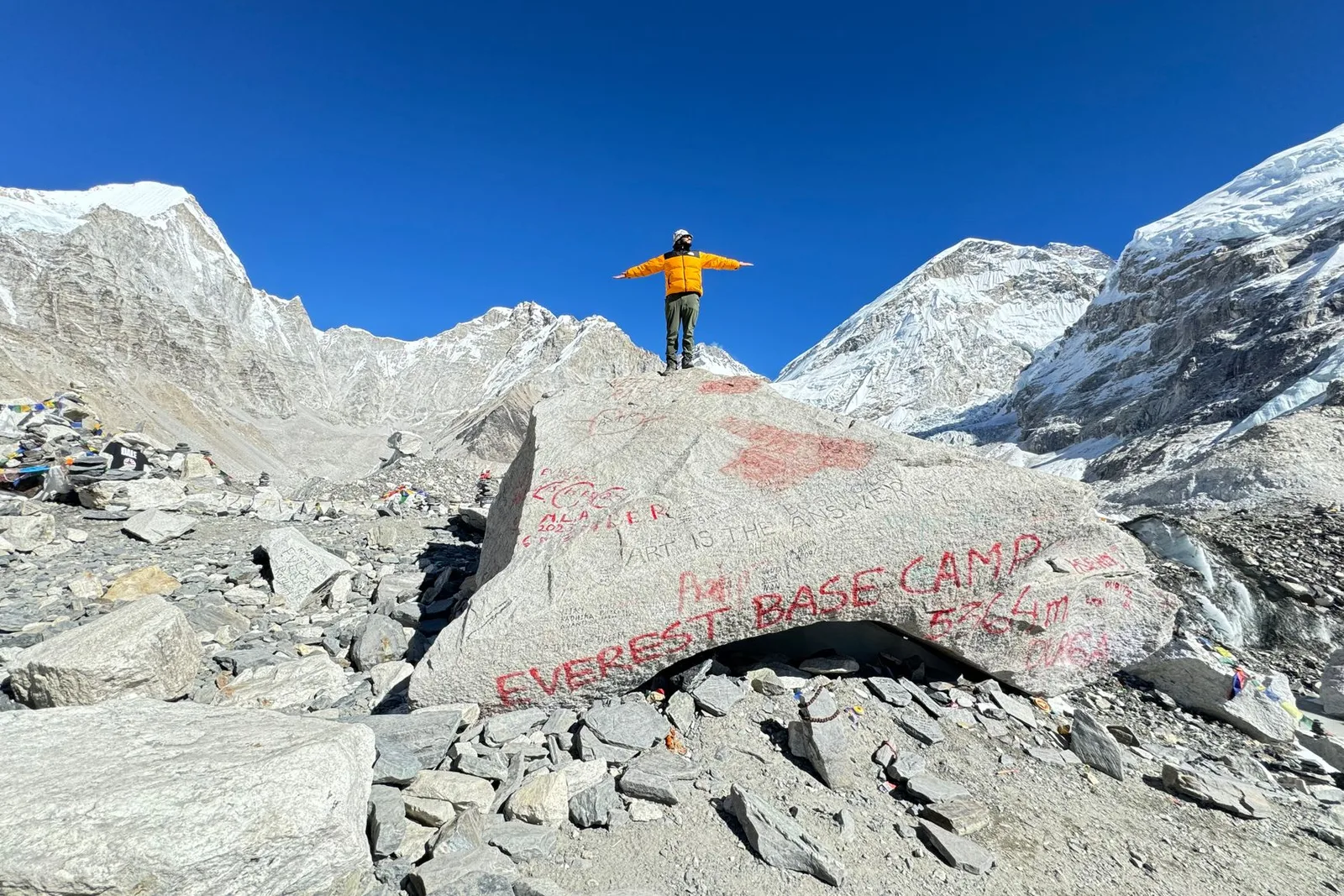
Here is the good news for the rest of us. K2 has no accessible tourist trek — its base camp lies at the end of a serious, high-risk mountaineering expedition across the Baltoro Glacier in Pakistan, not a route for ordinary travellers. But Everest's base camp is completely different. It sits at the end of one of the great walking journeys on the planet, a guided teahouse trek that any reasonably fit person can complete — no ropes, no ice axes, no climbing whatsoever. You sleep in warm lodges, eat hot meals, walk at a sensible pace with an acclimatisation plan, and stand at the foot of the highest mountain on Earth having climbed nothing more dangerous than a well-trodden trail.
Our classic Everest Base Camp Trek — 14 Days is the flagship: from US$1,850 per person as a solo traveller, dropping to US$1,350 per person for groups of eight or more. Want the quieter, more scenic variation with turquoise glacial lakes and arguably the best Everest panorama of all from Gokyo Ri? The EBC via Gokyo Lakes Trek — 15 Days runs from US$2,300 per person solo, and US$1,650 per person at eight-plus. Neither involves a single move of technical climbing. If you want to know exactly what the walk demands of your body, read our honest breakdown of how hard Everest Base Camp really is, and use our Everest Base Camp trek guide and Everest region guide to plan the trip.
And if the mountains stir something more ambitious in you, there is a genuine, safe first rung onto real Himalayan climbing — trekking peaks. Nepal's classic beginner summits give you crampons, an ice axe and a taste of the death-defying world above 6,000 m, with full guiding and none of K2's savagery. Our Island Peak Climbing — 18 Days starts from US$3,600 per person solo (from US$2,800 at eight-plus), and Mera Peak Climbing — 15 Days from US$2,500 per person solo (from US$1,950 at eight-plus) — Mera is often called Nepal's highest trekking peak, and both are worlds apart from the elite mountaineering that K2 demands.
Before you book anything, it is worth browsing our roundups of the best treks in the world, the most beautiful mountains in the world, and the best places to visit in Nepal to see where Everest fits into a bigger trip. And when you are ready to plan the practicalities, our Nepal trekking permits hub and Nepal visa guide cover everything you need to arrive and walk legally.
Frequently asked questions
Is K2 harder than Everest?
Yes. By almost every measure that matters to a climber, K2 is harder than Everest. It is steeper and more sustained, it is genuinely technical from bottom to top with no non-technical route, its weather in the remote Karakoram is more violent, and rescue is far more difficult. Everest is taller and can be attempted by well-supported amateurs on heavily fixed, guided routes; K2 turns those climbers away and remains a peak for elite mountaineers only.
Why is K2 so dangerous?
Several factors compound. Every route is steep and technical at altitudes where the body is failing; the notorious Bottleneck couloir at around 8,200 m forces climbers directly beneath a huge, unstable hanging serac that has caused catastrophes like the 2008 disaster; the Karakoram's weather is severe and unpredictable; and the mountain's remoteness makes rescue extremely hard. Together these give K2 a historical fatality rate of roughly 13–23% — many times higher than Everest's.
Which has killed more people, K2 or Everest?
In total numbers, Everest — more than 320 deaths as recorded, versus roughly 90-plus on K2. But that is because thousands more people have attempted Everest. By death rate — your odds of dying if you attempt the summit — K2 is far deadlier, historically around 13–23% against under about 1% for climbers above Everest Base Camp. Toll and rate are different measures, and K2 wins the one that reflects real danger.
Can tourists trek to K2 Base Camp?
Not in the way most people imagine. K2 Base Camp sits deep in Pakistan's Karakoram at the end of a long, demanding expedition across the Baltoro Glacier — a serious mountaineering undertaking, not a casual teahouse trek. There is no safe, easy tourist route to it. If you want to stand at the foot of a giant, Everest Base Camp is the far more accessible and safer choice.
Can I trek to Everest Base Camp without climbing?
Absolutely — and that is the whole point of the trek. The Everest Base Camp trek is a guided walking journey on established trails, with lodge accommodation and hot meals along the way. There is no technical climbing, no ropes and no ice axes. Any reasonably fit person who trains a little and follows a proper acclimatisation schedule can reach Base Camp at 5,364 m and stand in the shadow of the world's highest mountain.
Sources: figures in this article are drawn from the Himalayan Database and widely reported mountaineering records. Fatality figures are stated as recorded and approximate, and we deliberately distinguish the total death toll from the death rate, which are different measures.
Written by
Travel Himalaya NepalPokhara-based, NMA-certified trekking guides. We’ve led 5,000+ treks across the Annapurna and Everest regions since 1998 — every word here comes from the trail. More from this author →
Share this article
Ready to Trek?
From reading about it to standing on it
Our Pokhara-based guides have been doing this since 1998. Tell us your dates and fitness level — we'll build your perfect itinerary. Free, no obligation.
Why trek with our licensed agencyMore guides like this
Popular trips to consider
View all treks & toursFree Trekker's Insider Guide
Permits, packing lists, cost breakdowns — no fluff.
We send one useful email. You can unsubscribe anytime.