
The short version
Card points move to airline and hotel programmes in 1,000-point blocks, often 1:1 but not always, and the move is final. Find the seat before you transfer.
A transfer partner is an airline or hotel loyalty programme that will turn your card points into its own miles or points, usually in blocks of 1,000 and often, but not always, at one-for-one. The four big US programmes — Chase Ultimate Rewards, American Express Membership Rewards, Capital One miles and Citi ThankYou — each have their own list of partners and their own ratios, and the same card brand can pay a very different rate in another country. The one rule that matters more than any ratio: a transfer is final, so never move points until you have found the seat or room you want.

- Find the award first, transfer second. Points cannot come back once they leave your card account.
- Ratios vary. Most airline partners are 1:1, but Amex US gives 800 Emirates miles per 1,000 points and Capital One gives 750.
- Your country changes the deal. Amex Australia asks 3,000 points for 1,000 British Airways Avios; Amex US asks 1,000.
- Taxes and fees are extra. An award ticket still carries charges you pay in cash.
- We never put a value on a point. What a transfer is worth depends on the redemption you find.
How a points transfer works
You link your airline or hotel account to your card’s rewards portal, choose an amount in the allowed blocks, and the points arrive in the partner programme — usually quickly, sometimes after days. Chase says transfers go in 1,000-point increments, that many process by the next business day but can take up to seven, and that transfers to travel partners are final. Capital One sets a 1,000-mile minimum and says miles cannot be moved back once transferred. You need an account with the partner programme before you start, and the name on it must match your card account.
Not every card in a programme can transfer. Chase names the Sapphire Reserve, Sapphire Preferred and Ink Business Preferred as the cards that unlock its travel partners. If you want the full picture of earning and spending before you go further, start with miles and points for beginners.
Who partners with whom
The four programmes overlap on the big international airlines, but each has partners the others lack — Chase alone has World of Hyatt, Amex has Delta, Citi has American Airlines’ AAdvantage. The table shows selected partners and the ratio each issuer publishes. A tick without a ratio means the partner is listed but we could not verify the rate on the issuer’s public pages.
| Partner | Chase | Amex (US) | Capital One | Citi |
|---|---|---|---|---|
| Air Canada Aeroplan | 1:1 | 1:1 | 1:1 | — |
| Air France-KLM Flying Blue | 1:1 | 1:1 | 1:1 | Listed |
| British Airways (Avios) | 1:1 | 1:1 | 1:1 | — |
| Singapore Airlines KrisFlyer | 1:1 | 1:1 | 1:1 | Listed |
| Virgin Atlantic | 1:1 | 1:1 | Virgin Red, 1:1 | Listed |
| Qatar Airways (Avios) | — | 1:1 | 1:1 | Listed |
| Emirates Skywards | — | 1,000 = 800 | 2 : 1.5 | Listed |
| Cathay Pacific Asia Miles | — | 1,000 = 800 | 1:1 | Listed |
| JetBlue TrueBlue | 1:1 | 250 = 200 | 5 : 3 | Listed |
| Marriott Bonvoy | 1:1 | 1:1 | — | — |
| Hilton Honors | — | 1,000 = 2,000 | — | — |
| World of Hyatt | 1:1 | — | — | — |
The full lists are longer. Chase lists Aer Lingus, Aeroplan, British Airways, Flying Blue, Iberia, JetBlue, Singapore, Southwest, United and Virgin Atlantic among airlines, and IHG, Marriott, Hyatt and Wyndham among hotels; Chase describes its transfers as 1:1. Amex US lists 20 partners, including Delta, ANA, Avianca, Aeromexico and Qantas. Capital One adds Etihad, Finnair, TAP, Turkish, EVA and Japan Airlines, plus Accor, Choice, Wyndham and I Prefer hotels. Citi lists AAdvantage, Etihad, EVA, Qantas, Thai, Turkish and Wyndham among others.
When the ratio is not one-for-one
A ratio below 1:1 means you lose points in the move, and a ratio above it does not automatically mean a better deal. Capital One explains its ratios plainly: at 2:1.5, 1,000 miles become 750; at 5:3, they become 600; at 2:1, they become 500; at 1:2, they become 2,000.
- Amex US gives 800 Cathay Asia Miles and 800 Emirates miles per 1,000 points, 200 JetBlue points per 250, 250 Leading Hotels points per 1,000, but 1,600 Aeromexico points and 2,000 Hilton points per 1,000.
- Capital One transfers to Emirates, EVA Air and Japan Airlines at 2:1.5, JetBlue at 5:3, Accor at 2:1 and I Prefer at 1:2.
The Hilton and I Prefer ratios look generous, but hotel programmes often price rooms in far more points than airlines price seats, so a bigger number of hotel points is not the same as more value. Compare what the redemption actually costs in each programme’s own currency.
The same Amex transfer page shows different rates by country. Viewed from Australia on 27 September 2026, it listed 3,000 Membership Rewards points for 1,000 British Airways Avios, 4,000 for 1,000 Emirates miles and 7,500 for 2,500 KrisFlyer miles — against 1:1, 1,000 = 800 and 1:1 in the US. Never assume a ratio you read for one country applies to your card.
A worked example with real ratios
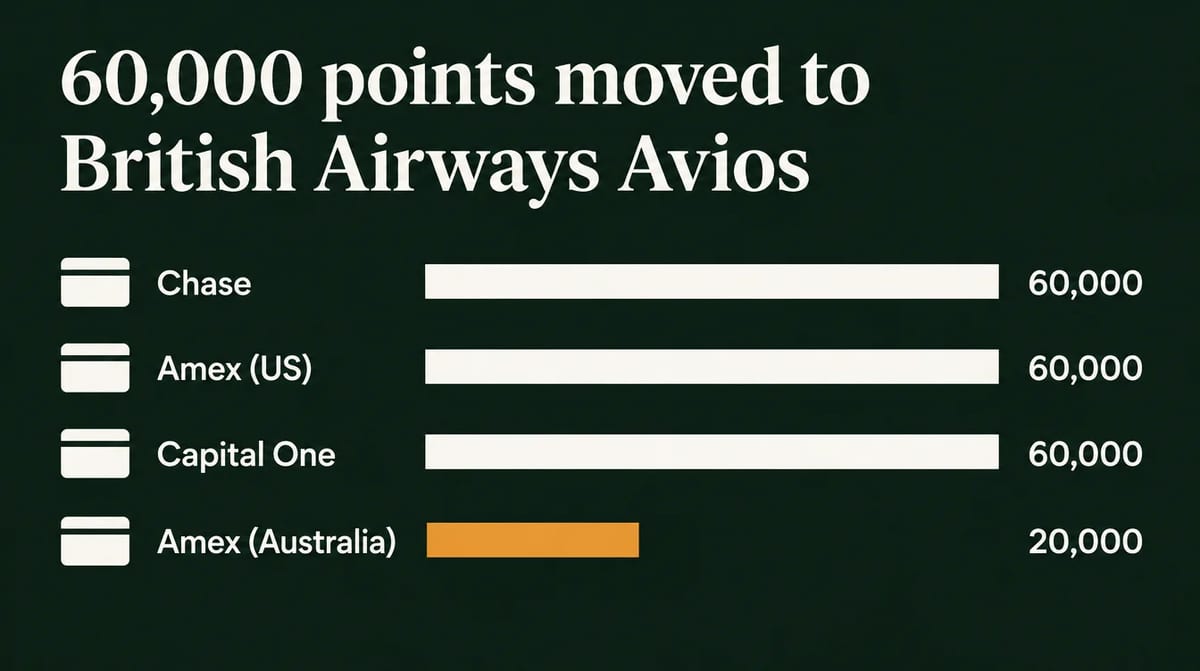
Sixty thousand points can become 60,000 Avios, 48,000 Emirates miles or 20,000 Avios, depending on the card and the country. Here is 60,000 points moved at the ratios each issuer published on 27 September 2026.
| 60,000 points from | To British Airways Avios | To Emirates Skywards |
|---|---|---|
| Chase | 60,000 | Not a partner |
| Amex (US) | 60,000 | 48,000 |
| Capital One | 60,000 | 45,000 |
| Amex (Australia) | 20,000 | 15,000 |
| Citi | Not listed | Check Citi’s transfer screen |
The arithmetic: Amex US gives 800 Emirates miles per 1,000 points, so 60,000 becomes 48,000; Capital One’s 2:1.5 turns 60,000 into 45,000; Amex Australia’s 3,000-for-1,000 Avios rate gives 20,000 and its 4,000-for-1,000 Emirates rate gives 15,000. What those miles buy depends on the airline’s award chart, the route, the date and the seat — which is why we do not put a dollar value on any of them. For how points can stretch to a better cabin, see how to fly business class for less.
Four ways a transfer goes wrong
Most transfer regrets come from moving points before checking the award, the fees and the timing.
- It cannot be undone. Chase calls transfers final; Capital One says transferred miles become subject to the partner’s rules and cannot come back. Points stranded in a programme you never use are worth nothing.
- The seat may not exist. Airlines release a limited number of award seats. Search the partner’s site for your exact dates first.
- Taxes and fees still apply. Award tickets carry taxes and carrier charges paid in cash, and they vary widely by airline and route.
- Transfers take time. Chase quotes up to seven business days for some partners. If the seat disappears while points are in transit, you still own the points — in the airline programme.
And the rule that sits above all of them: if you carry a balance on the card, the interest is costing you more than any transfer can earn back. Clear the balance first.
Using points for a trip to Nepal
Points can get you to Kathmandu, but they cannot pay for much once you are there, because Nepal outside the big hotels runs on cash. In our field reporting, cards work at a small number of upmarket hotels, large agencies and perhaps one or two restaurants per city, usually with a 3–4% surcharge, and not at all on the trail. The sensible plan is points for the long-haul flight, then a good no-foreign-fee card and cash for the ground. Our guide to paying in local currency and avoiding foreign transaction and ATM fees cover that part.
Once the flight is covered, the trek itself is simple to budget. Annapurna Base Camp is nine days at $920 USD solo and Everest Base Camp is twelve days at $1,700 USD solo, including permits, a government-registered guide, a porter, teahouses and meals.
See the Everest Base Camp trek →What are credit card transfer partners?
Airline and hotel loyalty programmes that accept points from a card rewards programme and convert them into their own miles or points, usually in blocks of 1,000 at a published ratio.
Are points transfers reversible?
No. Chase calls transfers to travel partners final, and Capital One says transferred miles cannot be moved back. Find the award you want before you transfer.
Are all transfers 1:1?
No. Many are, but Amex US gives 800 Emirates miles per 1,000 points, Capital One transfers to Emirates at 2:1.5, and some hotel partners convert at 1:2 or 2:1.
Do transfer ratios differ by country?
Yes. On 27 September 2026, Amex’s transfer page viewed from Australia listed 3,000 points for 1,000 British Airways Avios, while the US page listed 1,000 for 1,000.
How long does a points transfer take?
Often a day or less. Chase says many transfers process by the next business day but can take up to seven business days.
Keep reading
The four decisions that choose a card, with every comparison in one place.
How earning and redeeming really work.
Where points genuinely beat paying cash.
Which $95 card earns more on a normal budget.
The cards and passes that actually get you in.
Sources: Chase, Sapphire Preferred card page and education pages on transferring Ultimate Rewards points, plus Chase’s press release adding AerClub and Iberia; American Express, Membership Rewards transfer partner page as viewed from the US and from Australia; Capital One, miles transfer partners guide; Citi, ThankYou points transfer listing and Strata Premier card page. All read on 27 September 2026. Citi’s ratios were not visible on its public pages, so we do not state them. Card use in Nepal is Travel Himalaya Nepal field reporting. The worked example is our own arithmetic. This is general information, not financial advice; card offers change, so confirm the current terms with the issuer before you apply. No card issuer pays us for placement on this page.

Written by
Bishnu AdhikariPokhara-based, NMA-certified trekking guides. We’ve led 5,000+ treks across the Annapurna and Everest regions since 1998 — every word here comes from the trail. More from this author →
Share this article
Ready to Trek?
From reading about it to standing on it
Our Pokhara-based guides have been doing this since 1998. Tell us your dates and fitness level — we'll build your perfect itinerary. Free, no obligation.
Why trek with our licensed agencyMore guides like this
Popular trips to consider
View all treks & toursFree Trekker’s Insider Guide
Permits, packing lists, cost breakdowns — no fluff.
We send one useful email. You can unsubscribe anytime.