
The short version
Only when usable credits plus extra rewards over a free card beat the fee. A $95 card needs $6,333 to $19,000 of spend a year to pay for itself.
An annual fee is worth paying only when two things together beat it: the credits you would genuinely use anyway, and the extra rewards the card earns over a free one. For most people who spend a few hundred dollars a month and do not book travel through a card’s portal, a no-fee card with no foreign transaction fee is the better deal. For people who spend heavily or who would use a card’s travel credit anyway, a fee card can cost less than nothing. The maths is short, and it is worth doing before you apply rather than after.

- Compare against a free card, not against nothing. The fee has to beat what a no-fee card would have paid you.
- A credit counts only if you would have spent that money anyway. Otherwise it is a coupon, not a saving.
- The value of a point is your choice, so we show the maths at three values rather than pretend there is one.
- If you carry a balance, no fee card is worth it. Interest outruns every reward.
The three-line test
Add up the credits you would genuinely use, add the extra rewards over a free card, and subtract the fee; if the answer is positive, the card pays. Written out, it is three lines:
| Line | What to count | What not to count |
|---|---|---|
| 1. Usable credits | Credits for things you already buy, at the price you already pay | Credits for merchants you never use, or that push you to spend more |
| 2. Extra rewards | What the fee card earns minus what a free card earns on the same spending | The fee card’s rewards on their own, as if the free card earned nothing |
| 3. The fee | The annual fee, plus any authorised-user fees you would pay | The welcome bonus — it arrives once, the fee arrives every year |
The welcome bonus sits outside the test on purpose. It can make the first year a clear win, but the question that matters is whether you keep the card in year two, when the fee is due and the bonus is long spent.
The fair baseline is a free card with no foreign fee
Measure every fee card against a free card that earns 1.5% on everything and charges no foreign transaction fee, because that is what you would carry instead. The Capital One Quicksilver is exactly that: no annual fee, 1.5% cash back on every purchase and no foreign transaction fee, per Capital One’s own card page. A fee card that cannot beat it is charging you for nothing.
Be careful with the obvious alternative. The Chase Freedom Unlimited also has no annual fee and adds 3% categories, but it is not on Chase’s own list of cards with no foreign transaction fee — so abroad it can cost you on every purchase. For a traveller, the baseline has to be a card that works overseas without a fee, which is why we use the Quicksilver.
A $95 card, worked through
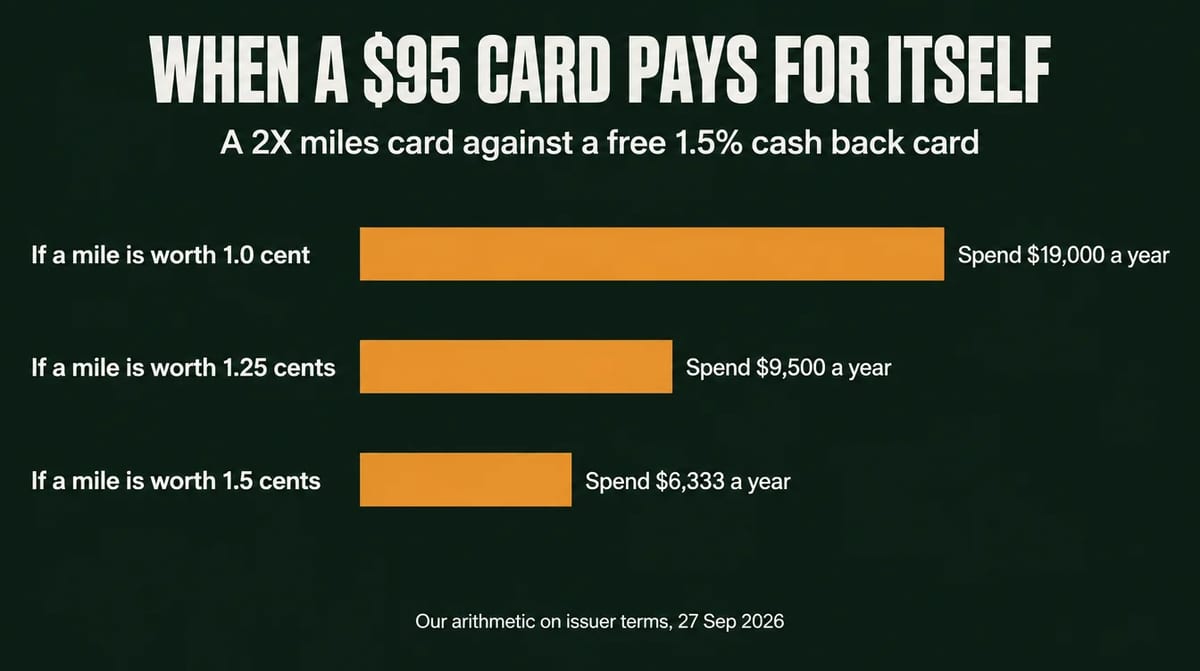
The Capital One Venture earns 2X miles on everything for $95 a year, and whether it beats a free 1.5% card depends entirely on what you think a mile is worth. So here is the break-even at three values. If a mile is worth one cent, the Venture earns 2% against the Quicksilver’s 1.5%, an extra half a cent per dollar; covering $95 takes $19,000 of spending a year.
| If a Venture mile is worth | Venture earns per $1 | Extra over a free 1.5% card | Spend a year to recover $95 |
|---|---|---|---|
| 1.0 cent | 2.0 cents | 0.5 cents | $19,000 |
| 1.25 cents | 2.5 cents | 1.0 cent | $9,500 |
| 1.5 cents | 3.0 cents | 1.5 cents | $6,333 |
That range is the whole argument. Someone who redeems miles for plain statement-style travel purchases and spends $800 a month is nowhere near break-even and should carry the free card. Someone who moves miles to airline partners for good value and puts $1,500 a month on the card is comfortably ahead. The card is the same; the owner is different. We do not tell you which value is right, because it depends on how you redeem.
The Venture does add one credit: up to $120 towards Global Entry or TSA PreCheck. It is worth the full amount only if you would otherwise have paid for one of them.
A card that can cost less than its fee
The Capital One Venture X charges $395, but if you would book $300 of travel through Capital One Travel anyway, its travel credit brings the real cost down to $95 — and its anniversary miles can push it below zero. Capital One lists a $300 annual credit for bookings through Capital One Travel and 10,000 bonus miles every account anniversary, starting at the first.
| If a mile is worth | Fee | Less the $300 travel credit | Less 10,000 anniversary miles | Net cost a year |
|---|---|---|---|---|
| 1.0 cent | $395 | $95 | $100 | $5 ahead |
| 1.25 cents | $395 | $95 | $125 | $30 ahead |
| 1.5 cents | $395 | $95 | $150 | $55 ahead |
That is before counting lounge access, which Capital One lists for the primary cardholder through Capital One Lounges and Priority Pass after enrolment. The catch is the first line: the $300 only counts if you would really book that much through Capital One Travel. If you always book directly with airlines and hotels, the credit is worth nothing to you and the card costs $395. We look at the step up from the Venture in detail in our Venture against Venture X comparison.
The coupon-book problem with premium cards
Premium cards advertise credits worth more than their fees, but most of that value is tied to particular merchants, and a credit you would not otherwise spend is not a saving. The Platinum Card from American Express costs $895. American Express lists these annual credits on its card page:

| Platinum Card credit | Up to, per year | Worth it only if you already… |
|---|---|---|
| Hotel credit (Fine Hotels + Resorts / The Hotel Collection, $300 each half-year) | $600 | book those hotels |
| Resy credit ($100 a quarter) | $400 | dine at Resy restaurants |
| Digital entertainment credit | $300 | pay for eligible subscriptions |
| lululemon credit | $300 | shop at lululemon |
| CLEAR+ credit | $219 | want CLEAR+ |
| Airline fee credit | $200 | pay airline incidental fees |
| Uber Cash | $200 | ride or order with Uber |
| Walmart+ credit | $155 | want Walmart+ |
| Uber One credit | $120 | pay for Uber One |
| Total at face value | $2,494 |
$2,494 of credits against an $895 fee looks like an easy win. It is not, unless you already spend in most of those places. Go down the list and cross out every line you would not have paid for anyway; the total that survives is your real number. For many travellers it lands well below $895. The Chase Sapphire Reserve works the same way at $795, though its largest single credit — up to $300 a year on travel purchases — is broad enough that most frequent travellers use it without trying.
If you carry a balance from month to month, no annual-fee card is worth it. Purchase APRs on the cards in this guide run from roughly 18% to 29%. A single month of interest on a modest balance can cost more than a year of rewards. Pay in full every month, or choose a card built for a low rate instead.
When a free card is the right answer
A free card wins when your spending is modest, you rarely travel, you would not use the credits, or you carry a balance. It also wins as a second card: many people keep a no-fee, no-foreign-fee card for travel abroad alongside whatever earns best at home, so there is never a fee on a purchase overseas.
Whatever you carry, the biggest avoidable cost abroad is not the annual fee at all. It is agreeing to pay in your home currency when a card machine offers it, which our guide to paying in local currency explains, and the stack of charges covered in how to stop paying foreign transaction and ATM fees.
What we would do
Run the three-line test on last year’s statements, honestly, before you apply. Cross out every credit you would not have spent anyway, compare the rewards against a free 1.5% card rather than against zero, and leave the welcome bonus out. If the answer is only positive because of the bonus, the card will cost you from year two.
For most readers of this site, that points to a simple pair: one no-fee card with no foreign transaction fee for travel, and a fee card only if its travel credit is something you would use regardless. For a trek in Nepal specifically, remember that the card gets you to the trailhead and cash does the rest — above Namche on the Everest trail there are no machines at all. See our Venture against Sapphire Preferred comparison if you have narrowed it to a $95 card.
A trek in Nepal is one of the few big trips where a modest points balance covers a real share of the cost. Annapurna Base Camp is nine days at $920 USD solo and Everest Base Camp is twelve days at $1,700 USD solo, including permits, a government-registered guide, a porter, teahouses and meals.
See the Annapurna Base Camp trek →Is a travel credit card annual fee worth it?
Only if the credits you would genuinely use plus the extra rewards over a free card add up to more than the fee. For modest spenders who do not use the credits, a no-fee card with no foreign transaction fee is usually better.
How much do I need to spend to make a $95 card worth it?
Against a free card earning 1.5%, a card earning 2X needs about $19,000 a year if a mile is worth one cent, $9,500 at 1.25 cents and $6,333 at 1.5 cents. What a mile is worth depends on how you redeem it.
Can a card cost less than its annual fee?
Yes, if its credits cover things you would buy anyway. The Capital One Venture X costs $395, but its $300 Capital One Travel credit brings that to $95 for someone who books that much through the portal, and its 10,000 anniversary miles can bring it below zero.
Should I count the welcome bonus?
Not in the keep-or-cancel decision. The bonus arrives once; the fee arrives every year. Judge the card on whether it pays in year two.
Are premium card credits worth their face value?
Only the ones you would use anyway. The Amex Platinum lists $2,494 a year of credits against an $895 fee, but most are tied to specific merchants; count only what you would have spent regardless.
Keep reading
The four decisions that choose a card, with every comparison in one place.
Which $95 travel card wins for your spending.
How earning and redeeming really work.
What the premium cards' lounge perks are worth.
The quiet fees that drain a trip budget.
Sources: Capital One card pages for the Venture, Venture X and Quicksilver; Chase card pages for the Sapphire Reserve and Freedom Unlimited, and Chase’s list of cards with no foreign transaction fee; American Express card page for the Platinum Card — all read on 27 September 2026. The break-even and net-cost tables are our own arithmetic on those published figures, at point values we chose to illustrate a range, not values any issuer guarantees. This is general information, not financial advice; card offers change, so confirm the current terms with the issuer before you apply. No card issuer pays us for placement on this page.
Photos via Pexels: Kaboompics (cover), Andrea Piacquadio.

Written by
Bishnu AdhikariPokhara-based, NMA-certified trekking guides. We’ve led 5,000+ treks across the Annapurna and Everest regions since 1998 — every word here comes from the trail. More from this author →
Share this article
Ready to Trek?
From reading about it to standing on it
Our Pokhara-based guides have been doing this since 1998. Tell us your dates and fitness level — we'll build your perfect itinerary. Free, no obligation.
Why trek with our licensed agencyMore guides like this
Popular trips to consider
View all treks & toursFree Trekker’s Insider Guide
Permits, packing lists, cost breakdowns — no fluff.
We send one useful email. You can unsubscribe anytime.