

The short version
Chase Sapphire Preferred is the best all-round travel card: no foreign fee, $95 a year and evacuation cover. Quicksilver and Freedom Flex are the free picks.
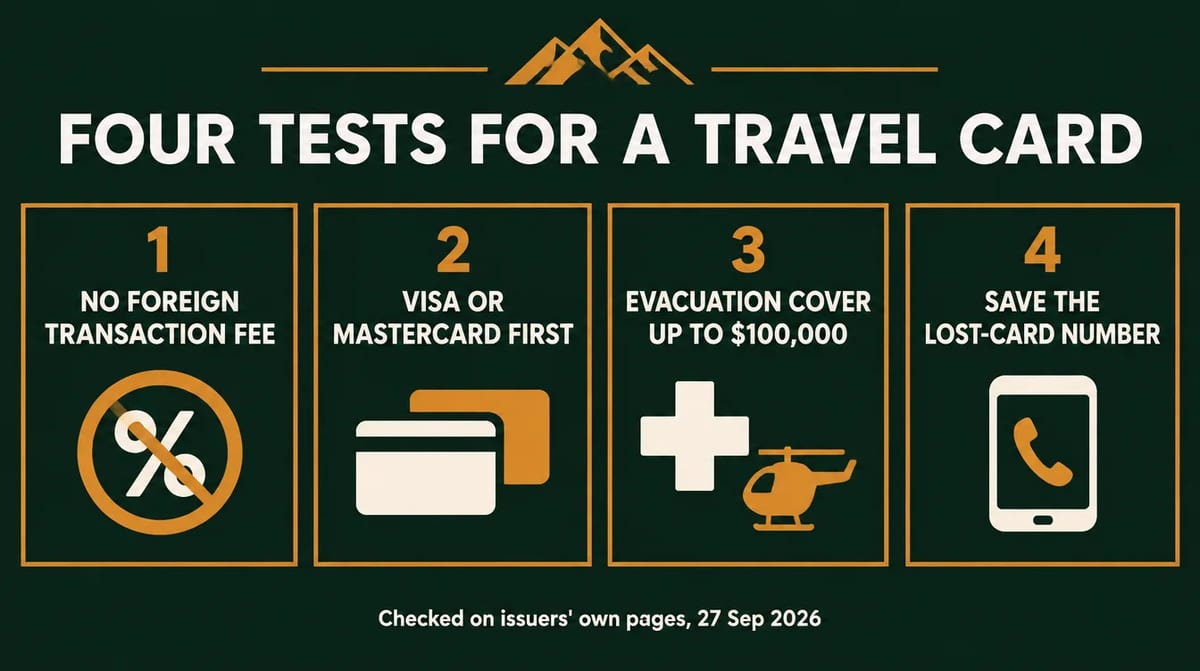
For most people travelling abroad, the Chase Sapphire Preferred is the best all-round card: no foreign transaction fee, a $95 annual fee, and trip cancellation plus emergency evacuation cover of up to $100,000 on trips 100 miles or more from home. If you want no annual fee, the Capital One Quicksilver or the Chase Freedom Flex charges no foreign fee either. If you fly often enough to use lounges, the Capital One Venture X adds them for $395. Whatever you carry, take a second card on a different network and always pay in the local currency.

- Rule one: no foreign transaction fee. A 3% fee on a $4,000 trip is $120 gone before any reward.
- Rule two: Visa or Mastercard as your main card. American Express charges no foreign fee on its travel cards but is accepted in fewer places abroad.
- Rule three: real protection. Only the Chase Sapphire cards list evacuation cover on the card page, and even that is not trekking insurance.
- Rule four: know who answers the phone when a card goes missing.
The four things that matter abroad
A good card at home can be an expensive one abroad, so we ranked on four tests: foreign transaction fee, network acceptance, travel protection, and what happens when a card is lost. Rewards come after those, because a card that is declined or charges 3% on every purchase loses more than any points rate earns. Every figure below was read on the issuer’s own page on 27 September 2026.
| Card | Annual fee | Foreign fee | Travel protection listed by the issuer | Everyday earn |
|---|---|---|---|---|
| Chase Sapphire Preferred | $95 | None | Trip cancellation up to $10,000 per traveller; evacuation up to $100,000; primary rental car cover up to $60,000 | 1x (3x dining) |
| Capital One Venture X | $395 | None | Trip cancellation and interruption, rental car collision cover (no amounts on the card page); lounges | 2X |
| Chase Sapphire Reserve | $795 | None | As the Preferred, plus emergency medical and dental up to $2,500; primary rental car cover up to $75,000 | 1x (3x dining) |
| Capital One Venture | $95 | None | None advertised on the card page | 2X |
| Capital One Quicksilver | $0 | None | None advertised on the card page | 1.5% |
| Chase Freedom Flex | $0 | None, since 21 Sep 2026 | Trip cancellation up to $1,500 per traveller, $6,000 per trip | 1% (5% rotating) |
| Chase Freedom Unlimited | $0 | 3% | — | 1.5% |
No foreign transaction fee comes first
Every card we recommend for travel charges no foreign transaction fee, and the one to watch is the Chase Freedom Unlimited, which charges 3%. Chase’s own pricing terms list that fee at 3% of each transaction in US dollars, even though its sister card, the Freedom Flex, dropped its foreign fee on 21 September 2026. The two cards look almost identical in a wallet, so check which one you are holding before you fly.
A no-fee card only saves money if you also refuse the terminal’s offer to charge you in dollars. That offer, called dynamic currency conversion, hands the exchange rate to the merchant’s payment provider. Choose the local currency every time; our guide to paying in local currency at a card machine shows what the other choice costs, and how to avoid foreign transaction and ATM fees covers cash withdrawals.
Visa and Mastercard versus American Express
Make a Visa or Mastercard your main card abroad and treat an American Express as a second card, not the only one. Amex charges no foreign transaction fee on its Gold and Platinum cards, according to its card pages, but fewer merchants accept it outside the US. In Nepal, for example, our guides see Visa and Mastercard taken at hotels and larger restaurants in Kathmandu and Pokhara far more often than Amex.
The simple fix is to carry two cards on two different networks, kept in different places. If one is declined, blocked for suspected fraud or swallowed by an ATM, the other still works. A no-fee Visa or Mastercard as your backup costs nothing to hold. Check the network logo on the card itself rather than assuming it from the issuer, because the same bank issues cards on both.
Travel protection, including evacuation
The Chase Sapphire Preferred and Sapphire Reserve are the only cards here whose issuer pages list emergency evacuation cover: up to $100,000 for medical services and transportation on a trip 100 miles or more from home. The Reserve adds emergency medical and dental cover of up to $2,500, with a $50 deductible. Both also list trip cancellation and interruption cover of up to $10,000 per covered traveller and $20,000 per trip, trip delay cover of up to $500 per traveller and lost luggage cover of up to $3,000.
That makes the $95 Preferred unusually strong for its price. The Venture X lists trip cancellation, interruption and rental car cover, but its card page gives no amounts, so read its Guide to Benefits before you count on it. The Freedom Flex lists smaller trip cancellation cover of up to $1,500 per traveller.
Chase says restrictions, limitations and exclusions apply to every one of these benefits, and they are set out in the Guide to Benefits you receive after approval. If your trip involves trekking at altitude, read those exclusions before you rely on the card, and see the gap in card travel insurance that a trek walks into and what card travel insurance actually covers.
Lost cards and emergency support
When a card goes missing abroad, the network can often get you emergency cash or a replacement faster than a new card in the post, but only with your bank’s approval. Visa says emergency cash is typically available within hours of your bank approving it and replacement cards typically arrive in three to five days. Mastercard says its Global Service runs around the clock and can usually get a temporary card to you within two business days almost anywhere outside the US.
| Network | What it says it offers | Number to call |
|---|---|---|
| Visa | Emergency cash typically within hours of bank approval; replacement card typically in 3–5 days | 1-800-847-2911 from the US; other countries on Visa’s site |
| Mastercard | 24/7 Global Service; temporary card within two business days almost everywhere, with issuer approval | 1-636-722-7111 from outside the US |
Chase also lists travel and emergency assistance on the Sapphire Preferred, which gives legal and medical referrals; you pay for any service you use. Before you leave, save your issuer’s international number in your phone and in an email to yourself, and photograph the back of each card. Our guide to cash versus card abroad covers how much cash to hold as your third line of defence.
Our verdict
Carry the Chase Sapphire Preferred as your main card and a no-fee Capital One Quicksilver or Chase Freedom Flex as your backup on a different network. Upgrade to the Venture X only if you will use the lounges and the travel credit, and to the Sapphire Reserve only if the extra medical cover and credits justify $795; our guide to whether an annual fee is worth it helps with that sum. Leave the Freedom Unlimited at home. And if you carry a balance, none of these is the right card: interest at 18% or more outweighs every reward here.
Nepal is where a modest travel budget goes furthest. Annapurna Base Camp is nine days at $920 USD solo and Everest Base Camp is twelve days at $1,700 USD solo, including permits, a government-registered guide, a porter, teahouses and meals.
See the Annapurna Base Camp trek →What is the best credit card for international travel in 2026?
For most people, the Chase Sapphire Preferred: no foreign transaction fee, a $95 annual fee, trip cancellation cover and emergency evacuation cover of up to $100,000 on trips 100 miles or more from home. With no annual fee, the Capital One Quicksilver or Chase Freedom Flex.
Does the Chase Sapphire Preferred cover emergency evacuation?
Yes. Chase lists emergency evacuation and transportation cover of up to $100,000 when you or a covered traveller are injured or fall sick on a trip 100 miles or more from home. Restrictions and exclusions apply, so read the Guide to Benefits, especially before trekking at altitude.
Should I take an American Express abroad?
As a second card, yes. Amex Gold and Platinum charge no foreign transaction fee, but Visa and Mastercard are accepted in more places abroad, so make one of those your main card.
Does the Chase Freedom Unlimited charge foreign transaction fees?
Yes, 3% of each transaction in US dollars, according to Chase’s pricing and terms. The Chase Freedom Flex no longer charges one as of 21 September 2026.
What should I do if my card is lost abroad?
Call your bank’s international number first, then the network if you need emergency cash or a temporary card. Visa says emergency cash is typically available within hours of bank approval; Mastercard says a temporary card usually arrives within two business days.
Keep reading
The four decisions that choose a card, with every comparison in one place.
The card-machine question that costs travellers most.
The gap your card insurance leaves at altitude.
When each one wins, and how much to carry.
Which $95 card earns more on a real budget.
Sources: Chase, Sapphire Preferred, Sapphire Reserve and Freedom Flex card pages, Freedom Unlimited pricing and terms, and the Chase Freedom Flex press release of 21 September 2026; Capital One, Venture X, Venture and Quicksilver card pages; American Express, Gold and Platinum card pages; Visa, lost or stolen card support page; Mastercard, Global Service emergency information. All read on 27 September 2026. Acceptance in Nepal reflects our guides’ field experience. This is general information, not financial advice; card offers change, so confirm the current terms with the issuer before you apply. No card issuer pays us for placement on this page.
Photos via Pexels: Tim Samuel

Written by
Bishnu AdhikariPokhara-based, NMA-certified trekking guides. We’ve led 5,000+ treks across the Annapurna and Everest regions since 1998 — every word here comes from the trail. More from this author →
Share this article
Ready to Trek?
From reading about it to standing on it
Our Pokhara-based guides have been doing this since 1998. Tell us your dates and fitness level — we'll build your perfect itinerary. Free, no obligation.
Why trek with our licensed agencyMore guides like this
Popular trips to consider
View all treks & toursFree Trekker’s Insider Guide
Permits, packing lists, cost breakdowns — no fluff.
We send one useful email. You can unsubscribe anytime.