

The short version
Chase Sapphire Preferred is the best pick for most at $95: trip cancellation up to $10,000 per traveller and primary rental cover. None replaces trek cover.
The best credit card with travel insurance for most people in 2026 is the Chase Sapphire Preferred: for $95 a year it lists trip cancellation cover of up to $10,000 per covered traveller, primary rental car cover up to $60,000, lost luggage cover and trip delay cover. The Chase Sapphire Reserve adds a shorter delay trigger, higher rental cover and a small emergency medical benefit for $795. The Amex Platinum covers cancellation and delay but its rental cover is secondary. The Chase Freedom Flex is the only card here with no annual fee, and its cancellation cover is much smaller. None of them replaces a travel medical policy, and none should be your only cover for a high-altitude trek.
- Card insurance is built around the trip: cancellation, delay, bags and rental cars.
- You usually have to pay with the card. Amex, for example, requires the round trip to be paid entirely with the eligible card.
- The binding document is the Guide to Benefits, not the marketing page. Read its exclusions before you travel.
- A trek needs its own policy that names the altitude you will reach and covers helicopter evacuation.
The four cards at a glance
The two Sapphire cards and the Platinum offer the same headline cancellation limit; the differences are in delay, rental and medical cover. Every figure was read on the issuer’s own card page on 27 September 2026.
| Card | Annual fee | Trip cancellation | Rental car | What it costs you |
|---|---|---|---|---|
| Chase Sapphire Preferred | $95 | Up to $10,000 per traveller, $20,000 per trip | Primary, up to $60,000 | Trip delay only after 12 hours |
| Chase Sapphire Reserve | $795 | Up to $10,000 per traveller, $20,000 per trip | Primary, up to $75,000 | A fee you must earn back in credits |
| Amex Platinum | $895 | Up to $10,000 per trip, $20,000 per card per 12 months | Secondary; not in Australia, Italy or New Zealand | The highest fee, weaker rental cover |
| Chase Freedom Flex | $0 | Up to $1,500 per traveller, $6,000 per trip, fares only | Not listed on the card page | Covers passenger fares, not hotels or tours |
Best overall: Chase Sapphire Preferred
The Sapphire Preferred gives the widest set of trip protections of any $95 card we checked. Chase lists trip cancellation and interruption cover of up to $10,000 per covered traveller and $20,000 per trip for prepaid, non-refundable travel including fares, tours and hotels. Trip delay pays up to $500 per covered traveller when a delay runs past 12 hours or needs an overnight stay. Lost luggage cover reaches $3,000 per traveller, baggage delay pays up to $100 a day for five days after six hours, and rental car cover is primary up to $60,000 when you decline the rental company’s collision cover and charge the whole rental to the card.
What it costs you: 1x on spending outside its categories, and a 12-hour delay trigger where the Reserve and Platinum start at six. We compare it with its closest rival in Capital One Venture vs Chase Sapphire Preferred.
Most complete: Chase Sapphire Reserve
The Reserve has the same cancellation limit as the Preferred but improves almost every other line. Trip delay pays up to $500 per covered traveller after six hours or an overnight stay, rental cover is primary up to $75,000 in the US and abroad, travel accident cover rises to $1,000,000, and it adds emergency medical and dental cover of up to $2,500, with a $50 deductible, on trips 100 miles or more from home.
| Benefit | Sapphire Preferred | Sapphire Reserve | Amex Platinum |
|---|---|---|---|
| Trip delay | Up to $500 per traveller after 12 hours | Up to $500 per traveller after 6 hours | Up to $500 per trip after 6 hours, 2 claims a year |
| Lost luggage | Up to $3,000 per traveller | Up to $3,000 per traveller | Not listed on the card page |
| Baggage delay | $100 a day, 5 days | $100 a day, 5 days | Not listed on the card page |
| Emergency evacuation | Up to $100,000 | Up to $100,000 | Not listed on the card page |
| Emergency medical | Not listed | Up to $2,500, $50 deductible | Not listed on the card page |
What it costs you: $795 a year. Unless you use its travel, dining and hotel credits, you are paying a lot for insurance you could buy separately.
Premium alternative: The Platinum Card from American Express
The Platinum is a lounge card first, and its insurance is solid on cancellation and delay but weaker on cars. If you pay for a round trip entirely with the card, trip cancellation and interruption cover reimburses non-refundable expenses up to $10,000 per trip and $20,000 per card in any 12 months. Trip delay pays up to $500 per trip after six hours, with a maximum of two claims in 12 months. Its car rental cover is secondary, includes no liability cover and is not available in Australia, Italy or New Zealand. Pick the Sapphire Preferred instead if insurance is the main reason you want a card.
No annual fee: Chase Freedom Flex
The Freedom Flex is the only no-fee card we checked that lists trip cancellation cover on its card page, and since 21 September 2026 it has no foreign transaction fee either. It reimburses up to $1,500 per covered traveller and $6,000 per trip for prepaid, non-refundable passenger fares if a trip is cancelled or cut short by sickness, severe weather or other covered reasons. What it costs you: it covers fares, not hotels or tours, so a prepaid trek package is mostly outside it.
What card insurance will not pay for on a trek
Card cover is trip insurance; a Himalayan trek needs medical and evacuation insurance that names your altitude, and that is a different product. Chase now lists emergency evacuation of up to $100,000 on both Sapphire cards, which is more than cards used to offer, but it says restrictions, limitations and exclusions apply, and the full terms sit in the Guide to Benefits. Before counting on it, find two things there: whether trekking or mountaineering is excluded as a hazardous activity, and whether there is an altitude limit. Everest Base Camp sits at 5,364 metres and the Thorong La at 5,416 metres.
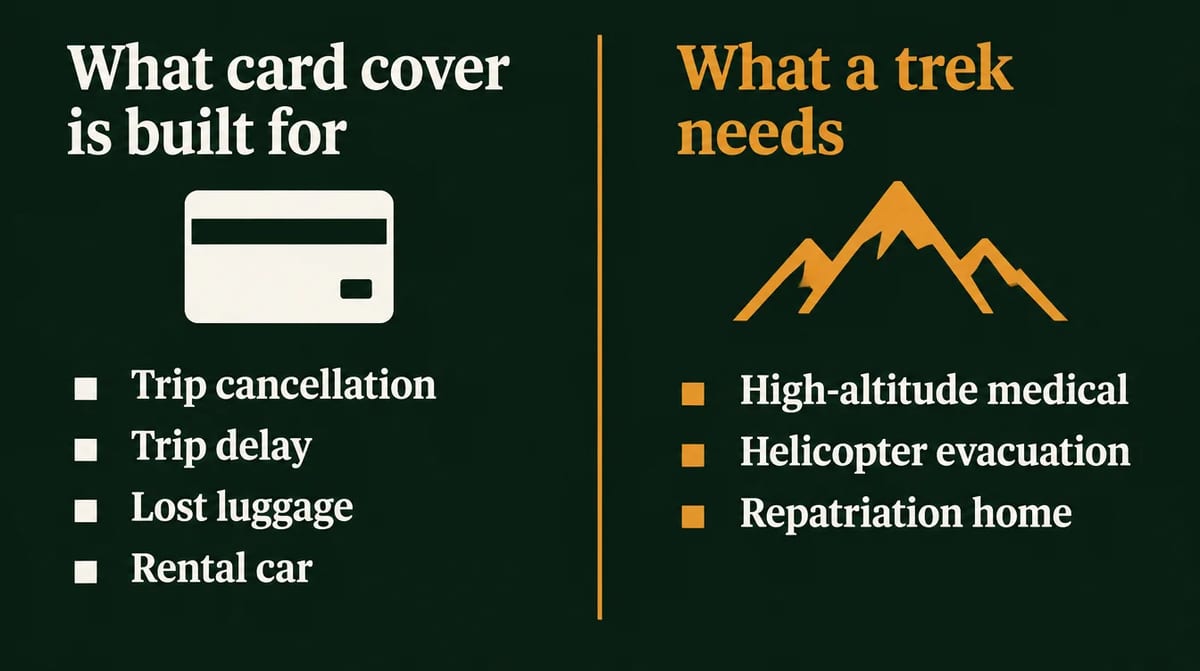
The medical side is the bigger gap. From our own rescue coordination, a helicopter evacuation from the Khumbu typically runs $4,000 to $6,000 and hospital admission in Kathmandu $500 to $3,000 a day. The Reserve’s $2,500 of emergency medical cover can be used up in a single day.
We require insurance that covers the altitude of the trek you book, helicopter evacuation and repatriation, with a 24-hour emergency number. Keep the card for cancellation, delays and bags, and buy a policy for the rest. Our guides to the gap in your card’s travel insurance that a trek walks into and what card travel insurance actually covers show exactly what to ask your issuer.
And if you carry a balance, no insurance benefit makes a rewards card worthwhile: the Sapphire Preferred’s variable APR runs from 19.24% to 27.49%, the Reserve’s from 19.49% to 27.99%.
Once the cover is sorted, the trek itself is simpler than people expect. Annapurna Base Camp is nine days at $920 USD solo and Everest Base Camp is twelve days at $1,700 USD solo, including permits, a government-registered guide, a porter, teahouses and meals.
See the Annapurna Base Camp trek →Which credit card has the best travel insurance?
For most people, the Chase Sapphire Preferred: trip cancellation up to $10,000 per covered traveller, primary rental car cover up to $60,000, lost luggage up to $3,000 per traveller and trip delay cover, for $95 a year. The Sapphire Reserve adds a six-hour delay trigger, $75,000 rental cover and $2,500 of emergency medical cover.
Do I have to pay for the trip with the card?
Generally yes. American Express requires the round trip to be paid entirely with the eligible card, and Chase’s rental cover requires the whole rental to be charged to the card. Check the Guide to Benefits for each benefit’s trigger.
Is there a no-annual-fee card with travel insurance?
The Chase Freedom Flex lists trip cancellation and interruption cover of up to $1,500 per covered traveller and $6,000 per trip, for prepaid passenger fares only.
Does credit card travel insurance cover trekking in Nepal?
Do not assume it does. Even where a card lists emergency evacuation, the Guide to Benefits may exclude trekking or set an altitude limit. Buy a policy that names your trek’s highest altitude and covers helicopter evacuation.
Is card insurance primary or secondary?
It depends on the benefit. Chase lists the Sapphire cards’ rental car cover as primary; American Express lists the Platinum’s as secondary. Primary cover pays before your own insurance.
Keep reading
The four decisions that choose a card, with every comparison in one place.
The gap a trek walks straight into, and how to check.
What card cover includes, and what it leaves out.
Which $95 card earns more on a real budget.
The costly habits to drop before your next trip.
Sources: Chase card pages for the Sapphire Preferred, Sapphire Reserve and Freedom Flex; American Express’s Platinum Card page, all read on 27 September 2026 for fees, insurance limits and APRs. Evacuation and hospital costs in Nepal are from Travel Himalaya Nepal’s own rescue coordination. This is general information, not financial advice; card offers change, so confirm the current terms with the issuer before you apply. No card issuer pays us for placement on this page.

Written by
Bishnu AdhikariPokhara-based, NMA-certified trekking guides. We’ve led 5,000+ treks across the Annapurna and Everest regions since 1998 — every word here comes from the trail. More from this author →
Share this article
Ready to Trek?
From reading about it to standing on it
Our Pokhara-based guides have been doing this since 1998. Tell us your dates and fitness level — we'll build your perfect itinerary. Free, no obligation.
Why trek with our licensed agencyMore guides like this
Popular trips to consider
View all treks & toursFree Trekker’s Insider Guide
Permits, packing lists, cost breakdowns — no fluff.
We send one useful email. You can unsubscribe anytime.