

The short version
The Venture earns more for most people at 2X on everything. The Sapphire Preferred wins on dining and adds trip cancellation and rental car cover.
For most people, the Capital One Venture earns more, because it pays 2X miles on every purchase while the Chase Sapphire Preferred pays 1X on anything that is not dining, travel, streaming, online groceries or gas. The Sapphire Preferred wins if a large share of your spending is restaurants, and it carries protection the Venture does not advertise: trip cancellation cover and primary rental car insurance. Both cost $95 a year and neither charges a foreign transaction fee, so the decision comes down to how you spend and whether you want the insurance.

- Pick the Venture if you want one card that earns the same on everything and you never want to think about categories.
- Pick the Sapphire Preferred if you eat out a lot and want trip cancellation and primary rental car cover built in.
- The bonus is easier on the Venture: $4,000 in three months against $5,000.
- Pick neither if you carry a balance. At APRs of roughly 19% to 28.5%, interest wipes out any reward.
The headline numbers
On paper the two cards look like twins: the same $95 fee, a 75,000 welcome bonus each and no foreign transaction fee. The differences are in how they earn and what they protect. Every figure below was read on the issuer’s own card page on 27 September 2026.
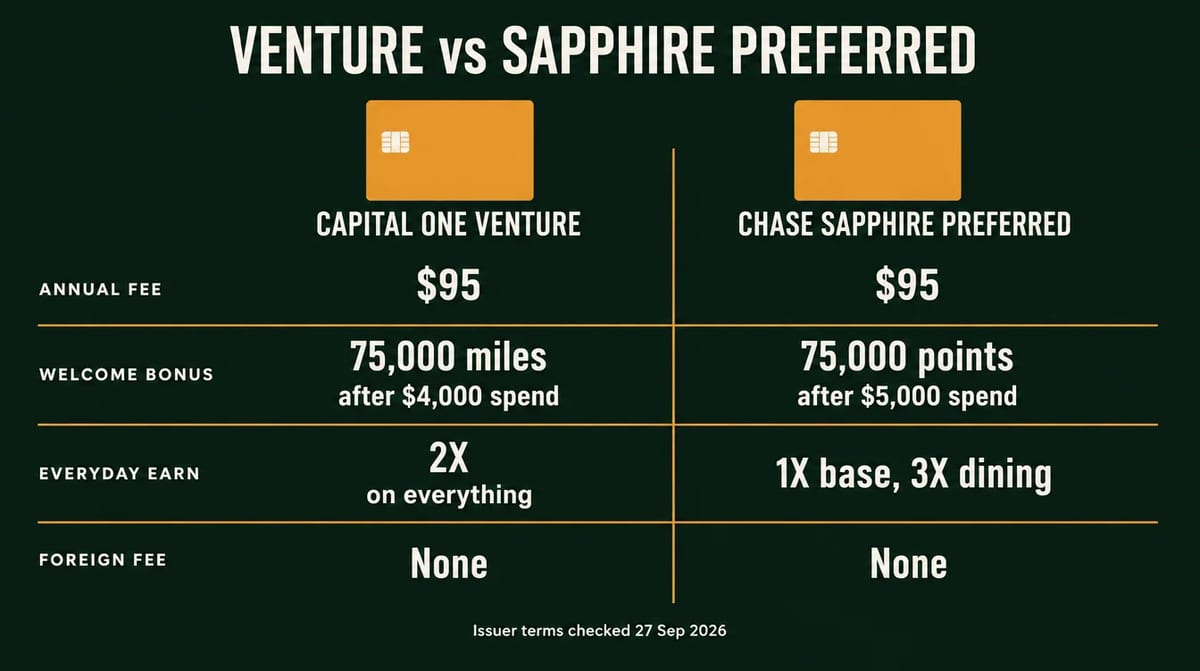
| Capital One Venture | Chase Sapphire Preferred | |
|---|---|---|
| Annual fee | $95 | $95 |
| Welcome bonus | 75,000 miles after $4,000 in 3 months | 75,000 points after $5,000 in 3 months |
| Everyday purchases | 2X | 1x |
| Dining | 2X | 3x |
| Travel booked through the issuer | 5X on hotels, vacation rentals and rental cars via Capital One Travel | 5x on Chase Travel |
| Other travel | 2X | 2x |
| Other 3x categories | — | Gas and EV charging, streaming, online grocery |
| Annual credit | — | $100 Chase Travel hotel credit |
| Trusted-traveller credit | Up to $120 for Global Entry or TSA PreCheck | — |
| Trip cancellation cover | Not advertised on the card page | Up to $10,000 per traveller, $20,000 per trip |
| Rental car cover | Not advertised on the card page | Primary, up to $60,000 |
| Foreign transaction fee | None | None |
| Purchase APR | 19.49%–28.49% variable | 19.24%–27.49% variable |
Which card earns more on a normal budget
On a typical spending mix the Venture earns more, and the gap comes from the purchases the Preferred pays only 1x on. Take a household putting $2,000 a month on the card: $500 at restaurants, $300 at the supermarket in person, $200 on travel booked directly and $1,000 on everything else.
| Monthly spend | Venture | Sapphire Preferred |
|---|---|---|
| $500 dining | 1,000 miles (2X) | 1,500 points (3x) |
| $300 groceries in store | 600 miles (2X) | 300 points (1x) |
| $200 travel booked direct | 400 miles (2X) | 400 points (2x) |
| $1,000 everything else | 2,000 miles (2X) | 1,000 points (1x) |
| Per month | 4,000 | 3,200 |
| Per year | 48,000 | 38,400 |
The rule is simple arithmetic. Against the Venture’s flat 2X, the Preferred gains one point per dollar in its 3x categories and loses one per dollar in its 1x categories, and ties on other travel at 2x. So the Preferred earns more only when your spending in its 3x categories is larger than your spending in its 1x categories. Put $1,200 of the same $2,000 on restaurants and it pulls ahead: 4,600 points a month against 4,000 miles. If you do not know which describes you, look at last month’s statement and count. It takes five minutes and it answers the question better than any ranking.
One honest caveat: miles and points are not the same currency. What each is worth depends on how you redeem it — booking travel through the issuer, or transferring to an airline or hotel partner. We compare the number earned, not a guessed value per point, because that value is yours to set.
The welcome bonus is easier on the Venture
Both bonuses are 75,000, but the Venture asks for $1,000 less spending to unlock it. Hitting $4,000 in three months means about $1,333 a month on the card; $5,000 means about $1,667. That gap matters more than it looks, because the worst way to earn a bonus is to spend money you would not otherwise have spent. If $1,667 a month is a stretch, the Preferred’s bonus is not really free.
Where the Sapphire Preferred earns its fee
The Preferred’s real advantage is protection, not points. Chase lists trip cancellation and interruption cover of up to $10,000 per covered traveller and $20,000 per trip for prepaid, non-refundable travel, and primary rental car cover of up to $60,000 for theft and collision damage. Primary means it pays before your own car insurance, so a scrape abroad does not touch your personal policy. It also lists emergency evacuation and transportation cover of up to $100,000 for trips 100 miles or more from home, marked as new on Chase’s page. The Venture’s card page advertises none of these.

It also gives a $100 hotel credit each account anniversary year — but only for stays booked through Chase Travel. If you book hotels directly or through another site, count that credit as zero. The Venture’s equivalent perk is up to $120 towards Global Entry or TSA PreCheck, which is worth real money only if you do not already have either.
Trip cancellation cover refunds a prepaid trip you could not take. The Preferred’s new evacuation cover is a real improvement, but Chase’s page does not say how it treats trekking at altitude and notes that restrictions and exclusions apply, so read the benefit guide first and do not treat the card as a substitute for a policy that names high-altitude trekking. If your trip ends above 3,000 metres, read the gap in your card’s travel insurance that a trek walks into before you rely on it, and what card travel insurance actually covers for the general picture.
Using either card abroad
Neither card charges a foreign transaction fee, so both are safe to carry overseas — as long as you pay in the local currency. When a terminal abroad offers to charge you in dollars, decline; that choice hands the exchange rate to the merchant’s payment provider. Our guide to paying in local currency at a card machine explains why, and how to stop paying foreign transaction and ATM fees covers the other charges.
In Nepal, cards work in Kathmandu and Pokhara hotels and larger restaurants, and increasingly not much further. Above Namche on the Everest trail everything is cash, so whichever card you choose, it gets you to the trailhead rather than up it.
The verdict
If you want a simple card that earns well on everything, choose the Capital One Venture. If you dine out heavily and want built-in trip cancellation and primary rental car cover, choose the Chase Sapphire Preferred. They cost the same, so there is no wrong answer at $95 — only a card that fits your statement better.
And choose neither if you carry a balance from month to month. At these APRs, a single month of interest on a modest balance costs more than the card’s entire annual reward. Pay in full, or pick a card built for low interest instead.
If the points are for a big trip, Nepal is where a modest balance goes furthest. Annapurna Base Camp is nine days at $920 USD solo and Everest Base Camp is twelve days at $1,700 USD solo, including permits, a government-registered guide, a porter, teahouses and meals.
See the Annapurna Base Camp trek →Is the Capital One Venture or Chase Sapphire Preferred better?
The Venture earns more on a typical spending mix because it pays 2X on everything. The Sapphire Preferred is better for heavy restaurant spending and includes trip cancellation and primary rental car cover. Both cost $95 a year.
What is the welcome bonus on each card?
As of 27 September 2026, the Venture offers 75,000 miles after $4,000 in purchases in the first three months, and the Sapphire Preferred offers 75,000 points after $5,000 in the first three months. Offers change, so check the issuer before applying.
Do either of these cards charge foreign transaction fees?
No. Neither the Capital One Venture nor the Chase Sapphire Preferred charges a foreign transaction fee.
Does the Chase Sapphire Preferred include travel insurance?
It includes trip cancellation and interruption cover of up to $10,000 per covered traveller and $20,000 per trip, primary rental car cover up to $60,000, and emergency evacuation and transportation cover up to $100,000 for trips 100 miles or more from home. Check the benefit guide’s exclusions before relying on it for a trek.
Is the $95 annual fee worth it?
It depends on how much you spend and how you redeem. The Venture’s fee pays off when 2X on everything outweighs what a no-fee card would earn you; the Preferred’s when you use its dining earning, hotel credit and insurance. If you would not use either card’s strengths, a no-fee card is the better choice.
Keep reading
The four decisions that choose a card, with every comparison in one place.
The card-machine question that costs travellers most.
The four charges on a trip abroad, and how to dodge them.
The cards and passes that actually get you in.
How earning and redeeming really work.
Sources: Capital One, Venture Rewards card page, and Chase, Sapphire Preferred card page, both read on 27 September 2026 for fees, welcome offers, earning rates, credits, insurance and APRs. The spending example is our own arithmetic on those published rates. This is general information, not financial advice; card offers change, so confirm the current terms with the issuer before you apply. No card issuer pays us for placement on this page.
Photos via Pexels: Natasha Chebanoo (cover), AirTeo.

Written by
Bishnu AdhikariPokhara-based, NMA-certified trekking guides. We’ve led 5,000+ treks across the Annapurna and Everest regions since 1998 — every word here comes from the trail. More from this author →
Share this article
Ready to Trek?
From reading about it to standing on it
Our Pokhara-based guides have been doing this since 1998. Tell us your dates and fitness level — we'll build your perfect itinerary. Free, no obligation.
Why trek with our licensed agencyMore guides like this
Popular trips to consider
View all treks & toursFree Trekker’s Insider Guide
Permits, packing lists, cost breakdowns — no fluff.
We send one useful email. You can unsubscribe anytime.