
The short version
Freedom Unlimited earns more at home with 3% dining. Quicksilver wins abroad: no foreign transaction fee, while Freedom Unlimited charges 3%.
At home, the Chase Freedom Unlimited earns more than the Capital One Quicksilver, because it adds 3% on dining and drugstores to the same 1.5% base; abroad, the Quicksilver is the one to carry, because it charges no foreign transaction fee and the Freedom Unlimited charges 3%. Both cards cost $0 a year and both pay a $200 bonus after $500 in purchases in the first three months. The Freedom Unlimited is not on Chase’s own list of no-foreign-transaction-fee cards, and Chase’s pricing and terms for it list a 3% fee on foreign transactions. One trip abroad can wipe out a year of its extra earning.
- Pick the Freedom Unlimited for spending at home, especially if you eat out, and if you want a 0% intro APR on purchases and balance transfers.
- Pick the Quicksilver if you travel abroad or buy from overseas websites. It charges no foreign transaction fee.
- This is the travel trap. The two cards look identical at 1.5%, but only one is safe to use outside the US.
- Chase changed the Freedom Flex, not the Freedom Unlimited. The Flex dropped its foreign transaction fee on 21 September 2026.
The headline numbers
On paper the two cards are twins; the differences are the Freedom Unlimited’s bonus categories and intro APR, and the Quicksilver’s freedom from foreign fees. Every figure below was read on the issuer’s own pages on 27 September 2026.
| Chase Freedom Unlimited | Capital One Quicksilver | |
|---|---|---|
| Annual fee | $0 | $0 |
| Welcome bonus | $200 after $500 in the first 3 months | $200 after $500 within the first 3 months |
| Everyday purchases | 1.5% | 1.5% |
| Dining | 3% | 1.5% |
| Drugstores | 3% | 1.5% |
| Travel through the issuer | 5% via Chase Travel | 1.5% |
| Intro APR | 0% for 15 months on purchases and balance transfers | “Low intro APR for 15 months” — check Capital One for the rate |
| APR after intro | 18.24%–27.74% variable | Check Capital One |
| Foreign transaction fee | 3% of each transaction | None |
Which card earns more at home
For a typical household the Freedom Unlimited earns around $60 a year more, all of it from restaurants and drugstores. Take $1,500 a month: $300 at restaurants, $50 at the drugstore and $1,150 on everything else.
| Monthly spend | Freedom Unlimited | Quicksilver |
|---|---|---|
| $300 dining | $9.00 (3%) | $4.50 (1.5%) |
| $50 drugstore | $1.50 (3%) | $0.75 (1.5%) |
| $1,150 everything else | $17.25 (1.5%) | $17.25 (1.5%) |
| Per month | $27.75 | $22.50 |
| Per year | $333 | $270 |
The Freedom Unlimited comes out $63 a year ahead. Spend more at restaurants and the gap widens by 1.5 cents on every extra dining dollar.
Why the Freedom Unlimited is the wrong card to take abroad
The Freedom Unlimited charges 3% on every foreign transaction, which is double its 1.5% base rate, so every purchase abroad costs you money even after the cash back. Chase’s pricing and terms for the card list foreign transactions at “3% of the amount of each transaction in U.S. dollars”, and the card does not appear on Chase’s own list of credit cards with no foreign transaction fee.
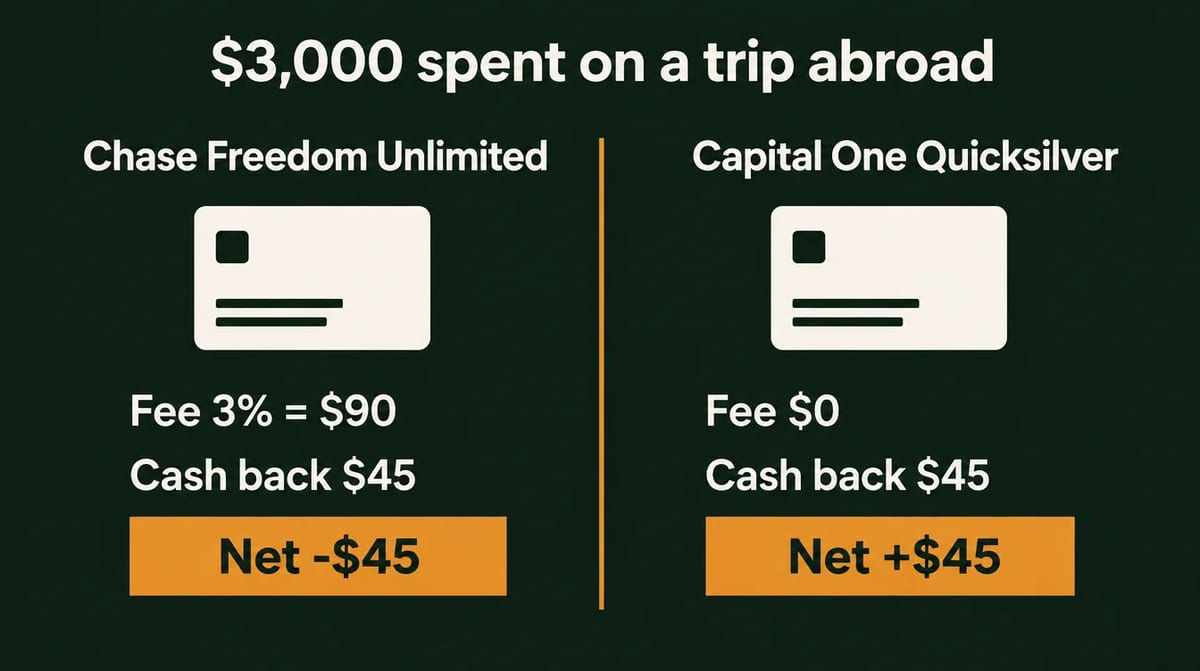
Put $3,000 of a two-week trip on each card. On the Freedom Unlimited you pay $90 in foreign transaction fees and earn $45 back at 1.5%, a net loss of $45. On the Quicksilver you pay nothing and earn $45. That is a $90 swing on one trip, more than the $63 the Freedom Unlimited earned you over a whole year at home. Even restaurant meals abroad do not rescue it: 3% back against a 3% fee is exactly zero.
Foreign transaction fees are not only a travel problem: Chase
The fee also applies when you buy from a merchant based overseas, even from your sofa, so it catches online orders from foreign shops too.rsquo;s own Freedom Flex announcement describes them as applying to purchases
The fee also applies when you buy from a merchant based overseas, even from your sofa, so it catches online orders from foreign shops too.ldquo;from international online merchants
The fee also applies when you buy from a merchant based overseas, even from your sofa, so it catches online orders from foreign shops too.rdquo; too, so an order from a foreign website can trigger one at home. Our guide to avoiding foreign transaction and ATM fees lists the other charges to watch.
On 21 September 2026 Chase removed foreign transaction fees from the Chase Freedom Flex, its rotating-category card. That change does not apply to the Freedom Unlimited. If you want a no-fee Chase card that is safe abroad, the Freedom Flex is now one; our news piece on the change explains what else it gained.
Whichever card you carry, the second trap is at the terminal. When a card machine or ATM abroad offers to charge you in dollars, decline and pay in the local currency; our guide to dynamic currency conversion explains why that choice costs more than any fee.
The intro APR, and who should pick neither
The Freedom Unlimited’s 0% intro APR for 15 months on purchases and balance transfers is useful if you are paying off a large purchase, but only if you clear it before the rate jumps. After the intro period Chase lists a variable APR of 18.24% to 27.74%, and a balance transfer fee applies. Capital One advertises a low intro APR for 15 months on the Quicksilver; check its rates and disclosures for the exact figure before you choose on that basis.
Anyone who carries a balance month to month should think of these as low-interest tools, not rewards cards. At 18% or more, interest on a $2,000 balance runs to hundreds of dollars a year, far more than the $63 difference in cash back. If you travel, our list of travel money mistakes is worth ten minutes before you go.
The verdict
Choose the Chase Freedom Unlimited if you spend almost entirely in the US, eat out often or want a 0% intro APR. Choose the Capital One Quicksilver if you travel abroad even once a year or shop from foreign websites. The cheapest answer for many people is both: the Freedom Unlimited for restaurants at home, the Quicksilver in your wallet on the plane.
If you are travelling more seriously, a travel card may suit you better than either; our Venture vs Sapphire Preferred comparison covers two $95 options with no foreign transaction fees. And in places like Nepal, where cards work in city hotels and larger restaurants but not on the trail, read when to use cash and when to use a card.
If the points are for a big trip, Nepal is where a modest balance goes furthest. Annapurna Base Camp is nine days at $920 USD solo and Everest Base Camp is twelve days at $1,700 USD solo, including permits, a government-registered guide, a porter, teahouses and meals.
See the Annapurna Base Camp trek →Is the Chase Freedom Unlimited or Capital One Quicksilver better?
The Freedom Unlimited earns more at home thanks to 3% on dining and drugstores. The Quicksilver is better for anyone who travels abroad, because it has no foreign transaction fee and the Freedom Unlimited charges 3%.
Does the Chase Freedom Unlimited charge a foreign transaction fee?
Yes. Chase’s pricing and terms list foreign transactions at 3% of each transaction in US dollars, and the card is not on Chase’s own list of no-foreign-transaction-fee cards.
Does the Capital One Quicksilver charge a foreign transaction fee?
No. Capital One states that you won’t pay a transaction fee when making purchases outside the United States.
What are the welcome bonuses?
As of 27 September 2026, both offer $200 after $500 in purchases in the first three months from account opening. Check the issuer before applying.
Did Chase remove foreign transaction fees from the Freedom Unlimited?
No. On 21 September 2026 Chase removed them from the Chase Freedom Flex. The Freedom Unlimited’s terms still list a 3% foreign transaction fee.
Keep reading
The four decisions that choose a card, with every comparison in one place.
The four charges on a trip abroad, and how to dodge them.
The card-machine question that costs travellers most.
When to pay which way on a trip.
The costly habits most travellers repeat.
Sources: Chase, Freedom Unlimited card page, its pricing and terms, and Chase’s list of no-foreign-transaction-fee credit cards; Chase media release of 21 September 2026 on the Freedom Flex; Capital One, Quicksilver card pages; all read on 27 September 2026. The earning and trip examples are our own arithmetic on those published rates. This is general information, not financial advice; card offers change, so confirm the current terms with the issuer before you apply. No card issuer pays us for placement on this page.
Photos via Pexels: Tim Samuel, Natasha Chebanoo.

Written by
Bishnu AdhikariPokhara-based, NMA-certified trekking guides. We’ve led 5,000+ treks across the Annapurna and Everest regions since 1998 — every word here comes from the trail. More from this author →
Share this article
Ready to Trek?
From reading about it to standing on it
Our Pokhara-based guides have been doing this since 1998. Tell us your dates and fitness level — we'll build your perfect itinerary. Free, no obligation.
Why trek with our licensed agencyMore guides like this
Popular trips to consider
View all treks & toursFree Trekker’s Insider Guide
Permits, packing lists, cost breakdowns — no fluff.
We send one useful email. You can unsubscribe anytime.