
The short version
Scotiabank's Passport Visa Infinite is the only card here with no foreign transaction fee. TD Aeroplan suits Air Canada flyers; RBC Avion has the top bonus.
For most Canadians who travel abroad, the Scotiabank Passport Visa Infinite is the card to beat, because it is the only card here we could confirm charges no foreign transaction fee — RBC and TD add 2.5% to everything you buy in another currency. If you fly Air Canada, the TD Aeroplan Visa Infinite earns its $139 fee through free checked bags. If you want the biggest welcome bonus, the RBC Avion Visa Infinite offers up to 70,000 points. And if most of your spending is restaurants and groceries at home, the American Express Cobalt earns the most on it. Every figure below was read on the issuer’s own site on 27 September 2026.

- Scotiabank Passport Visa Infinite is the pick if you spend in foreign currencies: no foreign transaction fee and six lounge passes a year for $150.
- TD Aeroplan Visa Infinite suits Air Canada flyers: a free first checked bag for you and up to eight companions on the same booking.
- RBC Avion Visa Infinite has the largest bonus, up to 70,000 Avion points, but charges 2.5% on foreign purchases.
- American Express Cobalt is a home-spending card: 5X on eats and drinks in Canada, at $15.99 a month.
- Pick none if you carry a balance. At 20.99% to 21.99% purchase interest, a rewards card costs more than it pays.
The four cards side by side
The fees are close; the difference is the foreign transaction fee and what each card earns on. Three of the four are Visa Infinite cards with a $60,000 personal or $100,000 household income requirement. The Cobalt is an American Express card billed monthly.
| Scotiabank Passport VI | RBC Avion VI | TD Aeroplan VI | Amex Cobalt | |
|---|---|---|---|---|
| Fee | $150 a year | $120 a year | $139 a year (first-year rebate, conditions apply) | $15.99 a month ($191.88 a year) |
| Foreign transaction fee | None | 2.5% | 2.5% | Not stated on the card page — check Amex |
| Welcome offer | Up to 35,000 Scene+ points | Up to 70,000 Avion points | Up to 50,000 Aeroplan points | Up to 15,000 Membership Rewards points |
| Top earn rate | 3 per $1 at Sobeys, Safeway, IGA and partner grocers | 1.25 per $1 on travel | 1.5 per $1 on gas, EV charging, groceries and Air Canada | 5X on eats and drinks in Canada |
| Everything else | 1 per $1 | 1 per $1 | 1 per $1 | 1X |
| Travel perk | Six lounge passes a year | — | Free first checked bag on Air Canada | — |
| Purchase interest | 20.99% | 20.99% | 21.99% | 21.99% |
The foreign transaction fee is the number that matters abroad
A 2.5% foreign transaction fee costs $25 on every $1,000 you spend in another currency, which on a big trip can wipe out a year of points. RBC states its rate as 2.5% over its benchmark exchange rate, and TD adds a 2.5% conversion fee on its Canadian-dollar credit cards. Scotiabank’s Passport card drops the fee entirely: only the exchange rate applies.
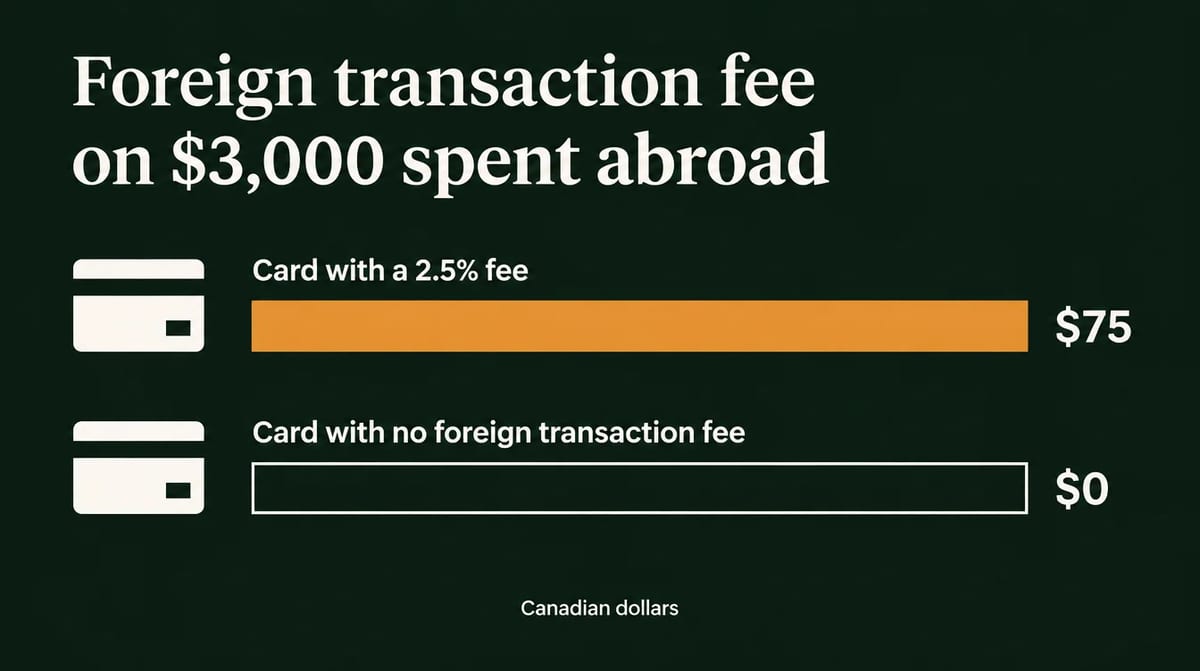
| Spent abroad in a year | At 2.5% | Scotiabank Passport VI |
|---|---|---|
| $1,000 | $25 | $0 |
| $3,000 | $75 | $0 |
| $6,000 | $150 | $0 |
At $6,000 of foreign spending the fee you avoid equals the Passport’s entire $150 annual fee. Most of that spending is not the flight, which you usually pay in dollars, but everything after landing: hotels, meals, transport, entry tickets. The saving only works if you also pay in the local currency. When a terminal abroad offers to charge you in Canadian dollars, decline — our guide to paying in local currency explains why.
Scotiabank Passport Visa Infinite, best for spending abroad
This is the card we would carry out of Canada: no foreign transaction fee, six airport lounge passes a year and a $150 fee. It earns 3 Scene+ points per dollar at Sobeys, Safeway, IGA and other partner grocers, 2 per dollar on dining, entertainment and transit, up to 4 per dollar on Scene+ Travel bookings and 1 on everything else. The current offer, for accounts opened between 4 August and 1 November 2026, is 25,000 bonus points after $2,000 in everyday purchases in the first three months, plus a 10,000-point annual bonus if you spend $40,000 in a year.
The lounge passes come through the Visa Airport Companion programme. Six a year is enough for one long trip with a partner, out and back. Read our lounge access guide for how passes like these compare. The fee is rebated in full with Scotiabank’s Ultimate Package chequing account and by $40 with the Preferred Package.
Who should pick something else: anyone who rarely leaves Canada. Without the foreign spending, the grocery earn rate is its main strength, and it applies only at Scotiabank’s partner stores.
TD Aeroplan Visa Infinite, best for Air Canada flyers
If you fly Air Canada, the free first checked bag for you and up to eight companions on the same booking can repay the $139 fee on a single trip. The bag benefit applies when travel starts on an Air Canada flight. The card also earns 1.5 Aeroplan points per dollar on gas, EV charging, groceries and purchases made directly with Air Canada, and 1 point per dollar elsewhere.
The offer, effective 1 September 2026, is up to 50,000 points: 10,000 on your first purchase, 15,000 after $3,000 in 90 days and 25,000 after $12,000 within 12 months. TD rebates the first year’s fee if you activate and make a purchase within three months. There is also a NEXUS application fee rebate of up to $100 every 48 months.
Who should pick something else: anyone who does not fly Air Canada, and anyone who spends a lot abroad — the 2.5% fee applies.
RBC Avion Visa Infinite, biggest welcome bonus
The Avion offer is the largest here at up to 70,000 points, and the everyday earning is the weakest. You get 35,000 points on approval, 20,000 after $5,000 in the first six months and a one-time 15,000-point anniversary bonus; the offer runs to 25 November 2026. After that it earns 1.25 points per dollar on travel-related purchases and 1 on everything else, for $120 a year.
The honest read: this is a bonus card. Take it if the welcome points fit a trip you are already planning, and understand that its ongoing earning is modest and every foreign purchase carries 2.5%.
American Express Cobalt, best for spending at home
The Cobalt earns the most on food in Canada, 5X at restaurants, grocery stores and food delivery on up to $2,500 a month, but it is a home card, not a travel one. It also pays 3X on streaming, 2X on gas, transit and ride share in Canada and 1X on everything else. The fee is $15.99 a month for most provinces, which is $191.88 a year and the highest here. The welcome offer is 1,250 points for each monthly billing period in the first year in which you spend $750, up to 15,000.
Two cautions. The 5X rate is for purchases in Canada, so it earns little on a trip. And American Express is accepted in fewer places abroad than Visa, so carry a Visa or Mastercard as well. The card page does not state a foreign transaction fee waiver, so check Amex’s information box before you rely on it overseas.
Most of these cards include some travel cover, but card policies are written for ordinary trips. If your trip includes trekking above 3,000 metres, read the gap in card travel insurance that a trek walks into before relying on it.
Using a Canadian card in Nepal
In Nepal a card is a city tool: it works at a small number of upmarket hotels, large agencies and perhaps one or two restaurants per city, usually with a 3–4% surcharge, and not at all on the trail. That is our own field reporting from Kathmandu and Pokhara. Teahouses, checkposts and highway bus stops take rupees in cash, so what matters most is withdrawing cash cheaply in the city. Carry two cards on two networks, and read how to avoid foreign transaction and ATM fees before you go.
If the points are for a big trip, Nepal is where a modest balance goes furthest. Annapurna Base Camp is nine days at $920 USD solo and Everest Base Camp is twelve days at $1,700 USD solo, including permits, a government-registered guide, a porter, teahouses and meals.
See the Annapurna Base Camp trek →What is the best travel credit card in Canada?
For spending abroad, the Scotiabank Passport Visa Infinite, because it charges no foreign transaction fee. For Air Canada flyers, the TD Aeroplan Visa Infinite. For the largest welcome bonus, the RBC Avion Visa Infinite at up to 70,000 points.
Which Canadian credit card has no foreign transaction fee?
Of the cards we checked, the Scotiabank Passport Visa Infinite. RBC and TD both charge 2.5% on foreign-currency purchases with the Avion and Aeroplan cards.
How much income do I need for a Visa Infinite card?
RBC and TD list $60,000 personal or $100,000 household income for the Avion and Aeroplan Visa Infinite cards. Scotiabank lists a range for the Passport card, so check its eligibility page.
Is the Amex Cobalt good for travel?
Not especially. Its 5X rate applies to eats and drinks in Canada, it costs $15.99 a month, and American Express is accepted in fewer places abroad. It is a strong card for spending at home.
Should I get a travel card if I carry a balance?
No. At 20.99% to 21.99% purchase interest, a month of interest on a modest balance can exceed the value of a year’s points. Pay in full, or choose a low-interest card instead.
Keep reading
The four decisions that choose a card, with every comparison in one place.
The card-machine question that costs travellers most.
The cards and passes that actually get you in.
How earning and redeeming really work.
The small errors that quietly cost the most abroad.
Sources: Scotiabank, Passport Visa Infinite card page; RBC, Avion Visa Infinite card page and information box; TD, Aeroplan Visa Infinite card page and TD’s guide to using its credit cards in the U.S. for the 2.5% conversion fee; American Express Canada, Cobalt card and benefits pages. All read on 27 September 2026. Card use in Nepal is Travel Himalaya Nepal field reporting. The fee table is our own arithmetic. This is general information, not financial advice; card offers change, so confirm the current terms with the issuer before you apply. No card issuer pays us for placement on this page.

Written by
Bishnu AdhikariPokhara-based, NMA-certified trekking guides. We’ve led 5,000+ treks across the Annapurna and Everest regions since 1998 — every word here comes from the trail. More from this author →
Share this article
Ready to Trek?
From reading about it to standing on it
Our Pokhara-based guides have been doing this since 1998. Tell us your dates and fitness level — we'll build your perfect itinerary. Free, no obligation.
Why trek with our licensed agencyMore guides like this
Popular trips to consider
View all treks & toursFree Trekker’s Insider Guide
Permits, packing lists, cost breakdowns — no fluff.
We send one useful email. You can unsubscribe anytime.