

The short version
Four decisions choose a travel card: no foreign transaction fee, a fee you earn back, the right rewards and the protection you need. Every figure dated.
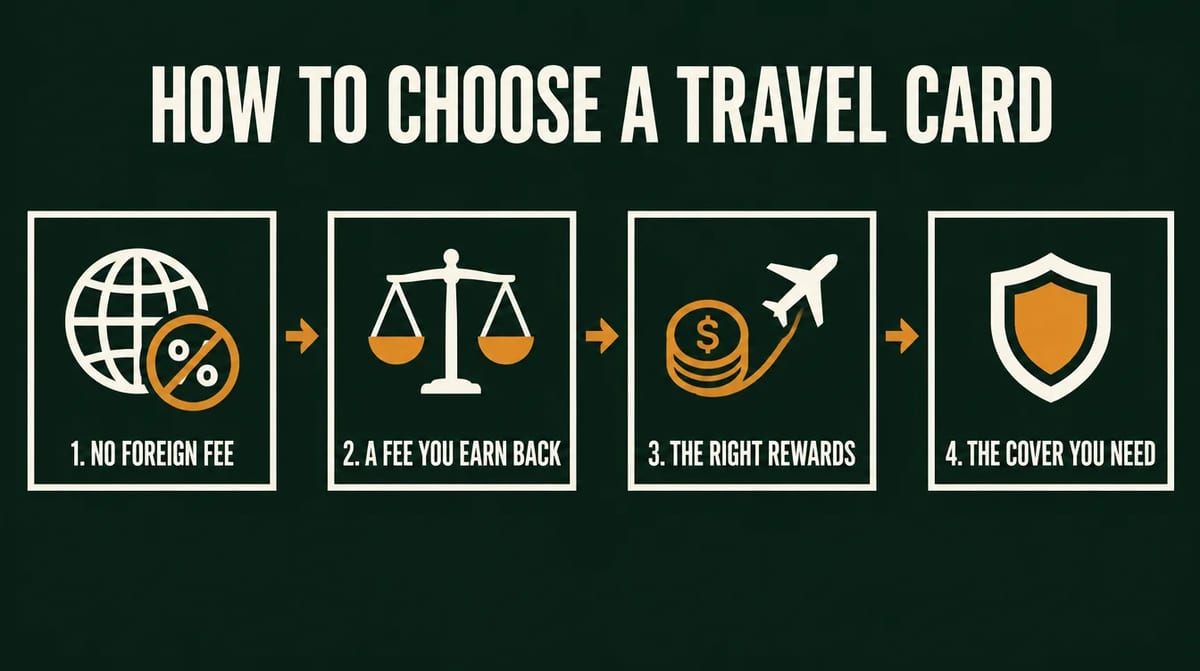
Choosing a travel credit card comes down to four decisions, in this order: no foreign transaction fee, an annual fee you will actually earn back, a rewards currency that suits how you redeem, and the protection you need on the road. Get the first one wrong and every purchase abroad costs you extra; get the second wrong and the card costs you from year two. This guide sets out each decision with the numbers, then sends you to the comparison or list that answers your exact question. Every figure was read on the issuer’s own site on the date shown.
- Want one simple card that works abroad: a no-fee card with no foreign transaction fee, or a $95 card that earns the same on everything.
- Spend heavily or travel often: a premium card can cost less than its fee — but only if you would use its credits anyway.
- Building credit: start with a student or secured card, and pick one with no foreign fee if you travel.
- Outside the US: jump to the Canada, UK or Australia lists below; the cards are completely different.
Decision 1: no foreign transaction fee
A travel card that charges a foreign transaction fee is not a travel card, because it adds a charge to every purchase you make abroad. Many popular cards, including several with no annual fee, carry one. Check this before anything else, and remember that even a fee-free card can cost you if you let a card machine charge you in your home currency instead of the local one.
Read the best cards with no foreign transaction fee for the list, the best cards for international travel for the ones that also protect you abroad, how to stop paying foreign transaction and ATM fees for the charges around them, and why you should always pay in local currency for the card-machine trap.
Decision 2: an annual fee you will earn back
An annual fee is worth paying only when the credits you would genuinely use and the extra rewards over a free card add up to more than the fee. A $95 card earning 2X on everything needs somewhere between $6,333 and $19,000 of spending a year to beat a free 1.5% card, depending on what you think a mile is worth. Premium cards at $395 to $895 can cost less than nothing — or a lot more than their headline — depending entirely on whether their credits match things you already buy.
The full method, with worked tables, is in is a travel credit card annual fee worth it.
The cards at a glance
These are the US cards our comparisons cover, on the numbers that decide them. Fees and earning rates are from each issuer’s card page on 27 September 2026; welcome offers change often and some issuers show them per applicant, so check before you apply.
| Card | Annual fee | Foreign fee | Headline earning | Stand-out feature |
|---|---|---|---|---|
| Capital One Quicksilver | $0 | None | 1.5% cash back on everything | The free baseline that works abroad |
| Chase Freedom Unlimited | $0 | Not on Chase’s no-fee list | 1.5%, 3% dining and drugstores | 0% intro APR for 15 months |
| Capital One Venture | $95 | None | 2X miles on everything | Same rate on everything |
| Chase Sapphire Preferred | $95 | None | 5x Chase Travel, 3x dining, 1x other | Trip cancellation and primary rental cover |
| American Express Gold | $325 | None | 4X restaurants and US supermarkets (capped), 1X other | Monthly dining and Uber credits |
| Capital One Venture X | $395 | None | 2X on everything, 10X hotels via Capital One Travel | $300 travel credit, 10,000 anniversary miles, lounges |
| Chase Sapphire Reserve | $795 | None | 8x Chase Travel, 3x dining, 1x other | $300 travel credit, lounges, travel insurance |
| The Platinum Card from American Express | $895 | None | 5X on flights booked direct (up to $500,000 a year) | Centurion lounges, $2,494 of listed credits |
Decision 3: points, miles or cash back
Cash back is simplest and cannot lose value; transferable points and miles can be worth more, but only if you redeem them with care. Points that move to airline and hotel partners are where the outsized value lives, and also where the traps are — transfers are usually one-way, and award seats are not always there when you want them. If you would rather not think about it, a flat cash-back or flat-miles card is the honest choice.
Start with airline miles and points for beginners, then how credit card transfer partners work, and how to fly business class for less if that is the goal.
Decision 4: insurance and lounges
Card travel insurance mostly protects the trip — cancellation, delays, rental cars — and even the best of it is not a policy written for trekking at altitude. The Chase Sapphire cards list trip cancellation cover of up to $10,000 per traveller and primary rental car cover, and since 2026 both also list emergency evacuation and transportation cover of up to $100,000 for trips 100 miles or more from home. That is a real improvement, but Chase notes that restrictions and exclusions apply, so read the benefit guide before relying on it above 3,000 metres. Lounge access is the other premium perk, worth real money only if you fly from airports with a lounge on your card’s network.
See the best cards with travel insurance, what card travel insurance leaves out, the gap a trek walks straight into, the best cards for lounge access and how to get into a lounge without flying business class.
Head-to-head comparisons
If you have narrowed it to two cards, one of these answers it. Each sets the fees, earning, credits and protection side by side and says who should pick the other card.
| If you are choosing between | Read |
|---|---|
| Two $95 cards | Capital One Venture vs Chase Sapphire Preferred |
| Dining and groceries | Amex Gold vs Chase Sapphire Preferred |
| The two Sapphire cards | Chase Sapphire Preferred vs Reserve |
| Whether to upgrade | Capital One Venture vs Venture X |
| Premium cards | Chase Sapphire Reserve vs Amex Platinum and Venture X vs Sapphire Reserve |
| Two no-fee cards | Chase Freedom Unlimited vs Capital One Quicksilver and Citi Double Cash vs Chase Freedom Unlimited |
| Travel money apps | Wise vs Revolut, and neobanks in Spain if you are moving there |
The best cards, by traveller
If you know what you need but not which card, start with the list for your situation. Every pick names the trade-off it asks you to accept.
The best travel credit cards overall ranks the field by traveller type. If you would rather pay no annual fee at all, see the best no annual fee cards, and if groceries are your biggest spend, the best cards for groceries. If you need a card for your business, see the best small business cards; if you are paying down a balance, the best 0% APR cards come before any rewards card. If you are building credit, read the best student credit cards or the best secured cards for rebuilding your score. Outside the US, the cards are entirely different: see the best travel cards in Canada, in the UK and in Australia.
Using a card on the road
Carry two cards on two different networks, always pay in the local currency, and know where the card stops working and cash takes over. A second card rescues you when the first is declined or lost. In much of the world a card covers nearly everything; in Nepal it covers the city hotels and little else, with a surcharge where it is accepted, and above Namche on the Everest trail there are no cash machines at all.
Our guide to using credit cards in Nepal covers acceptance, surcharges, ATMs and how much cash to carry for a trek, and cash, debit, credit or prepaid sets out the mix for any trip. The latest rule changes — like Chase Freedom Flex dropping its foreign transaction fee and Australia’s card surcharge ban — are in the card news section of our credit cards hub.
If you carry a balance from month to month, pay it off before choosing a rewards card. Purchase APRs on the cards above run from roughly 18% to 29%, and interest outruns every reward, credit and lounge on this page.
How we compare cards
Every figure is read on the issuer’s own site and dated, every comparison names the trade-off, and no card issuer pays us for placement. We do not assign a fixed value to a point, because that value depends on how you redeem; where it matters, we show the maths at several values instead. Offers change often, so treat the date on each figure as its expiry and check the issuer before you apply. This is general information, not personal financial advice.
A trek in Nepal is one of the few big trips where a modest points balance covers a real share of the cost. Annapurna Base Camp is nine days at $920 USD solo and Everest Base Camp is twelve days at $1,700 USD solo, including permits, a government-registered guide, a porter, teahouses and meals.
See the Annapurna Base Camp trek →What is the best travel credit card?
There is no single best card. For one simple card that works abroad, choose one with no foreign transaction fee that earns the same rate on everything. Frequent travellers who would use a premium card’s travel credit can do better with one, but only if those credits match what they already spend.
What matters most in a travel credit card?
No foreign transaction fee first, then an annual fee you will genuinely earn back, then a rewards type that suits how you redeem, and finally insurance or lounges if you need them.
Is a travel credit card worth it if I only travel once a year?
Usually a no-fee card with no foreign transaction fee is better for an occasional traveller. An annual-fee card pays only when its credits and extra rewards beat the fee every year.
Does credit card travel insurance cover trekking?
Card insurance generally covers trip cancellation, delays and rental cars, and a few cards, including both Chase Sapphire cards, now list emergency evacuation cover too. None is a substitute for a travel insurance policy that explicitly covers trekking at altitude, so check the benefit guide’s exclusions.
Can I use my credit card in Nepal?
In Kathmandu and Pokhara at upmarket hotels and a few larger businesses, usually with a 3–4% surcharge. On the trail almost everything is cash, and there are no ATMs above Namche on the Everest route.
Keep reading
The $95 decision most travellers face first.
Ranked by the kind of traveller you are.
The break-even maths, card by card.
Where cards work and where cash takes over.
Sources: issuer card pages for Capital One (Quicksilver, Venture, Venture X), Chase (Freedom Unlimited, Sapphire Preferred, Sapphire Reserve, and its list of no-foreign-fee cards) and American Express (Gold, Platinum), all read on 27 September 2026. Break-even figures are our own arithmetic on those published terms. Nepal card acceptance and ATM details are from Travel Himalaya Nepal field reporting. This is general information, not financial advice; card offers change, so confirm the current terms with the issuer before you apply. No card issuer pays us for placement on this page.

Written by
Bishnu AdhikariPokhara-based, NMA-certified trekking guides. We’ve led 5,000+ treks across the Annapurna and Everest regions since 1998 — every word here comes from the trail. More from this author →
Share this article
Ready to Trek?
From reading about it to standing on it
Our Pokhara-based guides have been doing this since 1998. Tell us your dates and fitness level — we'll build your perfect itinerary. Free, no obligation.
Why trek with our licensed agencyMore guides like this
Popular trips to consider
View all treks & toursFree Trekker’s Insider Guide
Permits, packing lists, cost breakdowns — no fluff.
We send one useful email. You can unsubscribe anytime.