
The short version
Amex Blue Cash Preferred pays most on a mid-size grocery bill at 6% up to $6,000. Capital One Savor's uncapped 3% wins for small and very large bills.
The best grocery card depends on how much you spend at the supermarket: the Amex Blue Cash Preferred pays the most between roughly $3,200 and $10,250 a year, the no-fee Capital One Savor wins above and below that, and the Amex Gold is for people who want points and dine out a lot. The Blue Cash Preferred pays 6% at US supermarkets on up to $6,000 a year for a $95 fee after the first year. The Savor pays an uncapped 3% at grocery stores with no fee. The Gold pays 4X at US supermarkets on up to $25,000 a year, for $325. If you buy most of your food at a warehouse club or a superstore, none of these bonus rates applies, and a flat 2% card beats them all.
- Small grocery bill, under about $3,200 a year: a free 3% card, the Savor or Blue Cash Everyday.
- Middle bill, about $3,200 to $10,250: the Blue Cash Preferred, even after its $95 fee.
- Big bill, above about $10,250: the Savor’s uncapped 3% overtakes the capped 6%.
- Shop at Costco, Walmart or Target? Check the exclusions below before you choose anything.
The grocery cards compared
Six cards pay a bonus on groceries, and the differences that matter are the cap, the fee and where the bonus stops applying. Every figure was read on the issuer’s card page or rates and terms on 27 September 2026.
| Card | Grocery rate | Cap | Annual fee | Stated exclusions |
|---|---|---|---|---|
| Amex Blue Cash Preferred | 6% at US supermarkets | $6,000 a year, then 1% | $0 first year, then $95 | Superstores, convenience stores, warehouse clubs, meal kits |
| Amex Blue Cash Everyday | 3% at US supermarkets | $6,000 a year, then 1% | $0 | Same as above |
| Amex Gold | 4X at US supermarkets | $25,000 a year, then 1X | $325 | Same as above |
| Capital One Savor | 3% at grocery stores | None | $0 | Superstores like Walmart and Target |
| Chase Sapphire Preferred | 3x on online grocery only | None stated on the card page | $95 | Target, Walmart, wholesale clubs |
| Chase Freedom Flex | 5% at grocery stores, Oct 2026 to Mar 2027 | $1,500 a quarter, shared with other 5% categories | $0 | Walmart and Target |
How much each card earns by household grocery spend
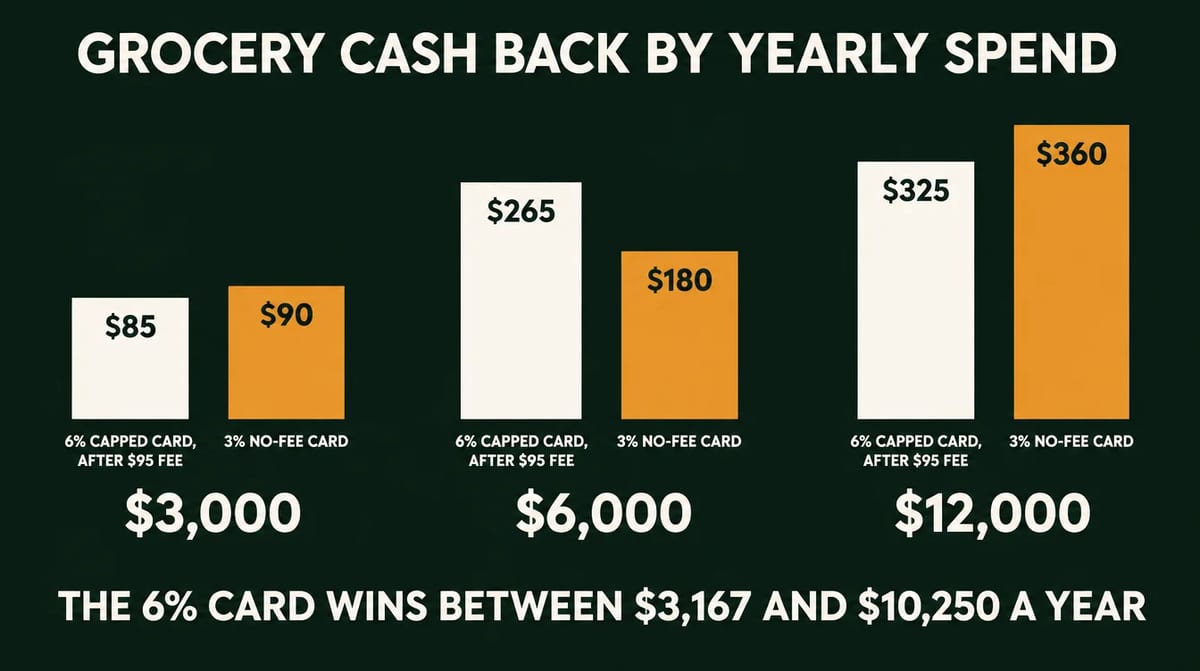
The capped 6% card wins in the middle, the uncapped 3% card wins at both ends, and the crossover points are about $3,200 and $10,250 a year. Here is the cash back on groceries alone for three households, with the Blue Cash Preferred shown after its $95 fee, as it works from year two.
| Yearly grocery spend | $3,000 | $6,000 | $12,000 |
|---|---|---|---|
| Blue Cash Preferred, after $95 fee | $85 | $265 | $325 |
| Blue Cash Everyday | $90 | $180 | $240 |
| Capital One Savor | $90 | $180 | $360 |
| Flat 2% card | $60 | $120 | $240 |
| Amex Gold, points | 12,000 | 24,000 | 48,000 |
The workings are short. At $12,000, the Blue Cash Preferred pays 6% on the first $6,000 ($360) and 1% on the next $6,000 ($60), which is $420, minus the $95 fee: $325. The Savor pays 3% on all $12,000: $360. The Blue Cash Preferred beats the free 3% cards once its extra 3% covers the fee, at $3,167 a year, and falls behind the Savor again above $10,250, where the Savor’s 3% on the whole bill catches up with the capped card’s $265 net plus 1% on the rest. In the first year, with no fee, the Blue Cash Preferred earns $180, $360 and $420.
The Amex Gold row is in points because we do not assign points a cash value. What we can say is that its $325 fee is not paid back by groceries alone for most households; the card makes sense when restaurants, where it also pays 4X on up to $50,000 a year, and its dining credits are part of your life too. That trade is the heart of the Amex Gold versus Sapphire Preferred decision.
Where your groceries do not count
American Express and Chase both exclude warehouse clubs, and Amex and Capital One both exclude superstores, so where you shop can matter more than which card you hold. Amex’s terms for all three of its cards here say superstores, convenience stores, warehouse clubs and meal-kit delivery services are not considered supermarkets. Capital One’s Savor excludes superstores like Walmart and Target. Chase’s online grocery category on the Sapphire Preferred excludes Target, Walmart and wholesale clubs, and the Freedom Flex grocery quarters exclude Walmart and Target.
Each issuer also decides categories by the code a merchant is assigned, not by what you bought. A pharmacy that sells milk is still a pharmacy. If a big share of your food comes from a warehouse club or a superstore, a flat 2% card such as the Citi Double Cash earns 2% on those trips, which beats the 1% base rate every card in the table would give you there.
The Sapphire Preferred’s 3x is for online grocery only; supermarket visits earn 1x. The Blue Cash Everyday pays 3% on US online retail purchases on up to $6,000 a year, separately from its supermarket cap. A delivery service can be coded differently from the store it delivers from, so check a statement before relying on it.
The best card for each kind of shopper
Match the card to where and how much you shop, then check the foreign fee if you travel.
- Family with a big supermarket bill, $6,000 to $10,250 a year: Blue Cash Preferred. It also pays 6% on select US streaming and 3% at US gas stations and on transit.
- Heavy grocery spender, above about $10,250 a year: Capital One Savor, whose 3% never stops. It also pays 3% on dining, entertainment and streaming.
- Single person or couple, under about $3,200 a year: Savor or Blue Cash Everyday. Both are free; the Everyday adds 3% at US gas stations and online retail, each capped at $6,000.
- Online grocery orderer who travels: Chase Sapphire Preferred, at 3x on online grocery and no foreign fee.
- Rotating-category fan: Chase Freedom Flex, at 5% on up to $1,500 a quarter at grocery stores through March 2027, if you activate each quarter. From October to December dining shares that $1,500 cap.
- Warehouse club or superstore shopper: a flat 2% card.
Using a grocery card abroad
Two of the best grocery cards charge a foreign transaction fee, so they belong at home. The Blue Cash Preferred and Blue Cash Everyday both charge 2.7% on foreign transactions. The Savor, Amex Gold, Sapphire Preferred and Freedom Flex charge none, which makes the Savor the rare card that is strong at the supermarket and safe abroad. Wherever you use a card overseas, pay in the local currency, for the reasons in paying in local currency at a card machine.
If the trip is Nepal, bring cash for the trail. Cards work in Kathmandu and Pokhara hotels and larger shops, but village shops on the trail take rupees; our guide to cash versus card abroad covers how much to carry.
The verdict
For most families the Blue Cash Preferred is the best grocery card, for heavy spenders and travellers it is the Savor, and for anyone shopping at warehouse clubs it is a flat 2% card. Work out your yearly supermarket spend from three months of statements, find it in the table, and the answer picks itself.
One group should skip grocery rewards entirely: anyone carrying a balance. The Blue Cash cards charge 19.74% to 28.74% variable after their intro periods, the Savor 18.49% to 28.49%, and a month of interest on a modest balance cancels a year of 6% on groceries.
Nepal is where a modest travel fund goes furthest. Annapurna Base Camp is nine days at $920 USD solo and Everest Base Camp is twelve days at $1,700 USD solo, including permits, a government-registered guide, a porter, teahouses and meals.
See the Annapurna Base Camp trek →Which credit card gives the most cash back on groceries?
The American Express Blue Cash Preferred, at 6% at US supermarkets on up to $6,000 a year, then 1%. It has a $0 intro annual fee for the first year, then $95. Above about $10,250 a year in grocery spending, the uncapped 3% on the Capital One Savor earns more.
Does Costco count as groceries on a credit card?
Not on the Amex cards in this guide, whose terms say warehouse clubs are not supermarkets, nor for Chase’s online grocery category, which excludes wholesale clubs. A flat-rate card earns more there.
Do Walmart and Target count as grocery stores?
Not for the bonus rates here. Amex excludes superstores, Capital One excludes superstores like Walmart and Target, and Chase excludes Walmart and Target from its grocery categories.
Is the Amex Gold worth it just for groceries?
Rarely. It pays 4X at US supermarkets on up to $25,000 a year, but its $325 fee makes most sense if you also use its 4X at restaurants and its dining credits.
Is the Blue Cash Preferred worth the $95 fee?
On groceries alone it beats a free 3% card once you spend about $3,200 a year at US supermarkets, and stays ahead until about $10,250. Its 6% on select streaming and 3% on gas and transit add to that.
Keep reading
The four decisions that choose a card, with every comparison in one place.
When a paid card beats a free one.
Flat rate or categories, at $95 a year.
The four charges on a trip abroad, and how to dodge them.
How earning and redeeming really work.
Sources: American Express, Blue Cash Preferred, Blue Cash Everyday and Gold card pages, offer terms and rates and fees; Capital One, Savor card page; Chase, Sapphire Preferred and Freedom Flex card pages; Citi, Double Cash card page. All read on 27 September 2026 for earning rates, caps, exclusions, fees and APRs. The household examples are our own arithmetic on those published rates. This is general information, not financial advice; card offers change, so confirm the current terms with the issuer before you apply. No card issuer pays us for placement on this page.

Written by
Bishnu AdhikariPokhara-based, NMA-certified trekking guides. We’ve led 5,000+ treks across the Annapurna and Everest regions since 1998 — every word here comes from the trail. More from this author →
Share this article
Ready to Trek?
From reading about it to standing on it
Our Pokhara-based guides have been doing this since 1998. Tell us your dates and fitness level — we'll build your perfect itinerary. Free, no obligation.
Why trek with our licensed agencyMore guides like this
Popular trips to consider
View all treks & toursFree Trekker’s Insider Guide
Permits, packing lists, cost breakdowns — no fluff.
We send one useful email. You can unsubscribe anytime.