
The short version
The longest 0% offers run up to 21 months. Citi Diamond Preferred is cheapest for balance transfers; Wells Fargo Reflect is best for a big purchase.
The longest 0% offers we could verify on issuers’ own pages run 21 months: the Wells Fargo Reflect on purchases and balance transfers, the Citi Diamond Preferred on balance transfers, and the BankAmericard and U.S. Bank Shield for 21 billing cycles. For moving an existing balance, the Citi Diamond Preferred is the cheapest of the long ones because its intro transfer fee is 3% rather than 5%. For a big purchase you want to spread out, the Wells Fargo Reflect gives the longest zero on new spending. Either way, the zero ends on a fixed date, and whatever you still owe then is charged at a normal rate of roughly 15% to 28.5%.

- Moving a balance: Citi Diamond Preferred, 21 months at a 3% intro fee if you transfer within four months.
- Financing a purchase: Wells Fargo Reflect, 21 months at 0% on new spending too.
- Divide by the months, not by hope. A $6,000 transfer with a 3% fee needs about $294 a month to clear in 21 months.
- Do not take any of these abroad. Every card here that states a foreign fee charges 3%.
The 0% cards, side by side
Six no-fee cards offer a genuine 0% intro rate of 15 months or longer, and they differ most on transfer fees and on whether new purchases are included. Every figure below was read on the issuer’s own card page or pricing terms on 27 September 2026. Note that some issuers count in months and others in billing cycles, which run about a month each.
| Card | 0% on purchases | 0% on transfers | Transfer fee | Rate afterwards |
|---|---|---|---|---|
| Wells Fargo Reflect | 21 months | 21 months (request within 120 days) | 5%, $5 min | 17.74%, 24.24% or 28.49% |
| Citi Diamond Preferred | 12 months | 21 months (complete within 4 months) | 3% intro, then 5% | 16.74%–27.49% |
| BankAmericard | 21 billing cycles | 21 billing cycles (within 60 days) | 5% | 14.99%–25.99% |
| U.S. Bank Shield Visa | 21 billing cycles | 21 billing cycles (within 60 days) | 5%, $5 min | 17.24%–28.24% |
| Citi Simplicity | 18 months | 18 months (complete within 4 months) | 3% intro, then 5% | 17.74%–28.49% |
| Chase Freedom Unlimited | 15 months | 15 months | 3% within 60 days, then 5% | 18.24%–27.74% |
All of these are variable rates tied to the prime rate, and the one you get depends on your credit. The fine print matters in three places: the transfer window (as short as 60 days), the fee after the intro window, and eligibility. Wells Fargo, for instance, says you cannot get the Reflect offer if you have opened one in the last 48 months.
How long the zero really lasts
The zero lasts exactly as long as the printed period, counted from the day the account opens, not from the day you move the balance. Transfer on day 50 of a 21-month offer and you have a little under 20 months of zero left. That is why the transfer window matters: the later you move the debt, the less of the offer you use.
It can also end early. The Consumer Financial Protection Bureau says an introductory rate has to stay in effect for at least six months unless you are more than 60 days late on a payment. Several issuers go further in their own terms: Chase’s Freedom Unlimited terms list a penalty rate of up to 29.99%, and Citi’s Diamond Preferred terms say its penalty rate of up to 29.99% applies if you pay late. The Citi Simplicity and the BankAmericard are the gentle exceptions: Citi advertises no late fees and no penalty rate on the Simplicity, and Bank of America says paying late will not automatically raise the BankAmericard’s rate.
Store cards often advertise deferred interest. The CFPB explains that with those, if you have not paid the whole purchase off by the deadline, interest is charged back to the date of purchase. A true 0% intro rate, like the cards above, charges the normal rate only on what is left from the day the offer ends. Read which one you are signing.
The balance transfer maths, worked through
A transfer fee of 3% to 5% is almost always cheaper than a year and a half of interest, as long as you clear the balance before the zero ends. Take a $6,000 balance on a card charging 24%. Paying $300 a month there takes 26 months and costs about $1,739 in interest, by our calculation.
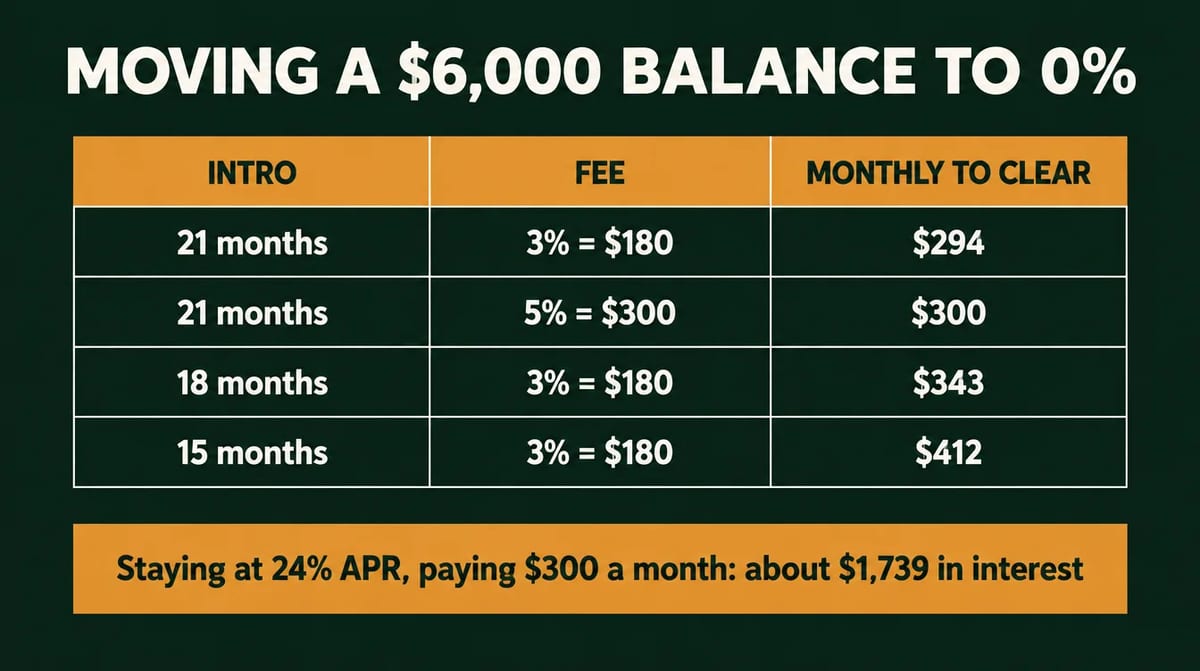
| Move $6,000 to | Fee | New balance | Monthly payment to clear in time |
|---|---|---|---|
| Citi Diamond Preferred, 21 months | $180 (3%) | $6,180 | $294.29 |
| Wells Fargo Reflect, 21 months | $300 (5%) | $6,300 | $300.00 |
| Citi Simplicity, 18 months | $180 (3%) | $6,180 | $343.33 |
| Chase Freedom Unlimited, 15 months | $180 (3%) | $6,180 | $412.00 |
On the Citi Diamond Preferred, the whole cost of clearing that debt is the $180 fee: roughly $1,559 less than staying put. The catch is discipline. Pay $250 a month instead of $294 and you will still owe $930 when the 21 months end, and that remainder starts collecting interest at up to 27.49%. So work out the monthly figure on the day you transfer, set it as an automatic payment, and treat the minimum payment the statement shows as irrelevant.
One rule of thumb to keep: a shorter offer with a lower fee can beat a longer one with a higher fee, but only if the higher monthly payment is one you can actually make.
What happens when the intro ends
On the first day after the intro period, any balance still on the card starts accruing interest at your normal variable rate, and nothing is charged backwards. On these cards that rate runs from 14.99% at the bottom of the BankAmericard range to 28.49% at the top of the Reflect’s. New purchases also move to the standard rate, which is the quiet trap on a card like the Citi Diamond Preferred, where purchases stop being 0% after 12 months while the transfer is still at zero for another nine.
The practical fix is to stop spending on a balance-transfer card altogether. Keep it for the debt, pay it down on schedule, and put everyday spending on a card you clear every month.
This is a debt tool, not a travel card
None of these cards is built for spending abroad, and most of them say so in the price list. The Reflect, both Citi cards and the Freedom Unlimited each charge a 3% foreign transaction fee, according to their terms. Bank of America and U.S. Bank did not state a foreign fee on the card pages we read, so check the pricing terms before relying on either overseas.
If you are paying off a trip rather than planning one, a 0% card is a sensible way to do it. If you are planning one, use a card with no foreign fee for the spending itself; our guide to avoiding foreign transaction and ATM fees explains the charges, and the travel money mistakes that cost the most covers the rest. Using a 0% card to fund a trip you cannot yet afford is the one use we would talk you out of: 21 months passes faster than it sounds.
Our verdict
To clear an existing balance, choose the Citi Diamond Preferred and transfer within the first four months to get the 3% fee. To spread a large purchase, choose the Wells Fargo Reflect. If you are worried about missing a payment, the Citi Simplicity is the forgiving choice: 18 months, a 3% intro fee, and no penalty rate. And if a 0% card would simply let you spend more, pick none of them; the interest you avoid is only saved if the balance actually goes down.
Once the balance is gone, Nepal is where a modest budget goes furthest. Annapurna Base Camp is nine days at $920 USD solo and Everest Base Camp is twelve days at $1,700 USD solo, including permits, a government-registered guide, a porter, teahouses and meals.
See the Annapurna Base Camp trek →Which credit card has the longest 0% APR in 2026?
On the issuer pages we checked on 27 September 2026, the longest was up to 21 months: the Wells Fargo Reflect on purchases and balance transfers, the Citi Diamond Preferred on balance transfers, and the BankAmericard and U.S. Bank Shield for 21 billing cycles.
How much does a balance transfer cost?
Usually 3% or 5% of the amount moved. On $6,000 that is $180 or $300. Citi and Chase charge 3% during an intro window, then 5%; Wells Fargo, Bank of America and U.S. Bank charge 5%.
What happens when my 0% APR ends?
Any remaining balance starts accruing interest at your normal variable rate from that day. On a true 0% intro offer, interest is not charged backwards, unlike a deferred-interest store card.
Can I lose the 0% rate early?
Yes. The CFPB says an intro rate must last at least six months unless you are more than 60 days late on a payment, and several issuers apply a penalty rate of up to 29.99% for late payment.
Should I use a 0% card for travel?
Not abroad. Most 0% cards charge a 3% foreign transaction fee. Use a no-foreign-fee card for spending overseas and keep the 0% card for paying down debt.
Keep reading
The four decisions that choose a card, with every comparison in one place.
The costly habits that follow people abroad.
The four charges on a trip abroad, and how to dodge them.
When a paid travel card earns back its cost.
Which $95 card earns more on a real budget.
Sources: Wells Fargo, Reflect card page and Important Credit Terms; Citi, Simplicity and Diamond Preferred card pages and pricing details; Bank of America, BankAmericard card page; U.S. Bank, Shield Visa card page; Chase, Freedom Unlimited card page and pricing and terms; Consumer Financial Protection Bureau, answers on introductory rates and deferred interest. All read on 27 September 2026. The payment examples are our own arithmetic on those published terms. This is general information, not financial advice; card offers change, so confirm the current terms with the issuer before you apply. No card issuer pays us for placement on this page.
Photos via Pexels: Tima Miroshnichenko

Written by
Bishnu AdhikariPokhara-based, NMA-certified trekking guides. We’ve led 5,000+ treks across the Annapurna and Everest regions since 1998 — every word here comes from the trail. More from this author →
Share this article
Ready to Trek?
From reading about it to standing on it
Our Pokhara-based guides have been doing this since 1998. Tell us your dates and fitness level — we'll build your perfect itinerary. Free, no obligation.
Why trek with our licensed agencyMore guides like this
Popular trips to consider
View all treks & toursFree Trekker’s Insider Guide
Permits, packing lists, cost breakdowns — no fluff.
We send one useful email. You can unsubscribe anytime.