
The short version
Chase Ink Business Unlimited is the best no-fee default at 1.5% back. Spark Cash Plus wins above $30,000 a year; Ink Business Preferred suits ad spend.
If your business spends across everything, the Chase Ink Business Unlimited (1.5% back, no annual fee) is the safest default, and the Capital One Spark Cash Plus (2% back, $150 fee) wins once you spend more than about $30,000 a year. If most of your spending is advertising, shipping, phone and travel, the $95 Chase Ink Business Preferred earns 3X on up to $150,000 of it. For a business that travels a lot, the $395 Capital One Venture X Business pays 2X on everything plus lounge access. Whichever you pick, you will almost certainly be personally liable for the balance.

- Rank by your statement, not the bonus. A $30,000 spend requirement is a bad deal if you would not spend it anyway.
- Flat-rate: Ink Business Unlimited for no fee; Spark Cash Plus if you pay in full every month and spend enough to cover $150.
- Category: Ink Business Cash for office supplies and telecoms; Amex Business Gold if your top two categories shift month to month.
- Business cards are not consumer cards. The Federal Reserve notes the CARD Act’s main protections do not apply to them.
The cards, by how your business spends
The right business card depends on whether your spending is spread evenly, concentrated in a few categories or dominated by travel. Every figure below was read on the issuer’s own business card page on 27 September 2026. Rewards shown as X are points or miles; percentages are cash back.
| Card | Annual fee | Earning | Welcome offer | Spending style |
|---|---|---|---|---|
| Chase Ink Business Unlimited | $0 | 1.5% on everything | $750 after $6,000 in 3 months | Flat-rate, low spend |
| Capital One Spark Cash Plus | $150, refunded at $150,000 spend | 2% on everything | $2,000 after $30,000 in 3 months | Flat-rate, high spend |
| Chase Ink Business Cash | $0 | 5% office supply and telecoms, 2% gas and restaurants (each on first $25,000), 1% else | $750 after $6,000 in 3 months | Category, small office |
| Chase Ink Business Preferred | $95 | 3X travel, shipping, online ads, telecoms on first $150,000, 1X else | 100,000 points after $8,000 in 3 months | Category, marketing-heavy |
| Amex Business Gold | $375 | 4X on your top 2 of 6 categories each cycle, on first $150,000 a year, 1X else | Varies; “as high as” 200,000 after $15,000 | Category, shifting |
| Amex Blue Business Plus | $0 | 2X on first $50,000 a year, then 1X | 15,000 points after $3,000 in 3 months | Flat-rate points, low spend |
| Capital One Venture X Business | $395 | 2X on everything, more via Capital One Business Travel | 150,000 miles after $30,000 in 3 months | Travel-heavy |
Flat-rate: the default for most small businesses
If you cannot say which category most of your spending falls into, a flat-rate card will earn more than a category card, because you never lose out on the purchases that fall outside the bonus. The Ink Business Unlimited pays 1.5% on everything with no fee and a 0% intro rate on purchases for 12 months, after which Chase lists 16.74%–24.74% variable.
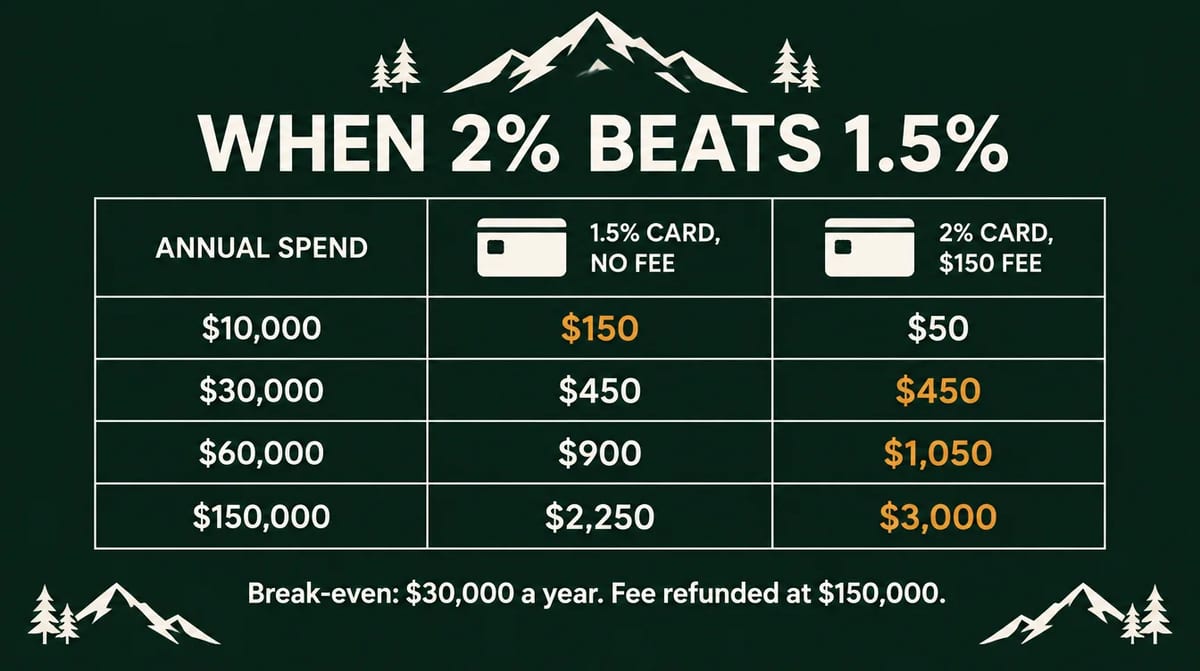
The Spark Cash Plus pays 2% but costs $150 a year until you spend $150,000, at which point Capital One refunds the fee. The half-point difference covers that fee once you spend $30,000 a year, because 0.5% of $30,000 is exactly $150:
| Annual card spend | Ink Business Unlimited (1.5%, $0) | Spark Cash Plus (2%, less $150 fee) |
|---|---|---|
| $10,000 | $150 | $50 |
| $30,000 | $450 | $450 |
| $60,000 | $900 | $1,050 |
| $150,000 | $2,250 | $3,000 (fee refunded) |
Two cautions before you pick the Spark: Capital One says the Spark Cash Plus is designed to be paid in full, with a 2.99% late fee if you miss the minimum, and its bonus asks for $30,000 in three months, or $10,000 a month.
The Amex Blue Business Plus is the points version: 2X on the first $50,000 a year, no fee, and 0% on purchases for 12 months before a 16.99%–28.74% variable rate. Choose it only if you already know how you would redeem Membership Rewards.
Category cards: when your spending clusters
A category card beats a flat rate only when a large, predictable share of your spending lands in its bonus categories. The Ink Business Cash is the clearest case. A small office paying $1,000 a month for internet, phones and supplies earns 5% on it, $600 a year from that line alone, within Chase’s $25,000 annual cap. Everything outside the categories earns only 1%.
The Ink Business Preferred suits a business that buys advertising on social media and search engines, ships goods and travels. It earns 3X on up to $150,000 a year across those categories for a $95 fee, and Chase lists no foreign transaction fees. Its bonus needs $8,000 in three months.
The Amex Business Gold does the sorting for you: it pays 4X on whichever two of six categories you spend most on in each billing cycle, from US advertising, US electronics and software, US restaurants, US gas stations, transit and wireless phone bills. At $375 a year it only makes sense if at least two of those are genuinely big lines for you.
Pull three months of statements and total the spending that would land in each card’s bonus categories. If it is under about a third of the total, a flat-rate card will almost always earn more.
Travel-heavy: when flights and hotels dominate
For a business with frequent travel, the Venture X Business is the strongest pick we verified, provided the lounges and travel credit replace spending you already do. It pays 2X on every purchase, 10X on hotels and rental cars and 5X on flights booked through Capital One Business Travel, and adds a $300 annual travel credit, 10,000 bonus miles each anniversary, up to $120 towards Global Entry or TSA PreCheck, and access to Capital One Lounges and more than 1,300 lounges worldwide.
The $300 credit only counts if you book through Capital One’s travel portal; if you do, the net fee is $95 before the anniversary miles. Like the Spark Cash Plus, it is designed to be paid in full. For the wider question of whether a premium fee pays off, see whether a travel card’s annual fee is worth it and our guide to airport lounge access.
Personal guarantees and what protection you lose
A small business card is almost always a personal debt too, and it sits outside most of the consumer rules that protect personal cardholders. The Federal Reserve’s 2010 report to Congress on small business credit cards says they typically stipulate a personal guarantee, so both the firm and the owner who signs are responsible for the balance. The same report states that the CARD Act’s substantive protections apply to consumer credit plans and do not apply to business credit cards. What business cards do keep, the report adds, is federal protection against cards being issued unsolicited and against unauthorised or fraudulent use.
In plain terms, if the business cannot pay, the issuer can come to you, and some limits that govern personal cards may not bind a business one. Read the cardmember agreement before you apply, and keep personal spending off the business card.
One more practical point for owners who travel: the Ink Business Unlimited’s pricing terms list a 3% foreign transaction fee, while the Ink Business Preferred, Spark Cash Plus and Amex Business Gold say they charge none. If you pay overseas suppliers or travel for work, see our guide to avoiding foreign transaction fees.
Our verdict
Start with the Chase Ink Business Unlimited if you want no fee and no thinking. Move to the Spark Cash Plus once you reliably spend more than $30,000 a year and pay in full. Choose the Ink Business Cash or Ink Business Preferred only if your statements show a large share in their categories, and the Venture X Business only if you travel enough to use its credit and lounges. If you carry a balance, the interest will outrun any reward.
If the rewards are going towards a trip, Nepal stretches them. Annapurna Base Camp is nine days at $920 USD solo and Everest Base Camp is twelve days at $1,700 USD solo, including permits, a government-registered guide, a porter, teahouses and meals.
See the Annapurna Base Camp trek →What is the best small business credit card in 2026?
For most small businesses, the Chase Ink Business Unlimited: 1.5% back on everything with no annual fee. Businesses spending more than about $30,000 a year earn more with the Capital One Spark Cash Plus at 2%, after its $150 fee.
Do business credit cards need a personal guarantee?
Usually. The Federal Reserve’s 2010 report to Congress on small business credit cards says they typically stipulate a personal guarantee, making the owner who signs responsible for the balance alongside the business.
Do business credit cards have the same protections as personal cards?
Not all of them. The same Federal Reserve report states that the CARD Act’s substantive protections apply to consumer credit plans and do not apply to business credit cards. Check the cardmember agreement.
Which business card is best for travel?
The Capital One Venture X Business if you travel often and book through Capital One Business Travel; the $95 Chase Ink Business Preferred is the cheaper option, with 3X on travel.
Is the welcome bonus worth chasing?
Only if you would spend the required amount anyway. Offers here ask for between $3,000 and $30,000 in three months. Spending extra to reach a bonus usually costs more than the bonus is worth.
Keep reading
The four decisions that choose a card, with every comparison in one place.
When a paid card earns back its cost.
The cards and passes that actually get you in.
How earning and redeeming really work.
The four charges on a trip abroad, and how to dodge them.
Sources: Chase, Ink Business Preferred, Ink Business Cash and Ink Business Unlimited card pages and Ink Business Unlimited pricing and terms; Capital One, Spark Cash Plus and Venture X Business card pages; American Express, Business Gold and Blue Business Plus card pages, all read on 27 September 2026; Board of Governors of the Federal Reserve System, Report to the Congress on the Use of Credit Cards by Small Businesses and the Credit Card Market for Small Businesses (May 2010). The spending examples are our own arithmetic on published rates. This is general information, not financial advice; card offers change, so confirm the current terms with the issuer before you apply. No card issuer pays us for placement on this page.
Photos via Pexels: Ivan S

Written by
Bishnu AdhikariPokhara-based, NMA-certified trekking guides. We’ve led 5,000+ treks across the Annapurna and Everest regions since 1998 — every word here comes from the trail. More from this author →
Share this article
Ready to Trek?
From reading about it to standing on it
Our Pokhara-based guides have been doing this since 1998. Tell us your dates and fitness level — we'll build your perfect itinerary. Free, no obligation.
Why trek with our licensed agencyMore guides like this
Popular trips to consider
View all treks & toursFree Trekker’s Insider Guide
Permits, packing lists, cost breakdowns — no fluff.
We send one useful email. You can unsubscribe anytime.