

The short version
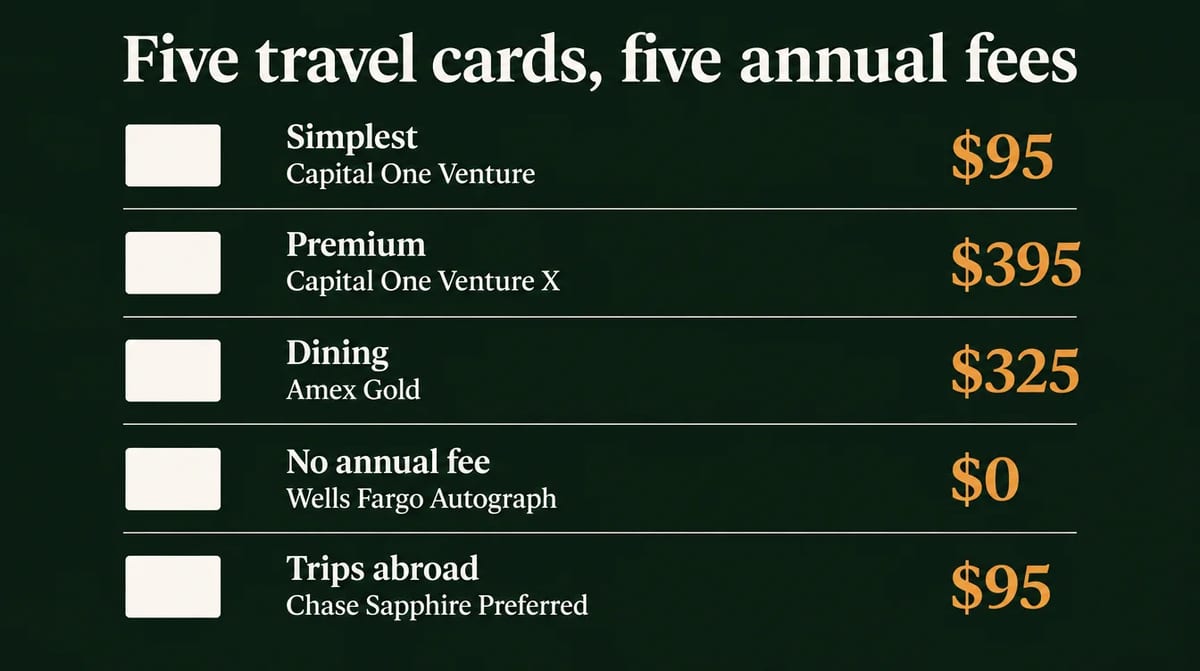
Capital One Venture is the simplest pick at 2X on everything for $95. Venture X leads premium, Amex Gold wins dining and Wells Fargo Autograph has no fee.
For most people the best travel credit card in 2026 is the Capital One Venture, because it earns 2X miles on every purchase for a $95 annual fee and never makes you think about categories. Frequent travellers who will use lounges should pick the Capital One Venture X, restaurant lovers the American Express Gold Card, fee-avoiders the Wells Fargo Autograph, and anyone who wants trip cancellation cover abroad the Chase Sapphire Preferred.

- Start with the Venture if you want one card that earns the same on everything.
- Go premium only if you will use the credits. A $395 or $795 fee is paid back by perks you actually spend, not by the brochure.
- No fee does not mean no rewards. The Autograph pays 3X on restaurants, travel, gas and transit, streaming and phone plans.
- Carry no rewards card at all if you keep a balance. At APRs of roughly 18% to 30%, interest beats any points you earn.
The five picks at a glance
Each card below wins for one kind of traveller, and each one costs you something the others do not. Every figure was read on the issuer’s own card page on 27 September 2026. We compare the number of points or miles earned rather than guessing what they are worth, because their value depends on how you redeem them.
| Pick | Card | Annual fee | Everyday earn | What it costs you |
|---|---|---|---|---|
| Simplest | Capital One Venture | $95 | 2X on everything | No trip cancellation cover on the card page |
| Premium | Capital One Venture X | $395 | 2X on everything | The $300 credit only works on Capital One Travel bookings |
| Dining | American Express Gold | $325 | 1X outside its categories | Credits come in monthly slices you must remember to use |
| No fee | Wells Fargo Autograph | $0 | 1X outside its categories | Only 1X on supermarkets and general shopping |
| Trips abroad | Chase Sapphire Preferred | $95 | 1x outside its categories | Loses to the Venture on non-category spending |
Simplest all-rounder: Capital One Venture
The Venture is the card to pick if you want one card, one rate and no homework. It pays 2X miles on every purchase and 5X on hotels, vacation rentals and rental cars booked through Capital One Travel, for $95 a year. The current welcome offer is 75,000 miles after $4,000 in purchases in the first three months, and it includes up to $120 towards Global Entry or TSA PreCheck.
What it costs you: its card page advertises no trip cancellation or rental car insurance, and it has no lounge access. Pick something else if a large share of your spending is restaurants, where the Sapphire Preferred pays 3x. We ran that exact comparison on a real budget in Capital One Venture vs Chase Sapphire Preferred.
Best premium card: Capital One Venture X
The Venture X is the premium card whose fee is easiest to earn back, because its two biggest perks cover most of the $395 on their own. It gives a $300 annual credit for bookings through Capital One Travel and 10,000 bonus miles every account anniversary, starting at the first. It earns 2X on everything, 10X on hotels and rental cars and 5X on flights and vacation rentals booked through Capital One Travel. The primary cardholder gets Capital One Lounges and Landings plus Priority Pass, after enrolling.
What it costs you: the $300 credit is worth $300 only if you book through Capital One Travel. Book direct and it counts as zero.
| Venture X | Sapphire Reserve | Amex Platinum | |
|---|---|---|---|
| Annual fee | $395 | $795 | $895 |
| Headline travel credit | $300 via Capital One Travel | Up to $300 travel credit | Up to $600 hotel credit, $300 per half-year |
| Lounges | Capital One Lounges, Priority Pass | Chase Sapphire Lounges, Priority Pass | Centurion Lounges, Priority Pass, 10 Delta Sky Club visits |
| Trip cancellation cover | Not listed on the card page | Up to $10,000 per traveller | Up to $10,000 per trip |
| Foreign transaction fee | None | None | None |
Pick the Sapphire Reserve instead if you will genuinely use its long list of credits, including up to $300 a year on dining and up to $500 a year on The Edit hotels, and want its 8x on Chase Travel and 4x on flights and hotels booked direct. The Platinum is a lounge card first; our guide to lounge access without flying business class covers when that is worth it.
Best for dining: American Express Gold Card
The Amex Gold is the strongest pick for people whose biggest spending is restaurants and groceries. It pays 4X at restaurants worldwide on up to $50,000 a year and 4X at US supermarkets on up to $25,000 a year, then 1X, plus 3X on flights booked directly or through AmexTravel. There is no foreign transaction fee from American Express.
What it costs you: $325 a year, and much of the value sits in monthly credits — up to $10 a month for dining, $10 a month in Uber Cash and up to $7 a month at Dunkin’. Miss a month and that slice is gone. Amex shows its welcome offer per applicant, so check yours before you apply. Pick the Capital One Savor instead if you want dining rewards without a fee: it pays 3% on dining, entertainment, popular streaming and grocery stores for $0, with no foreign transaction fee.
Best with no annual fee: Wells Fargo Autograph
The Autograph is the card we would give someone who refuses to pay a fee but still travels. It pays 3X on restaurants, travel, gas and transit, popular streaming services and phone plans, 1X on everything else, and charges no foreign transaction fee. The welcome offer is 20,000 points after $1,000 in purchases in the first three months.
What it costs you: supermarket and general shopping earn only 1X. Pick the Capital One Quicksilver instead if you want a flat 1.5% cash back on every purchase and no categories at all; it also has no annual fee and no foreign transaction fee.
Best for trips abroad: Chase Sapphire Preferred
The Sapphire Preferred is the $95 card to carry overseas if you want insurance, not just points. Chase lists trip cancellation and interruption cover of up to $10,000 per covered traveller and $20,000 per trip, primary rental car cover up to $60,000, lost luggage cover up to $3,000 per traveller and baggage delay cover of up to $100 a day for five days. It earns 5x on Chase Travel, 3x on dining and 2x on other travel.
What it costs you: 1x on everything outside its categories, which is why the Venture out-earns it for most budgets. Chase now also lists emergency evacuation and transportation of up to $100,000 on trips 100 miles or more from home, but a card benefit is not a trekking policy.
Before relying on any card for a trek, read the Guide to Benefits for hazardous-activity and altitude exclusions. Our guide to the gap in your card’s travel insurance that a trek walks into lists the three questions to ask the issuer, and what card travel insurance actually covers gives the wider picture.
Who should skip a rewards card entirely
If you carry a balance from month to month, no travel card on this page is right for you. The published variable purchase APRs on these cards run from 18.74% on the Autograph’s lowest tier to 28.74% on the Autograph’s highest tier and Reserve ranges. A year of interest on a $3,000 balance at 25% is about $750, more than most people earn in rewards. Pay the balance off first, and read our list of travel money mistakes to avoid before you go.
Whichever card you take abroad, pay in the local currency when a terminal offers you dollars; our explainer on dynamic currency conversion shows why. In Nepal, cards work in Kathmandu and Pokhara hotels and larger restaurants, but the trail runs on cash.
If the points are for a big trip, Nepal is where a modest balance goes furthest. Annapurna Base Camp is nine days at $920 USD solo and Everest Base Camp is twelve days at $1,700 USD solo, including permits, a government-registered guide, a porter, teahouses and meals.
See the Annapurna Base Camp trek →What is the best travel credit card in 2026?
For most people, the Capital One Venture: 2X miles on every purchase, a $95 annual fee and no foreign transaction fee. Frequent travellers who will use lounges and a $300 Capital One Travel credit should look at the Venture X.
Is a premium travel card worth the annual fee?
Only if you use the credits. The Venture X’s $300 travel credit and 10,000 anniversary miles offset much of its $395 fee for someone who books through Capital One Travel. The Sapphire Reserve at $795 and Amex Platinum at $895 pay off only for people who would spend on their specific credits anyway.
What is the best travel card with no annual fee?
The Wells Fargo Autograph, which pays 3X on restaurants, travel, gas and transit, streaming and phone plans with no foreign transaction fee. The Capital One Quicksilver is the simpler choice at a flat 1.5% cash back.
Which travel card has the best travel insurance?
Of these five, the Chase Sapphire Preferred. It lists trip cancellation up to $10,000 per covered traveller, primary rental car cover up to $60,000 and lost luggage cover up to $3,000 per traveller. Check the Guide to Benefits for exclusions before relying on it.
Do these cards charge foreign transaction fees?
No. The Venture, Venture X, Amex Gold, Wells Fargo Autograph and Sapphire Preferred all list no foreign transaction fee.
Keep reading
The four decisions that choose a card, with every comparison in one place.
Which $95 card earns more on a real budget.
The cards and passes that actually get you in.
The four charges on a trip abroad, and how to dodge them.
How earning and redeeming really work.
Sources: Capital One card pages for the Venture, Venture X, Savor and Quicksilver; Chase card pages for the Sapphire Preferred and Sapphire Reserve; American Express card pages for the Gold Card and the Platinum Card; Wells Fargo’s Autograph card page, all read on 27 September 2026 for fees, welcome offers, earning rates, credits, insurance and APRs. The balance example is our own arithmetic. This is general information, not financial advice; card offers change, so confirm the current terms with the issuer before you apply. No card issuer pays us for placement on this page.

Written by
Bishnu AdhikariPokhara-based, NMA-certified trekking guides. We’ve led 5,000+ treks across the Annapurna and Everest regions since 1998 — every word here comes from the trail. More from this author →
Share this article
Ready to Trek?
From reading about it to standing on it
Our Pokhara-based guides have been doing this since 1998. Tell us your dates and fitness level — we'll build your perfect itinerary. Free, no obligation.
Why trek with our licensed agencyMore guides like this
Popular trips to consider
View all treks & toursFree Trekker’s Insider Guide
Permits, packing lists, cost breakdowns — no fluff.
We send one useful email. You can unsubscribe anytime.