

The short version
Latitude's 28° Global and ING's Orange One Rewards Platinum charge no international transaction fee. Amex now charges 3.5% on foreign spending.
For most Australians travelling overseas, the Latitude 28° Global Platinum Mastercard is the simplest card to take: $0 international transaction fees on purchases and a $96 annual fee that is waived in the first year and every year you spend $12,000. If you want cashback and a low rate, the ING Orange One Rewards Platinum also charges no international transaction fee, for $149 a year. CommBank’s Ultimate card has no international fee either but is changing on 29 September 2026. And the Qantas American Express Ultimate earns Qantas Points well at home but charges 3.5% on foreign-currency spending. Every figure below was read on the issuer’s own site on 27 September 2026.
- 28° Global Platinum for overseas spending: $0 international transaction and currency conversion fees on purchases.
- ING Orange One Rewards Platinum for cashback: 1% up to $30 a month, no ING international transaction fees and a 16.99% p.a. purchase rate, for $149 a year.
- CommBank Ultimate has no international transaction fee, but its points scheme changes on 29 September 2026 and the spend-based fee waiver ends on 1 January 2027.
- Qantas Amex Ultimate suits heavy Qantas flyers who can use a $450 travel credit, but it charges 3.5% on foreign purchases.
- Pick none if you carry a balance — interest will outweigh any points or cashback.
The four cards side by side
Three of the four charge nothing on international purchases; the difference is fees, rates and what you earn. Australian card products change often, and the table shows only what each issuer’s own page said on the day we checked.
| 28° Global Platinum | ING Orange One Rewards Platinum | CommBank Ultimate | Qantas Amex Ultimate | |
|---|---|---|---|---|
| Fee | $96 a year; $0 first year; waived with $12k spend | $149 a year | $35 a month; waived with $4,000 spend in a statement period until 1 Jan 2027 | $450 a year |
| International transaction fee | $0 on purchases | No ING fee | 0% on purchases | 3.5% currency conversion fee |
| Earns | Latitude Rewards when you spend $1,000 a month | 1% cashback, up to $30 a month | Moving to CommBank Yello points from 29 Sep 2026 | 1.25 Qantas Points per $1 everyday; 2.25 on eligible Qantas spend |
| Travel extras | — | Complimentary international travel insurance with a $6,000+ limit | Two lounge passes a year | $450 Qantas Travel Credit; two Qantas Club lounge invitations |
| Purchase rate | 28.99% p.a. | 16.99% p.a. variable | Check CommBank | 23.99% p.a. |
What the international fee costs on a real trip
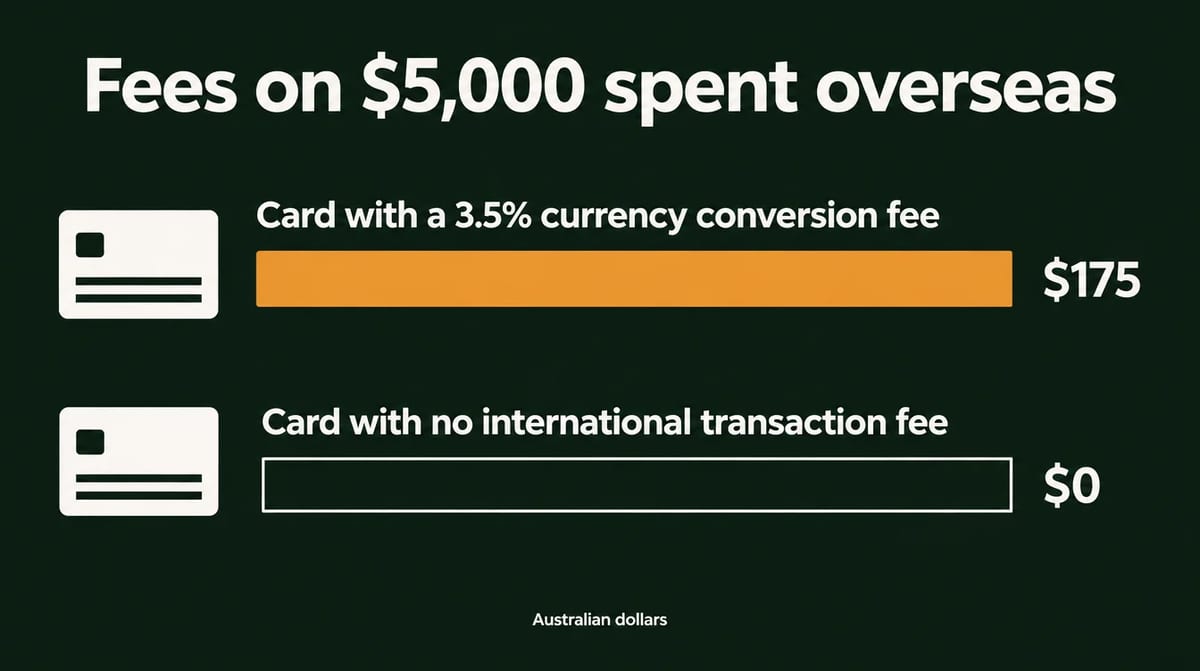
A 3.5% currency conversion fee costs $35 on every $1,000 you spend in a foreign currency, including online shopping priced in US dollars. American Express Australia lists 3.5% of the converted amount on its consumer credit cards, effective from 4 May 2026. The other three cards here charge nothing on international purchases.
| Spent overseas | At 3.5% (Amex) | 28°, ING or CommBank |
|---|---|---|
| $1,000 | $35 | $0 |
| $3,000 | $105 | $0 |
| $5,000 | $175 | $0 |
On a $5,000 trip the fee is $175 — more than the 28° card’s full annual fee. So the sensible set-up for a Qantas Points collector is two cards: the Amex for spending at home and a no-international-fee card for the trip. And wherever you are, pay in the local currency when a terminal offers Australian dollars; our guide to dynamic currency conversion explains why.
Latitude 28° Global Platinum, simplest card for overseas
The 28° card does one thing well: no international transaction or currency conversion fees on purchases, online or overseas. The annual fee is normally $96, waived in the first year and in any year you spend $12,000 on eligible purchases. You earn $10 in Latitude Rewards in each month you spend $1,000 on eligible purchases, and there is no additional cardholder fee.
The catches are the rates. Purchases are charged at 28.99% p.a. if you do not clear the balance, cash advances at 29.99% p.a., and a cash advance fee of 3.5% or $4, whichever is greater. Use it for purchases and pay in full; do not use it at an ATM.
ING Orange One Rewards Platinum, best cashback and rate
ING pairs no international transaction fees with 1% cashback, capped at $30 a month or $360 a year, and a 16.99% p.a. purchase rate. ING also charges $0 for international ATM withdrawals, although the ATM operator may add its own fee, and cash advances still accrue interest at 16.99% p.a. The annual fee is $149. The minimum credit limit is $6,000, you need to earn at least $36,000 a year, and complimentary international travel insurance applies when you are approved for a limit of $6,000 or more. Cashback is paid into an ING Orange Everyday account.
At the full $30 a month, the cashback repays the $149 fee about 2.4 times over. To earn all $360 you need about $3,000 a month of eligible spending, because 1% of $3,000 is $30. Spend less and the fee takes a bigger bite.
CommBank Ultimate, good today and changing
CommBank’s Ultimate card charges no international transaction fee on purchases and includes two lounge passes a year, but it is mid-change and the cost rises from January. From 29 September 2026 it becomes the Ultimate credit card, CommBank Awards points can no longer be earned or redeemed on it, and eligible customers earn CommBank Yello points instead. The $35 monthly fee is currently waived in any statement period in which you spend $4,000; CommBank says that waiver is removed from 1 January 2027, making the fee $420 a year.
If you already hold it, it remains a strong card for the trip itself. If you are choosing today, wait until the new version is live and its full terms are on CommBank’s page. The Reserve Bank’s card reforms help explain why rewards cards are being redesigned; our piece on Australia’s card surcharge ban covers what changes on 1 October.
Qantas American Express Ultimate, for Qantas flyers
The Qantas Amex Ultimate costs $450 a year and gives back a $450 Qantas Travel Credit each year, so it pays its way if you already book Qantas flights through Amex Travel. It earns 2.25 Qantas Points per dollar on eligible Qantas products and 1.25 on everyday purchases, dropping to 1 after 100,000 points in a calendar year, and 0.5 at government bodies. It includes two Qantas Club lounge invitations a year and up to four additional cards at no extra fee. The purchase rate is 23.99% p.a.
Who should pick something else: anyone who will not use the travel credit on Qantas flights booked through American Express Travel, and anyone looking for a card to spend with overseas — the 3.5% fee rules it out. Our miles and points guide explains how to judge a points balance.
Complimentary card cover is written for ordinary holidays. If you are trekking above 3,000 metres, read the gap in card travel insurance that a trek walks into before relying on it.
Taking an Australian card to Nepal
In Nepal a card works at a small number of upmarket hotels, large agencies and perhaps one or two restaurants per city, usually with a 3–4% surcharge, and not at all on the trail. That is our own field reporting from Kathmandu and Pokhara, and Nepal is not bound by Australia’s surcharge ban. Nepali ATMs charge about NPR 500 per withdrawal on top of your bank’s fee, so withdraw in large amounts in the city, carry two cards on two networks and plan to pay teahouses in rupees. Our guide to avoiding foreign transaction and ATM fees has the rest.
If the points are for a big trip, Nepal is where a modest balance goes furthest. Annapurna Base Camp is nine days at $920 USD solo and Everest Base Camp is twelve days at $1,700 USD solo, including permits, a government-registered guide, a porter, teahouses and meals.
See the Annapurna Base Camp trek →Which Australian credit cards have no international transaction fees?
Of the cards we checked on 27 September 2026, the Latitude 28° Global Platinum Mastercard, the ING Orange One Rewards Platinum and the CommBank Ultimate. American Express Australia charges a 3.5% currency conversion fee.
What is the best travel credit card in Australia?
For overseas spending, the 28° Global Platinum for simplicity or the ING Orange One Rewards Platinum for cashback and a lower rate. For collecting Qantas Points at home, the Qantas American Express Ultimate.
Is the Qantas Amex Ultimate worth $450?
If you use the $450 Qantas Travel Credit each year on Qantas flights booked through Amex Travel, the fee is effectively returned. If you would not, it is expensive, and its 3.5% foreign currency fee makes it a poor card to use overseas.
What is changing on the CommBank Ultimate card?
From 29 September 2026 it becomes the Ultimate credit card and moves from CommBank Awards points to CommBank Yello points. The $4,000 spend waiver on the $35 monthly fee is removed from 1 January 2027.
Should I get a rewards card if I carry a balance?
No. At the purchase rates we could verify on these cards, 16.99% to 28.99% p.a., interest on a carried balance outweighs the rewards. Pay in full each month.
Keep reading
The four decisions that choose a card, with every comparison in one place.
What changes on 1 October, and what it means for fares.
The card-machine question that costs travellers most.
The cards and passes that actually get you in.
When each one actually saves you money.
Sources: Latitude Financial, 28° Global Platinum Mastercard page; ING Australia, Orange One Rewards Platinum page; CommBank, Ultimate Awards card page and Ultimate credit card updates page; American Express Australia, Qantas Ultimate card page and card fees page. All read on 27 September 2026. Card use in Nepal is Travel Himalaya Nepal field reporting. The fee table and cashback sums are our own arithmetic. This is general information, not financial advice; card offers change, so confirm the current terms with the issuer before you apply. No card issuer pays us for placement on this page.

Written by
Bishnu AdhikariPokhara-based, NMA-certified trekking guides. We’ve led 5,000+ treks across the Annapurna and Everest regions since 1998 — every word here comes from the trail. More from this author →
Share this article
Ready to Trek?
From reading about it to standing on it
Our Pokhara-based guides have been doing this since 1998. Tell us your dates and fitness level — we'll build your perfect itinerary. Free, no obligation.
Why trek with our licensed agencyMore guides like this
Popular trips to consider
View all treks & toursFree Trekker’s Insider Guide
Permits, packing lists, cost breakdowns — no fluff.
We send one useful email. You can unsubscribe anytime.