
The short version
Cards work at a few upmarket hotels and big agencies, usually with a 3-4% surcharge. Everywhere else, and on every trail, Nepal runs on rupees in cash.
You can use a credit card in Nepal, but only in a narrow slice of the country: a small number of upmarket hotels, the larger trekking agencies and perhaps one or two restaurants per city, and usually with a 3–4% surcharge even there. Everywhere else — the bus stops on the Prithvi Highway, the trekking checkposts and every teahouse on the trail — runs on Nepali rupees in cash. So the card you bring matters less for paying and more for pulling cash out of an ATM cheaply, and the real planning question is where the machines stop.
- Cards are a city tool. Outside Kathmandu and Pokhara, assume cash only.
- Expect a 3–4% surcharge wherever a card is accepted, on top of any fee your own bank adds.
- Withdraw big, withdraw rarely. Each Nepali withdrawal costs about NPR 500 before your bank’s charges.
- Bring two cards on two networks, tell your bank you are travelling, and always choose to be charged in rupees.
- Pay the visa in US dollar notes. The airport takes cards now, but cash is the reliable option.
Where credit cards actually work in Nepal
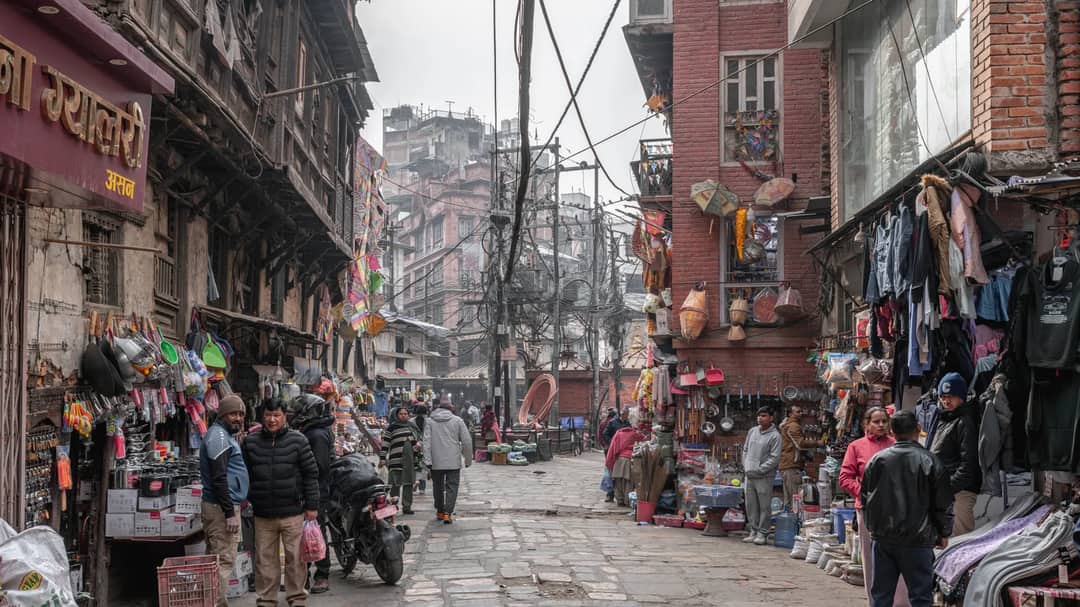
In practice a card works at a handful of upmarket hotels, the big trekking agencies and one or two restaurants per city, and almost nowhere else. That is what our guides have seen for years in Kathmandu and Pokhara: a card that works in your hotel lobby will not work at the shop across the street, or anywhere once you leave the city.
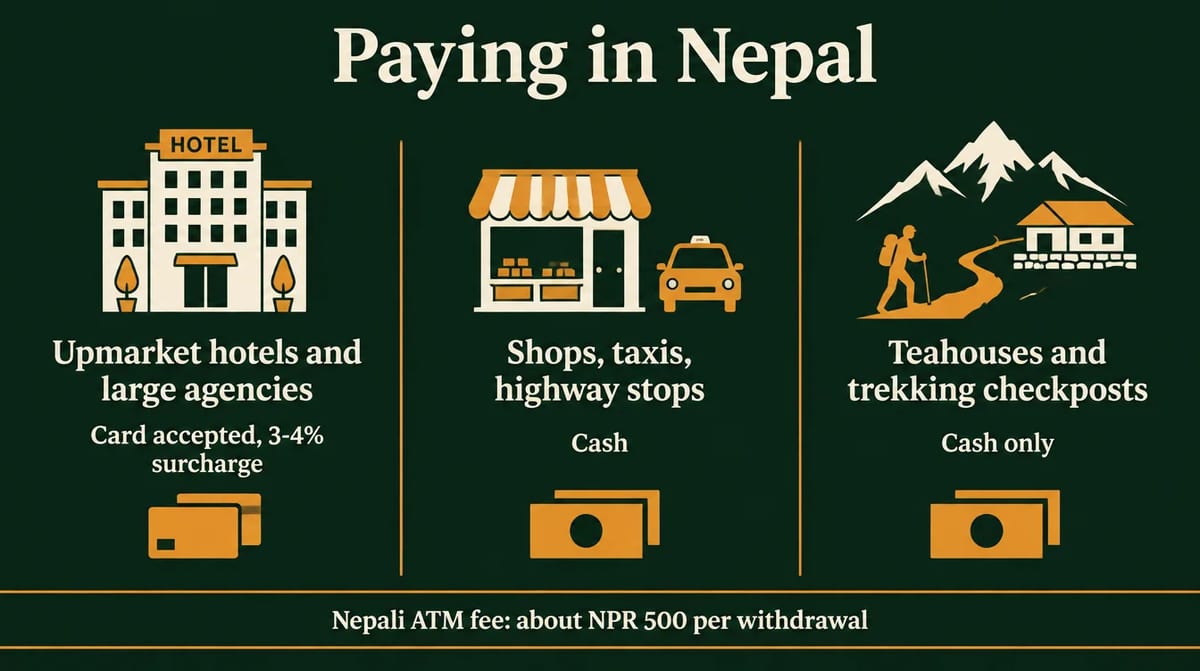
Three places catch people out: the Prithvi Highway bus stops between Kathmandu and Pokhara, where cards are not accepted and the Mugling ATMs are unreliable; the trekking checkposts, which want rupees; and the teahouses on the Annapurna and Everest trails, which take no cards at all.
| Where you are | Card? | What to carry |
|---|---|---|
| Upmarket hotel in Kathmandu or Pokhara | Usually, with a 3–4% surcharge | Card, plus rupees for tips |
| Large trekking agency | Usually, with a surcharge | Card or bank transfer |
| Local restaurant, shop or taxi | Rarely | Rupees in small notes |
| Prithvi Highway bus stops | No | Rupees; Mugling ATMs are unreliable |
| Trekking checkposts | No | Rupees |
| Teahouses on the trail | No | Rupees for the whole trek |
The surcharge, and the question you must answer at the machine
Where a card is accepted, expect a 3–4% surcharge added by the merchant, and never agree to be charged in your home currency. You can only avoid the surcharge by paying cash, but you can avoid making it worse.
The way to make it worse is dynamic currency conversion. A terminal or ATM may offer to charge you in dollars, pounds or euros instead of rupees. Say no, every time. Choosing your home currency hands the exchange rate to the merchant’s payment provider rather than your card network, and it is almost always the worse deal. Our guide to paying in local currency at the card machine explains how the markup works. With a card that also charges a foreign transaction fee, one hotel bill can carry three separate charges.
On a hotel bill of US$200, a 3–4% surcharge is US$6–8. If the same hotel takes cash, paying in rupees you withdrew in one large ATM transaction is usually cheaper, because one withdrawal fee is spread across the whole bill and several others.
ATMs in Nepal: fees, caps and where the machines stop
A Nepali ATM charges about NPR 500 per withdrawal, and counting your own bank’s fee the total is typically US$3–6 each time, so fewer, larger withdrawals are the cheapest way to get cash. Machines are plentiful in Kathmandu and Pokhara. Most allow a maximum of about NPR 35,000 per transaction, and some Standard Chartered and Nabil Bank machines allow NPR 50,000. In our experience Nabil Bank and Standard Chartered have the most reliable machines.
The fee is per withdrawal, not per rupee, which is why the size of each withdrawal matters. Take out NPR 35,000 in one go and the NPR 500 fee is about 1.4% of what you withdrew. Take out NPR 5,000 seven times and you pay NPR 3,500 in Nepali fees for the same NPR 35,000 — seven times as much, before your own bank adds anything.
What really matters on a trek is where the ATMs end.
| Route | Last reliable cash | Beyond that |
|---|---|---|
| Everest and every Khumbu route | Namche Bazaar, two ATMs, about NPR 30,000 per withdrawal | No ATMs at all |
| Kanchenjunga | Taplejung | No ATMs |
| Kathmandu to Pokhara by road | Either city | Mugling roadside ATMs unreliable |
| Annapurna trails | Withdraw in Pokhara before you start | Teahouses cash only |
Treat Namche as a top-up, not a plan. It is the last cash on any Khumbu route, a single withdrawal there is capped at around NPR 30,000, and machines that far up can run short when the trail is busy. Withdraw what you need in Kathmandu before you fly to Lukla. For the wider picture on fees, read how to stop paying foreign transaction and ATM fees.
Which cards to bring to Nepal
Bring two cards on two different networks — say one Visa and one Mastercard — ideally with no foreign transaction fee, and tell both banks you are going to Nepal. The second card is not about rewards. It is insurance against a fraud block, a swallowed card or a network outage on the one day you need cash.
- A no-foreign-fee card saves you your own bank’s charge on every hotel bill and, with some cards, on withdrawals. We have written separate country guides to the best travel cards for Canada, the UK and Australia, each with the no-foreign-fee options named.
- A debit card or travel money card for the ATM. Taking cash on a credit card usually counts as a cash advance, which on most cards starts charging interest the day you withdraw. A debit card or a travel money account avoids that; check your own card’s terms before you rely on it.
- A travel notice. An unexpected Kathmandu withdrawal is exactly what fraud systems block.
Rewards matter less here than anywhere, because the trail runs on cash. And if you carry a balance from month to month, no rewards card is worth it — the interest outweighs any points. If you are weighing cash against card for a trip generally, the logic in Nepal is simply more extreme.
How much cash to carry for a trek
On an independent teahouse trek, bed and food alone run about US$25–40 a day, so carry enough rupees for every trail day plus a buffer, withdrawn in Kathmandu or Pokhara before you start. That figure excludes permits and guide fees, and costs rise with altitude, above Namche especially.
A worked example. Ten trail days at the top of that range is US$400. At about NPR 134 to the dollar, that is roughly NPR 53,600 — two withdrawals at a 35,000-rupee machine, costing about NPR 1,000 in Nepali fees.
Carry plenty of NPR 100 and NPR 500 notes. Teahouses and stalls often cannot break a NPR 1,000 note, and small notes are what you need for a hot shower, a phone charge, snacks and tips. Split the stash between your daypack, a money belt and your duffel. Our Nepal budget guide has the full daily cost picture.
Paying for the visa on arrival
Pay for your Nepal visa on arrival in US dollar notes: US$30 for 15 days, US$50 for 30 days or US$125 for 90 days. Cards are now accepted at Kathmandu airport, but the card machines and ATMs are unreliable at peak arrival times, and exact cash avoids problems with change. The e-visa lets you pay online by card before you fly, which is the cleaner way to use plastic for this. Our visa on arrival guide walks through the counter step by step.
On a guided trek most of the cash question disappears. Annapurna Base Camp is nine days at $920 USD solo and Everest Base Camp is twelve days at $1,700 USD solo, including permits, a government-registered guide, a porter, teahouses and meals — so your card pays once, for the booking, and the rupees you carry are for tips, showers and snacks. We have guided out of Pokhara since 1998, and your guide will tell you exactly how much cash to take for your route.
See the Everest Base Camp trek → See the Annapurna Base Camp trek →Can I use my credit card in Nepal?
Yes, at a small number of upmarket hotels, large trekking agencies and perhaps one or two restaurants per city, usually with a 3–4% surcharge. Most shops, local restaurants, taxis, highway bus stops, trekking checkposts and teahouses take cash only.
Is Visa or Mastercard better in Nepal?
Neither reliably beats the other, which is why we recommend carrying one of each. Two cards on two networks protect you if one card is blocked or a machine refuses it.
How much does an ATM withdrawal cost in Nepal?
About NPR 500 per withdrawal charged by the Nepali bank, and typically US$3–6 per withdrawal once your own bank’s fees are counted. Most city machines cap a single withdrawal at about NPR 35,000.
Are there ATMs on the Everest Base Camp trek?
Namche Bazaar has the last two ATMs on any Khumbu route, with a single-withdrawal cap of around NPR 30,000. There are none beyond Namche, so withdraw what you need in Kathmandu before flying to Lukla.
Should I pay in rupees or in my home currency?
Always in rupees. If a card machine or ATM offers to charge you in dollars, pounds or euros, decline: that dynamic currency conversion lets the merchant’s provider set the exchange rate, and it is almost always worse.
Keep reading
The four decisions that choose a card, with every comparison in one place.
The last two ATMs on the Everest trail, and what else to sort there.
City and trail budgets, from $25 to $80 a day.
Visa, SIM, cash and the quirks worth knowing.
Which network, what it costs and where it works.
Sources: Travel Himalaya Nepal field reporting, from our guides’ experience in Kathmandu, Pokhara and on the trails since 1998, as published in our Nepal travel tips, Kathmandu, Namche Bazaar, Kathmandu–Pokhara, budget and visa-on-arrival guides; card acceptance, surcharges, ATM fees and caps, and ATM locations are our own reporting, not a bank’s published tariff. The cash example is our own arithmetic. This is general information, not financial advice; card offers change, so confirm the current terms with the issuer before you apply. No card issuer pays us for placement on this page.

Written by
Bishnu AdhikariPokhara-based, NMA-certified trekking guides. We’ve led 5,000+ treks across the Annapurna and Everest regions since 1998 — every word here comes from the trail. More from this author →
Share this article
Ready to Trek?
From reading about it to standing on it
Our Pokhara-based guides have been doing this since 1998. Tell us your dates and fitness level — we'll build your perfect itinerary. Free, no obligation.
Why trek with our licensed agencyMore guides like this
Popular trips to consider
View all treks & toursFree Trekker’s Insider Guide
Permits, packing lists, cost breakdowns — no fluff.
We send one useful email. You can unsubscribe anytime.