
The short version
Revolut, N26 and bunq are licensed banks with Spanish IBANs and €100,000 deposit cover. Wise is not a bank. Here's which to use for travel, salary and bills.
A neobank in Spain is an app-only bank or payment provider, and the ones worth using hold a full banking licence, protect deposits up to €100,000 and give you a Spanish IBAN: Revolut, N26 and bunq all do. Wise is not a bank; it safeguards your money instead of insuring it and issues Belgian IBANs, which makes it excellent for currency exchange but a weaker choice for a Spanish salary. If you want a Spanish-licensed digital bank covered by Spain’s own guarantee fund, Openbank, part of the Santander group, is the option we verified. None of them replaces a branch when you need cash handled in person.

- Visiting Spain: you need a card, not a Spanish account. Any no-fee card or Revolut’s free plan works.
- Moving to Spain: pick a licensed bank with a Spanish IBAN for your salary and bills: N26, Revolut, bunq or Openbank.
- Keep large savings under €100,000 per bank, and remember Wise balances have no deposit guarantee at all.
- Any EU IBAN is legally valid in Spain, but a Spanish one saves arguments with landlords and utilities.
What a neobank is, and which ones are actual banks
“Neobank” is a marketing word for a bank you run from an app, and the legal status behind it varies more than the apps suggest. Revolut, N26 and bunq hold banking licences from Lithuania, Germany and the Netherlands respectively, and operate in Spain under EU passporting rules. Revolut and N26 also run Spanish branches registered with the Banco de España. Wise is a regulated payment provider, not a bank. Every detail below was read on the provider’s own Spanish or EU pages on 27 September 2026.
| Provider | Legal status | Deposit protection | Spanish IBAN | Basic plan |
|---|---|---|---|---|
| Revolut | Bank: Revolut Bank UAB, Bank of Lithuania and ECB; Spanish branch no. 1583 at Banco de España | Lithuanian scheme, up to €100,000 | Yes | Estándar, free |
| N26 | Bank: N26 Bank SE (Germany); Spanish branch no. 1563 at Banco de España | German scheme, up to €100,000 | Yes, accounts opened since 17 April 2019 | Estándar, free |
| bunq | Bank: Dutch licence, supervised by De Nederlandsche Bank | Dutch scheme, up to €100,000 | Yes | Free plan; paid from €3.99 a month |
| Wise | Payment provider: Wise Europe SA, National Bank of Belgium | None; money is safeguarded | No; Belgian IBAN | Free account; card €7 once |
| Openbank | Bank: Open Bank S.A., Santander group, Spanish-registered | Spain’s FGD, up to €100,000 | Yes | Cuenta Corriente Open, €0 |
Deposit protection, explained plainly
A licensed bank’s deposits are protected up to €100,000 per person per bank by its home country’s scheme, which is the same limit Spain’s own fund applies. Spain’s Fondo de Garantía de Depósitos says it guarantees up to €100,000 per holder and entity; Revolut says its eligible deposits are covered by Lithuania’s fund up to the same amount, paid within seven working days; N26 and bunq name the German and Dutch schemes, each to €100,000.
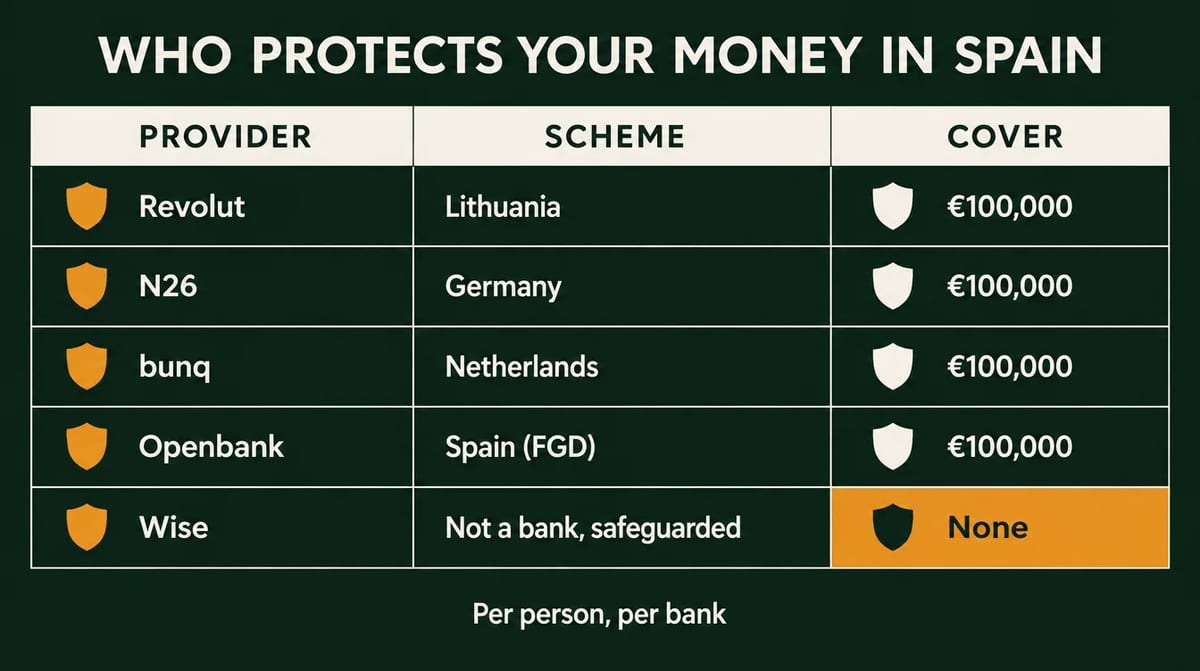
What differs is who pays out. With Revolut, N26 or bunq, a claim would go to a foreign fund, not the Spanish one. That is a real but modest difference for everyday balances. The bigger line is Wise: it describes itself as a payment institution that keeps customer money separate from its own and held with banks or in liquid assets, a method called safeguarding. Safeguarding is not deposit insurance, so we would not park savings there.
Keep no more than €100,000 with any single bank, and remember the limit is per bank, not per app. Two apps run by the same bank share one limit.
Using one while travelling in Spain
A short-stay visitor does not need a Spanish account at all; a card with no foreign fee does the job, and a neobank is just one way to get one. The free and basic plans compare like this, on the providers’ own fee pages:
| Basic plan | Paying in another currency | Cash machines |
|---|---|---|
| Revolut Estándar (free) | No extra fee Monday to Friday on up to €1,000 a month; 1% at weekends | €200 or five withdrawals a month; 2% outside Spain beyond that |
| N26 Estándar (free) | No N26 fee; Mastercard’s exchange rate applies | 1.7% outside the euro area |
| Wise (card €7 once) | Mid-market rate, Wise says; check its conversion fee in the app | Up to €200 a month without Wise fees |
| Openbank debit with Travel+ (€4.99 a month, or free with salary) | No Openbank fee | Two free withdrawals a month at any ATM worldwide |
Spending euros from a euro balance involves no currency conversion; these fees bite when you pay or withdraw in another currency, which matters on side trips outside the euro area.
If you already hold a travel credit card with no foreign transaction fee, you may not need any of this. Whatever you use, pay in euros when a terminal offers to charge you in your home currency; our guide to paying in local currency explains why, and how to avoid foreign transaction and ATM fees covers cash machines.
Moving to Spain, salaries and paying bills
For a salary and Spanish direct debits, choose a licensed bank that gives you a Spanish IBAN: N26, Revolut, bunq or Openbank. N26 says every account opened since 17 April 2019 has a Spanish IBAN that works for salary and direct debits; Revolut says you can receive your salary and pay bills with a national IBAN, and link Bizum; bunq says its Spanish IBAN handles salary, direct debits and bills. Openbank’s current account costs €0 with no conditions, and its Travel+ add-on removes foreign-currency fees on the debit card for €4.99 a month, or free if your salary of at least €900 is paid in.
Legally, any EU IBAN should work. The Banco de España explains that a company or public body refusing payments or direct debits from an account in another EU country breaches Article 9 of EU Regulation 260/2012, and that complaints about companies go to regional consumer authorities. In practice, a landlord or utility can still make life awkward, and Wise itself notes that some organisations ask for local IBANs it does not issue. A Spanish IBAN avoids the argument.
Remote workers splitting time between countries often run two accounts: a Spanish-IBAN bank for rent and bills, and a multi-currency account for being paid from abroad. The same logic applies further afield; our guide to working remotely from Pokhara covers how nomads handle money in Nepal.
What a neobank cannot replace
A neobank covers everyday spending, salary and bills, but it is a poor fit for anything that needs a counter, a local relationship or large sums. None of the app-only providers here has branches where you can pay in cash across a desk, so a business taking cash or a landlord insisting on a bank-stamped document is harder to satisfy. Large savings belong within the €100,000 limit per bank, and a Spanish mortgage is a conversation to have with a Spanish lender. Support is mostly in-app chat, which is fine until something urgent goes wrong.
That is why many people who move keep one traditional or Spanish digital bank alongside a neobank, using the app for daily spending and the bank for the paperwork. Our guide to the travel money mistakes that cost the most applies just as well to a move.
Our verdict
Visiting Spain: use a no-foreign-fee card or Revolut’s free plan. Moving to Spain: open N26 or Revolut for a Spanish IBAN and backstop it with Openbank if you want Spain’s own guarantee fund. Paid in several currencies: add Wise for exchange, but not for savings. Choose bunq if its paid plans suit you better; its Spanish IBAN and Dutch licence make it a like-for-like alternative. Whichever you pick, check the fee schedule in the app, because plans and allowances change more often than bank adverts do.
If Spain is your base, Nepal makes a remarkable break. Annapurna Base Camp is nine days at $920 USD solo and Everest Base Camp is twelve days at $1,700 USD solo, including permits, a government-registered guide, a porter, teahouses and meals.
See the Annapurna Base Camp trek →Which neobanks give a Spanish IBAN?
N26 (all accounts opened since 17 April 2019), Revolut and bunq each state on their Spanish pages that they provide a Spanish IBAN usable for salary and direct debits. Wise issues Belgian IBANs for euros.
Is my money safe in Revolut or N26 in Spain?
Both are licensed banks. Revolut’s eligible deposits are covered by Lithuania’s guarantee fund and N26’s by Germany’s, each up to €100,000 per person, the same limit as Spain’s FGD.
Is Wise a bank in Spain?
No. Wise Europe SA is a payment provider authorised by the National Bank of Belgium. It safeguards customer money in separate accounts, but balances are not covered by a deposit guarantee scheme.
Can a Spanish company refuse my foreign EU IBAN?
Not legally. The Banco de España explains that refusing SEPA payments or direct debits from another EU country’s IBAN breaches Article 9 of EU Regulation 260/2012. Complaints about companies go to regional consumer authorities.
Do I need a Spanish bank account as a tourist?
No. A card with no foreign transaction fee is enough. Pay in euros rather than your home currency at card machines.
Keep reading
The four decisions that choose a card, with every comparison in one place.
What a nomad base in Nepal really looks like.
The four charges on a trip abroad, and how to dodge them.
The card-machine question that costs travellers most.
When each one wins, and how much to carry.
Sources: Revolut Spain home page, pricing plans and deposit insurance information; N26 Spain home page and N26 support pages on payments abroad and ATM fees; bunq, bunq in Spain and Spain expats pages; Wise help centre pages on EUR account details and on how Wise Europe SA safeguards customer funds, and Wise’s Spain guide; Openbank home page and travel cards page; Fondo de Garantía de Depósitos; Banco de España, Portal del Cliente Bancario, on IBAN discrimination. All read on 27 September 2026. This is general information, not financial advice; card offers change, so confirm the current terms with the issuer before you apply. No provider pays us for placement on this page.
Photos via Pexels: Carlos Jamaica

Written by
Bishnu AdhikariPokhara-based, NMA-certified trekking guides. We’ve led 5,000+ treks across the Annapurna and Everest regions since 1998 — every word here comes from the trail. More from this author →
Share this article
Ready to Trek?
From reading about it to standing on it
Our Pokhara-based guides have been doing this since 1998. Tell us your dates and fitness level — we'll build your perfect itinerary. Free, no obligation.
Why trek with our licensed agencyMore guides like this
Popular trips to consider
View all treks & toursFree Trekker’s Insider Guide
Permits, packing lists, cost breakdowns — no fluff.
We send one useful email. You can unsubscribe anytime.