
The short version
The Citi Double Cash pays more for most people at 2% on everything. Freedom Unlimited wins if dining and drugstores are a third of your spend.
For most people the Citi Double Cash pays more, because it earns 2% on every purchase while the Chase Freedom Unlimited earns 1.5% on anything that is not dining, drugstores or Chase Travel. The Freedom Unlimited wins if restaurants and pharmacies make up roughly a third of your spending or more, and it is the better card if you want 0% interest on new purchases for 15 months. Both have no annual fee and a $200 welcome bonus, and both charge a 3% foreign transaction fee, so neither belongs in your wallet on a trip abroad.
- Pick the Double Cash if you want one number, 2%, on everything, or you need to move a balance at 0% for 18 months.
- Pick the Freedom Unlimited if you eat out a lot or want 0% on new purchases for 15 months.
- The bonus is easier on the Freedom Unlimited: $500 in three months against $1,500 in six.
- Leave both at home when you travel. A 3% foreign fee is bigger than the 2% either card pays you.
The headline numbers
Both cards are free to hold and pay a $200 bonus, but they earn in opposite ways: Citi pays a flat rate, Chase pays a lower base with three bonus categories. Every figure below was read on the issuer’s own card page on 27 September 2026.
| Citi Double Cash | Chase Freedom Unlimited | |
|---|---|---|
| Annual fee | $0 | $0 |
| Welcome bonus | $200 after $1,500 in 6 months | $200 after $500 in 3 months |
| Everyday purchases | 2% (1% when you buy, 1% as you pay) | 1.5% |
| Dining | 2% | 3% |
| Drugstores | 2% | 3% |
| Issuer travel portal | 5% on hotels, car rentals and attractions via Citi Travel | 5% on travel via Chase Travel |
| Intro APR on purchases | None | 0% for 15 months |
| Intro APR on balance transfers | 0% for 18 months | 0% for 15 months |
| Purchase APR after that | 18.49%–28.74% variable | 18.24%–27.74% variable |
| Foreign transaction fee | 3% | 3% |
One detail on the Double Cash matters more than it looks: the second 1% arrives only when you pay the bill. Citi awards it on the purchase balance you pay off, so the card is built for people who clear their statement, not for people who let it ride.
Which card earns more on a normal budget
On a typical spending mix the Double Cash earns more, and the gap comes from the everyday purchases the Freedom Unlimited pays only 1.5% on. Take a household putting $2,000 a month on one card: $400 at restaurants, $100 at the pharmacy and $1,500 on everything else, groceries and fuel included.
| Monthly spend | Double Cash | Freedom Unlimited |
|---|---|---|
| $400 dining | $8.00 (2%) | $12.00 (3%) |
| $100 drugstores | $2.00 (2%) | $3.00 (3%) |
| $1,500 everything else | $30.00 (2%) | $22.50 (1.5%) |
| Per month | $40.00 | $37.50 |
| Per year | $480 | $450 |
Now shift the same $2,000 towards eating out: $800 at restaurants, $100 at the pharmacy and $1,100 on everything else. The Freedom Unlimited earns $43.50 a month ($24 + $3 + $16.50), or $522 a year, and the Double Cash still earns $480. The card did not change; the statement did.
The break-even rule between a flat card and a category card
The Freedom Unlimited earns more only when your dining and drugstore spending is more than half of everything else you spend, which works out at roughly a third of your total. The arithmetic is short. Against a flat 2%, Chase gains one cent per dollar in its 3% categories and loses half a cent per dollar everywhere else. So every $1 at a restaurant cancels out $2 of ordinary spending.
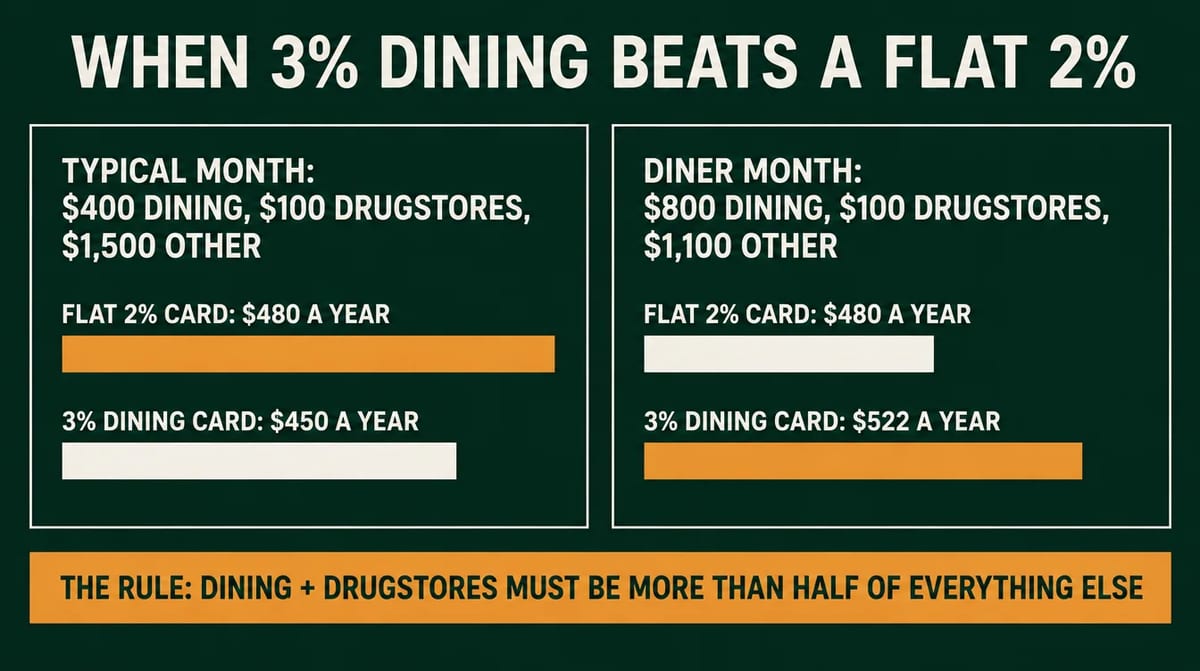
In the first example, $500 in the bonus categories against $1,500 elsewhere falls short of the line, because $500 is less than half of $1,500, so Citi wins. In the second, $900 against $1,100 clears it comfortably, so Chase wins. Pull up last month’s statement, add up restaurants and pharmacies, and compare that number with half of the rest. It takes five minutes and answers the question better than any ranking.
Both portals pay 5%, but on different things: Citi on hotels, car rentals and attractions booked through Citi Travel, Chase on travel bought through Chase Travel. If you book trips directly with airlines and hotels, as many people do, count both portal rates as zero.
Both cards pay their rewards as points that convert to cash back. We compare the cash figure each issuer advertises, not a guessed value for moving points to airlines, because that value depends on how you redeem and on which other cards you hold.
The welcome bonus and the 0% periods
The Freedom Unlimited’s bonus is far easier and its 0% period covers new purchases; the Double Cash’s 0% covers only balance transfers, but for longer. Chase asks for $500 in three months, about $167 a month. Citi asks for $1,500 in six months, about $250 a month. Both are within reach for most households, which is how a bonus should be: never spend money you would not have spent to earn one.
The 0% offers are the bigger difference. If you are about to make a large planned purchase and want to spread it, Chase’s 0% on purchases for 15 months is the tool; Citi’s intro rate does not apply to purchases at all. If you already carry a balance elsewhere, Citi’s 0% on balance transfers for 18 months gives you three more months to clear it. Citi charges a 3% transfer fee (minimum $5) on transfers made in the first four months and 5% after that, and transferred balances earn no cash back. Chase says a balance transfer fee applies; check its pricing and terms for the figure before you move money.
Using either card abroad
Both cards charge a 3% foreign transaction fee, which is larger than the 2% the better of them pays you, so every purchase abroad loses money. Spend $3,000 on a trip and you pay $90 in fees to earn $60 on the Double Cash, or $45 on most Freedom Unlimited spending. It is one of the most common travel-money mistakes, and one of the easiest to avoid.
Carry a card with no foreign fee for trips instead. Chase’s own sibling, the Freedom Flex, dropped its foreign transaction fee on 21 September 2026, and several other no-fee cards charge none either, which we cover in our guide to the best cards with no foreign transaction fee. Then pay in the local currency at the terminal, never in dollars, for the reasons in paying in local currency at a card machine. Our guide to avoiding foreign transaction and ATM fees covers the rest.
If the trip is Nepal, the card question shrinks further. Cards work in Kathmandu and Pokhara hotels and bigger restaurants; on the trail it is cash, so plan it with when to use cash and when to use a card abroad.
The verdict
If you want the most cash back with no thought, choose the Citi Double Cash. If restaurants and pharmacies are a third or more of your spending, or you want 0% on new purchases, choose the Chase Freedom Unlimited. Neither costs anything to hold, so the only wrong answer is carrying either one abroad.
And choose neither for rewards if you carry a balance. After the intro period the purchase APR runs from 18.49% to 28.74% on the Double Cash and 18.24% to 27.74% on the Freedom Unlimited. A single month of interest on a modest balance can cost more than months of 2%. Pay in full, or use the 0% period for exactly what it is: time to clear a debt.
If the cash back is going into a travel fund, Nepal is where a modest balance goes furthest. Annapurna Base Camp is nine days at $920 USD solo and Everest Base Camp is twelve days at $1,700 USD solo, including permits, a government-registered guide, a porter, teahouses and meals.
See the Annapurna Base Camp trek →Is the Citi Double Cash or Chase Freedom Unlimited better?
The Double Cash earns more on a typical spending mix because it pays 2% on everything. The Freedom Unlimited is better when dining and drugstore purchases make up about a third of your spending or more, and when you want 0% on new purchases for 15 months.
What is the welcome bonus on each card?
As of 27 September 2026, the Double Cash offers $200 cash back after $1,500 in purchases in the first six months, and the Freedom Unlimited offers $200 after $500 in the first three months. Offers change, so check the issuer before applying.
Do these cards charge foreign transaction fees?
Yes. Both the Citi Double Cash and the Chase Freedom Unlimited charge 3% on foreign transactions, according to each issuer’s pricing terms. Use a card with no foreign fee when you travel.
Which card is better for a balance transfer?
The Double Cash, with 0% on balance transfers for 18 months against 15 on the Freedom Unlimited. Citi’s transfer fee is 3% (minimum $5) in the first four months, then 5%, and transferred balances do not earn cash back.
Does the Double Cash really pay 2%?
Yes, as 1% when you buy and 1% when you pay for the purchase, with no caps or categories. If you do not pay the balance, you do not earn the second 1%.
Keep reading
The four decisions that choose a card, with every comparison in one place.
The four charges on a trip abroad, and how to dodge them.
The costly habits most travellers repeat.
The same flat-versus-category question at $95 a year.
When a paid card beats a free one.
Sources: Citi, Double Cash card page and pricing details, and Chase, Freedom Unlimited card page and pricing and terms, all read on 27 September 2026 for fees, bonuses, earning rates, intro offers, APRs and foreign transaction fees; Chase, Freedom Flex card page and 21 September 2026 announcement for its foreign fee. The spending examples are our own arithmetic on those published rates. This is general information, not financial advice; card offers change, so confirm the current terms with the issuer before you apply. No card issuer pays us for placement on this page.

Written by
Bishnu AdhikariPokhara-based, NMA-certified trekking guides. We’ve led 5,000+ treks across the Annapurna and Everest regions since 1998 — every word here comes from the trail. More from this author →
Share this article
Ready to Trek?
From reading about it to standing on it
Our Pokhara-based guides have been doing this since 1998. Tell us your dates and fitness level — we'll build your perfect itinerary. Free, no obligation.
Why trek with our licensed agencyMore guides like this
Popular trips to consider
View all treks & toursFree Trekker’s Insider Guide
Permits, packing lists, cost breakdowns — no fluff.
We send one useful email. You can unsubscribe anytime.