

The short version
Only if you'd use about $700 of Reserve credits a year. The $300 travel credit is easy; the rest needs OpenTable dining, Chase hotel stays and lounges.
The Chase Sapphire Reserve is worth its $700 higher fee only if you would genuinely use about $700 of its credits and benefits every year; for most people who travel once or twice a year, the $95 Sapphire Preferred is the better card. The Reserve’s $300 travel credit is easy to use and cuts the gap to $400. Closing the rest takes restaurants in one specific OpenTable programme, prepaid hotel stays through Chase, and enough airport time to use its lounges. Both cards carry the same trip cancellation cover and both now list emergency evacuation up to $100,000; the Reserve adds emergency medical and dental cover, shorter trip-delay thresholds and higher rental car limits.

- Pick the Preferred if you travel a few times a year and would not use restaurant, hotel and entertainment credits you do not already spend on.
- Pick the Reserve if the travel credit plus the dining, The Edit and StubHub credits you would really use add up to $700 or more, and you would use the lounges.
- The Preferred earns more on gas, streaming, online grocery and travel booked outside Chase Travel other than flights and hotels.
- Pick neither if you carry a balance; the APRs run from about 19% to 28%.
The headline numbers
The two cards share a points programme and a lot of DNA, but the Reserve costs $700 more and earns differently. Every figure below was read on Chase’s card pages on 27 September 2026.
| Sapphire Preferred | Sapphire Reserve | |
|---|---|---|
| Annual fee | $95 | $795; $195 per authorised user |
| Welcome bonus | 75,000 points after $5,000 in 3 months | 100,000 points after $6,000 in 3 months |
| Chase Travel | 5x | 8x |
| Flights and hotels booked direct | 2x | 4x |
| Dining | 3x | 3x |
| Gas, EV charging, streaming, online grocery | 3x | 1x |
| Other travel | 2x | 1x |
| Everything else | 1x | 1x |
| Lounge access | None | Chase Sapphire Lounges and 1,300+ Priority Pass lounges, up to two guests |
| Global Entry, TSA PreCheck or NEXUS | Up to $120 every four years | Up to $120 every four years |
| Foreign transaction fee | None | None |
| Purchase APR | 19.24%–27.49% variable | 19.49%–27.99% variable |
The earning rows cut both ways. The Reserve doubles the Preferred on flights and hotels booked directly, but pays 1x on petrol, streaming, online grocery and travel such as trains and car rentals booked outside Chase Travel, where the Preferred pays 2x or 3x. Someone who spends $6,000 a year on directly booked flights and hotels earns 24,000 points on the Reserve against 12,000 on the Preferred; someone who spends the same on fuel and groceries ordered online earns 18,000 on the Preferred and 6,000 on the Reserve.
The arithmetic of the $700 gap
Start with $700, subtract the Reserve credits you would use anyway, and add back the Preferred’s $100 hotel credit if you would have used it. What remains is the true yearly price of upgrading. A credit only counts if it pays for something you would have bought regardless; a credit that makes you spend is a discount, not money.
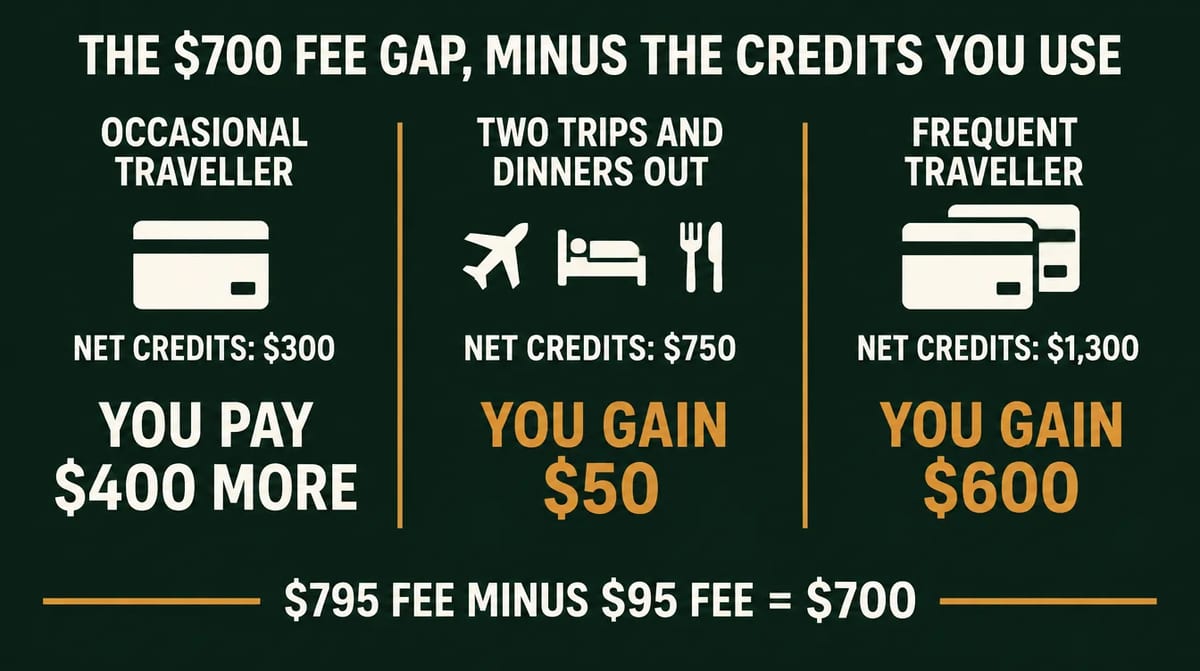
The Reserve’s credits, as Chase lists them: up to $300 on travel each account anniversary year; up to $300 a year in dining credits, $150 in each half of the calendar year, at restaurants in the Sapphire Exclusive Tables programme on OpenTable; up to $500 a year on prepaid stays with The Edit, $250 per booking with a two-night minimum; up to $300 a year in StubHub and viagogo credits, $150 per half-year, through 2027; plus Apple TV and Apple Music, DashPass with monthly DoorDash promos, and monthly Lyft and Peloton credits. The Preferred has a $100 Chase Travel hotel credit each account anniversary year, DashPass, and a year of Apple TV if activated by 31 December 2026.
| Reserve credits you would really use | Occasional traveller | Two trips and dinners out | Frequent traveller |
|---|---|---|---|
| $300 travel credit | $300 | $300 | $300 |
| $300 dining credit (OpenTable programme) | $0 | $300 | $300 |
| $500 The Edit credit | $0 | $250 | $500 |
| $300 StubHub credit | $0 | $0 | $300 |
| Less the Preferred’s $100 hotel credit, if used | $0 | −$100 | −$100 |
| Net credits | $300 | $750 | $1,300 |
| Real cost of upgrading ($700 minus net credits) | $400 a year | −$50 (you gain $50) | −$600 (you gain $600) |
So the occasional traveller pays $400 a year for lounges, extra insurance and a different earning mix, and would need to value those at $400 to break even. The middle profile roughly breaks even on credits alone and gets the lounges thrown in. The frequent traveller comes out well ahead. We have left out the Apple, DoorDash, Lyft and Peloton credits; add them only if you already pay for those services.
The Reserve’s bonus is 25,000 points larger but needs $1,000 more spending in the same three months, about $2,000 a month against $1,667. Do not let a bonus decide a card you will pay $795 a year to keep.
Insurance, including evacuation and medical cover
Both cards carry the same trip cancellation and lost luggage cover and both list emergency evacuation up to $100,000; the Reserve adds emergency medical and dental cover and pays trip delay sooner.
| Benefit | Sapphire Preferred | Sapphire Reserve |
|---|---|---|
| Trip cancellation and interruption | Up to $10,000 per traveller, $20,000 per trip | Same |
| Trip delay | Over 12 hours or overnight, up to $500 per traveller | Over 6 hours or overnight, up to $500 per traveller |
| Emergency evacuation and transportation | Up to $100,000, trips 100+ miles from home | Up to $100,000, trips 100+ miles from home |
| Emergency medical and dental | Not listed | Up to $2,500, $50 deductible |
| Primary rental car cover | Up to $60,000 | Up to $75,000 |
| Travel accident | Up to $500,000 | Up to $1,000,000 |
| Lost luggage | Up to $3,000 per traveller | Up to $3,000 per traveller |
The evacuation benefit is new on the Preferred and it narrows the insurance gap considerably. But Chase is clear that restrictions, limitations and exclusions apply, and the full terms sit in the Guide to Benefits, provided after you open the account. Before relying on either card for a trek, read that guide for what it says about altitude, adventure activities and helicopter rescue, and compare it with a dedicated policy. A $2,500 medical limit will not go far after a fall in the mountains. Our guides to card insurance on a trek and what card travel insurance covers go through the gaps.
Lounges, and whether you would use them
Lounge access is the Reserve’s biggest benefit the Preferred cannot match, and it is only worth something if you fly often enough to use it. The Reserve includes Chase Sapphire Lounges by The Club and more than 1,300 Priority Pass lounges, each with up to two guests, plus select Air Canada Maple Leaf Lounges with an eligible boarding pass. For a couple flying four round trips a year, that is a lot of airport meals. For someone who flies once a year, it is a nice afternoon. Our lounge access guide covers the cheaper ways in.
The verdict
Choose the Sapphire Preferred unless you can name $700 of Reserve credits and benefits you would use every year without changing your habits; if you can, choose the Reserve. The Preferred is the stronger everyday earner for most budgets, now carries evacuation cover, and costs $95. The Reserve rewards people who already travel often, book hotels through Chase and eat at the restaurants in its dining programme.
Carry a balance and neither card makes sense. At 19.24% to 27.49% on the Preferred and 19.49% to 27.99% on the Reserve, interest outruns any points you earn.
If the points are for a big trip, Nepal is where they go furthest. Annapurna Base Camp is nine days at $920 USD solo and Everest Base Camp is twelve days at $1,700 USD solo, including permits, a government-registered guide, a porter, teahouses and meals.
See the Annapurna Base Camp trek →Is the Chase Sapphire Reserve worth $795?
Only if you would use about $700 of its credits and benefits each year. The $300 travel credit brings the gap with the Preferred to $400; the dining, The Edit and StubHub credits, and the lounges, have to cover the rest.
Do the Sapphire cards include emergency evacuation cover?
Yes. As of 27 September 2026 both list emergency evacuation and transportation up to $100,000 for trips 100 miles or more from home, with restrictions and exclusions set out in the Guide to Benefits. The Reserve also lists emergency medical and dental cover up to $2,500.
Which card earns more points?
It depends on the spending. The Reserve earns more on Chase Travel and on flights and hotels booked direct. The Preferred earns more on gas, EV charging, streaming, online grocery and other travel. Both pay 3x on dining.
Does the Sapphire Preferred have lounge access?
No. Lounge access, including Chase Sapphire Lounges and Priority Pass, comes with the Reserve only.
What are the welcome bonuses?
As of 27 September 2026, 75,000 points after $5,000 in purchases in three months on the Preferred, and 100,000 points after $6,000 in three months on the Reserve. Offers change, so check Chase before applying.
Keep reading
The four decisions that choose a card, with every comparison in one place.
When a paid card beats a free one.
Which $95 card wins in 2026.
What points can and cannot buy you up front.
How earning and redeeming really work.
Sources: Chase, Sapphire Preferred and Sapphire Reserve card pages, read on 27 September 2026 for fees, welcome offers, earning rates, credits, lounge access, travel and purchase protections and APRs. The credit scenarios are our own arithmetic on those published figures. This is general information, not financial advice; card offers change, so confirm the current terms with the issuer before you apply. No card issuer pays us for placement on this page.

Written by
Bishnu AdhikariPokhara-based, NMA-certified trekking guides. We’ve led 5,000+ treks across the Annapurna and Everest regions since 1998 — every word here comes from the trail. More from this author →
Share this article
Ready to Trek?
From reading about it to standing on it
Our Pokhara-based guides have been doing this since 1998. Tell us your dates and fitness level — we'll build your perfect itinerary. Free, no obligation.
Why trek with our licensed agencyMore guides like this
Popular trips to consider
View all treks & toursFree Trekker’s Insider Guide
Permits, packing lists, cost breakdowns — no fluff.
We send one useful email. You can unsubscribe anytime.