

The short version
The Venture X wins for most people. After its $300 travel credit it costs $95 a year and earns 2X on everything; the Reserve suits heavy diners.
For most travellers the Capital One Venture X is the better buy: it costs $395 a year, and once you spend its $300 Capital One Travel credit the card effectively costs $95, while it adds 10,000 bonus miles every account anniversary. The Chase Sapphire Reserve costs $795, and after its $300 travel credit you are still $495 down, so its dining, hotel, ticket and Lyft credits have to earn back the rest. The Reserve wins for people who eat out a lot, want primary rental car cover with published limits, and will genuinely use those extra credits. Both include Priority Pass lounges and charge no foreign transaction fee.

- Pick the Venture X if you want lounge access and a flat 2X on everything for the lowest real cost.
- Pick the Reserve if restaurants are a big share of your spending and you will use its dining, hotel and event credits every year.
- The travel credits are not equal. The Venture X credit only works through Capital One Travel; the Reserve’s works on travel purchases generally.
- Pick neither if you carry a balance. Both APRs start at 19.49% variable.
The headline numbers
The Reserve costs $400 more a year and gives more credits and more insurance detail; the Venture X gives a flatter, simpler earning rate and an anniversary bonus. Every figure below was read on the issuer’s own pages on 27 September 2026.
| Capital One Venture X | Chase Sapphire Reserve | |
|---|---|---|
| Annual fee | $395 | $795 |
| Welcome bonus | 75,000 miles after $4,000 in 3 months | 100,000 points after $6,000 in 3 months |
| Travel booked through the issuer | 10X hotels and rental cars, 5X flights and vacation rentals via Capital One Travel | 8x on Chase Travel |
| Flights and hotels booked direct | 2X | 4x |
| Dining | 2X | 3x worldwide |
| Everything else | 2X | 1x |
| Travel credit | $300 a year, Capital One Travel bookings only | Up to $300 each account anniversary year on travel |
| Other yearly credits | 10,000 bonus miles each anniversary | Dining $300, The Edit hotels $500, StubHub $300, Lyft $120 |
| Global Entry / TSA PreCheck | Up to $120 | Up to $120 every four years |
| Lounges | Capital One Lounges and Landings plus Priority Pass (1,300+), primary cardholder, after enrolment | Chase Sapphire Lounges with up to two guests, plus Priority Pass (1,300+) |
| Foreign transaction fee | None | None |
| Purchase APR | 19.49%–28.49% variable | 19.49%–27.99% variable |
The real annual cost, after credits
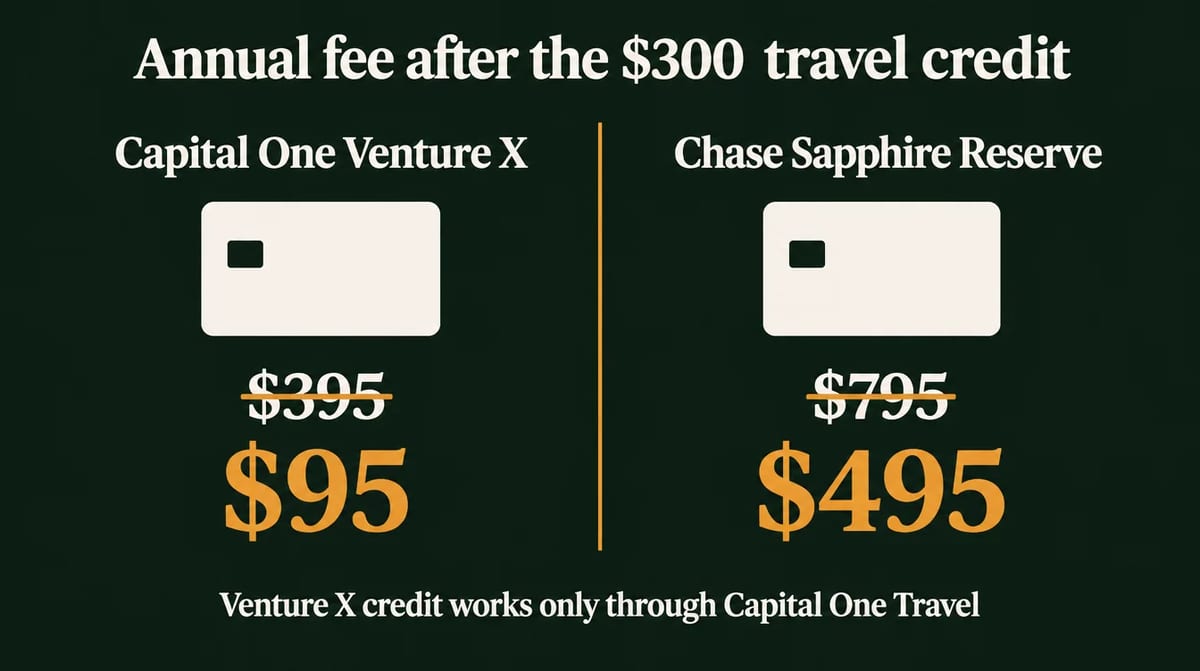
If you use only the $300 travel credit on each card, the Venture X costs $95 a year and the Reserve $495, so the Reserve has to find $400 of value elsewhere just to break even with it. Here is how that plays out at three levels of effort.

| How you use the credits | Venture X | Sapphire Reserve |
|---|---|---|
| Use nothing | $395 | $795 |
| Use the $300 travel credit | $95 | $495 |
| Plus one $250 Edit booking | $95 | $245 |
| Plus the full $300 dining credit | $95 | −$55 (credits exceed the fee) |
The last two rows assume you would have booked that hotel and eaten at those restaurants anyway. The Reserve’s dining credit only applies at restaurants in Chase’s Sapphire Exclusive Tables programme, split $150 from January to June and $150 from July to December, and The Edit credit needs a prepaid stay of at least two nights. If neither fits your life, the Reserve costs you $400 a year more than the Venture X for the same Priority Pass membership.
The Venture X has its own catch. Its $300 credit is for bookings through Capital One Travel, the issuer’s own booking site. If you always book flights and hotels directly with airlines and hotel chains, you may not use it, and the card then costs the full $395. The 10,000 anniversary miles arrive regardless, starting at your first account anniversary.
Which card earns more
On a typical spending mix the Venture X earns more, because the Reserve pays only 1x on anything that is not dining or travel. Take $2,000 a month: $500 at restaurants, $300 in the supermarket, $200 on flights booked directly and $1,000 on everything else.
| Monthly spend | Venture X | Sapphire Reserve |
|---|---|---|
| $500 dining | 1,000 miles (2X) | 1,500 points (3x) |
| $300 groceries | 600 miles (2X) | 300 points (1x) |
| $200 flights booked direct | 400 miles (2X) | 800 points (4x) |
| $1,000 everything else | 2,000 miles (2X) | 1,000 points (1x) |
| Per month | 4,000 | 3,600 |
| Per year | 48,000 + 10,000 anniversary = 58,000 | 43,200 |
Against the Venture X
The Reserve earns more only when restaurants and direct travel are a larger share of your card than groceries and everything else.rsquo;s flat 2X, the Reserve gains a point per restaurant dollar and two per dollar of direct travel, and loses a point on everything else. So it pulls ahead only when your restaurant spending plus twice your direct travel spending is bigger than the rest of what goes on the card, and by enough to cover the 10,000 anniversary miles too. Miles and points are different currencies, and what each is worth depends on how you redeem it, so we compare the number earned. Our guide to miles and points for beginners covers the redemption side, and how to fly business class for less shows where a balance like this goes furthest.
Lounges and insurance
Both cards give Priority Pass; the Reserve lets you bring up to two guests into Chase Sapphire Lounges, and it publishes firmer insurance limits. Capital One says lounge access is for the primary cardholder after enrolment and is subject to space. If you travel with a partner and fly from an airport with a Sapphire Lounge, the Reserve’s guest policy is worth real money; if you fly alone from an airport with no lounge at all, neither card’s lounge benefit is worth anything. See our lounge access guide before paying for it.

On insurance, Chase lists trip cancellation and interruption up to $10,000 per covered traveller and $20,000 per trip, trip delay up to $500 per traveller, lost luggage up to $3,000, emergency evacuation up to $100,000 and primary rental car cover up to $75,000. Capital One lists trip cancellation and interruption, travel accident insurance, an auto rental collision damage waiver and cell phone protection up to $800 for the Venture X, but its explainer page does not state the trip cover limits. For those, read the Venture X Guide to Benefits before you rely on it.
Card evacuation and trip cover is written for city breaks and beach holidays. Before a trek above 3,000 metres, read the gap in your card’s travel insurance that a trek walks into and what card travel insurance actually covers.
The verdict
Choose the Capital One Venture X if you want premium travel perks for close to the price of a mid-tier card and you are happy to book through Capital One Travel once a year. Choose the Chase Sapphire Reserve if you dine out heavily, travel with a companion, and will use its extra credits without changing your habits. If you are not sure, the Venture X is the cheaper mistake.
Choose neither if you carry a balance from month to month — interest at 19.49% or more will outrun any credit — or if you travel once a year. Our Venture vs Sapphire Preferred comparison covers the $95 alternatives. Whichever card you carry abroad, pay in the local currency when a terminal offers dollars; here is why.
If the points are for a big trip, Nepal is where a modest balance goes furthest. Annapurna Base Camp is nine days at $920 USD solo and Everest Base Camp is twelve days at $1,700 USD solo, including permits, a government-registered guide, a porter, teahouses and meals.
See the Annapurna Base Camp trek →Is the Venture X or Sapphire Reserve better?
For most travellers the Venture X, because after its $300 Capital One Travel credit it costs $95 a year and earns 2X on everything. The Reserve is better for heavy restaurant spenders who will use its dining, hotel and event credits.
How much do the cards really cost after credits?
Using only the $300 travel credit on each, the Venture X costs $95 a year and the Sapphire Reserve $495. The Reserve closes the gap only if you use its other credits.
What are the welcome bonuses?
As of 27 September 2026, the Venture X offers 75,000 miles after $4,000 in purchases within three months, and the Reserve offers 100,000 points after $6,000 in the first three months. Check the issuer before applying.
Do both cards include lounge access?
Yes. Both include Priority Pass. The Venture X adds Capital One Lounges and Landings for the primary cardholder; the Reserve adds Chase Sapphire Lounges with up to two guests.
Do they charge foreign transaction fees?
No. Neither the Capital One Venture X nor the Chase Sapphire Reserve charges a foreign transaction fee.
Keep reading
The four decisions that choose a card, with every comparison in one place.
The cards and passes that actually get you in.
How earning and redeeming really work.
What card cover pays for, and what it never will.
The four charges on a trip abroad, and how to dodge them.
Sources: Capital One, Venture X card page and “All about Venture X” page, and Chase, Sapphire Reserve card page, all read on 27 September 2026 for fees, welcome offers, earning rates, credits, lounge access, insurance and APRs. The cost and spending examples are our own arithmetic on those published figures. This is general information, not financial advice; card offers change, so confirm the current terms with the issuer before you apply. No card issuer pays us for placement on this page.
Photos via Pexels: Valeria Drozdova, HIEU NGUYEN.

Written by
Bishnu AdhikariPokhara-based, NMA-certified trekking guides. We’ve led 5,000+ treks across the Annapurna and Everest regions since 1998 — every word here comes from the trail. More from this author →
Share this article
Ready to Trek?
From reading about it to standing on it
Our Pokhara-based guides have been doing this since 1998. Tell us your dates and fitness level — we'll build your perfect itinerary. Free, no obligation.
Why trek with our licensed agencyMore guides like this
Popular trips to consider
View all treks & toursFree Trekker’s Insider Guide
Permits, packing lists, cost breakdowns — no fluff.
We send one useful email. You can unsubscribe anytime.