
The short version
Revolut's free plan wins small weekday trips with no fee up to £1,000 a month. Wise wins bigger or weekend-heavy trips with one small fee. UK terms checked.
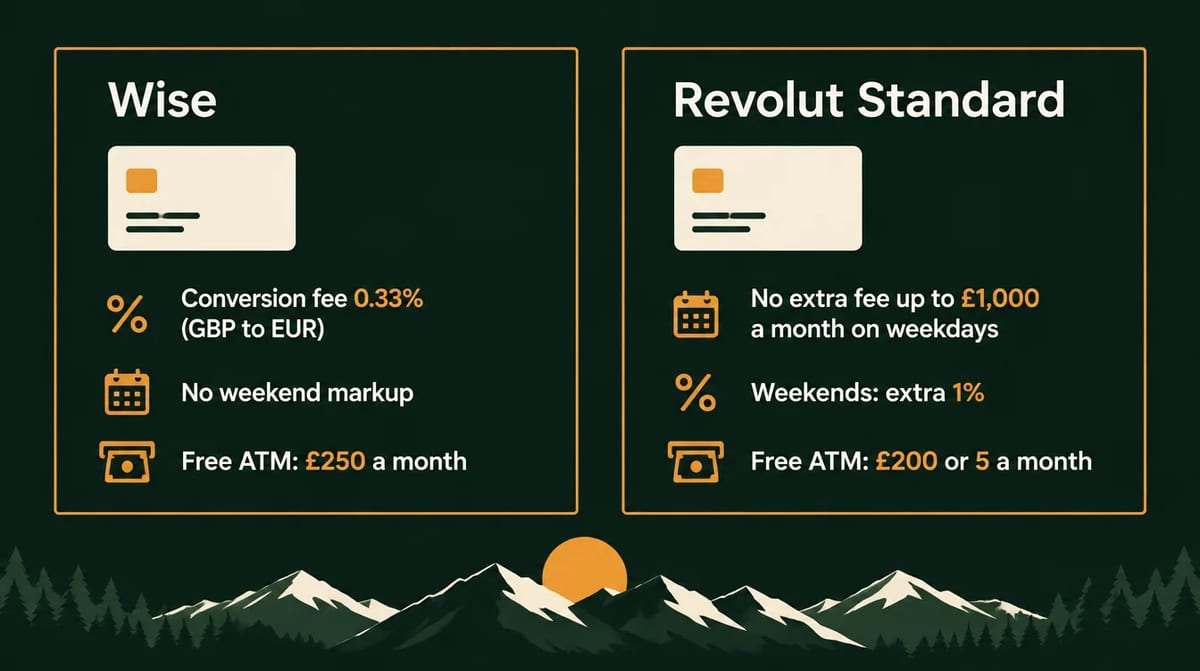
For a short trip with modest spending, Revolut’s free Standard plan usually costs less than Wise, because it adds no exchange fee on the first £1,000 a month exchanged on weekdays; on a bigger trip, or one where you spend at weekends, Wise’s small, flat conversion fee and larger free ATM allowance tend to win. Wise charges a conversion fee that varies by currency — 0.33% from pounds to euros in the quote we took — and lets you withdraw £250 a month from ATMs free. Revolut Standard adds 1% above its fair-usage limit and 1% at weekends, and allows £200 or five withdrawals a month. These are the UK terms, read on each provider’s own site on 27 September 2026; both companies price differently in other countries, so check your own market before you choose.

- Revolut Standard wins small, weekday trips: no additional exchange fee up to £1,000 a month, Monday to Friday.
- Wise wins bigger or weekend-heavy trips: one conversion fee, no weekend markup and £250 of free ATM cash a month.
- Revolut’s paid plans remove the limits, but Premium costs £7.99 a month, so they only pay off on heavy use.
- Exotic currencies cost more on Wise: pounds to Nepali rupees was quoted at 1.12%.
- Neither replaces a credit card for deposits and bookings; carry one as a backup on a different network.
The fees that matter, side by side
The two companies charge in different places: Wise on every conversion, Revolut only above a limit and at weekends. That single difference explains almost every “which is cheaper” answer you will read.
| UK terms | Wise | Revolut Standard (free) |
|---|---|---|
| Monthly cost | None; the card costs £7 once | Free |
| Exchange rate | Mid-market rate | Revolut’s own rate, not named on the plans page |
| Conversion fee | Varies by currency, from 0.24%; 0.33% GBP→EUR, 0.36% GBP→USD | None up to £1,000 a month, Monday to Friday; 1% above |
| Weekend exchange | Same as weekdays | Extra 1% |
| Free ATM withdrawals | Up to £250 a month in total | £200 a month or 5 withdrawals |
| ATM fee after that | 2.69% on the amount over £250 | 2% per transaction, £1 minimum |
Both warn that some ATM operators add their own charge, which neither company controls. Wise’s fee can also differ slightly with the amount and currency, so the percentages above are Wise’s own quotes for a £1,000 conversion on the day we checked.
What a real trip costs on each
On a small euro trip Revolut Standard is cheaper; on a larger one Wise is, unless you pay for a Revolut plan. Here are two trips worked through with the fees above, treating cash withdrawals as money converted from pounds.
| Trip (euros) | Wise | Revolut Standard | Revolut Premium |
|---|---|---|---|
| Small: £1,000 converted, £200 of it at weekends, £200 from ATMs | £3.30 | £2.00 (weekend 1%) | £7.99 (the plan) |
| Large: £2,500 converted, £500 of it at weekends, £400 from ATMs | £12.29 (£8.25 conversion + £4.04 ATM) | £24.00 (£15 over limit + £5 weekend + £4 ATM) | £7.99 (the plan) |
The Wise figures leave out the one-off £7 card, and the Premium figure is one month of the subscription with nothing else to pay in these examples, since Premium has no fair-usage limit, no weekend fee and £400 of free ATM withdrawals. The pattern holds beyond these numbers: Revolut Standard is cheapest while you stay under £1,000 a month and avoid weekends; Wise is cheapest once you do not. Weekends matter more than people expect, because a trip that starts on a Saturday often means changing your first cash at the weekend.
Revolut’s plans, and when paying makes sense
Paying for Revolut only makes sense if you would otherwise hit the Standard limits every month. Revolut lists five UK plans.
| Plan | Monthly price | Fair-usage exchange limit | Weekend fee | Free ATM |
|---|---|---|---|---|
| Standard | Free | £1,000, Mon–Fri | 1% | £200 or 5 withdrawals |
| Plus | £3.99 | £3,000, Mon–Fri | 0.5% | £200 |
| Premium | £7.99 | None | None | £400 |
| Metal | £14.99 | None | None | £800 |
| Ultra | £55 | None | None | £2,000 |
One inconsistency to know about: Revolut’s plan table gives Plus a £3,000 limit, while a footnote on the same page describes a combined £1,000 limit with a 0.5% fee for Plus customers. If you are choosing Plus for its limit, confirm the figure in the app first. The dearer plans bundle other things — insurance, lounge access, subscriptions — that may or may not be worth money to you; judge them on those, not on exchange fees alone.
Using Wise or Revolut in Nepal
In Nepal either card is mainly an ATM card, because few places take cards at all, and the Nepali bank’s own withdrawal fee of about NPR 500 applies whichever you use. Our field reporting is that cards work at a small number of upmarket hotels, large agencies and perhaps one or two restaurants per city, usually with a 3–4% surcharge, and that teahouses on the trail take cash only.
Two things change the maths. First, Wise quoted 1.12% to convert pounds to Nepali rupees on 27 September 2026, roughly three times its euro rate. Revolut’s plans page lists no separate rupee fee, so within its limits it may well be cheaper for a Nepal trip — check the rate in the app before you rely on it. Second, the NPR 500 local fee is charged per withdrawal, which rewards fewer, larger withdrawals — but both providers’ free ATM allowances are small, so a big withdrawal quickly runs into Wise’s 2.69% or Revolut’s 2% on the excess. Work out your trek cash, then decide. Our guides to Namche Bazaar, which has the last ATMs on the Everest trail, and to what a day in Nepal costs will help you size it.
A travel money card is a debit card. Keep a credit card on a different network for hotel deposits, bookings and the day a machine refuses your first card. Our guide to avoiding foreign transaction and ATM fees covers the full set-up, and the travel money mistakes to avoid covers the rest.
The verdict
If you take one or two short trips a year and spend under £1,000 a month abroad, Revolut’s free Standard plan is the cheaper choice — as long as you exchange on weekdays. If you travel for longer, spend more, or cannot control when you pay, Wise’s predictable fee and bigger free ATM allowance make it the safer pick. Heavy travellers who would hit Revolut’s limits every month can do better on Premium, but only if they use it enough to cover £7.99 a month. Many travellers simply carry both, which costs nothing extra beyond Wise’s £7 card and gives you a spare on a separate account. And whichever you use, pay in the local currency — our guide to dynamic currency conversion explains why.
If the money is for a big trip, Nepal is where it goes furthest. Annapurna Base Camp is nine days at $920 USD solo and Everest Base Camp is twelve days at $1,700 USD solo, including permits, a government-registered guide, a porter, teahouses and meals.
See the Annapurna Base Camp trek →Is Wise or Revolut cheaper for travel?
In the UK, Revolut’s free Standard plan is cheaper for small trips exchanged on weekdays, because it adds no fee up to £1,000 a month. Wise is usually cheaper for larger trips or weekend spending, because it charges one small conversion fee and no weekend markup.
How much can I withdraw from ATMs for free?
With Wise in the UK, up to £250 a month in total, then 2.69% on the excess. With Revolut Standard, £200 a month or five withdrawals, then 2% per transaction with a £1 minimum. ATM operators may add their own fees.
Does Revolut charge more at weekends?
On the Standard plan, yes: an extra 1% on currency exchange at weekends, and 0.5% on Plus. Premium, Metal and Ultra have no weekend fee.
Are these fees the same in every country?
No. We checked the UK terms. Wise and Revolut both set fees and limits by country, so check the pricing page for the country your account is in.
Can I use Wise or Revolut in Nepal?
Yes, mainly at ATMs, since cards are accepted in few places. The Nepali bank charges about NPR 500 per withdrawal on top of any Wise or Revolut fee, and Wise quoted 1.12% to convert pounds to rupees on 27 September 2026.
Keep reading
The four decisions that choose a card, with every comparison in one place.
The four charges on a trip abroad, and how to dodge them.
When each one actually saves you money.
The card-machine question that costs travellers most.
What a gigabyte really costs, SIM against eSIM.
Sources: Wise, UK pricing page and UK card fees page, plus Wise’s public price quote for £1,000 conversions on 27 September 2026; Revolut, UK plans comparison page, read the same day. Card use and ATM fees in Nepal are Travel Himalaya Nepal field reporting. The trip examples are our own arithmetic on those published fees. This is general information, not financial advice; card offers change, so confirm the current terms with the issuer before you apply. No provider pays us for placement on this page.

Written by
Bishnu AdhikariPokhara-based, NMA-certified trekking guides. We’ve led 5,000+ treks across the Annapurna and Everest regions since 1998 — every word here comes from the trail. More from this author →
Share this article
Ready to Trek?
From reading about it to standing on it
Our Pokhara-based guides have been doing this since 1998. Tell us your dates and fitness level — we'll build your perfect itinerary. Free, no obligation.
Why trek with our licensed agencyMore guides like this
Popular trips to consider
View all treks & toursFree Trekker’s Insider Guide
Permits, packing lists, cost breakdowns — no fluff.
We send one useful email. You can unsubscribe anytime.