

The short version
The Reserve is easier to justify for most travellers. Its $300 travel credit fits almost any trip, while most Platinum credits are tied to specific brands.
For most travellers the Chase Sapphire Reserve is the easier card to justify, because its biggest credit — up to $300 a year on travel — applies to almost any travel purchase, while most of the Amex Platinum’s credits are tied to specific brands and booking channels. The Platinum carries more credits on paper, and it wins for people who already use Uber, Resy, a streaming service and prepaid luxury hotels every year. But the Reserve costs $795 against the Platinum’s $895, earns 3x on dining worldwide, and comes with stronger published travel insurance. Neither card pays for itself unless you actually spend the credits.

- Pick the Reserve if you want the credits that are hardest to waste, 3x on restaurants and primary rental car cover.
- Pick the Platinum if you already spend money with the brands its credits name, and you book flights directly with airlines.
- Face value is not value. Count only the credits you would have spent money on anyway.
- Pick neither if you carry a balance or travel once a year. A $95 card, or a $0 card, will leave you better off.
The headline numbers
The Platinum costs $100 more a year and lists more credits; the Reserve earns more on everyday spending and publishes more insurance. Every figure below was read on the issuer’s own card page on 27 September 2026.
| Chase Sapphire Reserve | Amex Platinum | |
|---|---|---|
| Annual fee | $795 | $895 |
| Authorized user fee | $195 each | $195 each additional Platinum card |
| Welcome bonus | 100,000 points after $6,000 in 3 months | Varies; Amex shows offers per applicant |
| Travel booked through the issuer | 8x on Chase Travel | 5X on prepaid hotels via Amex Travel |
| Flights booked direct | 4x | 5X, on up to $500,000 a year |
| Hotels booked direct | 4x | 1X |
| Dining | 3x worldwide | 1X |
| Everything else | 1x | 1X |
| Lounges | Chase Sapphire Lounges with up to two guests, plus Priority Pass (1,300+ lounges) | Centurion Lounges, Priority Pass after enrolment, 10 Delta Sky Club visits a year on eligible Delta flights |
| Trip cancellation | Up to $10,000 per traveller, $20,000 per trip | Up to $10,000 per trip, $20,000 per card per 12 months |
| Rental car cover | Primary, up to $75,000 | Secondary, no liability cover |
| Foreign transaction fee | None | None |
| Purchase APR | 19.49%–27.99% variable | Check American Express |
The credits at face value, and what they ask of you
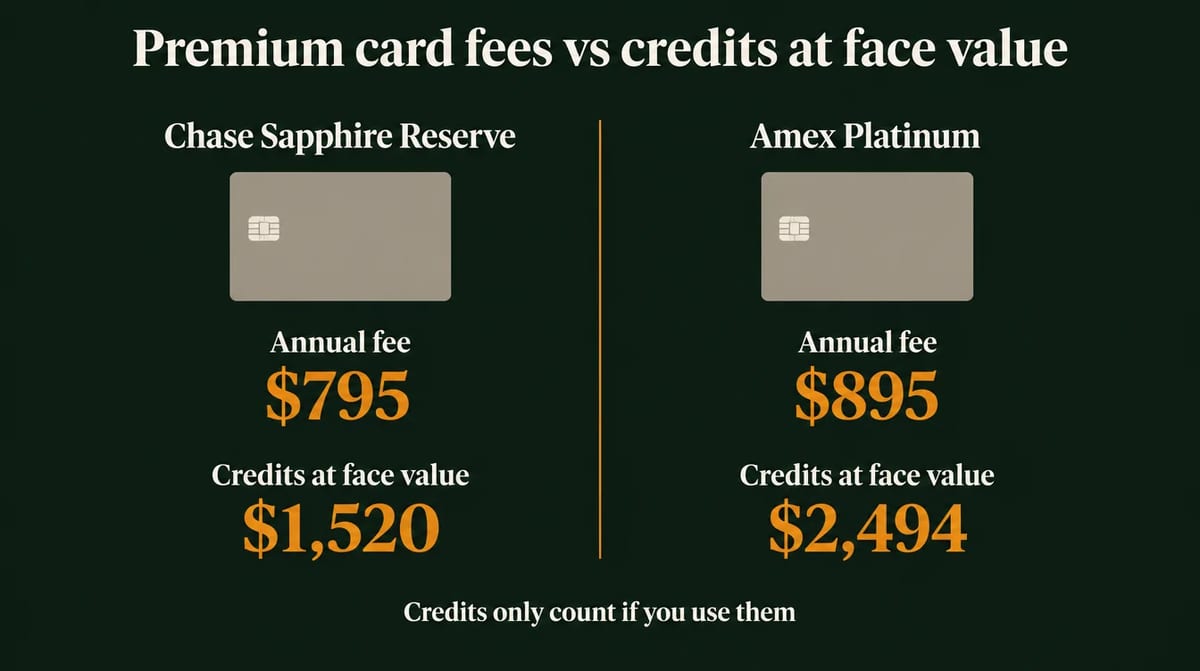
Add up every credit and the Platinum lists about $2,494 a year against the Reserve’s $1,520, but each Platinum credit is locked to one merchant or channel. That is the whole argument in one sentence. A credit you would never have spent money on is not a saving; it is a coupon for something you did not want.

| Card | Credit | Up to | Only counts if you… |
|---|---|---|---|
| Reserve | Travel credit | $300 | spend on travel at all — the broadest credit on either card |
| Reserve | Dining credit | $300 | eat at restaurants in Chase’s Sapphire Exclusive Tables programme ($150 each half-year) |
| Reserve | The Edit hotels | $500 | prepay stays with The Edit ($250 per booking, two-night minimum) |
| Reserve | StubHub / viagogo | $300 | buy event tickets there |
| Reserve | Lyft | $120 | ride Lyft monthly ($10 a month, through 30 Sep 2027) |
| Platinum | Hotel credit | $600 | prepay Fine Hotels + Resorts or The Hotel Collection stays ($300 each half-year) |
| Platinum | Airline fee credit | $200 | pay incidental fees such as checked bags on your selected airline |
| Platinum | Uber Cash + Uber One | $200 + $120 | use Uber and pay for Uber One |
| Platinum | Digital entertainment | $300 | pay for eligible subscriptions |
| Platinum | Resy | $400 | dine at Resy restaurants ($100 a quarter) |
| Platinum | lululemon, Walmart+, CLEAR+ | $300, $155, $219 | shop or subscribe there |
Both cards also reimburse Global Entry or TSA PreCheck; Chase states up to $120 every four years. Now take an ordinary traveller: two international trips a year, one nice hotel booked through the card’s own programme, no Uber habit, no StubHub account. On the Reserve they use the $300 travel credit and one $250 Edit booking — $550 against a $795 fee, a gap of $245. On the Platinum they use one $300 hotel credit and the full $200 in bag fees — $500 against $895, a gap of $395. The card with fewer credits comes out $150 ahead, because the credits it has are easier to use. A maximiser who spends every credit reverses that, which is why you should do this sum with your own statement, not ours.
Which card earns more points
The Reserve earns more for anyone who eats out; the Platinum earns more only on flights booked directly with airlines. Outside flights and prepaid Amex Travel hotels, the Platinum pays 1X on everything, restaurants included. The Reserve pays 3x on dining worldwide and 4x on flights and hotels booked direct.
Take a household spending $2,000 a month: $500 at restaurants, $300 on flights booked directly with the airline and $1,200 on everything else.
| Monthly spend | Sapphire Reserve | Amex Platinum |
|---|---|---|
| $500 dining | 1,500 points (3x) | 500 points (1X) |
| $300 flights booked direct | 1,200 points (4x) | 1,500 points (5X) |
| $1,200 everything else | 1,200 points (1x) | 1,200 points (1X) |
| Per month | 3,900 | 3,200 |
| Per year | 46,800 | 38,400 |
The Reserve gains two points per restaurant dollar and the Platinum gains one per dollar of direct airfare, so the Platinum pulls ahead only when you spend more than twice as much on direct airfare as you do at restaurants. Points from Chase and Amex are different currencies, and what either is worth depends on how you redeem, so we compare the number earned rather than guess a value per point. Our beginner’s guide to miles and points explains the redemption side.
Lounges, and when they are worth anything
Both cards give you Priority Pass, so the lounge difference is only the issuer’s own lounges and guest rules. The Reserve adds Chase Sapphire Lounges with up to two guests. The Platinum adds Centurion Lounges and 10 Delta Sky Club visits a year on eligible Delta flights. Which is better depends entirely on which airports you fly from; a lounge at an airport you never use is worth nothing. If lounge access is the main reason you are considering either card, read our guide to airport lounge access without business class first.

Insurance: where the Reserve pulls ahead
The Reserve’s rental car cover is primary and its published trip protections are broader; the Platinum’s rental cover is secondary. Chase lists trip cancellation and interruption up to $10,000 per covered traveller and $20,000 per trip, trip delay up to $500 per covered traveller, lost luggage up to $3,000 per traveller, emergency evacuation and transportation up to $100,000, and primary rental car cover up to $75,000. Amex lists trip cancellation and interruption up to $10,000 per trip and $20,000 per card in 12 months, trip delay up to $500 per trip after a six-hour delay, and car rental cover that is secondary and excludes liability.
Evacuation cover on a card is written for ordinary trips. Before you rely on it for a trek above 3,000 metres, read the card’s Guide to Benefits for altitude and activity limits, and read the gap in your card’s travel insurance that a trek walks into. For the general picture, see what card travel insurance actually covers.
The verdict
Choose the Chase Sapphire Reserve if you want a premium card whose value does not depend on changing where you shop. Choose the Amex Platinum if its named brands are already in your monthly spending and you fly often on tickets bought direct. Both charge no foreign transaction fee, but pay in local currency when a card machine abroad offers dollars — our guide to paying in local currency explains why.
Choose neither if you carry a balance: the Reserve’s variable APR runs from 19.49% to 27.99%, and interest on a modest balance outruns any credit. Choose neither if you take one trip a year. The $95 cards in our Venture vs Sapphire Preferred comparison give most of the travel value for an eighth of the fee.
If the points are for a big trip, Nepal is where a modest balance goes furthest. Annapurna Base Camp is nine days at $920 USD solo and Everest Base Camp is twelve days at $1,700 USD solo, including permits, a government-registered guide, a porter, teahouses and meals.
See the Annapurna Base Camp trek →Is the Chase Sapphire Reserve or Amex Platinum better?
For most travellers the Reserve, because its $300 travel credit applies to almost any travel and it earns 3x on dining. The Platinum is better for people who already use the brands its credits name and who book flights directly with airlines.
What are the annual fees?
As of 27 September 2026, the Chase Sapphire Reserve costs $795 a year and the Amex Platinum $895. Each charges $195 per additional cardholder.
Which has better lounge access?
Both include Priority Pass. The Reserve adds Chase Sapphire Lounges with up to two guests; the Platinum adds Centurion Lounges and 10 Delta Sky Club visits a year on eligible Delta flights. The better one is whichever has lounges at the airports you use.
Do the credits really cover the annual fee?
Only if you use them. At face value the Reserve lists about $1,520 in yearly credits and the Platinum about $2,494, but most are tied to specific merchants or booking channels. Count only the credits you would have spent money on anyway.
Do either charge foreign transaction fees?
No. Neither the Chase Sapphire Reserve nor the Amex Platinum charges a foreign transaction fee.
Keep reading
The four decisions that choose a card, with every comparison in one place.
The cards and passes that actually get you in.
Where premium-card points really stretch.
The gap a high-altitude trek walks into.
The card-machine question that costs travellers most.
Sources: Chase, Sapphire Reserve card page, and American Express, Platinum Card page, both read on 27 September 2026 for fees, welcome offers, earning rates, credits, lounge access, insurance and APRs. Credit totals and the worked examples are our own arithmetic on those published figures. This is general information, not financial advice; card offers change, so confirm the current terms with the issuer before you apply. No card issuer pays us for placement on this page.
Photos via Pexels: Quang Nguyen Vinh, Earl Andre Roca.

Written by
Bishnu AdhikariPokhara-based, NMA-certified trekking guides. We’ve led 5,000+ treks across the Annapurna and Everest regions since 1998 — every word here comes from the trail. More from this author →
Share this article
Ready to Trek?
From reading about it to standing on it
Our Pokhara-based guides have been doing this since 1998. Tell us your dates and fitness level — we'll build your perfect itinerary. Free, no obligation.
Why trek with our licensed agencyMore guides like this
Popular trips to consider
View all treks & toursFree Trekker’s Insider Guide
Permits, packing lists, cost breakdowns — no fluff.
We send one useful email. You can unsubscribe anytime.