
The short version
The Gold earns more if you spend big on restaurants and US supermarkets. The Preferred costs $95, not $325, and adds trip cancellation cover.
The Amex Gold earns far more points if you spend heavily at restaurants and US supermarkets, because it pays 4X at both against the Chase Sapphire Preferred’s 3x on dining and 1x on in-store groceries. But the Gold costs $325 a year against $95, and it only closes that gap if you use its monthly credits every single month. The Sapphire Preferred is the better travel card: it carries trip cancellation cover and primary rental car insurance that the Gold does not list. Big grocery and restaurant spenders who never miss a monthly credit should pick the Gold; everyone else, and anyone who wants built-in trip protection, should pick the Preferred.

- Pick the Gold if food is your biggest spending category and you will use a $10 credit every month without thinking about it.
- Pick the Preferred if you want the cheaper card with trip cancellation, trip delay and primary rental car cover.
- The Gold’s credits are monthly. Miss a month and that $10 is gone; it does not roll over.
- Pick neither if you carry a balance. The Preferred’s APR runs 19.24% to 27.49% variable.
The headline numbers
The Gold is a food card with travel extras; the Preferred is a travel card with a dining bonus. Every figure below was read on the issuer’s own card page on 27 September 2026.
| Amex Gold | Chase Sapphire Preferred | |
|---|---|---|
| Annual fee | $325 | $95 |
| Welcome bonus | Varies; Amex shows offers per applicant | 75,000 points after $5,000 in 3 months |
| Restaurants | 4X worldwide, on up to $50,000 a year, then 1X | 3x |
| Groceries | 4X at US supermarkets, on up to $25,000 a year, then 1X | 3x on online grocery only; 1x in store |
| Flights | 3X booked direct or via Amex Travel | 2x (5x through Chase Travel) |
| Hotels | 5X on prepaid hotels via Amex Travel | 2x (5x through Chase Travel) |
| Other bonus categories | — | 3x gas and EV charging, 3x streaming |
| Everything else | 1X | 1x |
| Yearly credits | $120 dining, $120 Uber Cash, $100 Resy, $84 Dunkin’ | $100 Chase Travel hotel credit |
| Trip cancellation | Not listed | Up to $10,000 per traveller, $20,000 per trip |
| Trip delay | Up to $300 per trip, after 12 hours | Up to $500 per traveller, after 12 hours or an overnight stay |
| Rental car cover | Secondary, no liability | Primary, up to $60,000 |
| Foreign transaction fee | None from American Express | None |
Which card earns more
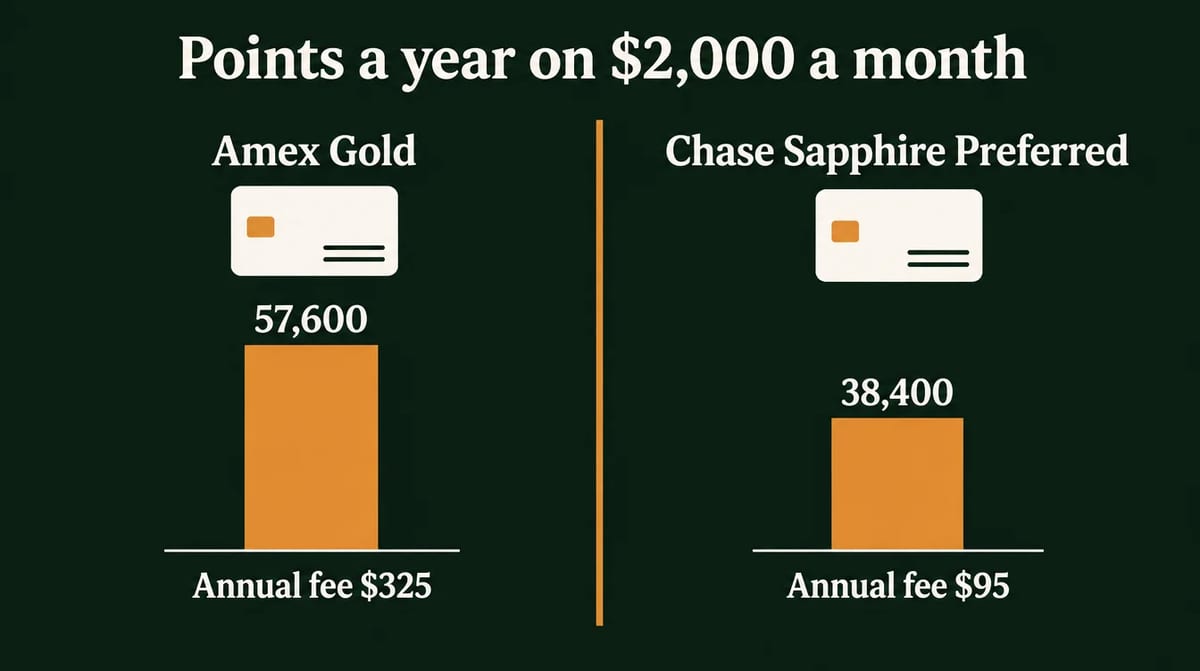
On a food-heavy budget the Gold earns about half as many points again as the Preferred, and the gap comes almost entirely from the supermarket. Take $2,000 a month: $500 at restaurants, $300 at a US supermarket in person, $200 on flights booked directly with the airline and $1,000 on everything else.
| Monthly spend | Amex Gold | Sapphire Preferred |
|---|---|---|
| $500 restaurants | 2,000 points (4X) | 1,500 points (3x) |
| $300 supermarket in store | 1,200 points (4X) | 300 points (1x) |
| $200 flights booked direct | 600 points (3X) | 400 points (2x) |
| $1,000 everything else | 1,000 points (1X) | 1,000 points (1x) |
| Per month | 4,800 | 3,200 |
| Per year | 57,600 | 38,400 |
That is 19,200 more points a year on the Gold, for $230 more in annual fee. The caps rarely matter for a household: you would need to spend more than $25,000 a year at US supermarkets, or $50,000 at restaurants, before the Gold drops to 1X. Two cautions. The Gold’s 4X grocery rate is for US supermarkets, so it does nothing on a trip abroad; and if you buy groceries online, the Preferred’s 3x on online grocery narrows the gap. Chase and Amex points are different currencies, and their worth depends on how you redeem them, so we compare the number earned, not a guessed value per point. Our guide to miles and points covers redemption.
The Gold’s monthly credits only work if you use them every month
The Gold lists up to $424 a year in credits, which beats its $325 fee on paper, but three of the four arrive as small monthly amounts that expire if you skip a month. The dining credit is up to $10 a month, Uber Cash $10 a month and the Dunkin’ credit up to $7 a month; only the $100 Resy credit is yearly. Check on the Amex page which merchants qualify for each, because none of them is a general restaurant credit.
| How you use the credits | Gold, real cost | Preferred, real cost |
|---|---|---|
| Use none | $325 | $95 |
| Use the dining and Uber credits every month ($240) | $85 | — |
| Use all four in full ($424) | −$99 (credits exceed the fee) | — |
| Book one hotel through Chase Travel ($100) | — | −$5 (credit exceeds the fee) |
The honest question is not whether the credits add up, but whether you would have spent that money anyway. If you already spend at the qualifying merchants and take Ubers most months, the Gold’s real cost falls towards zero. If you would be forcing a $10 order just to use the credit, it is not a saving.
Why the Preferred is the better travel card
The Preferred protects the trip itself; the Gold mostly covers delays and bags. Chase lists trip cancellation and interruption cover up to $10,000 per covered traveller and $20,000 per trip for prepaid, non-refundable travel, trip delay up to $500 per traveller, lost luggage up to $3,000 per traveller, emergency evacuation up to $100,000, and primary rental car cover up to $60,000. The Gold’s page lists trip delay cover up to $300 per trip after a 12-hour delay, a baggage insurance plan and secondary car rental cover with no liability — and no trip cancellation cover at all.

Trip cancellation refunds a prepaid trip you could not take. Before a trek above 3,000 metres, read the gap in your card’s travel insurance that a trek walks into and what card travel insurance actually covers.
Abroad, both cards are free of foreign transaction fees. American Express is not taken everywhere that Visa and Mastercard are, so if the Gold is your main card, carry a Visa or Mastercard as a backup. Our guide to avoiding foreign transaction and ATM fees covers the rest.
The verdict
Choose the Amex Gold if restaurants and US supermarkets are where most of your money goes and you will use its monthly credits without effort. Choose the Chase Sapphire Preferred if you want a $95 card that protects your trips and earns well on dining. Plenty of people hold both, using the Gold for food at home and the Preferred for booking travel.
Choose neither if you carry a balance from month to month; interest will cost more than any reward. If the Preferred appeals but you want a flat rate on everything, read how it compares with the Capital One Venture.
If the points are for a big trip, Nepal is where a modest balance goes furthest. Annapurna Base Camp is nine days at $920 USD solo and Everest Base Camp is twelve days at $1,700 USD solo, including permits, a government-registered guide, a porter, teahouses and meals.
See the Annapurna Base Camp trek →Is the Amex Gold or Chase Sapphire Preferred better?
The Gold earns more for people who spend heavily at restaurants and US supermarkets and use its monthly credits. The Sapphire Preferred is cheaper at $95 and is the better travel card, with trip cancellation and primary rental car cover.
Is the Amex Gold worth $325?
Only if you use its credits. It lists up to $424 a year, but $10 dining, $10 Uber Cash and $7 Dunkin’ credits are monthly and expire if unused. If you would not use them anyway, the fee is hard to justify.
Does the Amex Gold have spending caps?
Yes. The 4X restaurant rate applies to up to $50,000 a year and the 4X US supermarket rate to up to $25,000 a year, then both drop to 1X.
Does the Amex Gold include trip cancellation insurance?
Its card page does not list trip cancellation cover. It lists trip delay cover up to $300 per trip, baggage insurance and secondary car rental cover. The Sapphire Preferred lists trip cancellation up to $10,000 per traveller.
Do either charge foreign transaction fees?
No. Neither the Amex Gold nor the Chase Sapphire Preferred charges a foreign transaction fee.
Keep reading
The four decisions that choose a card, with every comparison in one place.
What card cover pays for, and what it never will.
How earning and redeeming really work.
When to pay which way on a trip.
The costly habits most travellers repeat.
Sources: American Express, Gold Card page, and Chase, Sapphire Preferred card page, both read on 27 September 2026 for fees, welcome offers, earning rates and caps, credits, insurance and APRs. The spending and credit examples are our own arithmetic on those published figures. This is general information, not financial advice; card offers change, so confirm the current terms with the issuer before you apply. No card issuer pays us for placement on this page.
Photos via Pexels: Matheus Bertelli, DAVE GARCIA.

Written by
Bishnu AdhikariPokhara-based, NMA-certified trekking guides. We’ve led 5,000+ treks across the Annapurna and Everest regions since 1998 — every word here comes from the trail. More from this author →
Share this article
Ready to Trek?
From reading about it to standing on it
Our Pokhara-based guides have been doing this since 1998. Tell us your dates and fitness level — we'll build your perfect itinerary. Free, no obligation.
Why trek with our licensed agencyMore guides like this
Popular trips to consider
View all treks & toursFree Trekker’s Insider Guide
Permits, packing lists, cost breakdowns — no fluff.
We send one useful email. You can unsubscribe anytime.