
The short version
Capital One Platinum Secured is the best pick for most: no annual fee and a refundable deposit from $49. Discover it Secured pays rewards while you rebuild.
The best secured credit card for most people rebuilding their credit in 2026 is the Capital One Platinum Secured, because it has no annual fee and a refundable deposit that can start at $49, $99 or $200 depending on your application. If you want to earn rewards while you rebuild, the Discover it Secured Cash Back pays cash back and matches everything you earn in your first year. The Capital One Quicksilver Secured pays a flat 1.5% on every purchase. None of these charges an annual fee, and all of them give you a clear path back to an ordinary card.

- A secured card is a normal credit card backed by a deposit you get back. It reports to the credit bureaus like any other card.
- Choose one with no annual fee. Every card below costs $0 a year, so rebuilding costs you nothing if you pay in full.
- The APRs are high, from 27.49% to 28.99% where published. Pay the whole statement balance every month.
- Six months of on-time payments is when Capital One says it may first consider you for a higher line.
The four cards at a glance
All four cards have no annual fee and a refundable deposit, and they differ mainly in deposit size and rewards. Every figure was read on the issuer’s own page on 27 September 2026.
| Card | Minimum deposit | Rewards | Purchase APR | Foreign fee |
|---|---|---|---|---|
| Capital One Platinum Secured | $49, $99 or $200 | None | 28.99% variable | None |
| Discover it Secured Cash Back | As low as $49, for a line of at least $200 | 5% rotating categories, 1% other, first-year match | Check Discover | Check Discover |
| Capital One Quicksilver Secured | $200 | 1.5% on everything | 28.99% variable | None |
| BofA Secured Travel Rewards | $200 (up to $5,000) | 1.5 points per $1 | 27.49% variable | None |
How a secured card works
You give the issuer a deposit, the issuer gives you a credit line, and your deposit sits there as a safety net you get back later. You use the card like any other and pay a bill each month. The deposit is not used to pay your bill; it only covers the issuer if you stop paying altogether. Because the issuer reports your payments to the credit bureaus, every on-time month becomes part of a new, better record. Discover says it reports to all three major bureaus.
There are two ways to get your deposit back. The first is to use the card well until the issuer returns it and moves you to an unsecured card. The second is to close the account with the balance paid, when the deposit is refunded.
| Card | What the issuer says about graduating | Where it leads |
|---|---|---|
| Capital One Platinum Secured | Higher line considered in as little as six months; responsible use can earn the deposit back | Unsecured Platinum card |
| Discover it Secured Cash Back | Deposit back with a positive track record | Discover it Cash Back |
| Capital One Quicksilver Secured | Responsible use could earn the deposit back | Unsecured Quicksilver |
| BofA Secured Travel Rewards | Periodic review of your overall credit history | Deposit returned |
Best overall: Capital One Platinum Secured
The Platinum Secured is our first pick because it can open with the smallest deposit and it charges nothing to hold. Depending on your application, the minimum refundable deposit is $49, $99 or $200, and you can add more, up to $1,000, to raise your line. Capital One says that by making on-time payments you may be considered for a credit line increase in as little as six months, and that responsible use can earn your deposit back and an upgrade to the unsecured Platinum card. What it costs you: no rewards at all, and a 28.99% variable APR if you carry a balance.
Best for rewards: Discover it Secured Cash Back
The Discover it Secured is the one secured card here that pays meaningful rewards while you rebuild. It earns 5% cash back at places that change each quarter, up to a quarterly maximum when you activate, and 1% on everything else, and Discover matches all the cash back you earn in your first year. A deposit as low as $49 unlocks a line of at least $200, and depositing more within 35 days of approval raises it. With a positive track record, Discover says you can earn your deposit back and move to its standard Discover it Cash Back card. What it costs you: remembering to activate the categories, and its APR and foreign fee were not stated on the page we read, so check both with Discover.
Best flat cash back: Capital One Quicksilver Secured
The Quicksilver Secured suits someone who wants simple rewards and can spare a $200 deposit. It pays 1.5% on every purchase with no annual fee and no foreign transaction fee, and responsible use could earn the deposit back and an upgrade to the unsecured Quicksilver. Capital One assigns a maximum credit limit of $1,000 to $3,000 at approval. Pick the Bank of America Secured Travel Rewards instead if you already bank there or want room for a bigger deposit: it takes $200 to $5,000, earns 1.5 points per $1 and charges no foreign transaction fee.
How to rebuild your credit, step by step
Rebuilding is mostly patience: a small card, small balances, full payments on time, month after month. Nothing here costs money if you follow it.
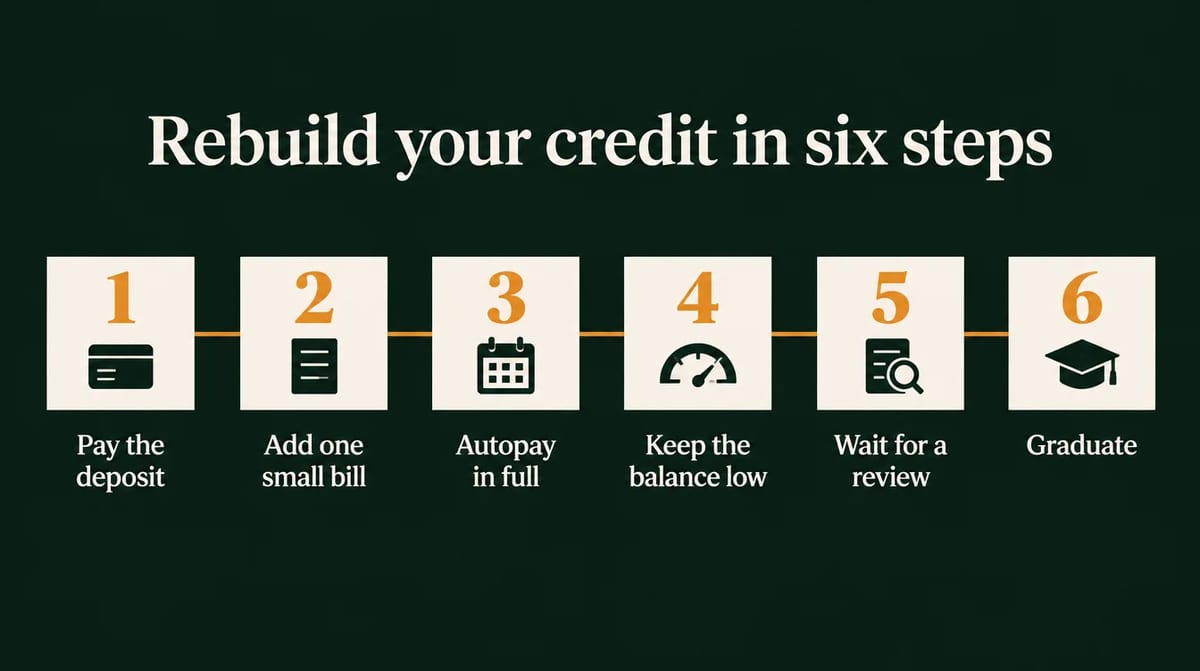
- Look at your credit reports first. They are free at AnnualCreditReport.com, the official site. Dispute anything that is wrong before you apply.
- Pick one card with no annual fee. Apply for one, not several; each application is a new inquiry on your report.
- Deposit only money you will not need. Never use rent or bill money for the deposit. The smallest deposit that gets you a card is fine.
- Put one small, regular bill on it. A phone plan or a streaming subscription is ideal: predictable and easy to cover.
- Turn on autopay for the full statement balance. Paying in full means you pay no interest; autopay means you never miss a due date.
- Keep the balance low. On a $200 line, a $40 bill uses 20% of your limit. Many people aim to stay well under a third.
- Wait for the review. Capital One says it may consider a higher line in as little as six months. Bank of America says it reviews accounts periodically.
- Graduate, then keep the account. When your deposit comes back and the card becomes unsecured, keep it open if it still has no annual fee; an old account in good standing helps your history.
At 28.99%, a $300 balance carried for a year costs about $87 in interest — more than the smallest deposit on this page. Carrying a balance does not help your score. Paying on time does.
If you will use the card abroad
Three of these cards — both Capital One cards and the Bank of America card — state no foreign transaction fee, so they are safe to take on a trip. Pay in the local currency when a card machine offers you dollars; our guide to paying in local currency explains why. A low limit fills up fast on a trip, so keep an eye on your balance and pay it down before the statement closes. For the other costs of spending abroad, see travel money mistakes to avoid.
Rebuilding takes months, not days. When you are ready for a big trip, a Nepal trek is one of the best-value adventures there is: Annapurna Base Camp is nine days at $920 USD solo, including permits, a government-registered guide, a porter, teahouses and meals.
See the Annapurna Base Camp trek →What is the best secured credit card for bad credit?
For most people, the Capital One Platinum Secured: no annual fee, a refundable deposit of $49, $99 or $200 depending on your application, and a possible upgrade to an unsecured card with responsible use.
Do I get my secured card deposit back?
Yes. On these cards the deposit is refundable, either when the issuer moves you to an unsecured card after a good track record, or when you close the account with the balance paid.
How long does it take to rebuild credit with a secured card?
It builds month by month. Capital One says it may consider a higher line in as little as six months of on-time payments; moving to an unsecured card usually takes longer and depends on your whole credit history.
Does a secured card earn rewards?
Some do. The Discover it Secured Cash Back earns 5% in rotating categories and 1% on everything else, the Quicksilver Secured earns 1.5%, and the Bank of America Secured Travel Rewards earns 1.5 points per $1. The Platinum Secured earns none.
Should I carry a balance to build credit?
No. Carrying a balance only costs you interest. Pay the full statement balance every month; the on-time payments are what help your score.
Keep reading
The four decisions that choose a card, with every comparison in one place.
The costly habits to drop before your next trip.
The card-machine question that costs travellers most.
The four charges on a trip abroad, and how to dodge them.
When each one wins, and how much to carry.
Sources: Capital One’s Platinum Secured and Quicksilver Secured card pages; Discover’s Discover it Secured Cash Back page; Bank of America’s Secured Travel Rewards card page, all read on 27 September 2026 for deposits, fees, rewards, APRs and upgrade terms. The utilisation and interest examples are our own arithmetic. This is general information, not financial advice; card offers change, so confirm the current terms with the issuer before you apply. No card issuer pays us for placement on this page.

Written by
Bishnu AdhikariPokhara-based, NMA-certified trekking guides. We’ve led 5,000+ treks across the Annapurna and Everest regions since 1998 — every word here comes from the trail. More from this author →
Share this article
Ready to Trek?
From reading about it to standing on it
Our Pokhara-based guides have been doing this since 1998. Tell us your dates and fitness level — we'll build your perfect itinerary. Free, no obligation.
Why trek with our licensed agencyMore guides like this
Popular trips to consider
View all treks & toursFree Trekker’s Insider Guide
Permits, packing lists, cost breakdowns — no fluff.
We send one useful email. You can unsubscribe anytime.