
Flying with a CPAP? What airlines can and can't ask of you
On US flights a CPAP is a free extra item and you can use it on board if it carries the FAA label. What to bring for power, and what to do at security.
On this page (7)
You can take a CPAP machine on any US flight as an extra item, free, and on most of them you can use it in your seat, as long as the machine carries the manufacturer’s label saying it meets FAA requirements. US disability rules (14 CFR Part 382) say an airline must not count an assistive device such as a CPAP towards your carry-on limit, and US and foreign airlines flying to, from or within the US must let you use a labelled CPAP on board aircraft with more than 19 seats. What the airline does not have to do is give you power: it can require you to bring enough charged batteries for 150% of the flight.
- Carry it on, never check it. A CPAP in the hold can be lost, and its lithium battery belongs in the cabin anyway.
- Look for the label. The in-flight right applies to machines with a manufacturer’s label saying they meet FAA requirements.
- Do not count on a seat socket. Airlines may ask for batteries covering 150% of the longest segment.
- Outside the US, the airline’s own policy decides. Part 382 protects you on flights to, from or within the United States.
Does a CPAP count as a carry-on bag?
No, not on any flight covered by US rules. Under 14 CFR 382.121, airlines must let passengers with a disability bring assistive devices into the cabin, including ventilators and respirators that use non-spillable batteries, and paragraph (b) says the airline must not count assistive devices towards a limit on carry-on baggage. So the CPAP in its case is an extra item on top of your bag and personal item.
The FAA pushes the same way. Its advisory circular on portable electronic devices (AC 91.21-1D) defines medical portable electronic devices as those medically necessary to support physiological functions, says passengers may use them at all times, and encourages airlines to include them in their carry-on and personal-item policies to make flying more accessible.
Can you use a CPAP on the plane?
Yes, on aircraft with more than 19 seats, if your machine carries the FAA label. 14 CFR 382.133 requires US airlines to permit a continuous positive airway pressure machine that displays a manufacturer’s label showing it meets FAA requirements. Foreign airlines must do the same on flights to, from or within the US, applying their own government’s standard where one exists. An airline can refuse only if the device fails those requirements or cannot be stowed and used safely in the cabin.
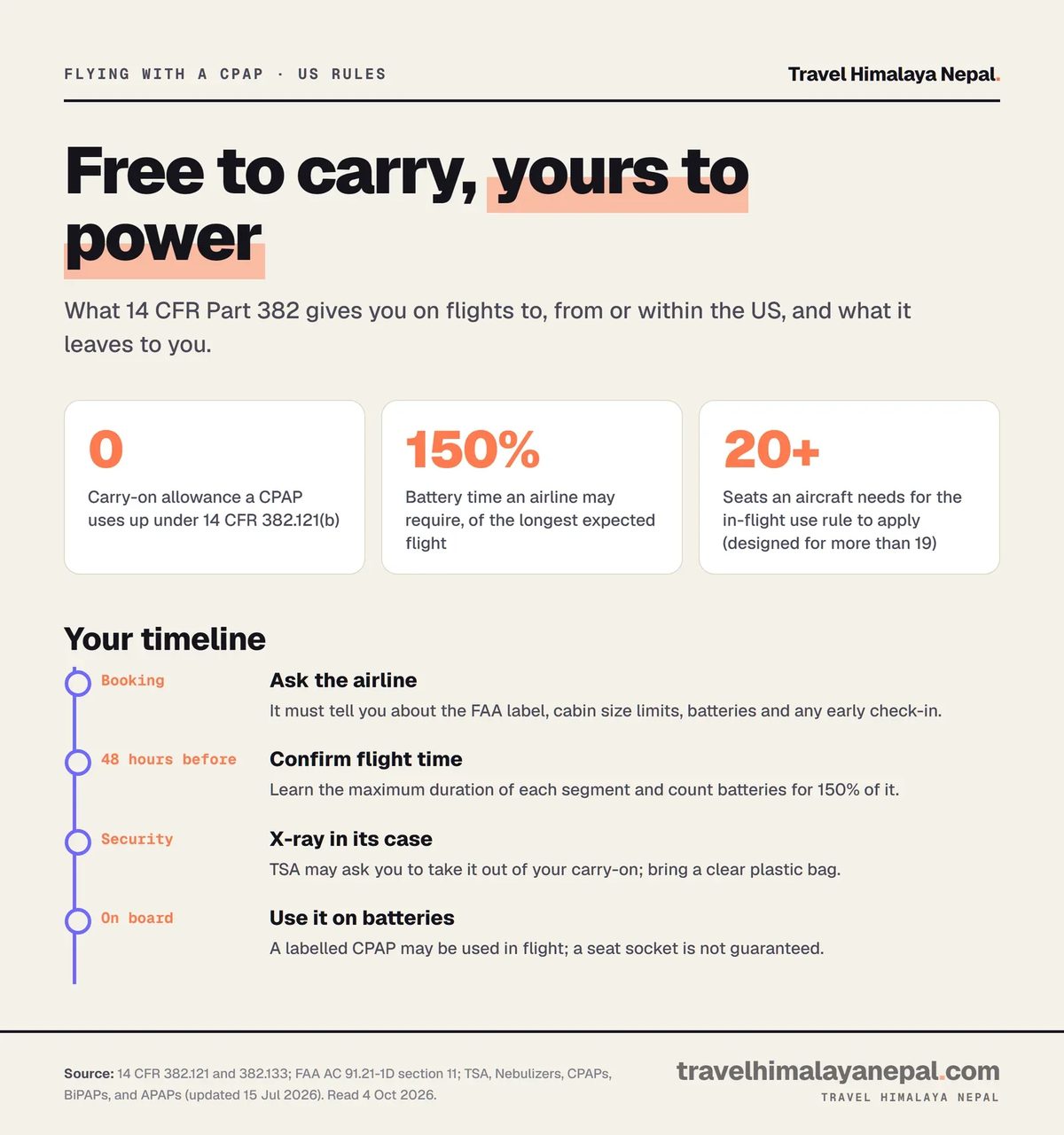
The same rule lists what the airline must tell you when you ask during booking:
- whether a manufacturer’s FAA label is required;
- the largest device, by weight and dimensions, it can accommodate in the cabin;
- that you must bring enough batteries, with spares protected from short circuits;
- whether you must contact the operating airline 48 hours before departure to learn the maximum flight time;
- whether you must check in up to one hour earlier than the normal deadline.
On a codeshare, the airline whose code is on your ticket must either give you that information or send you to the airline actually operating the flight.
Power on board, and how many batteries to bring
Plan to run the machine on batteries. Part 382 lets an airline require enough fully charged batteries to power the device for at least 150% of the expected maximum flight duration, based on the battery maker’s estimate of run time. The airline must tell you the expected maximum duration of each segment within 48 hours of your booking, or 24 hours before departure, whichever is earlier. If you do not meet its conditions, it may refuse to board you, but must explain why in writing.
For the batteries themselves, the usual lithium rules apply. The FAA allows lithium-ion batteries up to 100 Wh without approval, 101 to 160 Wh with the airline’s approval (up to two spares), and nothing above 160 Wh. Spares travel in the cabin only, with the terminals protected. Since 27 March 2026, ICAO also limits each passenger to two power banks, so a generic power bank used to run the machine counts towards that cap; the maker’s own CPAP battery is the cleaner choice.
Check your battery maker’s run-time figures with the heated humidifier on and off before you do the 150% sum. Either way, empty the tank before the airport and buy distilled water when you land.
Which rules apply on your flight
The strongest protection is on a US airline; outside US routes you depend on the airline’s own policy.
| Your flight | CPAP counts as a bag? | Use on board? | Rule |
|---|---|---|---|
| US airline, any route, more than 19 seats | No | Yes, with FAA label | 14 CFR 382.121 and 382.133 |
| Foreign airline to, from or within the US | No | Yes, with the label its government or the FAA requires | 14 CFR 382.133(b) and (d) |
| Foreign airline elsewhere (e.g. London to Bangkok) | Airline policy | Airline policy | Ask the airline in writing |
| Small aircraft, 19 seats or fewer | Airline policy | Not guaranteed | Outside 382.133 |
What to do at security
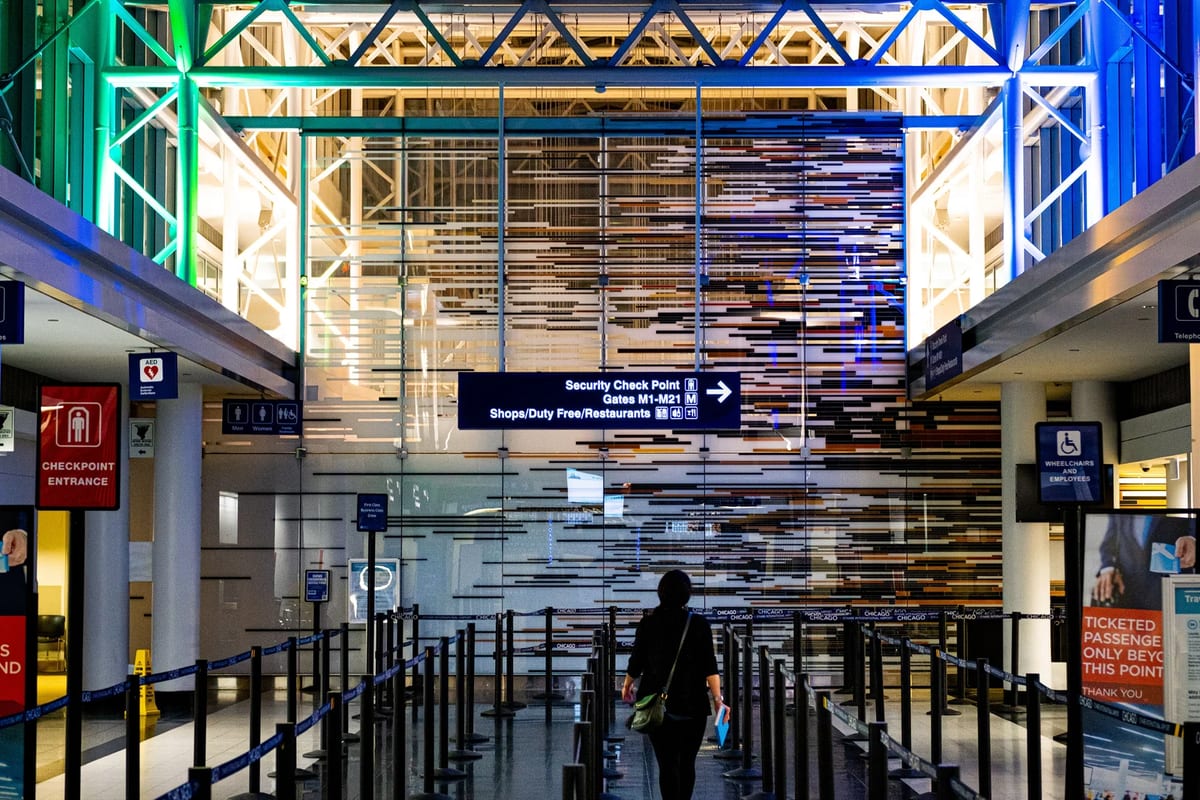
Keep the CPAP in your hand luggage and expect it to go through the X-ray in its case. TSA’s item page, updated in July 2026, says CPAPs, BiPAPs and APAPs, with their masks and tubing, may stay in their carrying case for X-ray but may be asked to come out of your carry-on; with TSA PreCheck they can stay in both. An older TSA answer says the machine itself must come out of its case, so carry a clear plastic bag in case an officer asks: TSA says you may provide one to put the device in.
- Before the trip: photograph the FAA label on the machine and print your prescription and a short doctor’s letter. Not every country’s border officers will know what the device is.
- 48 hours out: call the operating airline, say you will use a CPAP on board, and ask for the maximum flight time so you can count batteries.
- At check-in: arrive early in case the airline wants to see the device or label.
- At the gate: if your cabin bag is taken for the hold, take the CPAP out first. It is an assistive device and stays with you.
- On board: ask for a seat where the tubing will not cross the aisle, and stow the machine for take-off and landing as the crew directs.
Our verdict
Always carry it on, check the FAA label, and phone the airline 48 hours ahead with your battery maths ready. On a US-linked flight the law is firmly on your side: the CPAP is free, extra and usable. On a long-haul between two other countries, get the airline’s answer in writing before you fly, because no US rule follows you there.
Do I need a doctor’s letter to fly with a CPAP?
US rules do not require one for a CPAP (they require a physician’s statement for portable oxygen concentrators). We still recommend carrying your prescription, because some airlines and border officers abroad ask what the device is.
Can the airline charge me for my CPAP bag?
Not on flights covered by US rules. 14 CFR 382.121(b) says airlines must not count assistive devices towards carry-on limits, so the CPAP is an extra item.
Can I plug my CPAP into the seat power socket?
Only if the airline allows it, and there is no guarantee the socket works or exists. US rules let airlines require you to bring batteries for 150% of the flight time, so plan on batteries.
What if my CPAP has no FAA label?
The in-flight right under 382.133 applies to machines labelled as meeting FAA requirements. Without the label, the airline can refuse in-flight use. You can still carry it on as an assistive device, and use it at your destination.
Can I put the CPAP in checked luggage?
TSA allows it in checked bags, but we would never do it: a lost bag means nights without therapy, and any lithium battery must travel in the cabin.
Is distilled water for the humidifier allowed through security?
TSA exempts liquids for nebulizers from the 3-1-1 rule, but its CPAP guidance does not mention humidifier water. Travel with the tank empty and buy distilled water after security or on arrival.
Keep reading
Getting prescriptions through a border.
What counts, and what is exempt.
Who is at risk and what helps.
Every health topic we cover, in one place.
Sources: 14 CFR 382.121 and 382.133 (Air Carrier Access Act rules), via the Legal Information Institute; FAA Advisory Circular 91.21-1D, “Use of Portable Electronic Devices Aboard Aircraft”, section 11; FAA PackSafe lithium battery limits; TSA, “Nebulizers, CPAPs, BiPAPs, and APAPs” (updated 15 July 2026) and TSA FAQ on CPAP screening; ICAO, power bank restrictions announced 27 March 2026. All read 4 October 2026.
Photos: Pexels (Pew Nguyen, beyzahzah, Matthew Turner).

Written by
Anjali ShresthaPokhara-based, NMA-certified trekking guides. We’ve led 5,000+ treks across the Annapurna and Everest regions since 1998 — every word here comes from the trail. More from this author →
Ready to Trek?
From reading about it to standing on it
Our Pokhara-based guides have been doing this since 1998. Tell us your dates and fitness level — we'll build your perfect itinerary. Free, no obligation.
More guides like this
Popular trips to consider
View all treks & toursFree Trekker’s Insider Guide
Permits, packing lists, cost breakdowns — no fluff.
We send one useful email. You can unsubscribe anytime.