
Flying while pregnant? Check this airline cut-off first
Most airlines fly a routine pregnancy to the end of week 36 and twins to week 32, with a doctor's letter from week 28. BA, Emirates and Qantas compared.
On this page (6)
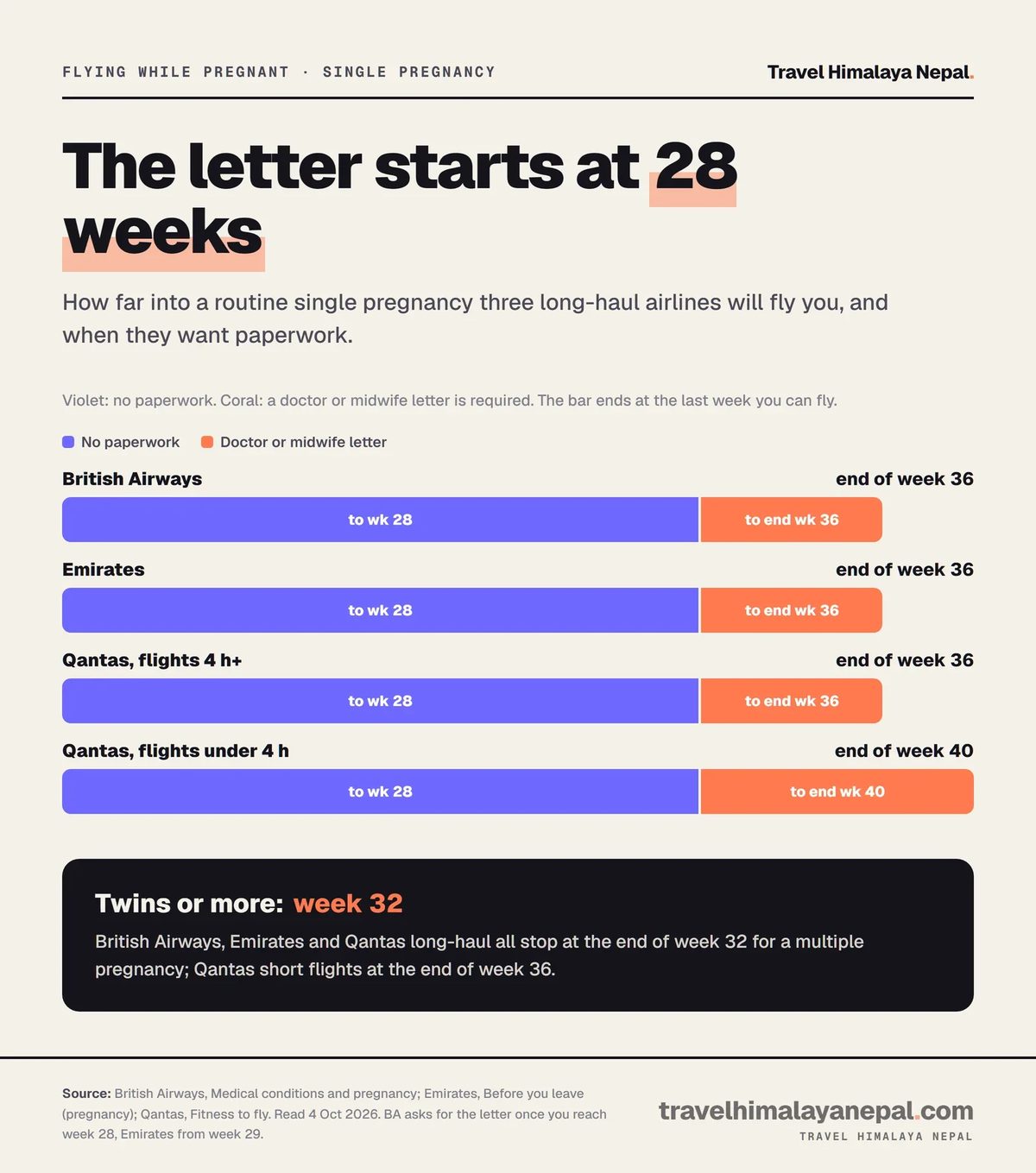
Most airlines will fly you in a routine single pregnancy until the end of week 36, but from about week 28 they want a letter from your doctor or midwife, and for twins the cut-off is usually the end of week 32. British Airways, Emirates and Qantas (on flights of four hours or more) all stop at the end of week 36 for one baby; Qantas lets you fly to the end of week 40 on flights under four hours. The airline’s cut-off is the ceiling, not the advice: the American College of Obstetricians and Gynecologists says the best time to travel is weeks 14 to 28, and that travel after 28 weeks may be riskier.
- The return flight decides. Count the weeks you will be on the day you fly home, not the day you leave.
- Get the letter even if nobody asks. Past week 28 or 29, an airline can refuse you at check-in without one.
- Twins change everything: four weeks less at all three airlines on long flights.
- Insurance is a separate question. Emirates itself tells pregnant travellers to make sure they are covered for preterm labour abroad.
Airline pregnancy cut-offs compared
The three long-haul airlines we checked agree on the end of week 36 for one baby and week 32 for twins; they differ on when the paperwork starts. Every row below is from the airline’s own page, read on 4 October 2026.

| Airline | One baby: last week | Twins or more: last week | Letter required |
|---|---|---|---|
| British Airways | End of week 36 | End of week 32 | From week 28: BA’s pregnancy form or an official letter, signed and stamped by your doctor or midwife |
| Emirates | End of week 36 (no travel from week 37) | End of week 32 (no travel from week 33) | From week 29: a medical certificate from your doctor or midwife |
| Qantas, flights of 4 hours or more | End of week 36 | End of week 32 | After 28 weeks: a certificate or letter from a registered medical practitioner or midwife |
| Qantas, flights under 4 hours | End of week 40 | End of week 36 | After 28 weeks, as above |
| American Airlines | Travel within 7 days of your due date goes through its special assistance coordinators, who check the medical paperwork before the flight | ||
We could not read the current pregnancy pages of United, Delta, Southwest, easyJet, Ryanair or Virgin Atlantic directly, so they are not in the table. Their cut-offs are often quoted secondhand, and those quotes disagree; check your own airline’s page or call before you book.
What the doctor’s letter has to say
Your due date, whether it is one baby or more, and that the pregnancy is routine with no complications. Qantas asks for exactly those three points. Emirates asks for more: confirmation of a single or multiple pregnancy, no complications, the estimated delivery date, the latest date your doctor expects you to be fit to travel, that you are in good health, and that there is no known reason you cannot fly.
British Airways publishes its own pregnancy form and says the document should be dated as close to your travel date as possible. One letter covers both the outbound and return flights, as long as you need no medical care during the trip. You hand it to check-in staff on the day.
Emirates requires medical clearance through its MEDIF form for any complicated pregnancy, at any stage, completed within a month of travel and submitted at least 48 hours before the flight. Other airlines run similar clearance desks: British Airways has a Passenger Medical Clearance team. Do not rely on the routine cut-offs.
Is it safe to fly while pregnant?
The airlines set a booking rule; the medical answer comes from your own doctor or midwife. ACOG’s guidance is that mid-pregnancy, weeks 14 to 28, is the best time to travel, because energy has returned, morning sickness has usually eased and moving around is still easy. After 28 weeks it says travel may be riskier: sitting for long periods is harder and the chance of going into labour is higher.
ACOG also suggests a prenatal check-up 4 to 6 weeks before you leave, carrying a copy of your health record, and, for trips outside the United States, calling your health insurer to ask whether you are covered abroad for pregnancy and newborn complications. On long flights, our own guide to blood clots on long-haul flights covers the moving, drinking and aisle-seat habits that matter more when you are pregnant.
What to do at booking and check-in
Have the letter in your hand, not in your hold bag, and tell staff how far along you are. Our checklist for clients:

- When booking: work out your week on the return date. A trip that starts at week 33 and ends at week 37 fails the cut-off on the way home.
- From week 28: get the letter, dated as close to departure as the airline asks, with the details it lists.
- At check-in: show the letter at the desk. British Airways asks you to present it there, and Emirates says you may not be accepted without one.
- On board: book an aisle seat so you can stand and walk regularly.
- Insurance: check that your policy covers pregnancy, preterm labour and the newborn abroad. Emirates names this risk directly.
Our verdict
Book the trip for weeks 14 to 28 if you can, and treat week 36 as the absolute ceiling, not a target. Get the letter from week 28 whatever your airline says, plan around the return date, and phone the airline if you are expecting twins or have any complication. The difference between a smooth trip and a refusal at the desk is a single dated page from your midwife.
Until how many weeks can you fly when pregnant?
For a routine single pregnancy, British Airways, Emirates and Qantas on flights of four hours or more stop at the end of week 36. Qantas allows up to the end of week 40 on flights under four hours. For twins or more, the usual limit is the end of week 32.
Do I need a fit-to-fly letter when pregnant?
From about week 28, yes, at the airlines we checked. British Airways asks from week 28, Emirates from week 29 and Qantas after 28 weeks. Before that, no paperwork is needed for a routine pregnancy.
What should a pregnancy fit-to-fly letter include?
At minimum: your due date, whether it is a single or multiple pregnancy, and that it is routine with no complications. Emirates also asks for the latest date your doctor expects you to be fit to travel and that you are in good health.
Can I fly in the first trimester?
Airlines do not restrict it. ACOG says mid-pregnancy, weeks 14 to 28, is the most comfortable time to travel, so talk to your doctor or midwife about early-pregnancy plans.
Does one letter cover my return flight?
At British Airways, yes: the letter covers the whole journey, outbound and return, provided you need no medical care during the trip. Check with other airlines, and make sure the dates on the letter cover your return.
Can the airline refuse to let me board?
Yes. Emirates says you may not be accepted without the certificate after week 29, and British Airways will not fly you past the end of week 36 (or week 32 for twins) whatever the letter says.
Keep reading
Who is at risk and what helps.
Medical devices on board, and your rights.
Getting prescriptions through a border.
Every health topic we cover, in one place.
Sources: British Airways, “Medical conditions and pregnancy”; Emirates, “Before you leave” (pregnancy section); Qantas, “Fitness to fly”; American Airlines, conditions of carriage and special assistance; American College of Obstetricians and Gynecologists, “Travel During Pregnancy”. All read 4 October 2026. This article is general information, not medical advice.
Photos: Pexels (Amina Filkins, Atlantic Ambience, Vlada Karpovich).

Written by
Anjali ShresthaPokhara-based, NMA-certified trekking guides. We’ve led 5,000+ treks across the Annapurna and Everest regions since 1998 — every word here comes from the trail. More from this author →
Ready to Trek?
From reading about it to standing on it
Our Pokhara-based guides have been doing this since 1998. Tell us your dates and fitness level — we'll build your perfect itinerary. Free, no obligation.
More guides like this
Popular trips to consider
View all treks & toursFree Trekker’s Insider Guide
Permits, packing lists, cost breakdowns — no fluff.
We send one useful email. You can unsubscribe anytime.