
Stuck on the tarmac? When the airline has to let you off
US airlines must let you off after 3 hours on domestic flights and 4 on international ones. Canada allows 3, the EU reform 2. What to ask for meanwhile.
On this page (8)
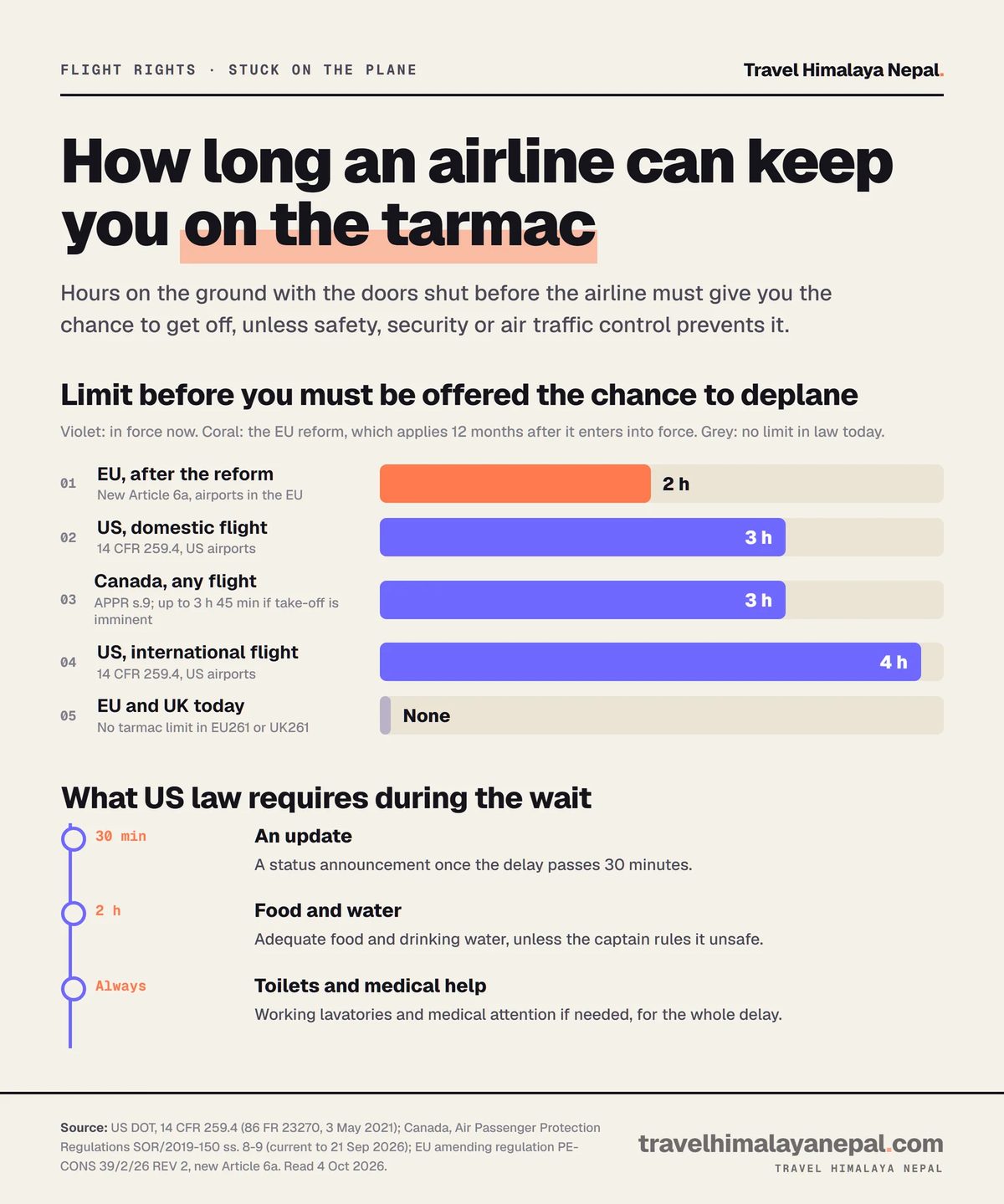
At a US airport an airline must give you the chance to get off a plane stuck on the ground before the delay passes three hours on a domestic flight or four hours on an international one, unless safety, security or air traffic control prevents it. Canada sets three hours, stretched to three hours 45 minutes if take-off is imminent. The EU and the UK have no tarmac limit today, but the EU’s reformed passenger rules add one of just two hours once they apply. Food and water are due after two hours in the US, and toilets, air and updates throughout.
- The US rule covers every airline at a US airport flying aircraft with 30 or more seats, foreign carriers included, though foreign carriers only have the four-hour limit.
- A diversion counts. A plane sitting at the wrong airport is treated as an arriving flight until you are offered the chance to get off.
- Getting off is an offer, not an order. Ask whether the flight will wait before you take your bag and go.
- A tarmac delay pays no cash in the US, but it can push the flight into refund territory, and in Europe it counts toward the three-hour arrival delay.
What the US tarmac delay rule requires
Every covered airline must publish a tarmac delay contingency plan and follow it, and the plan must meet the minimums in 14 CFR 259.4. A tarmac delay is any time the aircraft is on the ground with passengers who have no opportunity to deplane. The rule applies at large, medium, small and non-hub US airports, to US airlines and to foreign airlines flying to or from the US with at least one aircraft of 30 or more seats.
- 3 hours domestic, 4 hours international: the airline must offer you the chance to deplane before the delay passes that mark. On a departing flight it complies if the plane has begun returning to a gate or other disembarkation point by then.
- Food and water by 2 hours: adequate food and drinking water no later than two hours into the delay, unless the captain decides safety or security rules it out.
- Toilets and medical care: working lavatories and medical attention if needed, for the whole delay.
- An update at 30 minutes: a status announcement once the delay passes half an hour, with further updates at the airline’s discretion.
- Notice when you can get off: each time an opportunity to deplane exists, passengers must be told.
The three exceptions are narrow: the captain decides that deplaning would put passengers at risk, there is a safety or security reason the aircraft cannot move, or air traffic control advises that returning to the gate would significantly disrupt airport operations. Breaking the plan is treated as an unfair and deceptive practice, which DOT can enforce, and the airline must report every delay over the limit to DOT within 30 days.
How long is too long, country by country?
The EU reform will be the strictest at two hours; today the US and Canada are the only ones with a hard limit.
| Where you are stuck | Limit before you can get off | Care during the wait | Rule |
|---|---|---|---|
| US airport, domestic flight | 3 hours | Food and water by 2 h, toilets, medical, 30-min update | 14 CFR 259.4 |
| US airport, international flight | 4 hours | Same as above | 14 CFR 259.4 |
| Canadian airport | 3 hours, or 3 h 45 if take-off is likely | Toilets, ventilation and heating or cooling, a way to communicate, food and drink | APPR ss. 8–9 |
| EU airport, after the reform applies | 2 hours | Updates, heating or cooling, toilets, free drinking water | Reg. 261/2004, new Art. 6a |
| EU or UK airport today | No limit in law | Care rules for long delays still apply | EU261 / UK261 |
What if your flight is diverted?
In the US a diverted flight is treated as an arriving flight until you are offered the chance to get off, and as a departing flight after that. Paragraph (d) of the rule means the clock that protects you keeps running when weather sends you to an alternate airport. Once the doors open and you are offered the chance to deplane, the airline can board everyone again and use the departure exception, so if you stay on, you accept that the plane may sit again. Canada’s three-hour rule counts from landing, wherever that is.
The EU’s new two-hour limit
The reform of Regulation 261/2004 adds Article 6a: after two hours on the ground at an EU airport, the aircraft must go to a gate or other point where passengers may get off. The final text, PE-CONS 39/2/26 REV 2, defines a tarmac delay as more than 30 minutes between doors closing and take-off, or between touchdown and the doors opening. During one, the airline must give regular real-time updates, keep the cabin heated or cooled, keep toilets open free of charge and, unless it would lengthen the delay, hand out free drinking water. After two hours the delay can only continue for safety, immigration, air traffic control or security reasons. The regulation applies 12 months after it enters into force, so the current rules, with no tarmac limit, still govern flights until then. The UK left the EU before the reform and is not bound by it.
What to do when you are stuck on the plane
Note the times, ask for what the rule gives you, and decide before the limit whether you would rather get off.
- Write down when the main door closed or when you landed. It is the start of every clock above.
- Ask a crew member for the reason and the expected wait once 30 minutes pass. The reason matters later for any refund or compensation claim.
- Ask for water and food at two hours on a US flight. It is a requirement, not a favour.
- If you want off, say so before the limit, and ask whether the flight will wait for passengers who leave. Take your passport, medication and charger.
- Afterwards, complain in writing to the airline, then to DOT’s Office of Aviation Consumer Protection, the Canadian Transportation Agency, or the national enforcement body in the EU country you left from.
Do you get compensation for a tarmac delay?
Not for the tarmac time itself in the US, but the delay can earn a refund, and in Europe and Canada it counts toward a compensable late arrival. If the wait pushes your arrival three hours late on a domestic US itinerary or six hours on an international one and you decide not to travel, DOT’s automatic refund rule in 14 CFR 260 applies. Under EU261 and UK261, what counts is arriving three hours or more late at your final destination for a reason within the airline’s control, tarmac time included; whether the reason qualifies is set out in our guide to what counts as extraordinary circumstances. Canada pays CAD 400 to 1,000 on a large airline for a controllable delay of three hours or more. The full picture by country is in our flight rights guide, and if the delay costs you a connection, see when the airline has to rebook you on another airline.
Tarmac holds and missed connections are why we tell trekkers to land a day early. Our 12-day Everest Base Camp trek is $1,700 solo, from $1,230 each in a group of eight or more, with permits, a government-registered guide, porter, teahouses and meals, and we move start dates when flights run late.
See the trek →Frequently asked questions
How long can an airline keep you on the tarmac in the US?
Three hours on a domestic flight and four on an international one before it must offer you the chance to deplane, unless safety, security or air traffic control prevents it.
Do airlines have to give you food and water during a tarmac delay?
In the US, yes: adequate food and drinking water no later than two hours into the delay, unless the captain rules it unsafe. Canada requires food and drink in reasonable quantities.
Does the tarmac rule apply to foreign airlines?
At US airports, yes, for airlines with aircraft of 30 or more seats; foreign airlines must meet the four-hour international limit and the care rules.
Is there a tarmac delay rule in Europe or the UK?
Not today. The EU reform adds a two-hour limit at EU airports once it applies, 12 months after entry into force. The UK is not covered by the reform.
Does a diverted flight count as a tarmac delay?
Yes. Under the US rule a diversion is treated as an arriving flight until passengers are offered the chance to get off.
Can I get compensation for being stuck on the tarmac?
Not in the US for the wait itself. In the EU, UK and Canada the time counts toward a late arrival, which pays if it reaches three hours and the cause was within the airline’s control.
Keep reading
What airlines owe you, country by country.
Which excuses stop an EU261 payout.
When the airline must put you on a rival.
Limits, deadlines and how to claim.
Sources: US Department of Transportation, 14 CFR 259.3 and 259.4 (86 FR 23270, 3 May 2021) and 14 CFR 260.2; Canada, Air Passenger Protection Regulations SOR/2019-150, sections 8 and 9 (current to 21 September 2026); European Parliament and Council, regulation amending Regulation (EC) No 261/2004, PE-CONS 39/2/26 REV 2 (16 September 2026), Articles 2(y), 6a and 3. Read 4 October 2026. This is general information, not legal advice.
Photos via Pexels: Asif Methar (cover), Zuzanna Musial, Anugrah Lohiya.

Written by
Anjali ShresthaPokhara-based, NMA-certified trekking guides. We’ve led 5,000+ treks across the Annapurna and Everest regions since 1998 — every word here comes from the trail. More from this author →
Ready to Trek?
From reading about it to standing on it
Our Pokhara-based guides have been doing this since 1998. Tell us your dates and fitness level — we'll build your perfect itinerary. Free, no obligation.
More guides like this
Popular trips to consider
View all treks & toursFree Trekker’s Insider Guide
Permits, packing lists, cost breakdowns — no fluff.
We send one useful email. You can unsubscribe anytime.