
Missed a connecting flight? What the airline has to do now
On one booking the airline must get you there, and in the EU, UK or Canada pay up to €600, £520 or CAD 1,000. Separate tickets get nothing at all.
On this page (10)
- Why one booking matters more than anything else
- Your rights under EU261 and UK261
- What the EU reform changes for missed connections
- Canada: rebooking deadlines in law
- The United States: what the law does and does not say
- What to do when you miss the connection
- How to claim afterwards
- Connecting to Nepal
- Frequently asked questions
- Keep reading
If both flights are on one booking and the first one makes you miss the second, the airline must get you to your final destination, and in the EU, the UK and Canada it owes you cash if you arrive three hours or more late for a reason within its control: €250 to €600, £220 to £520, or CAD 400 to 1,000. The delay is measured at the end of the whole journey, not at the connection. In the US no federal rule makes the airline rebook you; its own policy does. And if you bought the two flights separately, none of this covers the second one.
- Separate tickets are on you. A cheap self-connection saves money until the first flight runs late.
- Distance counts from your first departure to your final destination, so a long journey pays the higher band even if the late leg was short.
- Meals and a hotel at the connecting airport are owed in Europe and the UK while you wait.
- The EU reform adds a deadline: if the airline cannot reroute you within five hours, it must also offer a refund.
Why one booking matters more than anything else
Passenger-rights rules treat flights booked together as one journey and flights booked apart as strangers. The European Commission’s 2024 guidelines say flights booked as a single unit are considered as a whole, from the first departure to the final destination. Since December 2023 the UK has the same rule in writing: Article 3(1A) of the UK regulation treats a multi-leg flight booked as a single unit as one flight, departing from the first leg’s origin. A travel agency that sells several airlines on one ticket for one price counts as a single booking too. Two reservations made separately do not: the guidelines are explicit that a passenger who misses a second flight booked on a separate ticket has no compensation claim for it.
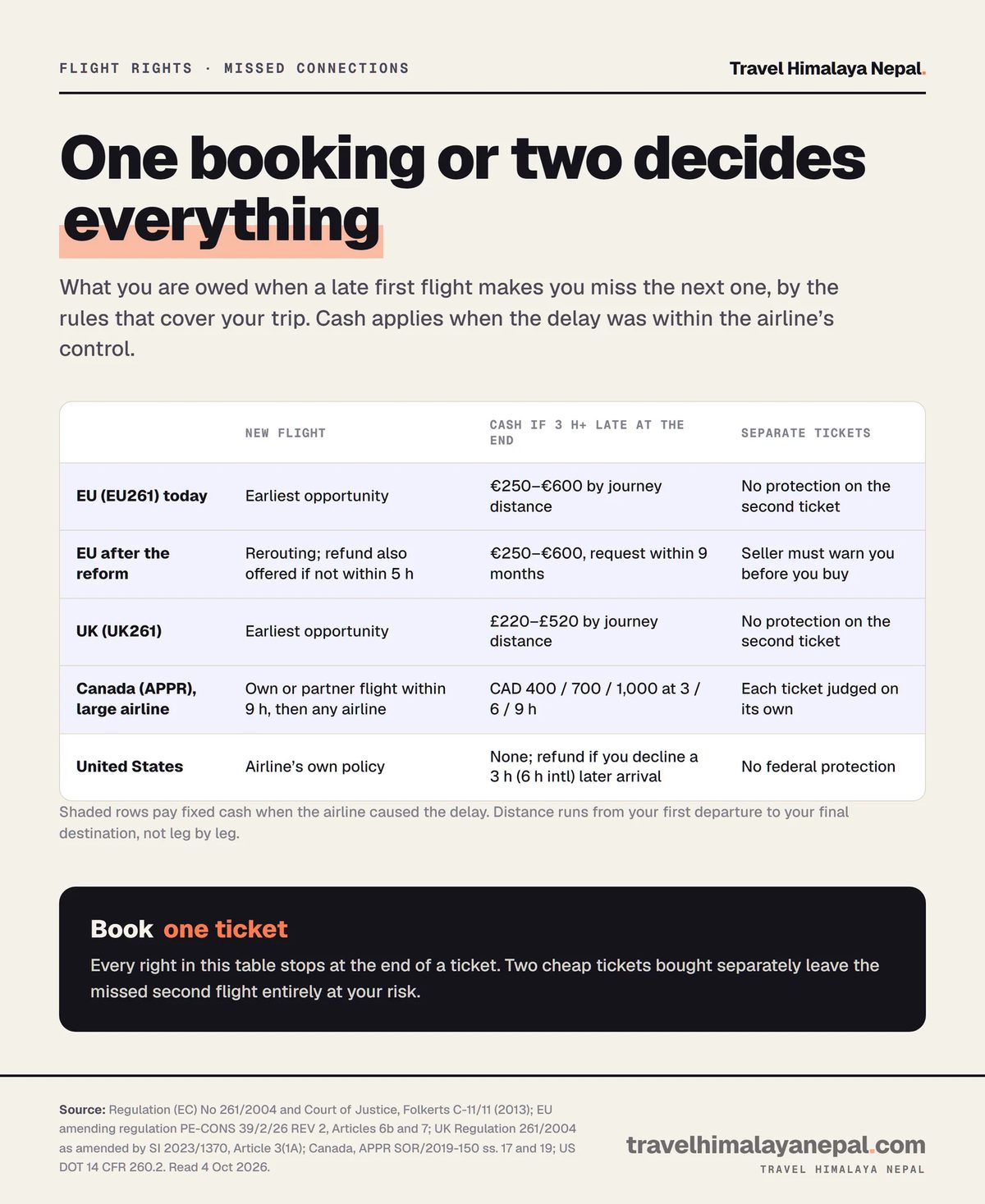
| Your trip is covered by | New flight | Cash if 3 h+ late at the end | Care while you wait |
|---|---|---|---|
| EU261 (from the EU, or into it on an EU airline) | Earliest opportunity, or refund | €250 / €400 / €600 by distance | Meals, hotel, transfers |
| UK261 (from the UK, or into it on a UK or EU airline) | Earliest opportunity, or refund | £220 / £350 / £520 by distance | Meals, hotel, transfers |
| Canada APPR, large airline | Own or partner flight within 9 h, then any airline | CAD 400 / 700 / 1,000 at 3 / 6 / 9 h | Only if the cause is within its control |
| United States | Airline’s own policy | None | Airline’s own commitments |
Your rights under EU261 and UK261
You are owed rerouting at the earliest opportunity, care while you wait, and compensation if you reach your final destination three hours or more late. The Court of Justice settled the compensation point in Folkerts (C-11/11, 2013): on directly connecting flights the delay is measured at the destination of the last flight, so a first leg that was only 90 minutes late can still pay out in full if it cost you the connection. In Bossen (C-559/16) it added that the distance band is the great-circle distance from your first departure to your final destination, not the sum of the legs. So a single booking from London to Kathmandu via Doha sits in the top band, £520 under UK261, because the journey is over 3,500 km.
Care applies at the transfer airport as well, and the guidelines say airlines must actively offer it rather than leave you to find a hotel. If the airline offers a new flight that lands you within four hours of your original arrival on a journey over 3,500 km, current rules let it halve the payment. Who to claim from depends on the routing: the court has held that any operating airline on a single booking can be liable, even if a partner’s leg caused the delay.
What the EU reform changes for missed connections
The reformed regulation adds Article 6b: the airline that operated the late flight is responsible for rerouting you, and if it cannot get you away within five hours of your missed flight’s departure, it must also offer you a refund. Compensation stays at €250 to €600 for arriving more than three hours late, now measured against the arrival time on your ticket before the connection was missed. Sellers of separately ticketed itineraries will have to tell you before you pay that the second flight carries no rerouting, refund or compensation rights if you miss it. Requests for compensation will have to be made within nine months of departure. The reform applies 12 months after it enters into force, and not in the UK.
Canada: rebooking deadlines in law
A large Canadian airline that caused the disruption must put you on its own or a partner’s next flight leaving within nine hours, then on any airline within 48 hours, then via a nearby airport. Those steps are in section 17 of the Air Passenger Protection Regulations. Compensation under section 19 is measured by your arrival at the destination on your original ticket, so a missed connection counts like any other delay: CAD 400 from three hours, 700 from six and 1,000 from nine. If the cause was outside the airline’s control, such as weather, section 18 still requires a confirmed seat within 48 hours or, failing that, a refund or a seat on another airline, but no cash and no meals. The rule changes Canada proposed in December 2024 are covered in our guide to Canadian delay compensation.
The United States: what the law does and does not say
No federal rule makes a US airline rebook you after a missed connection; your protection is the refund rule and the airline’s own promises. Under 14 CFR 260, a trip is “significantly changed” if you would now arrive three hours or more late on a domestic itinerary, six hours on an international one, or with more connections than you booked. If the airline’s fix looks like that and you decline it, you are owed a cash refund for the unused part: within 7 business days on a card, 20 calendar days otherwise. Beyond that, rebooking, meal vouchers and hotels come from each airline’s customer service plan, which differs between carriers, so read your airline’s before you argue at the desk. If the delay keeps you on the plane, the tarmac delay rule applies.
What to do when you miss the connection
Stay airside, go to the transfer desk or the app at once, and ask for the earliest flight on any airline.
- Do not leave the transfer area to queue at check-in. Transfer desks and airline apps rebook faster, and you may not be allowed back without a visa.
- Ask for the earliest arrival, not just the airline’s next flight. In Europe and the UK that can mean another airline; the Civil Aviation Authority says so in its own guidance.
- Ask for meal vouchers and, overnight, a hotel and transfers. If none are offered, keep receipts for reasonable costs.
- Keep every boarding pass and the original itinerary. Your claim turns on the scheduled arrival at the final destination against the actual one.
- On separate tickets, call the second airline before its departure. It owes you nothing, but some will move you for a fee if you ask before you are a no-show.
Travel insurance with a missed-connection benefit covers the separate-ticket gap that the law leaves open; our guide to trip delay and missed-connection cover explains what it pays.
How to claim afterwards
Write to the airline with your booking reference, both flight numbers, the scheduled and actual arrival at your final destination, and the reason you were given. If the airline says the delay was outside its control, test that against what counts as extraordinary circumstances; if it refuses or ignores you, go to the UK airline’s dispute resolution scheme or the CAA, the national enforcement body of the EU country you left from, or the Canadian Transportation Agency. You do not need a claims company. Our flight rights guide sets out every system side by side.
Connecting to Nepal
Most of our trekkers reach Kathmandu on one ticket through a Gulf or Indian hub, which is exactly the trip these rules protect. From a European or UK airport that booking is covered end to end, connection included; the return through the same hub on a non-European airline usually is not. The detail is in when EU261 covers a flight to Kathmandu. Book one ticket, leave at least a comfortable connection, and land a day before your trek starts.
Our 12-day Everest Base Camp trek is $1,700 solo, from $1,230 each in a group of eight or more, with permits, a government-registered guide, porter, teahouses and meals. If a missed connection costs you a day, tell us from the airport and we move the start date when flights allow.
See the trek →Frequently asked questions
Do I get compensation if I miss a connecting flight?
In the EU, the UK and Canada, yes, if both flights were on one booking, you reached your final destination three hours or more late, and the cause was within the airline’s control. In the US there is no cash compensation.
What if my flights were on separate tickets?
The second airline owes you nothing for missing its flight. You can only claim against the first flight if that flight alone was three hours or more late under EU or UK rules.
Does the airline have to put me on another airline?
In Europe and the UK, rerouting at the earliest opportunity can include another airline. In Canada a large airline must use any airline if its own or a partner’s flight is not leaving within nine hours. In the US it depends on the airline’s own policy.
How is the delay measured for a missed connection?
At your final destination. A first flight that was only an hour late can still earn full compensation if it made you three hours late at the end.
Do I get a hotel if I miss my connection overnight?
In the EU and UK, yes, plus meals and transfers, whatever the cause. In Canada only if the cause was within the airline’s control. In the US it depends on the airline.
What changes under the new EU rules?
If the airline cannot reroute you within five hours, it must also offer a refund, and compensation requests must be made within nine months. The rules apply 12 months after entry into force and not in the UK.
Keep reading
What airlines owe you, country by country.
When a Gulf connection is still covered.
When the airline must put you on a rival.
Cover for the gap the law leaves open.
Sources: Regulation (EC) No 261/2004; European Commission, Interpretative Guidelines C/2024/5687, sections 2.1 and 4.4, citing Folkerts C-11/11 and Bossen C-559/16; European Parliament and Council, regulation amending Regulation (EC) No 261/2004, PE-CONS 39/2/26 REV 2 (16 September 2026), Articles 6b and 7; legislation.gov.uk, UK Regulation 261/2004, Article 3(1A) as inserted by SI 2023/1370; UK Civil Aviation Authority, rights when you miss a connection; Canada, Air Passenger Protection Regulations SOR/2019-150, sections 17 to 19 (current to 21 September 2026); US DOT, 14 CFR 260.2. Read 4 October 2026. This is general information, not legal advice.
Photos via Pexels: MIANHU XIAO (cover), Daniel Ponomarev, Marcelo Renda.

Written by
Anjali ShresthaPokhara-based, NMA-certified trekking guides. We’ve led 5,000+ treks across the Annapurna and Everest regions since 1998 — every word here comes from the trail. More from this author →
Ready to Trek?
From reading about it to standing on it
Our Pokhara-based guides have been doing this since 1998. Tell us your dates and fitness level — we'll build your perfect itinerary. Free, no obligation.
More guides like this
Popular trips to consider
View all treks & toursFree Trekker’s Insider Guide
Permits, packing lists, cost breakdowns — no fluff.
We send one useful email. You can unsubscribe anytime.