
Flight hit by a strike? Who pays depends on who walked out
An airline crew strike over pay earns you €250–€600 or £220–£520 in Europe. Air traffic control and airport strikes pay nothing, but care is still owed.
On this page (8)
Whether a strike earns you cash depends on who is striking. In the EU and the UK, a strike by the airline’s own pilots or cabin crew over pay or conditions is the airline’s problem, so a late cancellation or a three-hour delay pays €250 to €600 or £220 to £520. A strike by air traffic controllers, airport security or ground handlers is usually an extraordinary circumstance and pays nothing. Rebooking or a refund is owed whoever walks out, and in Europe so are meals and a hotel. Canada treats every labour disruption, the airline’s own included, as outside its control. The US pays no cash for any delay.
- Check who called the strike before anything else. It decides the money.
- Fourteen days’ notice wipes out compensation in Europe and the UK, even for the airline’s own strike, so a strike announced weeks ahead rarely pays.
- Care is not optional in Europe. Meals and a hotel are owed during an air traffic control strike just as during an airline one.
- Insurance bought after the strike is announced will not cover it.
Strikes by the airline’s own staff
Under EU261 and UK261, a strike by the airline’s own employees over pay or working conditions is not an extraordinary circumstance, so compensation is owed. The Court of Justice decided it in Airhelp v SAS (C-28/20, 2021): a strike called by unions over pay is part of the normal exercise of the airline’s activity, because the employment relationship is something the airline controls. It had already said the same about a wildcat strike after a surprise restructuring (Krüsemann, C-195/17), and later about a solidarity strike with a parent company’s staff (Eurowings, C-613/20). The one opening for airlines is a strike over demands that only a government can meet, which the court said can be extraordinary.
That is why the two French and Italian strikes we covered this autumn come out differently. easyJet’s Italy crew strike on 16 October is a dispute with the airline, so a cancellation notified late pays. The French flight crew strike of 17 to 21 October targets a government pension reform, which is exactly the case where an airline can argue the strike was beyond its control. The reformed EU regulation writes that distinction into its list of extraordinary circumstances: strikes at the airline count only where they originate from demands that public authorities alone can satisfy.
Air traffic control strikes
An air traffic control strike is external to the airline, so in Europe and the UK it pays no compensation, but meals, drinks and a hotel are still owed. The Commission’s 2024 guidelines list strikes by air traffic controllers and airport staff as external events that may be extraordinary circumstances, and the UK Civil Aviation Authority names air traffic control and airport strikes among the causes that do not earn compensation. A controllers’ strike in one country also delays flights that only cross its airspace, which is why a French or Italian stoppage can ground flights between two other countries. Italy protects departures in two guaranteed bands, 07:00 to 10:00 and 18:00 to 21:00, as our report on the 30 September controllers’ strike explains, and a system failure is treated the same way as a strike: see what airlines owe when air traffic control fails.
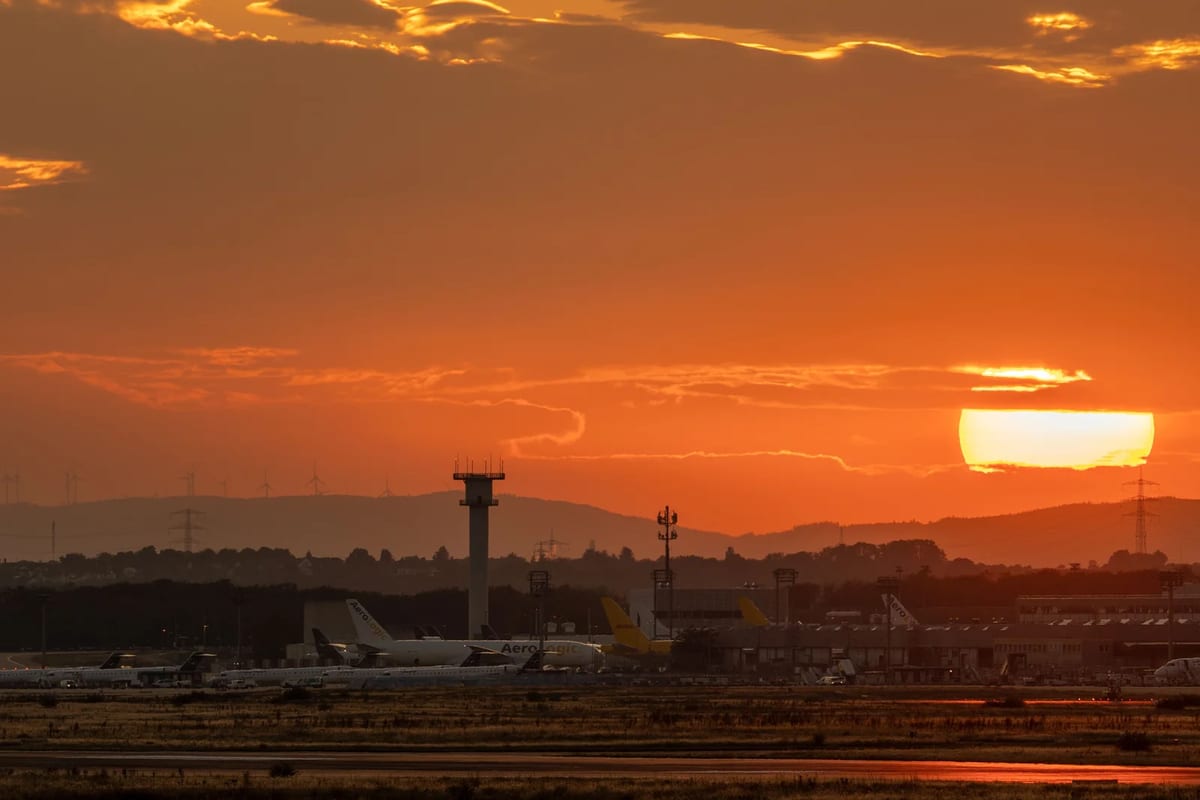
In the United States the question rarely arises: federal law bars anyone who strikes against the US government from holding a federal job, and the Federal Aviation Administration’s controllers are federal employees.
Airport security, baggage and ground-handling strikes
Usually extraordinary, because the airline does not employ the strikers, but not always. The guidelines treat strikes by airport staff as external, and the court has also accepted that a shortage of the airport operator’s own baggage-loading staff can be extraordinary (Touristic Aviation Services, C-405/23). The reform narrows it: a strike by an airport, air navigation or ground-handling provider counts only where the airline did not effectively choose that provider and the strike is beyond its control or its group’s. An airline that picked and contracts its own handler at an airport may not be able to hide behind that handler’s strike. Outside Europe the money question is simpler, as the Sydney security and Qantas ground staff strikes showed: Australia has no fixed payout at all.
What you are owed, country by country
Europe and the UK are the only places where a strike can earn cash, and only for the airline’s own staff.
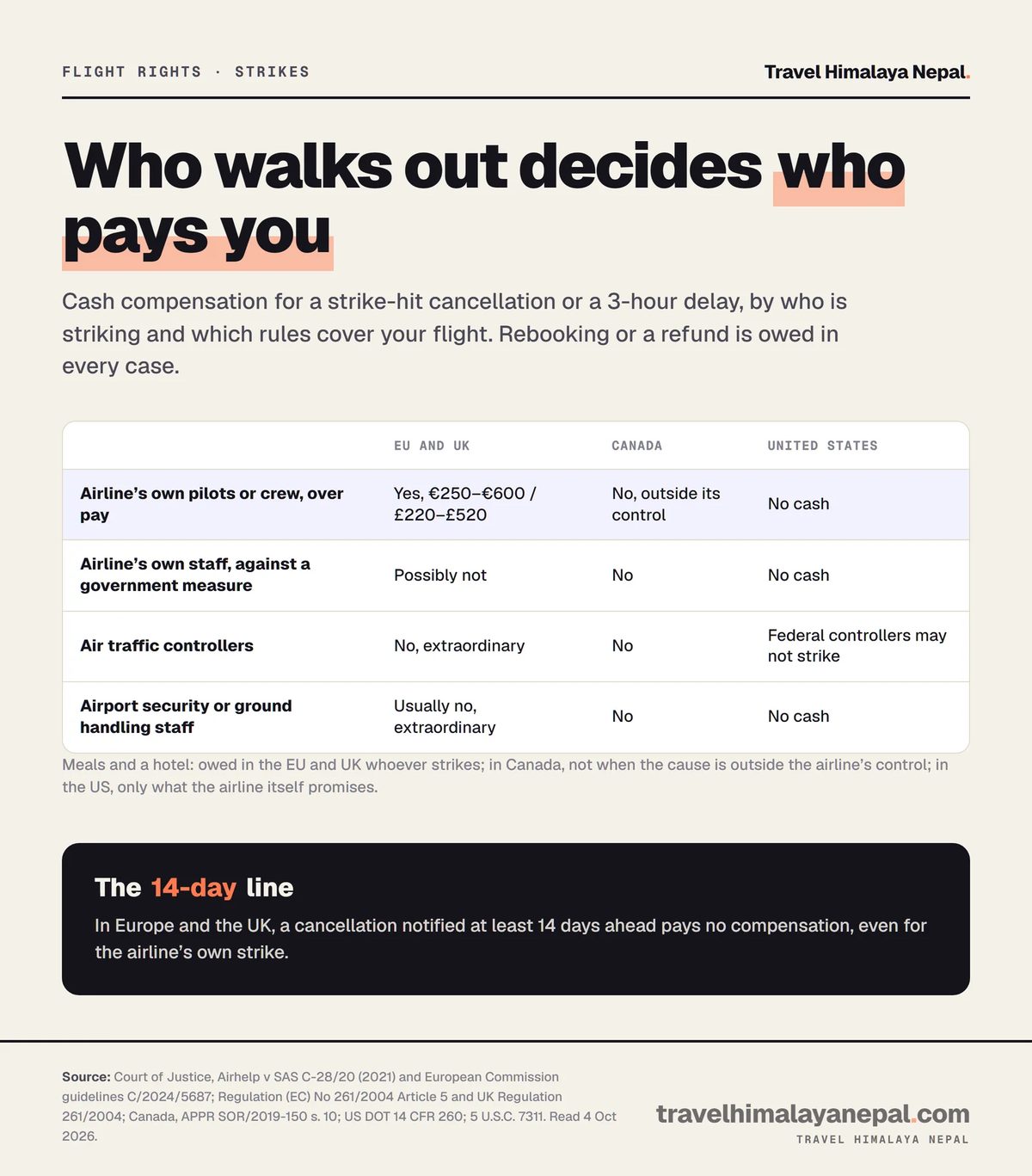
| Who strikes | EU (EU261) and UK (UK261) | Canada (APPR) | United States |
|---|---|---|---|
| Airline’s own staff, over pay | €250–€600 / £220–£520 unless told 14+ days ahead | No cash; rebooking within 48 h or refund | No cash; refund if you don’t travel |
| Airline’s own staff, against a government measure | Possibly extraordinary, no cash | No cash | No cash |
| Air traffic controllers | No cash; care owed | No cash | Federal controllers may not strike |
| Airport, security or ground handlers | Usually no cash; care owed | No cash | No cash |
| Meals and a hotel | Owed whoever strikes | Not owed when outside the airline’s control | Airline’s own promises |
Canada’s Air Passenger Protection Regulations list “a labour disruption within the carrier or within an essential service provider such as an airport or an air navigation service provider” among situations outside the airline’s control. That means a Canadian airline must rebook you or refund you, but owes no compensation and no meals. Amendments proposed in December 2024 would change the structure, and our Canadian delay compensation guide tracks where they stand. In the US, a cancelled flight or a significantly changed one that you decline triggers an automatic cash refund under 14 CFR 260, whatever the cause. Australia gives a refund or replacement under consumer law, with no set sum; see what Australians can claim.
What to do when a strike is announced
Find out who is striking, when your airline was told, and whether you can move your flight for free before the day.
- Read the strike notice, not the headline. Is it the airline’s crew, the controllers or the airport? Our strike reports name the union and the employer for that reason.
- Note the date the airline told you about any cancellation. In Europe and the UK, 14 days or more before departure means no compensation, though rerouting or a refund is still yours.
- Take the free change if the airline offers one. Airlines often waive change fees for strike days; moving early beats queueing on the day.
- On the day, ask for rerouting at the earliest opportunity, and meals and a hotel in Europe. Keep receipts if you have to pay.
- Check your insurance date. Cover bought after a strike is announced will not pay for it, as the known-event exclusion makes clear.
How to claim after a strike
Claim from the airline that operated the cancelled or delayed flight, with the reason it gave and when it told you. If it calls an airline crew strike “extraordinary”, cite C-28/20; if it calls a handler’s strike extraordinary, ask who chose that handler. Escalate to the national enforcement body in the EU country you departed from, or to the airline’s dispute resolution scheme or the CAA in the UK. The wider set of excuses is in what counts as extraordinary circumstances, and if a strike-day delay costs you a connection, see your rights after a missed connection. Every system is compared in our flight rights guide.
Autumn strikes in Europe land in Nepal’s best trekking months. Land a day early. Our 12-day Everest Base Camp trek is $1,700 solo, from $1,230 each in a group of eight or more, with permits, a government-registered guide, porter, teahouses and meals, and we move start dates when flights run late.
See the trek →Frequently asked questions
Do I get compensation if my flight is cancelled because of a strike?
In the EU and UK, yes if the airline’s own staff struck over pay or conditions and you were told less than 14 days ahead. No if air traffic controllers or airport staff struck. In Canada and the US, no cash for any strike.
Is an air traffic control strike an extraordinary circumstance?
Yes. It is outside the airline’s control, so no compensation is owed in Europe or the UK, but meals, drinks and a hotel still are.
Is a pilot or cabin crew strike an extraordinary circumstance?
Not when it is about pay or conditions, the EU court ruled in 2021. It may be if the strike targets a government measure only the authorities can change.
Am I owed a hotel during an airport strike?
Under EU261 and UK261, yes, plus meals and transfers, whoever is striking. In Canada, not when the cause is outside the airline’s control.
Can I get a refund instead of a new flight?
Yes, in every system covered here. In the US the refund is automatic and in cash if you choose not to travel.
Does travel insurance cover strikes?
Usually only strikes that were not announced when you bought the policy. Buy cover when you book the trip.
Keep reading
What airlines owe you, country by country.
Which excuses stop an EU261 payout.
Rebooking and cash when a connection goes.
What airlines owe after a system failure.
Sources: Regulation (EC) No 261/2004, Articles 5 and 9, and the UK version on legislation.gov.uk; European Commission, Interpretative Guidelines C/2024/5687, section 5.2, citing Airhelp C-28/20, Krüsemann C-195/17, Eurowings C-613/20 and Touristic Aviation Services C-405/23; European Parliament and Council, regulation amending Regulation (EC) No 261/2004, PE-CONS 39/2/26 REV 2 (16 September 2026), Annex I, points 3(g), 3(h) and 3(l); UK Civil Aviation Authority, cancellations guidance; Canada, Air Passenger Protection Regulations SOR/2019-150, section 10 (current to 21 September 2026); US DOT, 14 CFR 260; 5 U.S.C. 7311. Read 4 October 2026. This is general information, not legal advice.
Photos via Pexels: João Saplak (cover), Masood Aslami, Owen Sun.

Written by
Anjali ShresthaPokhara-based, NMA-certified trekking guides. We’ve led 5,000+ treks across the Annapurna and Everest regions since 1998 — every word here comes from the trail. More from this author →
Ready to Trek?
From reading about it to standing on it
Our Pokhara-based guides have been doing this since 1998. Tell us your dates and fitness level — we'll build your perfect itinerary. Free, no obligation.
More guides like this
Popular trips to consider
View all treks & toursFree Trekker’s Insider Guide
Permits, packing lists, cost breakdowns — no fluff.
We send one useful email. You can unsubscribe anytime.