
How much cash can you actually carry across a border before it gets seized
Carrying any amount is legal. Above a set line you must declare it, and the US counts a whole family together while the EU counts each person. Here is where.
On this page (8)
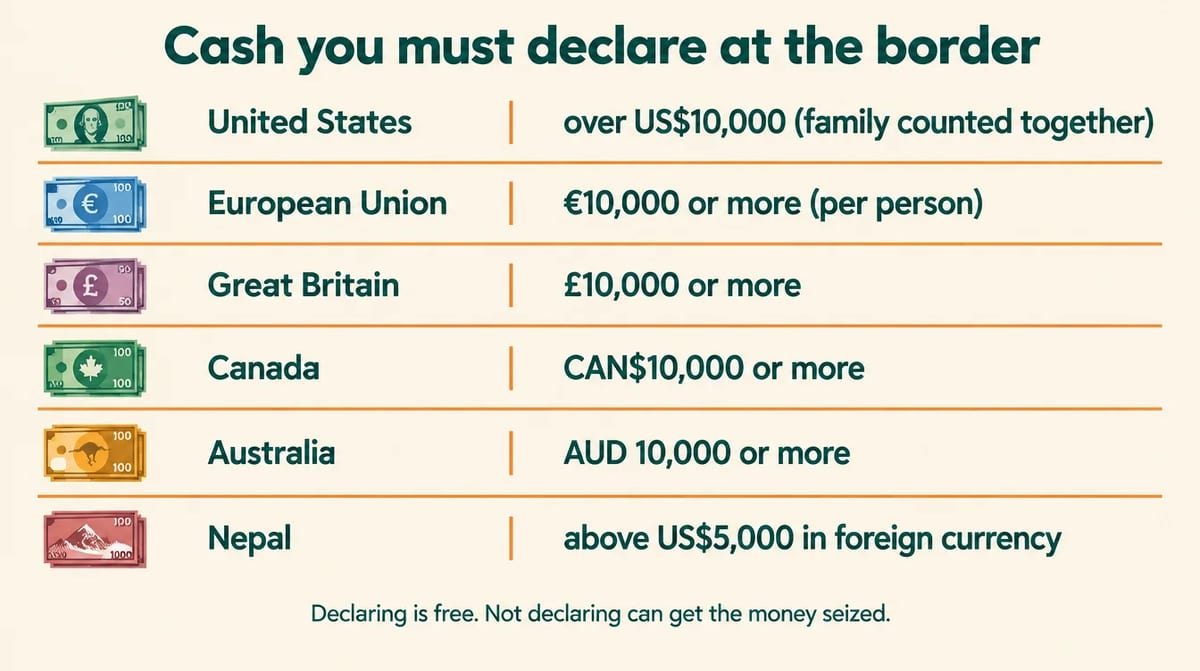
You can carry as much cash as you like across most borders, but above a set amount you must declare it, and the usual line is 10,000 in the local currency: over US$10,000 for the United States, €10,000 or more for the EU, £10,000 or more for Great Britain, CAN$10,000 or more for Canada and AUD 10,000 or more for Australia. Nepal’s airport asks you to declare foreign currency above US$5,000. Declaring is free and the money is not taxed. Not declaring is what gets it seized.
- A declaration is not a tax or a ban. Every border agency below says carrying the money is legal once it is reported.
- The US counts a family together. Two parents each carrying US$6,000 must file, because the threshold applies to what the group carries collectively.
- The EU counts each person separately. The €10,000 limit is individual, and it does not apply between EU countries.
- Splitting cash to stay under the line is itself an offence in the US, and the penalty for not declaring anywhere starts with losing the money.
The declaration limits, country by country
Almost every major border uses a figure of 10,000 in its own currency, but the wording differs: the US line is “more than” US$10,000, while the EU, Britain, Canada and Australia catch 10,000 “or more”. If you are carrying exactly the threshold, declare it.
| Country | You must declare | How | Group rule |
|---|---|---|---|
| United States | More than US$10,000, in or out | FinCEN Form 105, online before you reach the gate or on paper to a CBP officer | Counted together for families and groups |
| European Union | €10,000 or more entering or leaving the EU | EU cash declaration form, to customs in the country you enter or leave | Each person individually |
| Great Britain | £10,000 or more between GB and a country outside the UK | Online or by phone before travel, or the red channel | Not stated |
| Canada | CAN$10,000 or more, in or out | Report to the CBSA; you cannot use NEXUS when carrying it | Not stated |
| Australia | AUD 10,000 or more, in or out | Cross-border movement report, including online before travel | Not stated |
| Nepal | Foreign currency above US$5,000 | Customs declaration at Tribhuvan airport | Not stated |
The United States reports on a US$10,000 threshold in both directions and the form is FinCEN 105. CBP lets you file it online before you arrive at the departure gate. The EU form works the same way for anyone entering or leaving the Union with €10,000 or more, and the European Commission’s Your Europe guide says you do not need to declare when you travel between EU countries, for example from the Netherlands to France.
Great Britain’s rule covers journeys between England, Scotland or Wales and anywhere outside the UK. Northern Ireland follows the EU-style €10,000 rule instead. Canada’s border agency is blunt about the point most people worry about: there are no restrictions on carrying CAN$10,000 or more into or out of Canada, and it is not illegal as long as you declare it.
What counts as cash
Banknotes and coins in any currency count, and so do bearer instruments such as signed traveller’s cheques; in the EU and Northern Ireland, gold coins and bullion count too. The total is the combined value of everything, converted into the threshold currency.
GOV.UK lists notes and coins, bearer bonds, traveller’s cheques and cheques signed but not made out to a named person. For Northern Ireland it adds money orders, gold coins, bullion and prepaid cards. The EU definition includes coins with a gold content of at least 90% and bullion of at least 99.5% gold. CBP’s list for the US includes currency, endorsed personal cheques, traveller’s cheques, gold coins and bearer securities.
Mixed currencies add up. Carrying US$4,000, €3,000 and £2,500 into the EU puts you near the €10,000 line even though no single currency is anywhere close.
Why the group rule catches families out
The United States adds up what a family or group is carrying, while the EU treats every traveller separately, so the same bag of cash can need a declaration on one side of the Atlantic and not the other.
CBP’s wording is explicit: when families or groups are involved, the US$10,000 threshold applies to the total amount they are carrying collectively, not per individual. A couple flying home to New York with US$6,000 each is carrying US$12,000 and must file. The same couple leaving Frankfurt with €6,000 each does not need to declare to EU customs, because the Your Europe guide says the €10,000 limit applies to each person individually in a group.
Do not try to engineer your way under either line. Splitting cash deliberately to avoid a US report is known as structuring and is an offence in its own right under 31 U.S.C. 5324. The simple rule is: if you are anywhere near the line, declare. Declaring costs nothing.
What happens if you do not declare
The first consequence everywhere is that the undeclared money can be seized, and getting it back can cost a penalty on top.
| Country | What the authority says can happen |
|---|---|
| United States | Currency forfeited and seized; in some cases civil or criminal penalties, including fines or imprisonment |
| Great Britain | All the cash can be seized by Border Force; a penalty of up to £5,000 to get it back |
| Canada | Seizure of the currency, returned on payment of a penalty unless it is suspected proceeds of crime |
| European Union | Penalties set by each member state; customs can detain the cash |
| Australia | Seizure of the money and possible fines or investigation |
CBP publishes a steady stream of press releases about travellers losing five-figure sums at Dulles and Philadelphia for exactly this, including a Global Entry member who lost US$21,000. None of them were carrying anything illegal. They simply did not fill in a form that would have taken five minutes.
A declaration asks where the money came from and what it is for. Have a bank withdrawal slip or a sale receipt with you. That turns a conversation at the red channel into a formality.
Carrying cash into Nepal
Nepal asks you to declare foreign currency above US$5,000 when you arrive, half the usual figure, and a trekker rarely needs to carry anywhere near that. Tribhuvan International Airport’s arrival guidance sets the US$5,000 line and points to the red channel for anything you must declare.
We see the same pattern every season. First-time trekkers bring thick envelopes of US dollars because they have read that ATMs are scarce in the mountains. That is true above the trailheads, but it does not mean you need thousands in cash on the plane. Your visa on arrival costs US$50 for 30 days, your trek is usually paid before you land, and Kathmandu and Pokhara have plenty of ATMs. What you do need is enough Nepali rupees for the days beyond the last cash machine, which is a few hundred dollars for most treks, not a few thousand. Our guide to money on a Nepal trek sets out how much to draw and where.
Indian banknotes are the one trap. For roughly a decade Nepal did not accept Indian notes above ₹100. India changed its own rules in November 2025 to allow travellers to carry up to ₹25,000 in higher notes between the two countries, and Nepal Rastra Bank said it would follow, according to The Kathmandu Post. Check the current position with your bank before you rely on ₹500 notes, or simply carry ₹100 notes.
Our 12-day Everest Base Camp trek is US$1,700 solo, or from US$1,230 each in a group, with permits, a government-registered guide, a porter, teahouses and meals included. Paying ahead means the only cash you carry is spending money.
See the Everest Base Camp trek →How much cash should you actually carry
For most trips the honest answer is far less than any declaration line: a few days of local spending money plus a small emergency reserve in US dollars or euros. Cards and ATMs do the rest, and our cash-versus-card breakdown shows where each wins.

Large cash is a theft and loss problem long before it is a customs problem. If a bag goes missing, many travel insurance policies cap cash cover at a few hundred pounds or dollars. If you genuinely need to move a large sum, for a car, a deposit on a flat or a family event, a bank or money-transfer service is safer and leaves a paper trail. Wise and Revolut both move money across borders for less than most banks charge.
Two last habits save money. Draw local currency from an ATM on arrival rather than changing notes at home, and when a machine or shop offers to charge you in your home currency, say no. Why you should always pay in the local currency explains that one.
Our verdict
Carry what you will spend, declare anything near the line, and never split money to avoid a form. The declaration limits are generous and the forms are quick. The travellers who lose money at the border are almost never smugglers. They are people who did not know a family counts as one in the US, or thought a declaration meant a tax.
Is it illegal to carry more than $10,000 in cash?
No. The US, Canada, Great Britain, the EU and Australia all allow you to carry any amount. Above the threshold you must declare it. The money is not taxed; failing to declare it is what gets it seized.
Does the $10,000 limit apply per person?
In the United States, no: CBP says families and groups count the total they carry collectively. In the EU, yes: the €10,000 limit applies to each person individually.
Do I need to declare cash travelling between EU countries?
Not under the EU cash declaration rules, which apply when you enter or leave the EU. Some countries have national rules for cash moving inside the EU, so check if you carry a large sum.
How much cash can I bring into Nepal?
There is no upper limit for foreign currency, but Tribhuvan airport guidance says to declare anything above US$5,000. Most trekkers need only a few hundred dollars in Nepali rupees for the days beyond the last ATM.
What happens if I forget to declare?
The money can be seized. In Great Britain you may pay a penalty of up to £5,000 to get it back; in the US the currency can be forfeited and civil or criminal penalties can follow.
Keep reading
How much to draw, where the last ATM is, and what things cost on the trail.
Where each one wins, and what it costs you.
The charges that quietly eat a travel budget.
The errors we see travellers make every season.
Sources: US Customs and Border Protection, Money and other monetary instruments (FinCEN 105, family rule, penalties) and CBP seizure press releases; European Commission, Your Europe, carrying cash in and out of the EU; GOV.UK, Bringing cash into or out of the UK; Canada Border Services Agency, Travelling with CAN$10,000 or more; Australian Border Force and AUSTRAC cross-border cash reporting (read via their published summaries, as the pages did not load for us); Tribhuvan International Airport arrival information (read via its published summary); The Kathmandu Post, 10 December 2025, on Indian banknotes. All read on 27–28 September 2026. This is general information, not legal or financial advice; check the official source before you travel.
Photos: Pexels.

Written by
Bishnu AdhikariPokhara-based, NMA-certified trekking guides. We’ve led 5,000+ treks across the Annapurna and Everest regions since 1998 — every word here comes from the trail. More from this author →
Ready to Trek?
From reading about it to standing on it
Our Pokhara-based guides have been doing this since 1998. Tell us your dates and fitness level — we'll build your perfect itinerary. Free, no obligation.
More guides like this
Popular trips to consider
View all treks & toursFree Trekker’s Insider Guide
Permits, packing lists, cost breakdowns — no fluff.
We send one useful email. You can unsubscribe anytime.